This summer has once again brought a string of hot days, making it clear that addressing climate change is a matter of urgent priority. It was in 2023—a year of record-breaking heat—that UN Secretary-General António Guterres declared the “arrival of the era of a boiling Earth,” and both corporate operations and our daily lives continue to be forced to undergo transformations in preparation for this “era of a boiling Earth.”
As corporate advertisers advance their decarbonization efforts at the executive level, a major turning point has been announced: starting with the fiscal year ending March 2027, companies with a market capitalization of 3 trillion yen or more will be required to disclose their Scope 3 emissions (*). These companies will be compelled to take action in response.
*Scope 3 emissions = Greenhouse gas emissions from other companies related to a company’s business activities, such as raw material procurement, outsourced packaging, employee commuting, and shipping and transportation (excluding indirect emissions from energy sources such as electricity, heat, and steam purchased or used by the company).
In light of this, what contribution can advertising agencies make? To support companies facing these challenges, the Dentsu Group developed “MIRAI STANDARD SWITCH,” a new solution for decarbonization within the marketing process, and released it in August 2026.
This solution package provides comprehensive support—through a variety of solutions—for decarbonization at every phase of marketing activities, from formulating decarbonization policies to the production and distribution of content and events, as well as communications.
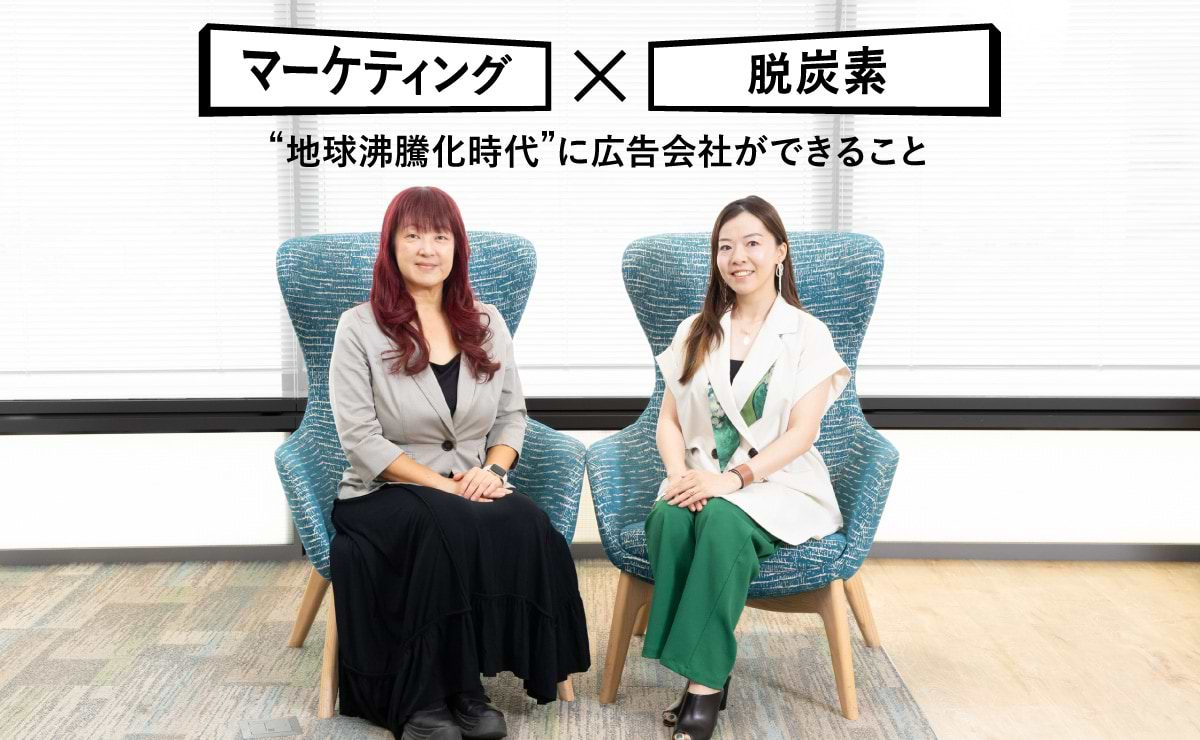
In this article, project members Rie Takeshima and Yurika Mori discuss the background behind the launch of “MIRAI STANDARD SWITCH,” the significance of decarbonization in the marketing process, and future developments.
DIM (Decarbonization Initiative for Marketing) is an initiative aimed at transforming the entire advertising industry through the decarbonization of marketing activities. In this series, we will introduce the various practices and solutions being developed at dentsu Japan, as well as the future envisioned through them.
Pictured from left: Rie Takeshima, Executive Planning Director of the Sustainability Consulting Office, and Yurika Mori, Creative Writer and Planner at the same office
“Building a Community,” “Visualizing GHG Emissions,” and “Proposing Reduction Methods” Marketing × Decarbonization: Tackling the Challenge Through These Three Pillars
Takeshima: I’m Takeshima, an Executive Planning Director in Dentsu Inc.’s Sustainability Consulting Office. My primary responsibilities currently involve supporting corporate brands, business strategies, new business development, and communications from a sustainability perspective.
“MIRAI STANDARD SWITCH,” which we’ll be discussing today, is a new solution being pursued by the entire Dentsu Group—including not only Dentsu Inc. but also Dentsu Creative Pictures Inc., Dentsu Live Inc., Dentsu Promotion, and the Dentsu Group Sustainability Office.
Mori: I’m Mori, and I’m also part of the Sustainability Consulting Office. As a creative writer and planner, I support companies in advancing their sustainability initiatives by linking social issues to corporate value. For this project, I helped define the solution’s concept and other key elements.
While corporate decarbonization is progressing, the decarbonization of marketing activities—such as advertising, content, and events—is an area that has not yet been sufficiently addressed. I’m eager to explore this topic together with companies.
Takeshima: Before we discuss “MIRAI STANDARD SWITCH,” I’d like to briefly touch on the Dentsu Group’s initiatives for “decarbonizing the marketing process.” Currently, we are advancing these efforts based on three main pillars.
Takeshima: The first pillar is raising awareness and building a community across the entire industry—including advertising and media. We believe this is not something Dentsu Inc. can achieve alone; it requires a collective effort from the entire industry. To that end, we established the “Decarbonization Initiative for Marketing (DIM).” Our goal is to start by sharing the significance and objectives of this initiative with everyone, thereby laying the groundwork for collaborative action.We are advancing these activities through cross-industry collaboration with organizations such as the Japan Advertising Agency Association (JAAA) and the Japan Advertisers Association (JAA), as well as with the production and event industries.
Mori: As is true across all industries, decarbonization requires a unified effort involving the entire value chain and even competitors. I strongly feel that we need to create an environment where the entire industry—not just Dentsu Inc.—can work together on this issue.
Takeshima: The second initiative involves the development of an industry-standard calculator (a tool for calculating GHG* emissions) and the establishment of operational guidelines. Since understanding GHG emissions is crucial for decarbonization, we have created industry-standard calculators tailored to specific sectors. Furthermore, Dentsu Inc. has already accumulated a track record of initiatives to visualize GHG emissions in the production processes for advertising, long-form content, and events.In some cases, by precisely measuring GHG emissions and implementing reduction solutions, we can cut GHG emissions in the production process by 90 percent, thereby contributing to companies’ carbon neutrality goals and reducing their offset costs.
*GHG: Refers to greenhouse gases, including carbon dioxide (CO₂), methane (CH₄), nitrous oxide (N₂O), hydrofluorocarbons (HFCs), perfluorocarbons (PFCs), and others. It is an abbreviation for “Greenhouse Gas.”
Mori: I was surprised to find that, in most cases, using the calculator we developed to precisely measure GHG emissions in the production process resulted in a total volume lower than the original estimates calculated using existing formulas. This reaffirmed my belief that precise measurement is essential.
Takeshima: The third is the Dentsu Group’s decarbonization solution, “MIRAI STANDARD SWITCH,” which I introduced earlier. This is not only a set of solutions that uses the calculator to grasp the actual state of GHG emissions but also a suite of measures to implement GHG reductions at each stage of the production process; at the same time, it refers to a movement to tackle decarbonization in the marketing field.
The “MIRAI STANDARD SWITCH” logo (designed by Ayumi Kitano, 3CR Planning Bureau)
Mori: In other words, “MIRAI STANDARD SWITCH” is a compilation of methods and options for actually reducing emissions—built on the foundation of building a community through DIM and visualizing emissions using the calculator.
Why is the Dentsu Group tackling the “decarbonization of marketing processes” right now?
Takeshima: Mr. Mori, you led the development of the concept and statement. Could you tell us about the vision behind them?
Mori: Decarbonization is important, but the reality is that, for those on the production front lines, it inevitably comes across as something they “have to do” or as something that “adds extra work.” That’s precisely why, with “MIRAI STANDARD SWITCH,” I wanted people to view it not as an “obligation,” but as a proactive choice to create the “standard of the future.”
The passion to “create great ads,” “put on great events,” and “deliver great content” is not at odds with decarbonization. Rather, the starting point for this initiative was my belief that adding a little “consideration for the future” to that passion would enhance the value of our work. We don’t have to be perfect right away; we can gradually change what we consider “normal.” I’ve infused this initiative with the hope that it will serve as a kind of switch to help bring about that change.
Takeshima: There is no clear-cut answer to the monumental challenge of realizing a decarbonized society; we must continue moving forward together with like-minded colleagues. Therefore, Dentsu Inc. decided to start taking action—beginning with what we can do—for the future of the advertising and media industries and the healthy development of society as a whole.
“MIRAI STANDARD SWITCH” is not a finished solution. It is something we will nurture from this point forward, together with the advertising and media industries, as well as all of you in the corporate world. The concept of decarbonization may seem difficult or confusing, or it might evoke a strong sense of obligation, but to realize a decarbonized society, we want to take on the challenge of creating new standards for the future—with our colleagues—while feeling excited about the process.
Mr. Mori, I understand you’re also involved in production on the front lines as a planner and creator. What are your thoughts on this initiative?
Mori: When you’re on the front lines, everyone shares the desire to “deliver something great.” However, we rarely have the opportunity to consider how that production process might impact the future. That’s why I believe having options that can be incorporated step by step is a crucial first step. Marketing is, by its very nature, a deeply positive endeavor—it involves creating and delivering products and services that enrich people’s lives. Advertising, content, and events all have the power to move people’s hearts.
That’s precisely why I want the way they’re “created” to be something positive for the future as well. I’d like to frame environmental sustainability not as something we “have to do,” but as a “switch” that allows us to rethink how we create things going forward—and I believe Dentsu Group’s ideas and implementation capabilities can play a key role in that.
“MIRAI STANDARD SWITCH”: Decarbonization Support Across Five Areas
Takeshima: Let’s now take a closer look at the details of “MIRAI STANDARD SWITCH.” This solution is designed to be implemented primarily across five areas: “Content Production,” “Event Production,” “Merchandise and Campaign Production,” “Media Placement,” and “Communication.”
1. Content Production This solution addresses the production processes for advertisements, web videos, and long-form content such as TV dramas and movies. Led by Dentsu Creative Pictures Inc., it reduces GHG emissions during content production by visualizing GHG emissions for each process using the “Carbon Calculator for Content Production” (a GHG emissions visualization tool for video production, or CCCP), which calculates GHG emissions using the Carbon Calculator.
[Key Implementation Concepts]
Introduction of Virtual Production / Utilization of Generative AI
FACTORY ANZEN STUDIO, Capable of Virtual Production
Sustainability Production Services
2. Event Production Sector Based on Dentsu Live Inc.’s proprietary Sustainable Event Guidelines and the “Event Carbon Simulator (ECS),” we support decarbonization efforts in venue selection, spatial design, and operations while visualizing GHG emissions.
Spatial design for eco-friendly booths and interiors
Proposal and implementation of event operations that contribute to decarbonization
3. Merchandise and Campaign Production Led by Dentsu Inc., we support decarbonization throughout the entire process—from printing and merchandise production using proprietary materials and products to delivery.
[Key Implementation Examples]
Printing: Promotional tools, POP displays, and other materials made with eco-friendly materials and processing methods
Sales Promotion: Premium gifts and promotional items made with eco-friendly materials and processing methods
Fulfillment: Environmentally friendly packaging materials and carbon-neutral shipping, etc.
An example of “danbal,” Dentsu Inc.’s cardboard product brand, which can be used at events and other occasions
4. Media Placement Sector Dentsu Inc. and Dentsu Digital Inc. are leading the way in promoting solutions to visualize and reduce GHG emissions in the process of placing produced advertisements across various media. For greenhouse gas reduction solutions in digital media placement, the use of “SeenThis” —which significantly reduces data transfer volumes through proprietary streaming technology—enables digital ad placement that contributes to decarbonization while maximizing advertising effectiveness and prioritizing cost efficiency.
5. Communication Since decarbonization efforts are often difficult for outsiders to perceive, it is crucial to communicate the value of these initiatives in a way that is easy to understand and resonates with audiences. Dentsu Inc. takes the lead in supporting communications aimed at internal awareness, enhancing corporate value, and creating business opportunities—by positioning decarbonization efforts within the marketing process as compelling facts.
[Key Implementation Examples]
Preliminary Awareness-Raising for the Company and Staff Effectively conduct preparatory sessions to enhance understanding and motivation among internal staff, as well as those in production and operations.
Post-campaign communication of initiatives to internal and external audiences Using these initiatives as concrete facts, we will actively disseminate information post-implementation through press releases, PR campaigns, and advertising, while developing mechanisms to attract new environmentally conscious sponsors and partners.
Mori: When it comes to content and events, the ingenuity of the production team directly impacts emissions. Things we usually think of as “production decisions”—such as travel to filming locations, venue selection, setup, and operations—actually tie into decisions regarding decarbonization.
Takeshima: When you include all the touchpoints that reach consumers, the marketing process is truly vast, isn’t it? Creating videos, hosting events, distributing promotional items, and running ads—the fact that there’s room to reevaluate each and every one of these steps is what makes the “MIRAI STANDARD SWITCH” movement so fascinating.In the fifth area of communication, I imagine you, Mr. Mori, also recognize the importance of “countering greenwashing” when supporting companies. As an expert, is there anything in particular you’d like to emphasize?
Mori: With decarbonization initiatives, if you communicate them incorrectly, there’s a risk they’ll be perceived as making the situation look better than it actually is. That’s precisely why it’s crucial to communicate honestly—including what you’re measuring, how much you’ve reduced emissions, and where challenges still lie. “MIRAI STANDARD SWITCH” isn’t just a communication topic; it’s also a reassuring initiative that builds the facts needed for communication right into the production process.
“The Standard of the Future” is something we all build together
Takeshima: We already have examples of decarbonizing the production process.
For example, in advertising, this includes TV commercials for M&A Capital Partners and Morinaga Milk Industry’s “Mount Rainier”; in television dramas, NHK’s Taiga drama “Berabou” (FY 2025); and in films, Amazon MGM Studios’ “Broken Rage” and the “Silent Fleet” series.
In these cases, we’ve received feedback such as, “Using the calculator to refine the GHG emissions of the production process led to emissions reductions,” and “The introduction of virtual production eliminated the need for long-term location shoots in remote areas, contributing to work-style reforms.” In the magazine sector, we conducted a GHG emissions and reduction assessment covering all stages of the content production process for “Fujin Gahō” and “ELLE Japon” in collaboration with Hearst Fujin Gahō.
Mori: Initiatives that not only reduce GHG emissions but also alleviate travel burdens and improve staff working conditions tend to be well-received by production teams, don’t they?
Takeshima: As for event examples, at last year’s ACN EXPO EKIDEN 2025—held to commemorate the Osaka-Kansai World Expo—we formulated “Sustainability Event Guidelines” and provided end-to-end support, from declaring the initiative to calculating GHG emissions, implementing reduction actions, offsetting, and post-event communication.When implementing such initiatives at an event, it’s essential to widely publicize the details of the efforts—not only to staff and other stakeholders but also to attendees—and to secure their cooperation. We believe that by engaging a large number of people, the event can serve as a catalyst for driving positive change in society.
Mori: In addition to events organized by advertising agencies, these guidelines should also be applicable to entertainment events, such as sports and music. By working toward decarbonization through “MIRAI STANDARD SWITCH,” the sustainability value of the events and the content itself increases; this creates more compelling stories to share and translates into greater benefits for sponsors.
Takeshima: So far, we’ve discussed how advertising agencies can contribute to realizing a decarbonized society, along with an introduction to “MIRAI STANDARD SWITCH.” To reiterate one last time, “MIRAI STANDARD SWITCH” is not a finished solution. There are still many gaps to fill and elements currently under development. It is, in essence, a platform that we hope to build together with all of you, using this initiative as a starting point.
Please join us. Let’s work together to shape the standards of the future. If you’re interested in this initiative or have any questions, please feel free to contact us.
I am involved in communication planning for products and services across a wide range of genres, from strategy and campaign development to web, events, and store development. As an SDGs consultant, I support various stakeholders in formulating sustainability-driven strategies, communications, and business transformation. Together with the Dentsu Group Sustainability Office, I am working to promote decarbonization in the advertising and media industries. Dentsu Team SDGs Project Leader
Bringing new meaning and appeal to the “future challenges” facing society and businesses. Leveraging my experience as an advertising copywriter and in the field of business design, I work across disciplines—from management, business, and environmental vision to narrative development, communication, and internal activation—all starting from words and creativity. While carefully assessing the unique risks of expression inherent to sustainability, I strive to identify points of connection between social issues, companies, and people, and to create approaches that lead to corporate value and action. I love whiskey and the theater.

 dentsu Japan Takes on the Challenge of DIM: “Marketing × Decarbonization” [1/1]