Note: This website was automatically translated, so some terms or nuances may not be completely accurate.
 Fact-Based "Attractiveness Branding Model Ver.3" [3/3]
Key Branding Perspectives to Keep in Mind
─ Economic Value, Social Value, Brand Value ─
The Corporate Public Relations Strategy Research Institute (within PR Consulting Dentsu Inc.) conducted the "Attractiveness Brand Survey," designed based on the "Attractiveness Branding Model Ver. 3" ( click here for details ). The purpose of this survey is to clarify what kinds of corporate activities and facts consumers find appealing, and how these are being communicated.
In this series, we will introduce the main findings from this survey. In this third installment, we will delve deeper into corporate value by dividing it into three categories and explain its relationship to corporate appeal.
What aspects of appeal should companies enhance to improve their brand value? We will provide some insights.
Defining Corporate “Value”
Generally, brands are broadly categorized into “product brands” and “corporate brands.” It is often said that “corporate brands” represent a company’s philosophy and trustworthiness, while “product brands” represent a product’s uniqueness and competitive advantage. Furthermore, brands are considered to be closely linked to the “value” that a company provides to its stakeholders.
In this “Brand Appeal Survey,” we surveyed 10,000 consumers nationwide regarding 200 companies across 20 industries. To clarify the relationship between a company’s “value” and “appeal,” we conducted an analysis from the following perspectives.
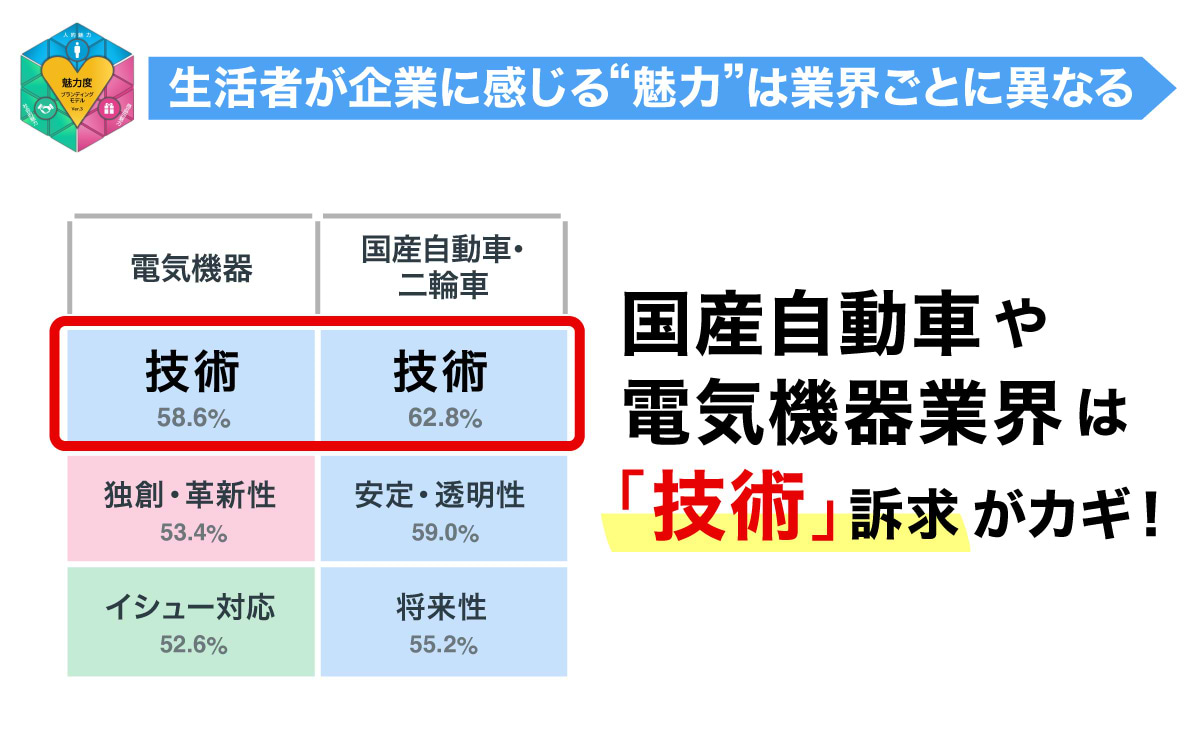
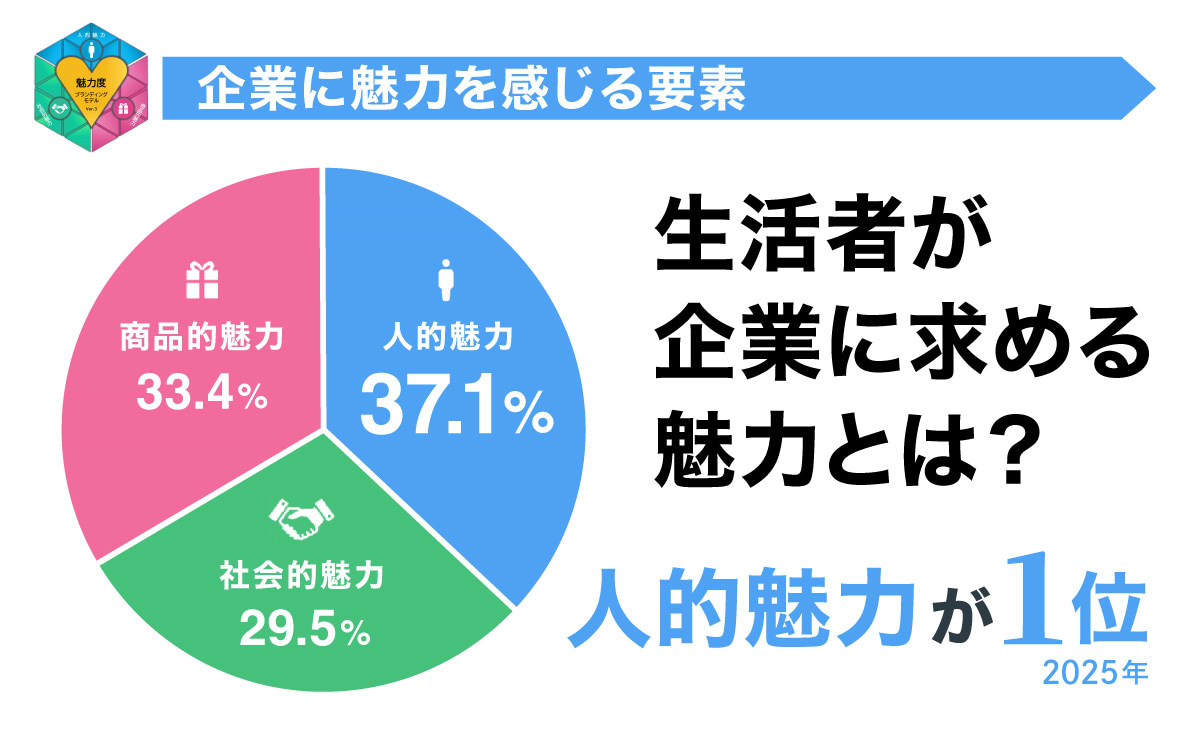
First, regarding corporate “appeal,” as discussed earlier, we surveyed each company across three elements—“human appeal,” “social appeal,” and “product appeal”—covering 24 domains (with 48 response options).
Next, regarding corporate “value,” we asked consumers—in separate questions distinct from those on corporate “appeal”—to identify companies they felt corresponded to each of the three types of value: “economic value,” “social value,” and “brand value.”
Figure 3 below shows the results of the correlation analysis for these three corporate values. Generally, a correlation coefficient of 0.7 or higher is considered to indicate a strong correlation; therefore, it can be seen that “Economic Value,” “Social Value,” and “Brand Value” are all strongly correlated with one another.
What Makes a Company Attractive in Terms of Enhancing Economic, Social, and Brand Value?
Furthermore, we would like to examine the relationship between these three values—"Economic Value," "Social Value," and "Brand Value"—and corporate appeal. By conducting multiple regression analysis (*), we identified the areas of appeal that were found to have a positive (significant) impact, as shown below.
*Multiple regression analysis: A statistical method that uses mathematical formulas to quantify the extent to which multiple factors influence an outcome, thereby estimating the impact of those factors or predicting future outcomes.
In multiple regression analysis, the standardized regression coefficient is an indicator showing the extent to which each explanatory variable influences the outcome. The larger the absolute value of the coefficient, the greater the influence that explanatory variable is judged to have on the outcome.Additionally, * < 0.05 and ** < 0.01 are p-values, which serve as indicators of the significance of the coefficients.
The larger the coefficient, the greater the influence of that factor. There are distinct areas of appeal that significantly influence economic value, social value, and brand value, respectively, indicating that different factors are at play in each domain.
Based on these results, we can conclude that the foundation for building “brand value” lies in corporate “trust” and “peace of mind,” represented by factors such as “Stability and Transparency” and “Purpose and Vision.” The coefficients for these two areas of appeal are overwhelmingly larger than those for others, proving that they have a significant impact on the brand. In other words, stable management, transparent management, and clearly articulating the company’s guiding principles and direction can be interpreted as a means of gaining “peace of mind and trust.”
Furthermore, it is inferred that “brand value” is not driven by various appeal factors operating at the same level; rather, it is only after the aforementioned foundation of “trust and reassurance” has been established that factors such as “customer service,” “reputation,” and “issue management” contribute to the brand’s value.
Summarizing these findings, it becomes clear that the following elements are essential for “brand value”:
- To enhance a company’s “brand value,” it is essential to improve both “economic value” and “social value” in a balanced manner.
- The foundation for building "brand value" is being a "trustworthy and reliable company." In other words, it involves ensuring that stakeholders understand the company’s ability to "maintain stable management" and its possession of a "clear purpose and vision."
- Building on this, companies must present “brand value-specific appeal”—such as “pioneering spirit,” “issue response,” “evaluation and reputation,” and “customer service”—which differs from economic and social value.
To Aim for Greater Heights in Brand Value
The insights discussed so far were derived from an analysis of all 200 companies and represent the key areas to focus on in order to achieve above-average ratings in “brand value.” Of course, the 200 companies analyzed here represent a diverse group of firms across 20 industries, and these results alone are sufficient to serve as a guideline for future corporate actions.
So, how can companies aim to further enhance their brand value?
To address this, we compared the correlation coefficients between “brand value” and each appeal domain for the top 30 companies—which are rated particularly highly for “brand value”—and the 200 companies as a whole. As a result, notable characteristics unique to the top-ranked companies emerged.
First, among the top 30 companies with high brand value and the entire group of 200 companies, only the following two areas were consistently ranked in the top five:
- "Purpose/Vision" (Human Appeal)
- "Needs Development" (Product Appeal)
On the other hand, while “Stability & Transparency,” “Motivation,” and “Safety & Security” were among the top five areas for the entire group of 200 companies, they did not rank among the top five for the top 30 companies. Instead, the top five areas for the top 30 companies were the following three:
- "Internal" (Social Appeal)
- "Information Disclosure" (Social Appeal)
- "Evaluation and Reputation" (Product Appeal)
Looking at these results, the top 30 companies with high brand value tend to receive strong support in the "Social Appeal" category. It is particularly noteworthy that the communication of corporate initiatives and stances—such as "Internal" and "Information Disclosure"—leads to recognition as "companies with high brand value."
For companies with high brand value, factors such as management stability and issue management are considered standard expectations and may no longer serve as key differentiators.
Going forward, for companies aiming to rank highly in brand value, it will become increasingly important to determine which aspects of their business to highlight as appealing and how to effectively manage their reputation.
Corporate Image That Enhances Brand Value
Next, the results of the correlation analysis between the 40 corporate image items and brand value are shown below.
As corporate images that enhance “brand value,” elements such as “being top-tier,” “successful,” “stable,” “high quality,” “reliable,” “popular,” and “capable of execution” are cited as fundamental elements that form the foundation for positive evaluation.
On the other hand, we also found that images such as “conveys a sense of concept and conviction,” “has a strong commitment to detail,” and “has good taste” are important image elements that represent a company’s “originality,” built upon that foundation. It appears that the key to further enhancing brand value lies in how a company expresses its originality while maintaining these fundamental images.
Reputation management that takes the stakeholder perspective into account is crucial!
Based on an analysis of the “relationship between corporate value and appeal,” the Corporate Public Relations Strategy Research Institute has drawn the following three major insights:
- To enhance “brand value,” companies must strike a balance between increasing both “economic value” and “social value.”
- To enhance “brand value,” it is essential to be a “trustworthy company”—that is, to possess stable management and a clear purpose and vision.
- Once this prerequisite is met, companies must also continuously demonstrate elements such as “proactive initiative,” “social responsibility,” and “reputation.”
Furthermore, what we focused on in particular this time was “evaluation and reputation”—that is, the importance of reputation.
Just as the origin of branding is said to have begun with “branding irons used to distinguish cattle from other ranches,” it has been reaffirmed that it is essential for corporate brands to be mindful of the stakeholders’ perspective.
A company’s “brand value” is not something that is complete merely by unilaterally communicating economic or social value. It can be said to be a value nurtured within the process of how stakeholders perceive and evaluate the company, and how they shape its reputation.
In today’s world, where stakeholder perceptions are highly volatile and the business environment is rapidly changing, the question is: How should companies manage their reputation through advertising, public relations, and social media?
We believe that this, precisely, is what branding means for a company.
Over the past three installments, we have presented analyses based on the Attractiveness Branding Model.
Please note that the Appeal Branding Survey also allows for detailed analysis of individual companies. If you are interested, please contact us at the address below.
■ PR Consulting Dentsu Inc., Corporate Public Relations Strategy Research Institute
info-csi@dentsuprc.co.jp
■We also provide information on other research themes at our institute.
https://www.dentsuprc.co.jp/csi/
[Survey Overview]
Survey Name: Brand Appeal Survey
Survey Period: June 20, 2025 – July 8, 2025
Survey Method: Online survey
Survey Area: Nationwide
Survey Population & Sample: 10,000 respondents nationwide (ages 20–69, men and women) (equal allocation of men and women across each segment below)
(Breakdown: 2,000 respondents each for those in their 20s, 30s, 40s, 50s, and 60s)
*To select the above sample, a screening survey was conducted targeting the general public aged 20–69 (high school students and older, regardless of marital status or occupation). In addition to age criteria, respondents were allocated to 20 industries (companies) they found appealing, with 500 respondents per industry.
Survey Release:
https://www.dentsuprc.co.jp/releasestopics/news_releases/20251020.html
Was this article helpful?
Share this article


Newsletter registration is here
We select and publish important news every day
For inquiries about this article
Back Numbers
Author

Shohei Suetsugu
PR Consulting Dentsu Inc.
Corporate Public Relations Strategy Research Institute
Deputy Director