Note: This website was automatically translated, so some terms or nuances may not be completely accurate.
 DENTSU DESIRE DESIGN's Approach to Marketing Reconstruction Based on "Theory of Desire" [34/40]
Job-hopping or staying with one company? Understanding Japanese perceptions of career happiness through two models
Dentsu Inc. Desire Design (DDD) is an organization that develops various solutions and disseminates information based on the relationship between consumption and desire.
In this article, we analyze DDD’s “Emotional Consumption Survey” ( see survey overview here ). We will share the insights and findings derived from the survey results. Based on the results of the 11th survey conducted in November 2025, Ayaka Yoneya of DDD examines the relationship between job changes and career well-being.
<Table of Contents>
▼ Job changes are becoming a more common option for both consumers and companies
▼ About 40% believe that “changing jobs and gaining experience working at multiple companies leads to greater happiness”
▼ The “Single-Company Career Oriented Group” seeking “connections and stability” and the “Multi-Company Career Oriented Group” seeking “change and growth”
▼ The diversification of career perspectives itself serves as an opportunity to reevaluate one’s outlook on life
Job changes are becoming a more common option for both employees and companies
In recent years in Japan, “changing jobs” has become commonplace. The job-changing rate for full-time employees is projected to reach a record high of 7.6% in 2025 (estimated at approximately 2,077,000 people*1).
*1 Source: Mynavi Job Change Trends Survey 2026 Edition (2025 Actual Results) Preliminary Report
Although this is a record high, tracking the “job-changing rate for full-time employees” only began around 2018—within the last decade. Paradoxically, this suggests that while people were changing jobs even before 2018, efforts to systematically track the rate have expanded in recent years due to heightened interest in changes in the job market and labor mobility.In other words, this trend toward data collection itself can be seen as a sign that “changing jobs” has begun to be recognized as a more common career option in Japan.
Furthermore, companies are increasingly adopting hiring practices based on the premise of “labor mobility.” Approximately 80% of companies conduct mid-career hiring, with the rate reaching 95.9% among companies with 5,000 or more employees. There is also a tendency for larger companies to engage more actively in mid-career hiring. (*2)
*2 Source: Recruit Works Institute, Survey on Mid-Career Hiring (FY2023 results, regular employees)
As the so-called “Japanese-style employment” system—characterized by “mass hiring of new graduates” and “lifetime employment”—begins to change, these shifts on the corporate side are likely lowering the psychological barriers to changing jobs for workers as well.
In this article, we will examine the "Survey on Consumption Driven by Emotional Motivation" based on the hypothesis that, within such a Japanese society, differences in attitudes toward changing jobs may also reflect differences in other consciousness and values that shape an individual.
About 40% believe that “changing jobs and gaining experience working at multiple companies leads to greater happiness”
First, regarding a question in the survey on changing jobs:
“[A] I think it’s happier to continue working at one company without changing jobs”
“[B] I think it’s happier to change jobs and gain experience working at multiple companies”
We will examine the results of this question.
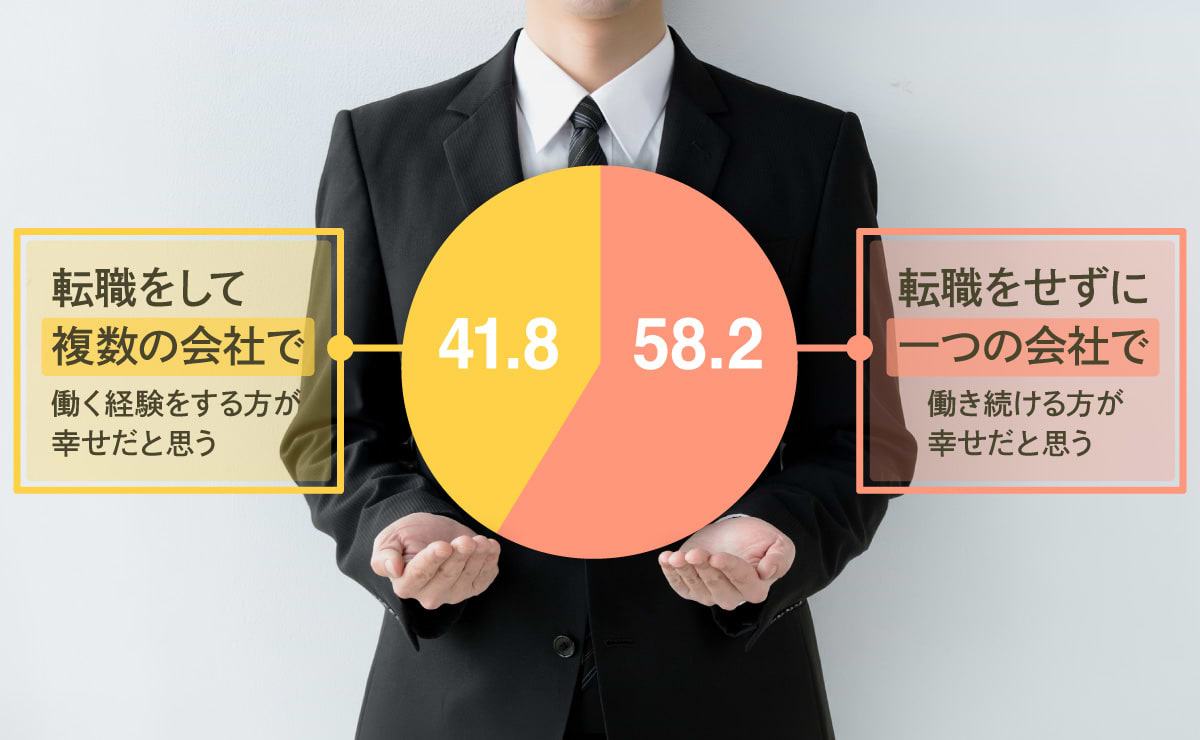
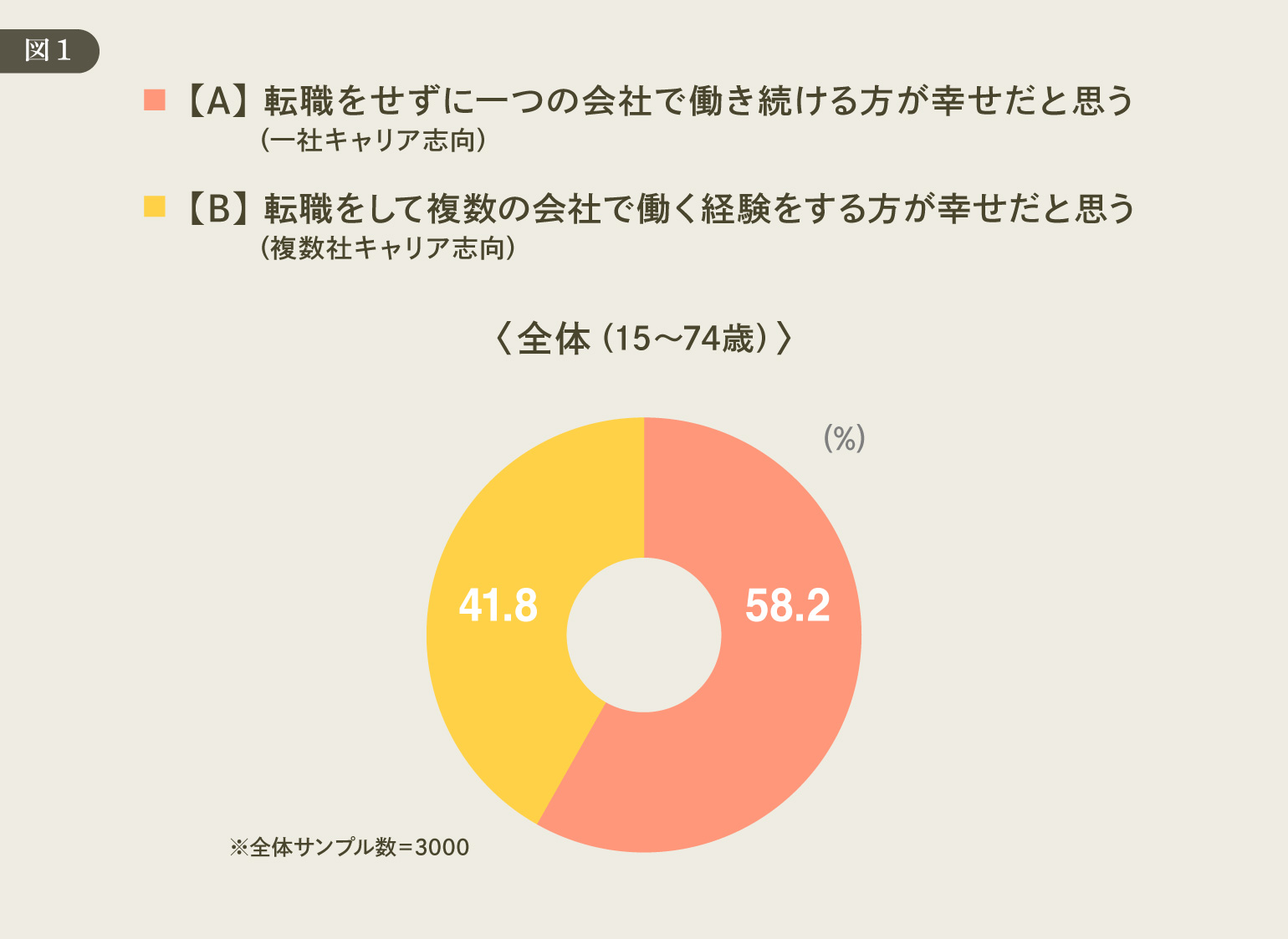
Among the overall respondents (ages 15–74), 58.2% selected “【A】 I think it’s happier to continue working at one company without changing jobs (hereinafter referred to as the ‘single-company career orientation group’),” while 41.8% selected “【B】 I think it’s happier to change jobs and gain experience working at multiple companies (hereinafter referred to as the ‘multi-company career orientation group’).”
The chart below shows the results broken down by gender and age group.
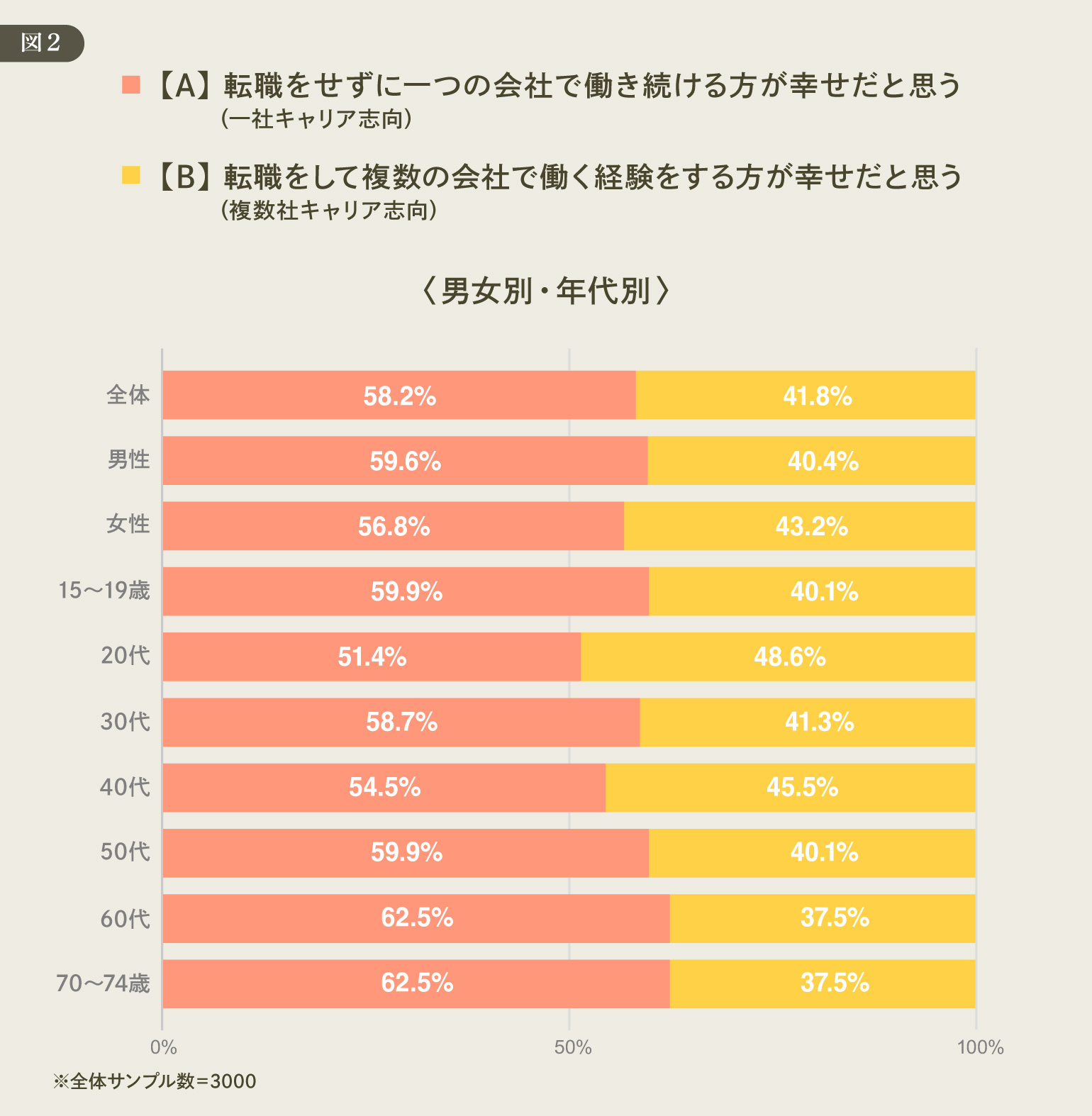
By gender, the “multi-company career orientation group” was 2.8 percentage points higher among women than among men. By age group, only the senior generation (aged 60 and over) had a “multi-company career orientation group” of just under 40%; in all other age groups from 15 to their 50s, the figure exceeded 40%.
While "Japanese-style employment" has traditionally been defined as lifetime employment, where new graduates are hired en masse and work until retirement, these results—which show no significant generational differences—make it clear that a certain number of people with a "multi-company career orientation" have existed for some time.
Furthermore, as mentioned at the beginning, reflecting the broader societal trend where “changing jobs” has become a more common career option, the “multi-company career orientation group” is gaining ground among the younger generation in their 20s, who have just entered the workforce. As a result, their proportion may be slightly higher compared to other generations. Going forward, as labor and employment mobility accelerates, it is likely that the “multi-company career orientation group” will continue to expand.
So, regarding these attitudes toward work, what are the characteristics of people with completely different values—those with a “single-company career orientation” and those with a “multi-company career orientation”? From here, I would like to unravel these differences based on responses to other questions regarding attitudes and values, and deepen our understanding of each group.
The “Single-Company Career Oriented Group,” which seeks “connections and stability,” and the “Multi-Company Career Oriented Group,” which seeks “change and expansion”
The survey covers various aspects of consumers’ attitudes and values. First, we will examine the items where the combined percentage of “Agree” and “Somewhat Agree” responses is higher among the “Single-Company Career Oriented Group” compared to the “Multi-Company Career Oriented Group.”
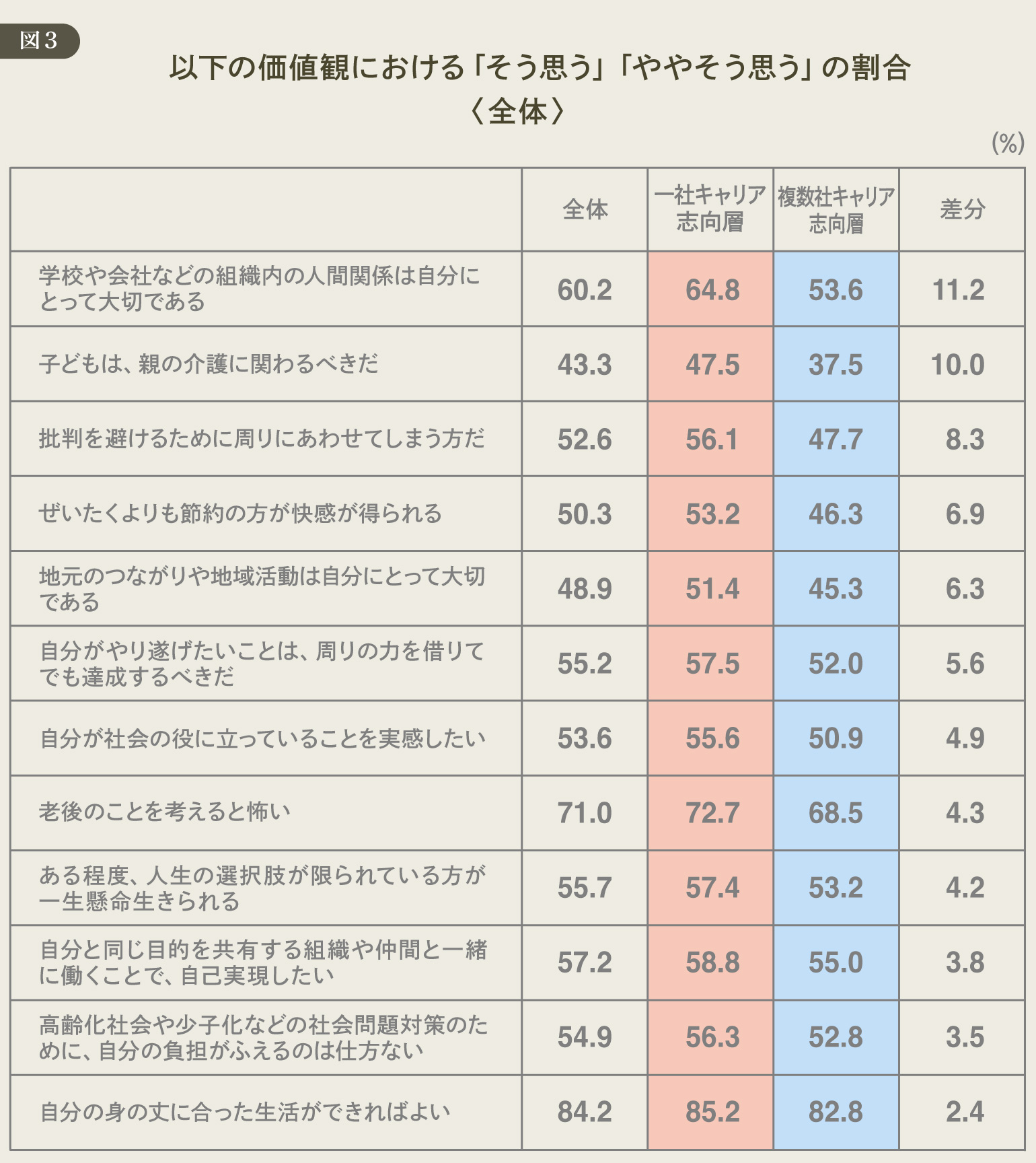
Looking at the chart, it becomes clear that the “single-company career-oriented group” places strong importance on interpersonal relationships within organizations and connections with local communities, revealing a persona that values building long-term relationships with colleagues who share the same goals. For example, the largest difference compared to the “multi-company career-oriented group” was in the response to “Interpersonal relationships within organizations such as schools or companies are important to me,” with a difference of 11.2 percentage points.
Additionally, as seen in their willingness to accept responsibilities such as “caring for elderly parents” and “bearing the burden of social issues,” a value system that prioritizes responsibility toward family and society is also characteristic of this group. In terms of lifestyle, there is a stronger emphasis on “living within one’s means” and “frugality.” Combined with high levels of “anxiety about old age,” this suggests a tendency to prioritize continuity and maintenance over change and expansion, roles over the self, and security over challenges in their careers as well.
Conversely, for the “multi-company career orientation group,” the scores for these items are lower than those of the “single-company career orientation group,” indicating that these values are less pronounced. This suggests a tendency to prioritize change and expansion over continuity and maintenance, the self over roles, and challenge over security.
Next, the items for which the “multi-company career orientation group” scored higher in “agree” and “somewhat agree” are shown in the figure below.
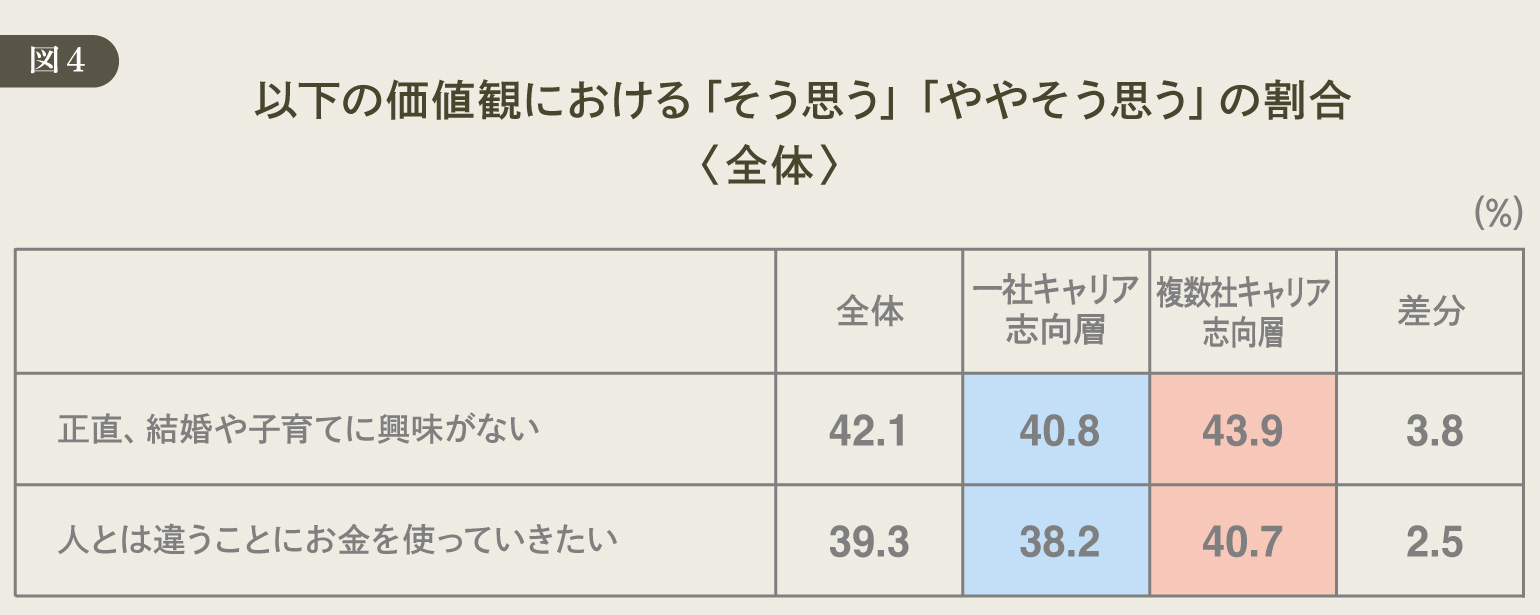
The "multi-company career orientation group" exhibits characteristics such as a desire to spend money on things that set them apart from others and a relatively low interest in marriage and child-rearing. When considered alongside the previous figure, it suggests that even within a community, they place a strong emphasis on the self and their own values. In terms of career, it can be said that they are more likely to find value in expanding their personal potential and experiences.
Furthermore, a notable feature of this data is that there were few items where the “multi-company career-oriented group” scored higher. Even for the items where the “multi-company career-oriented group” scored higher, as mentioned above, the numerical difference from the “single-company career-oriented group” was not particularly significant. This serves as evidence that the “multi-company career-oriented group” does not hold particularly strong values to begin with.
In other words, while the “single-company career orientation group” has internalized social norms—such as those related to society, organizations, communities, and family—to a certain extent, it has become clear that the “multi-company career orientation group” does not necessarily hold these as their own values.
The diversification of career perspectives itself serves as an opportunity to reevaluate one’s outlook on life
Based on the above results, in today’s Japanese society—where career mobility is increasing and job changes are becoming more common—we can infer that two distinct value systems coexist: a career outlook that finds happiness by valuing “stable life within a community,” and a career outlook that finds happiness by valuing “living while expanding one’s self without being overly constrained by social norms.”
The choice between changing jobs and building a career at a single company is not merely a matter of career strategy; it may also serve as an opportunity to consider the direction of your future life, including the underlying life philosophy of “What kind of life do I want to live?” and “Where do I find happiness?” Furthermore, for companies involved in the job market, recognizing the existence of these two models of career happiness could provide insights for improving the matching of talent.
At DDD, we will continue to explore consumer insights from various perspectives through our “Emotionally Resonant Consumer Survey.”
[Survey Overview]
〈Overview of the 11th "Emotionally Driven Consumption Survey"〉
・Target Area: All of Japan
・Eligibility: Men and women aged 15–74
・Sample Size: 3,000 respondents total (allocated according to population demographics across 7 age groups—15–19, 20s–60s, and 70–74—and 2 gender groups)
・Survey Method: Online survey
・Survey Period: November 7 (Fri) – November 12 (Wed), 2025
・Survey Sponsor: Dentsu Inc., DENTSU DESIRE DESIGN
・Survey Agency: Dentsu Macromill Insight, Inc.
Was this article helpful?
Share this article


Newsletter registration is here
We select and publish important news every day
For inquiries about this article
Back Numbers

Author

Ayaka Yoneya
Dentsu Inc.
Marketing Division 2