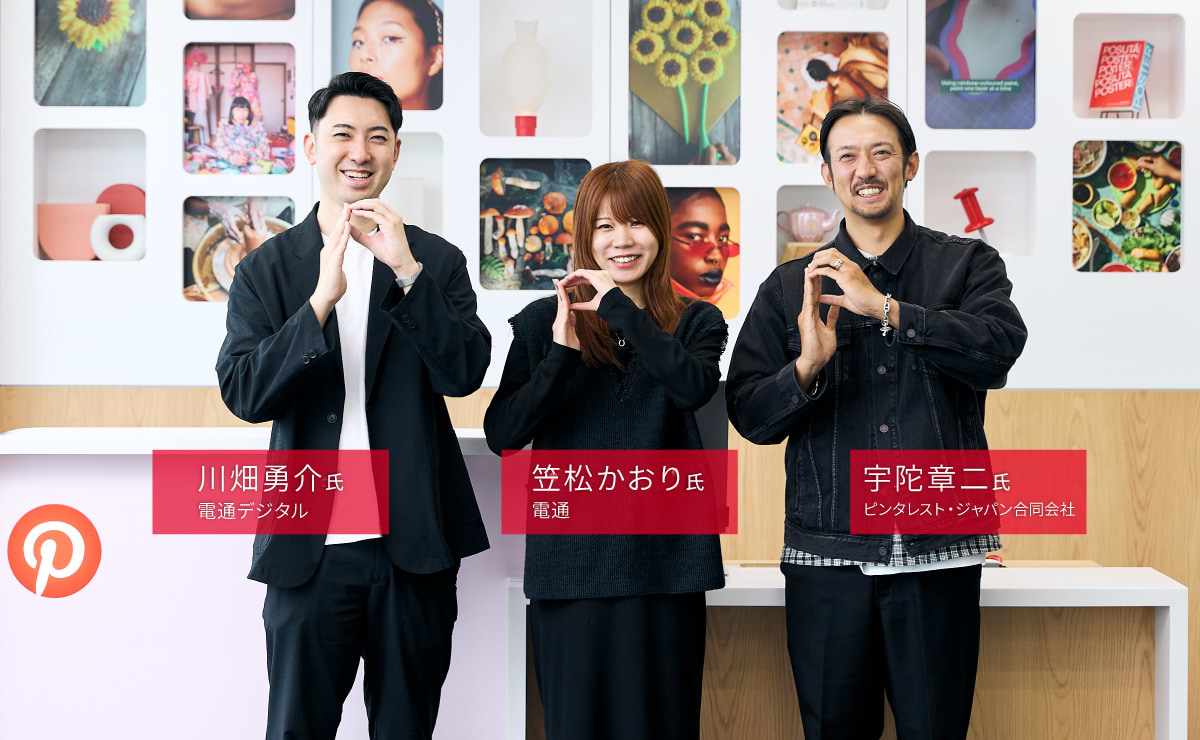
“Pinterest is a visual-focused social media platform for people with a keen sense of style”—many people may hold this perception. However, in reality, it is a highly unique platform where users discover, compare, and save products, taking action based on what they “like” and what resonates with them.
In this session, Shoji Uda of Pinterest and Kaori Kasamatsu of Dentsu Inc. will explore Pinterest’s unique user characteristics and advertising tips based on the “4P📌 (Four Pins)” framework, which was jointly developed by both companies. The session will be facilitated by Yusuke Kawabata of Dentsu Digital Inc.
Just Visual Appeal? A Pinterest Framework to Dispel That Misconception
Kawabata: First, I’d like to start by introducing myself. I’m part of the Platform Division at Dentsu Digital Inc., where I’m responsible for sales support related to the advertising products of various platform companies. My mission also includes supporting the business expansion of these platform companies through a collaborative approach to ensure we effectively convey the value of their advertising products to clients.
Uda: I’m Uda from Pinterest. I’ve been working as an insights specialist since the advertising business launched in Japan about four years ago, analyzing Pinterest user behavior and search trends, and identifying the platform’s characteristics through consumer research. My role is to communicate the platform’s advertising value to advertisers and advertising agencies based on data.
Kasamatsu: I’m part of Dentsu Inc.’s Data Marketing Center. I specialize in strategic planning and am responsible for promoting the use of Pinterest advertising from a planner’s perspective.
Kawabata: In our previous article, we introduced the overall picture and features of Pinterest. This time, we’ll focus on user characteristics and delve deeper into the “4P📌 (Four Pins)” framework, which Pinterest and Dentsu Inc. developed jointly. First, could you tell us about the background that led to the development of this framework?
Kasamatsu: We were thinking about how to further expand the use of Pinterest ads within the Dentsu Group, so we interviewed several planners. It turned out that many planners had the impression that “Pinterest is for people with a keen sense of style” or that it’s “for luxury and high-end brands.” Also, quite a few felt that “because it’s visually focused, it isn’t well-suited for promoting product features.”
In other words, many people viewed Pinterest as a platform specialized solely for visual appeal. But in reality, it’s not limited to visual appeal—it’s a platform that fits seamlessly into marketing strategies depending on the campaign’s objectives and messaging. To effectively communicate that value, Mr. Uda and I developed an original framework called “4P📌.”
Kawabata: Could you please explain the overall concept of “4P📌”?
Kasamatsu: The “4P📌” was designed with a focus on user characteristics and usage patterns to leverage Pinterest’s value more strategically. Using this framework as a guide, we can determine which advertising approaches are effective for users at each stage of their journey.
1. Pioneer: Early adopters in the very early stages of the journey
Kawabata: Now, I’d like to ask about the specific details of the “4P📌.” The first “P” stands for “Pioneer.” This refers to early adopters who appear in the very early stages of the user journey—what kind of users does this category encompass?
Kasamatsu: A major characteristic of Pinterest users is that they are extremely receptive to new things. There are many so-called early adopters who actively share information themselves. In fact, our own survey conducted at Dentsu Inc. (*1) showed that values such as “wanting to catch new information,” “being sensitive to trends,” and “wanting to share information themselves” were approximately twice as high among Pinterest users compared to users on other platforms.
Uda: Our own survey (*2) found that the percentage of monthly users who responded that they “want to learn about new information” in response to ads for products and services is about 1.3 times higher than on other platforms. In other words, this demographic is open to advertising and actively seeks out new experiences.
Uda: There are also distinctive characteristics in how Pinterest is used. It tends to be used from the “earliest stages” of considering a purchase, and rather than searching for something specific, users often explore information from a broad perspective, thinking, “I wonder if there are any good ideas out there.”As for search terms, category-based, non-brand-specific searches—such as “interior design,” “fashion,” and “Christmas” (*3)—are the norm, rather than specific brand or product names. In fact, data shows that 96% of all top searches on Pinterest are non-brand-specific (*4).
For example, if you want to buy a sofa, on other social media platforms or search engines, you’d likely start with a narrowed-down search like “white three-seater sofa” or “●● (brand name) sofa.” On Pinterest, however, users often begin with broader terms such as “stylish living room” or “creating a cozy space.” In other words, users are engaging with the platform at an even earlier stage of their journey—one where they haven’t even settled on the keyword “sofa” yet.
*1 Source: PDM Tunes 2024 Spring, Japan, May–June 2024; average of Pinterest users who use the platform at least once a month and users of other online platforms who use them at least once a month *2 Source: Global Web Index, Japan, October 2023; average of values for users who access Pinterest at least once a month and users who access other online platforms at least once a month *3 Pinterest’s advertising guidelines prohibit, among other things, targeting audiences based on religious beliefs. *4 Source: Pinterest internal data, English-language searches, global, June 2023
Kasamatsu: In other words, Pinterest is a platform that can capture early adopters at the very beginning of their journey, before they even start comparing options. Therefore, Pinterest is an excellent fit when launching new products or categories, or when you want users to recognize a new option as soon as possible. It also serves as a starting point for trends, introducing concepts and cultures that haven’t yet become mainstream.
Kawabata: Looking at it that way, it seems like a platform that’s well-suited for products with low brand awareness or services that aren’t yet mainstream.
2. Plan: Users Eager to Take Action on Moments
Kawabata: Next, the second “P” stands for “Plan.” This refers to a user segment that is eager to take action in response to “moments.” What specific characteristics do they have?
Kasamatsu: One characteristic of Pinterest users is their high motivation to take action on “Moments” related to seasonal events and lifestyle. For example, many people are highly motivated to incorporate seasonal activities into areas like fashion, makeup, interior design, and food. Compared to other platforms, I feel it’s particularly well-suited for seasonal products. The impression I get is that users come here throughout the year to search for ideas and products related to various events.
Kawabata: When it comes to building excitement around these moments, I get the impression that content also surges rapidly on other platforms—is there anything unique to Pinterest in this regard?
Uda: I think the biggest characteristic is that “searches for specific moments start much earlier.” There’s a clear trend where search activity leading up to an event begins gradually one to two months in advance and peaks on the day of the event itself. I believe this is a major difference compared to other social media platforms and search engines. While searches on other platforms tend to spike on the day of the event or just before, on Pinterest, we can clearly see users planning and preparing well in advance.
Furthermore, since users can save content (Pins) on Pinterest in a folder-like format called “boards,” they can create their own personal idea collections in advance and prepare thoroughly. For example, events like Christmas, Halloween, and New Year’s are particularly popular on Pinterest in Japan. Searches for these topics often begin several months in advance, and in many cases, users continue to explore options right up until the event day while saving ideas to their boards.
Moreover, even for a single occasion, ideas continue to evolve day by day. Take Christmas, for instance: it often starts with thematic searches like “how to spend Christmas” or “decorating ideas,” and as the season progresses, these evolve into concrete actions such as “meal plans,” “gift ideas,” and “outfits and nail designs for the big day.” The appeal of Pinterest lies in its ability to help users gather information that spans these diverse lifestyle elements, allowing them to fully enjoy the moment.
Kawabata: Are there any examples of advertising campaigns that have leveraged these characteristics?
Kasamatsu: Yes. Let me share the example of Suntory’s “Fresine Prosecco.” This campaign was launched ahead of the holiday season with the goal of reaching a new customer segment: women in their 20s and 30s.
We leveraged Pinterest’s unique “moment” design to target users who were still in the planning stages—those thinking, “I want to throw a holiday party, but I haven’t decided what to prepare yet.”By combining “Standard Ads” (performance-based advertising) with “Premium Spotlight”—a reserved-slot ad format that allows only one company per day to run a video ad—we achieved exceptionally strong results: video view rates were 1.6 times higher than initially projected, click-through rates were 1.36 times higher, and brand purchase intent lift was 8.3 times higher. (*5)
*5 Pinterest internal data, Japan, December 2023; Pinterest Brand Lift Survey Meta-Analysis, Global, October 2023
3. Personal: Users who want to delve deeper into compatibility and sense of conviction
Kawabata: Let’s move on to the third “P”: “Personal.” I understand this refers to the phase where users want to carefully explore compatibility and sense of satisfaction with a brand. Specifically, what characteristics do these users have?
Kasamatsu: These users tend to prioritize “quality” and “satisfaction” over “price” when choosing brands and products (*6). That’s precisely why I believe Pinterest is a platform where ads are viewed thoroughly. In other words, many users take the time to carefully read the content itself.
In fact, we often receive feedback from clients stating that “users are even reading the descriptions accompanying the creatives,” and we’re seeing an increasing number of cases where Pinterest is utilized for products—such as new releases or revamped items—where communicating features and benefits is crucial.
*6 The proportion of users who say, “I often buy high-quality items or things I like, even if they’re a bit more expensive,” is approximately 1.2 times higher than the average for users of other platforms. Source: Ipsos, (1) Survey on “Online Platform Usage” (commissioned by Pinterest), October 2022, Japan; users who access each platform at least once a month versus other online users (non-users).
Kawabata: I see. I now have a clear understanding of the user characteristics. With that in mind, are there any trends in how Pinterest is actually used?
Uda: Users tend to use it when they want to carefully consider “what they want” or “what they want to do.” A survey in the UK (*7) found that the scrolling speed on Pinterest is about one-third that of other platforms. In other words, we know that Pinterest users scroll slowly through the screen and look closely at each piece of content.
Furthermore, Pinterest is highly compatible with shopping because it excels at “discovery” and “consideration.” About 60% of users report that they “use Pinterest to search for brands and products,” and data also shows that 50% of users utilize the save feature to create “wish lists.”
As a result, about one in four users says they’ve “actually purchased a product they found on Pinterest.” In other words, in many cases, purchases result from users carefully considering whether a product is a good fit for them.
*7 Source: Pinterest Lumen Pinpointing Attention Study, UK, January 2022
Kasamatsu: On Pinterest, I feel that users engage with content with a “deep-dive mindset”—carefully considering whether a product suits them, whether they’ll be satisfied with its quality, and whether they can accurately understand the benefits of the brand or product.
It is precisely because of this characteristic that I believe it is a highly effective platform during the phase when you want to clearly communicate a product’s functions and features. Furthermore, while other social media platforms often rely on posts from KOLs (Key Opinion Leaders) or influencers, Pinterest allows you to focus on the product or brand itself to deliver value to users. I think that’s what makes it unique.
Kawabata: From an advertising perspective, the fact that ads are less likely to be skipped is incredibly important, isn’t it? On many platforms, I often hear about the frustration that ads are skipped immediately after they appear, preventing the intended message from reaching the audience.
In that regard, scrolling on Pinterest is slow to begin with, and users have a deep-rooted habit of engaging with content at a leisurely pace. That’s why I felt it’s an environment where ads are highly likely to be read thoroughly.
4. Passion: Users who want to explore a brand’s worldview or their own interests
Kawabata: So, the final “P” stands for “Passion.” This refers to users who want to delve deeper into a brand’s worldview or their own interests. Could you tell us what characteristics define this user segment?
Kasamatsu: Pinterest attracts many users who prioritize a brand’s philosophy and worldview when making choices. According to the Dentsu Inc. survey I mentioned earlier, users who access Pinterest at least once a month are about twice as likely as users of other platforms to choose brands based on a connection with their purpose or philosophy.
Uda: Since Pinterest is a platform where users discover and explore their “favorite things” and “things they want to do,” a key characteristic is that it’s used in a positive frame of mind. Globally, we position it as a “positive space,” and we often hear comments from Japanese users describing it as “heart-fluttering” or “exciting.”
Kasamatsu: Furthermore, since there is virtually no risk of defamation or online backlash on Pinterest, it serves as a safe space for brands to communicate with confidence. In this more positive and brand-safe (*8) environment, users can pursue their “passions” and immerse themselves in a brand’s worldview. It is precisely because of this structure that the platform is well-suited for conveying brand stories.I believe it’s a truly unique platform that enables brands to boost engagement with audiences who value a brand’s worldview.
*8 Based on a survey by IAS (conducted in May 2024, covering over 150 million Pins). Scoring was conducted in accordance with the floor criteria of the GARM framework. Based on advertiser campaign results during the beta testing period.
Kawabata: Are there any actual advertising examples that leverage these characteristics?
Kasamatsu: Let me introduce a campaign conducted by Kao’s “Lorie” brand.When introducing a new menstrual product to Gen Z, the goal was to appeal to the right brain by conveying “sensory gentleness on the skin” in addition to highlighting functionality, thereby promoting “a new form of gentleness.” On Pinterest, we centered the campaign around “a new form of gentleness” and rolled it out as part of a five-senses approach to visually convey the brand’s worldview.
As a result, the campaign achieved exceptional results, with a higher-than-average CTR (Click-Through Rate) on the home screen and a view-through rate of 192% compared to the benchmark. I believe this case study demonstrates how Pinterest’s unique characteristics align perfectly with the goal of conveying sensory value.
Kawabata: I suppose these results stem from the fact that there’s a fertile ground for people to embrace the brand’s philosophy and story.
Kasamatsu: Additionally, Pinterest serves as a “place to delve deeper into the things you love,” making it a perfect fit for campaigns centered around fandom and “oshi-katsu” (supporting your favorite idols).
Uda: In our user surveys conducted at least once a week (*9), approximately 60% of all respondents said Pinterest is “easy to use for supporting their favorite things,” and among Gen Z, that figure rises to a staggering 76%. The genres covered are diverse, ranging from actors and idols to K-pop, anime, manga, games, athletes, and characters. Since Pinterest is a visually-driven platform, it makes it easy to save and collect these objects of affection, functioning as a true “place to collect what makes your heart flutter.”
Furthermore, unlike other social media platforms, Pinterest is characterized by a strong tendency for users to “build their own world with their favorites” rather than sharing or interacting with others. By revisiting saved content and discovering related posts, users deepen their feelings of “liking” something. The ability to provide this kind of immersive experience is one of Pinterest’s key strengths.
*8 Source: Macromill (commissioned by Pinterest), Japan, June 2024; percentage of Pinterest users who use the platform at least once a week and responded “Top 2 Box” (strongly agree or somewhat agree) on a 4-point scale when asked about their perception of Pinterest.
Kasamatsu: Within fandom, Pinterest can be viewed as a space for fostering “medium- to long-term enthusiasm” rather than “momentary buzz,” right? Of course, buzz and trending topics are also important, so I think the ideal approach is to use Pinterest as a “hub for the fandom” while utilizing it in conjunction with other platforms.
Unique characteristics expand the possibilities for advertising strategies
Kawabata: So far, you’ve explained the four “P’s”—from user behavior patterns to key advertising strategies based on them. I think many of you have been able to visualize how to use Pinterest more concretely through the “4P📌” framework. Finally, could you tell us how you plan to utilize this framework moving forward?
Uda: As you can see from the “4P📌” we’ve introduced today, Pinterest users and their usage patterns have very unique characteristics. Because of this, there may be times when it feels a bit harder to understand compared to other platforms. However, I hope that by learning about these characteristics through this framework, we can work together with advertisers to consider the future of advertising.
Kasamatsu: As I mentioned at the beginning, I think there are still many people who feel that “Pinterest might not be a good fit for our products.” However, I’m sure it will align with at least one of the four Ps we introduced today. If you use it as a complement to your strategies on other platforms, it can make a solid contribution to your overall strategy. It’s a platform with that kind of potential, so I’d be delighted if you’d consider using it proactively.
Kawabata: Personally, as I’ve been engaging with Pinterest alongside other platforms, I’ve come to realize every day that there are usage patterns and user behaviors unique to Pinterest. When it comes to advertising strategies, there’s tremendous value in incorporating these unique characteristics. I hope that through today’s discussion, as many of you as possible will gain a sense of these “best practices” for Pinterest.
In 2022, I joined Pinterest Japan as a founding member of the advertising division.Since joining, I have focused on strategic partnerships with major advertisers and advertising agencies, driving the design and execution of joint initiatives, building ongoing relationships, and creating business opportunities. In my previous role at an advertising agency, I served as the head of partnerships and business development, primarily in the e-commerce and social media sectors, working with major platform providers and key media companies. I led the planning and development of multiple products and solutions, contributing to business growth.
Kaori Kasamatsu
Dentsu Inc.
Data Marketing Division
Planner
Since joining the company, I have been responsible for data-driven planning across a wide range of marketing areas, including new product and service development, growth support, and integrated communications.
After working in mass media relations, I was seconded to Dentsu Digital Inc. in 2023. I serve as a partner supporting the expansion of the advertising business in Japan, primarily focusing on foreign-affiliated platforms. I promote collaboration between various Dentsu Group departments and these platforms, and am engaged in the development of new solutions.

 Pinterest's Cutting Edge: From Platform Features to Creative Tips [2/3]