Pinterest isn’t just a place to enjoy visuals. Users envision “what they want to do next” or “what they want to buy,” then actively search for it, save it, and take action. This proactive usage is a unique feature not found on other platforms.
How should you design creatives on Pinterest to drive results?For this session, we welcomed John Anderson, Head of Agency Partnerships at Pinterest Japan, and Takumi Miyagi, who handles creative production for Pinterest at Dentsu Digital Inc., as our guests. Drawing on Pinterest’s official “4C” creative framework and the “Pinterest Predicts™” trend forecasting report—which has boasted an 88% accuracy rate over the past six years—they will share practical tips for putting these strategies into action.
Exploring Ideas for the Future: The Visual Search Platform
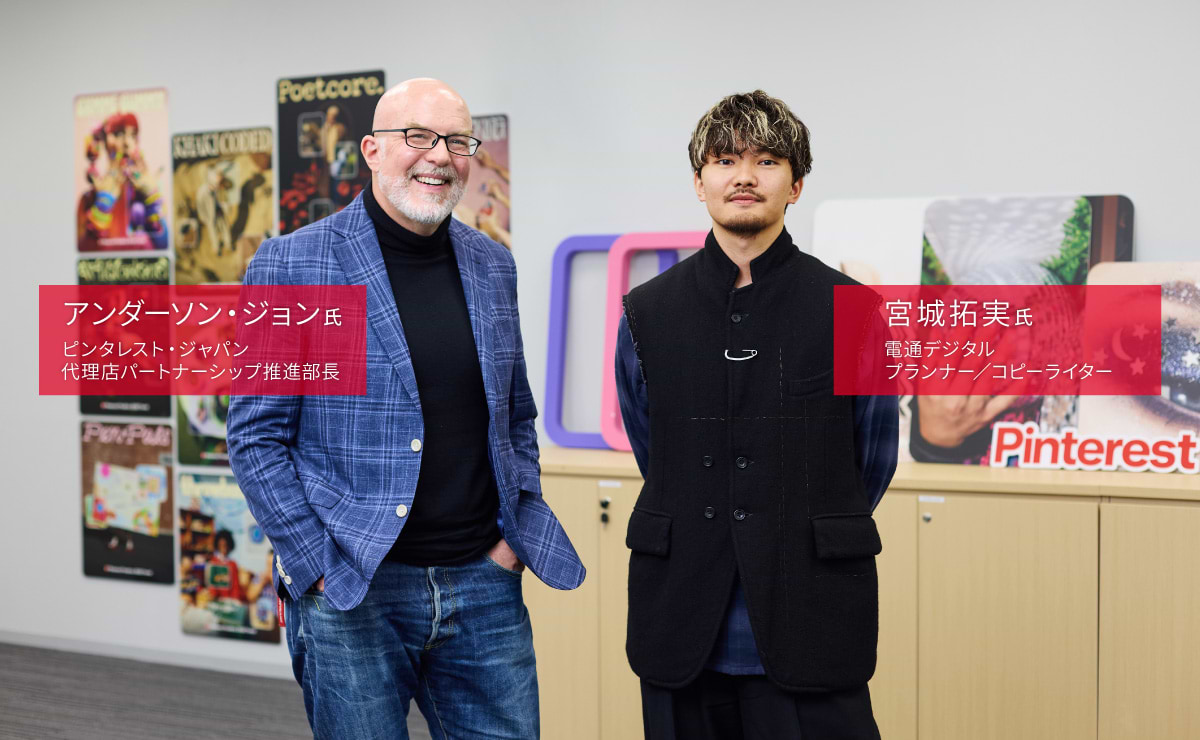
Miyagi: Let me start by introducing myself. In my previous role at an influencer marketing agency, I was involved in planning and casting. After joining Dentsu Digital Inc., I joined a department focused on social media marketing, where I’m responsible for communication planning and copywriting centered around social media.
As part of our collaboration with Pinterest, I’m in charge of planning and producing the “Creative Support Program” between Pinterest Japan and Dentsu Digital Inc. Depending on the objective—whether it’s raising awareness or sparking interest—I plan and produce videos and still images for distribution on Pinterest.
John: At Pinterest Japan, I’m focused on building strategic partnerships with major agencies in Japan and overseas, and driving joint business growth. I’m responsible for creating systems that make it easier for members of the Dentsu Group in Japan to propose Pinterest to their clients.
Miyagi: Before we dive into today’s topic, could you first remind us what kind of platform Pinterest is?
John: In a nutshell, Pinterest is a “visual discovery platform.” Users search for things visually, save items that catch their eye, and use those as a starting point to explore further. Within that loop, their ideas gradually take shape, ultimately leading to actions such as making a purchase, visiting a store, or planning an event.
Miyagi: A major characteristic is that users aren’t just passively viewing information—they’re actively coming here to search for things, right?
John: Exactly. While other platforms tend to be centered around users passively receiving information that flows to them, on Pinterest, users actively search for things they want to do in the future—such as “planning a summer trip” or “looking for ideas for a winter party.” It’s a platform used to find ideas for the near future, rather than searching for things that have happened in the past or are happening right now.
Miyagi: Plus, users are often searching for images they can’t quite put into words yet, aren’t they? I think it’s also a space where they gradually bring their ideas to life while exploring things that fit their room or their personal style.
John: That’s right. That’s precisely why ads aren’t seen as something that interrupts users’ activities—they’re more likely to be perceived as just another piece of content. Since it’s a medium where people tend to browse at a relatively leisurely pace, ads can convey a lot of information. I think it’s a platform that offers a great deal of creative freedom for both creators and advertisers.
Miyagi: In terms of genres where it’s widely used, fashion, beauty, cosmetics, travel, furniture, home appliances, and entertainment are particularly well-suited to the platform, and recently, its use has been expanding into industries like telecommunications, automotive, and finance as well. What becomes extremely important here is knowing how to create creative content that fits the Pinterest environment. The “4C” framework we’re introducing today summarizes that approach.
How Do You Design Content That Drives Results? Unraveling Pinterest’s “4C”
Miyagi: Pinterest advocates the “4C” framework (Context, Content, Craft, Color) as a guide for creating effective creative content. Could you briefly explain the “4C” framework again?
John: As I mentioned earlier, Pinterest is characterized by users actively searching for and saving content, and viewing it at a relatively leisurely pace. When we consider this usage pattern, it becomes clear what kind of presentation works best, how information should be organized, and what color schemes and visual styles are most effective. The “4C” framework summarizes these insights. I believe it’s a clear framework that helps even advertisers new to Pinterest understand the key design principles.
Miyagi: Could you explain each of these points? Let’s start with Context.
John: The key to Context is to view the ad as part of the content. The Pinterest feed features multiple Pins—visual images posted by other users, creators, and businesses—and ads blend naturally into that mix. Since users are on the platform seeking new ideas and discoveries, ads that align with that context are more likely to be accepted.
Miyagi: I, too, am very conscious of “Context” when developing creative concepts. Since Pinterest is a social media platform where users scroll vertically through the screen, it’s crucial to figure out how to make them pause their scroll. For example, by using visuals that deliberately disrupt the usual flow of the screen, you can create a moment that catches the eye and then lead the user to the message you want to convey. I try to keep these kinds of techniques in mind. In fact, I’ve found that ads where this aspect is carefully designed tend to generate a better response.
John: The next element is “Content”—what to show and how to show it. On Pinterest, it’s crucial to convey your message within the first one or two seconds, so elements necessary for brand recognition—such as logos and products—should be clearly displayed early on. Furthermore, since Pinterest is a platform used for searching and discovering things, showing the final result first is also an effective approach. For example, with recipes or interior design, it works well to first show the end result—so users know “this is what it will look like”—and then reveal the process or story that led to it.
“Craft” refers to the refinement of your presentation. Since it’s a visual search platform, images and videos take center stage, but copy is also crucial. Placing the right words in a spot that doesn’t distract from the main visual can make a huge difference in how your message is received.
Miyagi: The role of copy is particularly significant for still images and carousel images. Since you can control where the Pinterest carousel starts, you need to use catchphrases and composition to indicate where you want viewers to focus and what comes next. The power of copy and design is indispensable in creating a path that guides viewers to read the content in sequence.
John: Finally, regarding “Color,” this isn’t simply a matter of whether bright or dark colors are better. What’s important is the overall balance and contrast. Do the visuals and text work together to create content that’s easy to read and visually appealing? We need to give careful thought to that. If we can design the visuals and copy—including their color combinations—in a cohesive way, the result will be a more polished creative piece.
Miyagi: The 4Cs aren’t meant to be viewed in isolation—they’re all interconnected. I believe that understanding the context of Pinterest ultimately helps bring out the best in the other elements as well.
An 88% Accuracy Rate in Predicting Trends Over the Past 6 Years! Signs of the Future Revealed by “Pinterest Predicts™”
Miyagi: So far, I’ve introduced the “4Cs” as a framework for creating effective creative content on Pinterest. On the other hand, when thinking about creative content, you’re probably also curious about the current mood in society and what trends are set to take off in the future. “Pinterest Predicts™” serves as a source of inspiration for such ideas. First, could you explain what this is?
John: “Pinterest Predicts™”—officially titled “Pinterest Predicts™ - Pinterest Trend Forecast”—is an annual report published by Pinterest that compiles “trends that haven’t become trends yet.” It analyzes billions of Pinterest searches and the visual content that Pinterest users have engaged with.Our trend experts use machine learning to combine data insights with real-world observations to identify patterns. We then collaborate with external partners to ensure the trends are comprehensive and have global appeal.
Finally, we combine predictive analytics with Pinterest engagement signals to assess a trend’s growth potential. After the report is published, we monitor the trends to verify whether we’ve successfully identified those with the potential for sustained growth. Pinterest’s trend predictions have been 88% accurate over the past six years (*).
*Based on internal Pinterest search data. Global search volume related to Pinterest Predicts™ 2025.Comparison of August 2024–July 2025 versus August 2023–July 2024. Search volumes for August 2024–July 2025 were normalized and compared to the volumes for August 2023–July 2024 to calculate the rate of change.
Miyagi: That’s quite accurate, isn’t it? What kinds of categories are most commonly included in these predictions?
John: It’s mainly themes that people explore on Pinterest on a daily basis, such as travel, fashion, interior design, beauty, design, and food. We also predict which colors will be popular the following year. We look not only at search volume but also at how often content is actually saved and stored as personal inspiration. I believe that interpreting this data through both machine learning and a human perspective is what leads to such high-accuracy predictions.
Also, as I mentioned earlier, on Pinterest, users tend to search for “what’s coming next” rather than the past or the present. They’re looking for places they want to visit next month or things they’ll want to buy in the future. Precisely because the platform is used with future actions in mind, we can spot the early signs of trends at a very early stage.
Miyagi: I also found the 2026 edition of Pinterest Predicts™ quite fascinating. The section on “Poetcore” was particularly memorable. While the fashion industry is currently focusing on a return from streetwear to classic styles, this trend closely resembles the recent direction of luxury brands that command respect from fashion-savvy individuals. It was interesting to see that kind of vibe emerging as a trend.
John: I think it’s a particularly good fit for genres like fashion, where signs of societal change appear very early on.
A board introducing the “Pinterest Predicts™” 2026 edition. Trends include Gummy Touch, Nature Mood, Khaki Code, Poetcore, and the Cabbage Boom. Click here for the full report.
Miyagi: That’s right. I also felt that a vibe blending classic and decorative elements—like “Asymmetrical Beauty”—feels very on-trend right now. Pinterest has many trend-savvy users, so I think these changes are emerging there early on.
Asymmetrical Beauty: Imperfect beauty will be mainstream in 2026. It’s predicted that Gen Z and Millennials will let their individuality shine by deliberately “offsetting” elements—such as asymmetrical nails, two-tone lips, and eye makeup.
John: “Pinterest Predicts™” is based on global data, so it may not directly apply to Japanese trends. However, even if these trends aren’t yet visible in Japan, if there are signs of them emerging overseas, they may eventually spread here. I think it’s perfectly valid to use it as a source of inspiration from global trends. In fact, our company offers sponsorship packages that leverage “Pinterest Predicts™” trends, and various companies are already utilizing them.
Miyagi: In terms of corporate use, rather than simply looking at “Pinterest Predicts™” and thinking, “This trend is coming, so let’s use this creative approach,” it seems better to view it as a clue for grasping the broader spirit of the times. It’s not just about superficially chasing trends, but about reading the emotions and values behind them. If you can grasp that level of insight, I think it will change the way you approach advertising.What kind of atmosphere are today’s consumers in, and what kinds of things are drawing them in? I think Pinterest Predicts™ is an effective starting point for getting a feel for that.
John: That’s right. If there’s a trend that’s a clear fit for our products, we can use it directly in our promotions. I think it’s important to determine which perspectives are most useful for us. By combining this with the context of the Pinterest platform, I believe we’ll be able to identify even better ways to utilize it.
It’s interesting precisely because there’s no single “right answer” yet. The Future of Pinterest Creativity
Miyagi: Finally, I’d like to discuss the topic of “What makes creative content effective on Pinterest?”
John: Ultimately, the most important thing is understanding the context. What mindset do users have, when do they use Pinterest, and for what purposes? Understanding that is the starting point for “effective creative.”
Pinterest users aren’t just passively browsing; they’re actively searching for things they want, the person they aspire to be, and what they want to do next. Moreover, on Pinterest, many actions are closer to “exploration” than to “search.” Rather than seeking a clear answer from the start, users browse through various options to find what suits them. It’s important to create creative content with that context in mind.
Miyagi: On Pinterest, I’ve found that deliberately disrupting the “familiar sense of scale” users have developed from seeing images arranged in a fixed width often leads to effective creative.On Pinterest, images of various sizes are arranged in two columns, with ads interspersed among them. Since this visual layout itself is slightly different from other social media platforms, if you can effectively leverage that characteristic, the resulting still images and videos naturally take on a style unique to Pinterest. As a result, you end up with a form of expression that’s never been seen before, which leads to both interest and effectiveness. That’s the kind of positive response we’ve been getting.
In fact, I’ve heard that when we produced a certain ad, it generated one of the highest levels of engagement in the company’s history in Japan. We created it with a presentation that slightly subverted conventional ad formats and by consciously designing the user journey—specifically, how users would want to swipe through the carousel.
John: So it wasn’t just about using the format—it was about how to design a new experience within it.
Miyagi: That’s right. What really stands out to me is when we presented it in a way that made it look like a character was rolling right into the ad—it went viral on X with screenshots attached, and reactions like “cute” spread widely. Even though it was an ad, I was thrilled that users reacted to it spontaneously and shared it on their own.
John: That’s exactly what it means for an ad to be accepted as content, isn’t it?
Miyagi: Especially with more discerning users, if you present something that screams “this is marketing,” they’ll tune out. But if you craft it well, they’ll enjoy it and accept it as good content. I find that balance really fascinating.
John: In terms of future potential, there’s room to expand beyond fashion, interior design, and travel to a wider range of industries, isn’t there? I think there are many scenarios where it could work well for products and services that haven’t utilized it yet.
Miyagi: That’s right. Precisely because it’s not yet a massive platform, I think that’s part of what allows a unique atmosphere to flourish—and within that, we can create a slightly richer experience even on a smartphone. From a creative standpoint, that’s quite appealing. There are surely many approaches we haven’t fully explored yet, so I hope we can continue to explore new forms of expression moving forward.
John: As Pinterest, we want to grow while prioritizing our commitment to remaining a positive space. Within that context, I’d be delighted if our ads could become part of the valuable discoveries users make.
Miyagi: It’s a place for delivering ads, but it’s also a place that fosters discovery. I think Pinterest’s creative content has the potential to make both of those things work. I’m really looking forward to seeing how this evolves in the future!
General Manager, Agency Partnership Promotion Department
Joined Pinterest Japan in 2025, where he is responsible for building strategic partnerships with major agencies in Japan and overseas and driving joint business growth. In his previous role at Twitch Japan, he oversaw the sales organization as a platform manager, and at LinkedIn, he served as the head of client solutions. In the U.S., he worked in digital advertising sales and produced branded content for video, games, and websites.
Takumi Miyagi
Dentsu Digital Inc.
Social Engagement Design Division
Planner / Copywriter
Previously worked in casting and planning at a specialized influencer marketing agency. Subsequently joined Dentsu Digital Inc., where he currently holds his current position. Specializes in social media-first communication planning and copywriting. Tends to spend a large portion of his income on clothing.

 Pinterest's Cutting Edge: From Platform Features to Creative Tips [3/3]