Note: This website was automatically translated, so some terms or nuances may not be completely accurate.
 【Continued】Local Gurgle [206/208]
Management of "Lifestyles"
Last April, at a memorial seminar for Professor Ikujiro Nonaka— whom I have introduced many times in this series — Professor Emeritus Akihiro Okumura of Keio University shared several heartwarming anecdotes.
The value of Professor Nonaka’s “Knowledge Creation,” which transcended Herbert Simon’s “Information Processing” (the view of organizations as information-processing devices) and Peter Drucker’s “Knowledge Society” (a society centered on knowledge workers). The fact that “philosophy” (such as that of Kitaro Nishida) lay at its core. The fact that such topics were frequently discussed even over drinks, and so on.
Consequently, I had been eagerly awaiting the publication of the book announced at that time, *Eisai: A Knowledge-Creating Company—Management of the “Way of Life”* (by Akihiro Okumura, Ikujiro Nonaka, and Hideki Kawata / Nikkei BP), which focuses on the pharmaceutical company Eisai as its subject.
While there are numerous examples of applying management theory to interpret corporate activities, Eisai is, quite literally, the “premier example” of “Organizational Knowledge Creation” as proposed by Professor Nonaka. The company has permeated this theory into every corner of its organization and is rolling out products such as the Alzheimer’s disease treatment Lecanemab on the global stage.
To briefly “refresh” our memory, the core of the theory of organizational knowledge creation is “SECI.” It is a dynamic model that explains organizational knowledge creation by treating the following four modes as an infinite spiral.
① “Socialization”: Acquiring, sharing, and forming tacit knowledge through direct experience in the midst of dynamic reality
② “Externalization”: Converting the essence of that tacit knowledge into explicit knowledge in the form of concepts through dialogue and other means
③ “Combination”: Mobilizing all forms of explicit knowledge to create collective knowledge (theories, models, products, services, etc.) that can be shared within the organization and society
④ “Internalization”: Through trial and error with collective knowledge, tacit knowledge is enriched within each individual practitioner
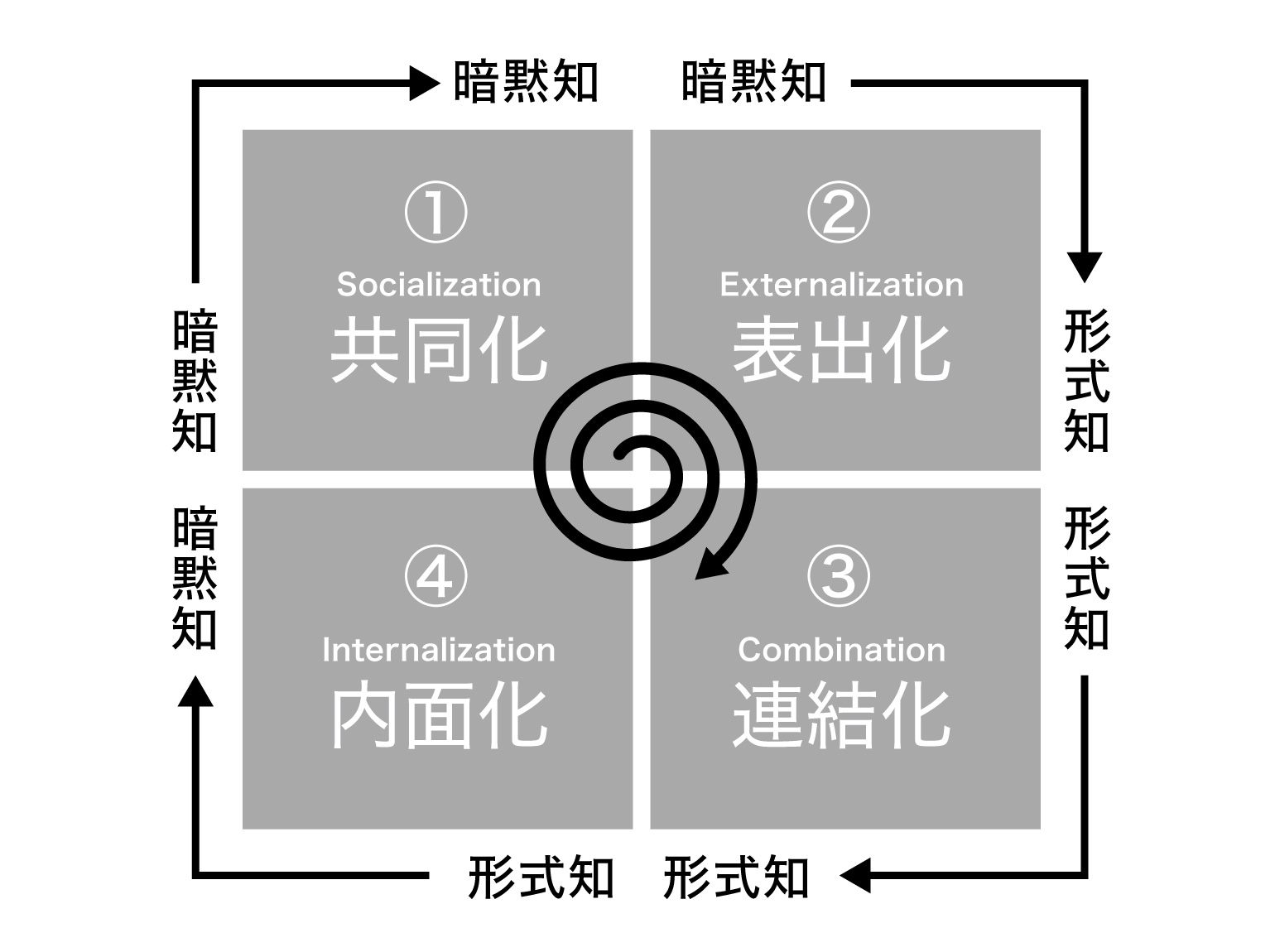
Now, within this SECI framework, Haruo Naito, Representative Executive Officer and CEO of Eisai, places particular emphasis on “① Socialization.” He states that all employees, including those in global operations, are encouraged to spend 1% of their working hours with patients and consumers, gaining insight into their often-unspoken feelings through direct experience.
Underpinning this initiative is the corporate philosophy known as “Human Health Care (hhc).”While many pharmaceutical companies view doctors and pharmacists with whom they do business as their customers, Eisai aims to “have all employees prioritize the joys and sorrows of patients and consumers above all else; discuss from the customer’s perspective what needs to be done to enhance their well-being; put this into practice through business activities; demonstrate its effectiveness; share it with the world; and transform society.” ( From the official website )
It is important to note that the “hhc” corporate philosophy is not merely flowery rhetoric espousing ideals, as was often seen during the “purpose boom,” but rather a set of behavioral guidelines that directs each individual member of the organization on what they should be doing “here and now.”
For example, for researchers who feel stuck (though reading through foreign literature is certainly valuable), the message embedded within is: “Do you truly understand the joys and sorrows of patients and consumers?” and “Go out to the front lines as part of your official duties and experience it firsthand.”
And the reason why “hhc” contains this message for the front lines is because it stems from an overwhelming “sense of ownership” driven by a genuine desire to fundamentally change the “conventional wisdom” of the pharmaceutical industry, which typically views doctors and pharmacists as its customers.
This is a far cry from flowery slogans like “Bringing smiles of delight to every dining table” or “Pioneering the future through innovation.” In fact, Eis ai has donated 2.2 billion tablets of lymphatic filariasis medication to the World Health Organization (WHO) to help eradicate tropical diseases. This clearly demonstrates a commitment to the principle that “realizing social good” is the priority, and “profit is merely a result.”
As a humble contributor to the movement aiming to put “organizational knowledge creation” into practice, I find this book—which chronicles Eisai’s efforts over the past 40 years—to be incredibly valuable. As CEO Naito states, “I believe that the only true ‘motivation’ for an organization lies in knowledge creation,” and I highly recommend this book to anyone seriously committed to organizational transformation.

My mother, who turns 92 this year, is experiencing a gradual decline in her cognitive function. With no medication offering the prospect of dramatic improvement, we now simply let nature take its course. Even when I mention the traditional European desserts she used to make for us—like trifle, polvoron, and Christmas pudding—she just laughs and says, “Did I really make those?”
That said, her appetite remains as hearty as ever; at our favorite sushi restaurant, she polishes off the same number of pieces as my wife and I every time. While I used to associate cognitive decline and caregiving solely with “despair,” I now find myself grateful every day for the simple joys and sorrows of life.
Please, help yourself!
 For more details on “Indwelling Creators,” a project led by Takeo Yamada, click the logo.  |  |
Was this article helpful?
Share this article


Newsletter registration is here
We select and publish important news every day
For inquiries about this article
Back Numbers

Author

Sōo Yamada
Dentsu Inc.
First CR Planning Bureau
Creative Director