How can Dentsu Inc.’s creative team contribute to the ever-evolving field of CX (Customer Experience)? “Monthly CX” is a series of articles written by members of Dentsu Inc.’s dedicated CX division, the “CXCC” (Customer Experience Creative Center) ( click here for more on Monthly CX).
In this installment, we introduce “DEI CARD,” a tool that allows users to learn about DEI while experiencing Dentsu Inc.’s unique creative approach firsthand. “DEI” is an acronym for “Diversity,” “Equity,” and “Inclusion,” referring to the mindset necessary to respect each individual’s uniqueness and build a better society.
While there is a growing call to promote DEI, Japan’s Gender Gap Index remains low, and the wage gap between men and women, as well as the divide between people with and without disabilities, has not yet been bridged.
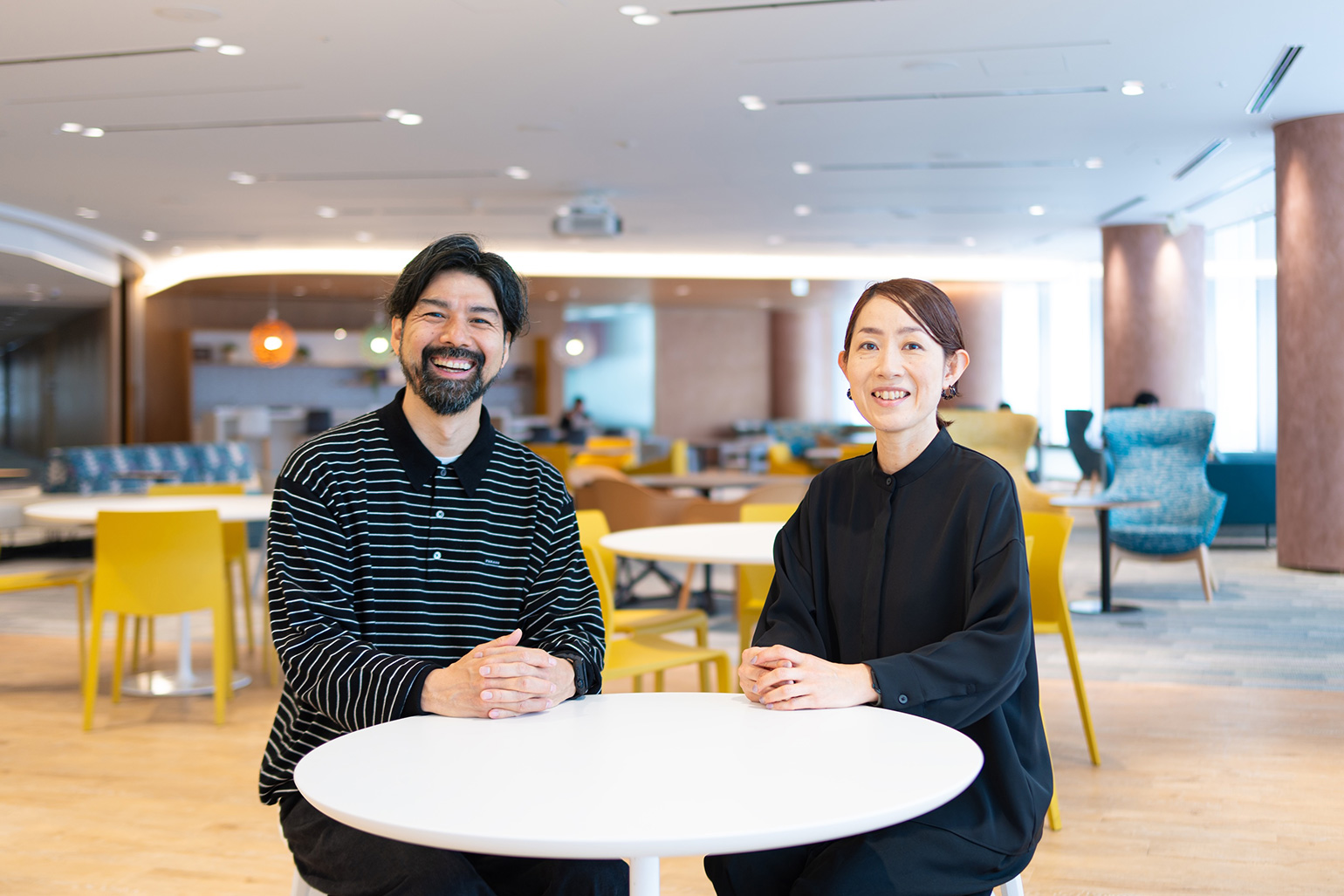
“DEI” is indispensable when considering the future of creativity. What exactly is “DEI CARD,” a tool designed to help people learn this framework, and what kind of experience did it create? We spoke with Art Director Yuko Katsumata and Creative Director Toru Suwa, who played central roles in its production.
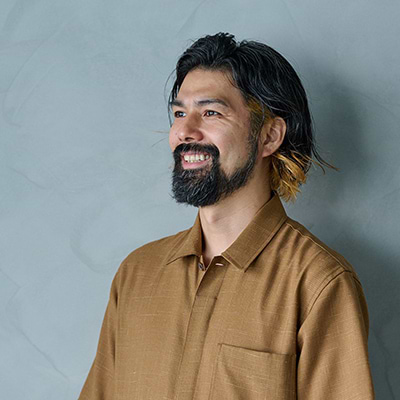
[Yuko Katsumata Profile] Dentsu Inc. Business Transformation Creative Center Creative Director / Art Director She has worked with numerous clients, focusing on product development, in-store and mass communications, and VI development, and contributes to solving client challenges by visualizing their purpose. She also conducts new product development through workshops utilizing generative AI and promotes DEI both internally and externally through workshops using the “DEI CARD,” which she is developing with a group of volunteers .
[Profile of Toru Suwa] Dentsu Inc. Customer Experience & Creative Center Creative Director / Communication Planner After joining the company, he worked in business production and marketing before transitioning to a creative role. From 2016 to 2017, he worked at North Kingdom in Sweden, and upon returning to Japan, he joined the Customer Experience & Creative Center in January 2021.He handles a wide range of projects, from product and service development to branding communications, working under the motto, “Develop strong concepts that transcend a single domain!” His major awards include Cannes Lions, D&AD, The One Show, AD STARS, Spikes, ADFEST, NYADC, TOKYO ADC, and ACC.
*Affiliation and title are as of the time of the interview.
“DEI CARD”: A Tool for Actively Learning DEI Concepts
Monthly CX: Could you tell us exactly what “DEI CARD” is?
Katsumata: It’s a card game designed to help companies and frontline staff actively learn about DEI principles with the goal of solving DEI challenges. As part of this initiative, we also host workshops using the “DEI CARD.”
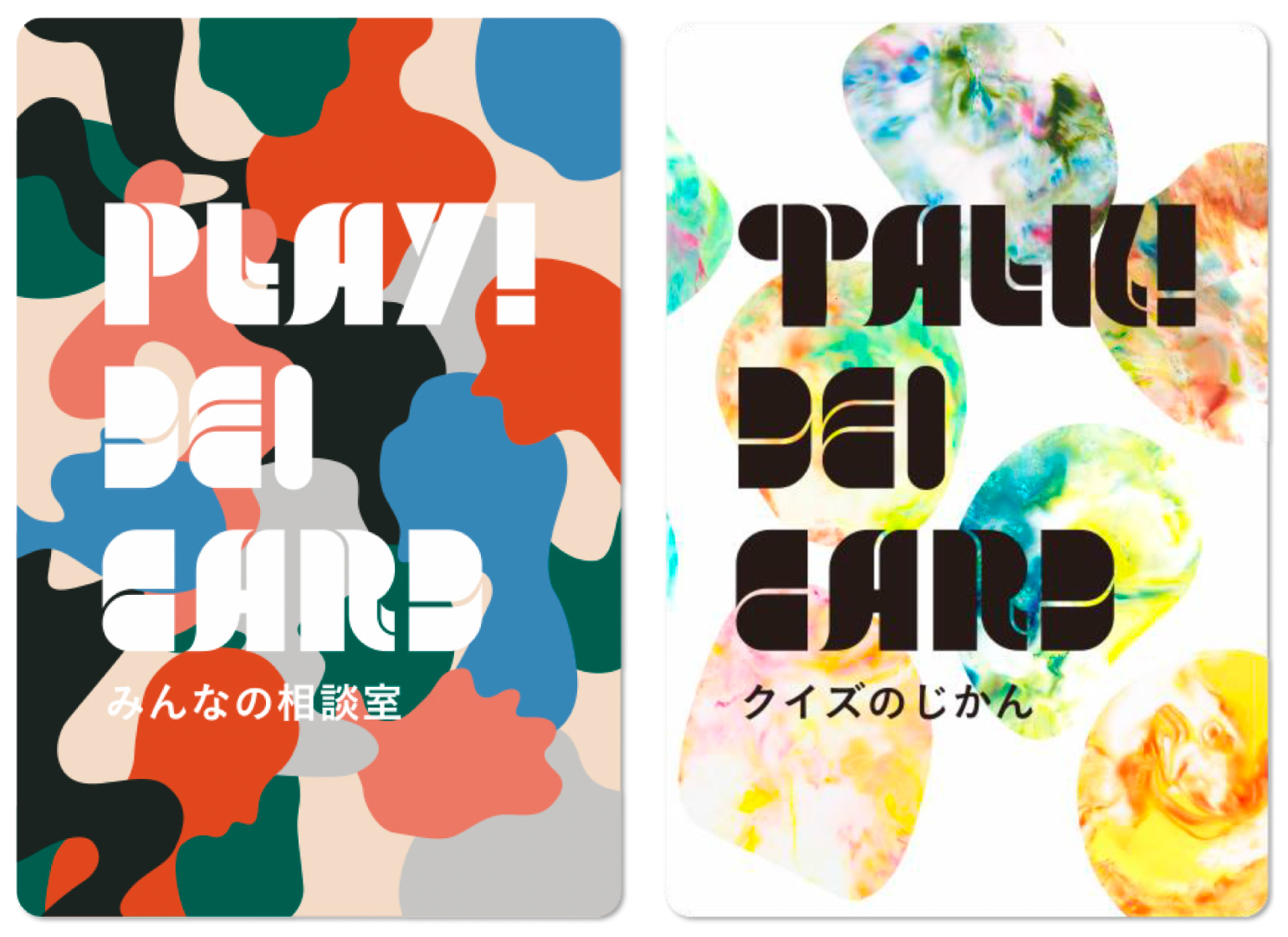
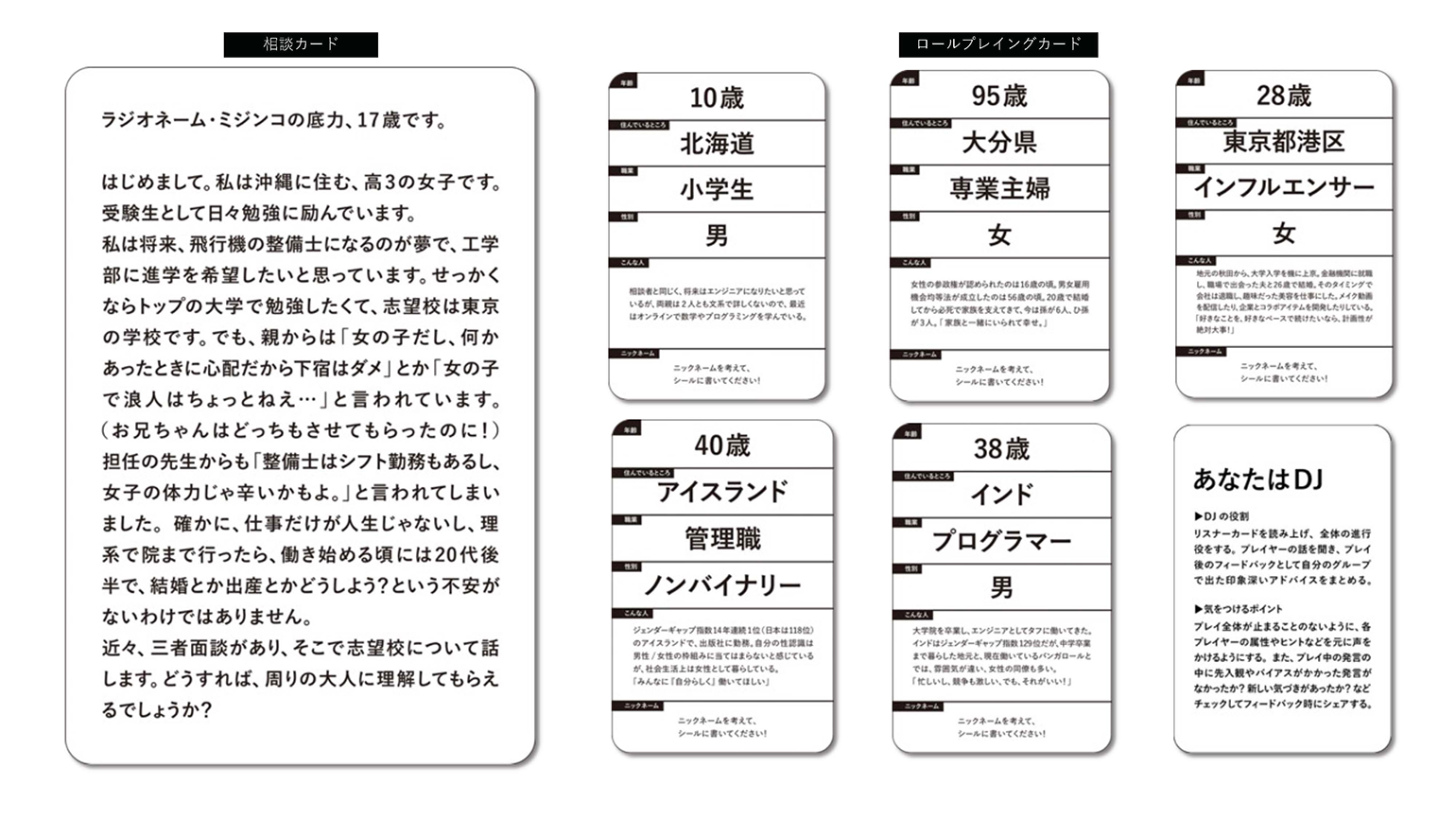
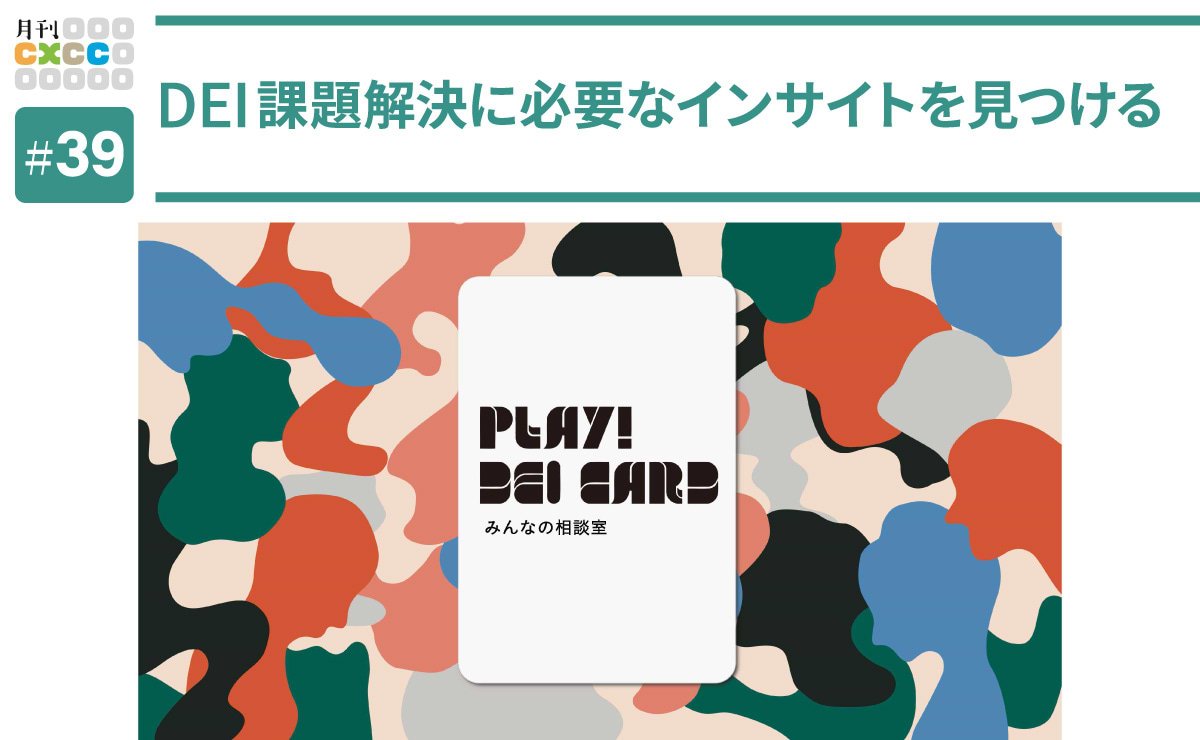
We’ve created two sets of cards: the first is “PLAY DEI CARD,” a game that offers role-playing experiences tailored to specific DEI challenges by responding to consultation scenarios; the second is “TALK DEI CARD,” designed for participants to brainstorm ideas together on DEI-related issues.
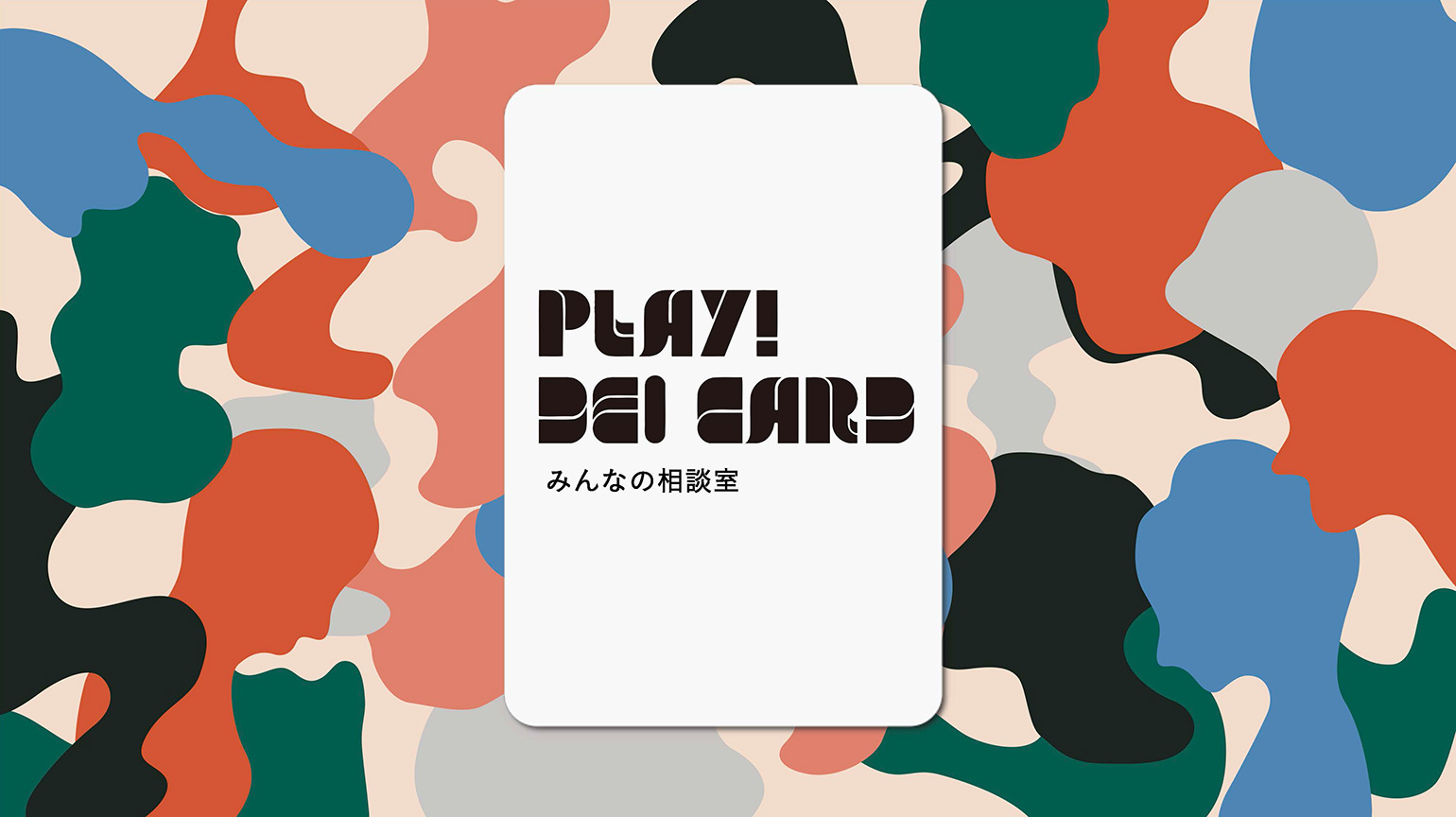
Suwa: “PLAY DEI CARD” comes in sets of seven cards, consisting of one consultation card featuring DEI-specific concerns submitted by various individuals and six role-playing cards. We’ve prepared multiple consultation cards, such as “A 17-year-old high school girl who wants to become an aircraft mechanic but is worried because her parents oppose her going to college” and “A 48-year-old woman concerned about her daughter’s excessive dieting.”
For each concern described on a card, participants use “role-playing cards”—which depict characters of different ages, races, and occupations—to fully embody the given persona and respond accordingly. All personas and concerns described on the cards are based on real-life situations; we made sure not to include any fabricated details intended solely to prompt discussion.
A camouflage design combining human figures that reflects the cards’ ability to embody diverse personasThe consultation topics and content on the role-playing cards are all based on real people. Another distinctive feature is the inclusion of “DJ Cards,” which serve as a listening partner to facilitate conversation.
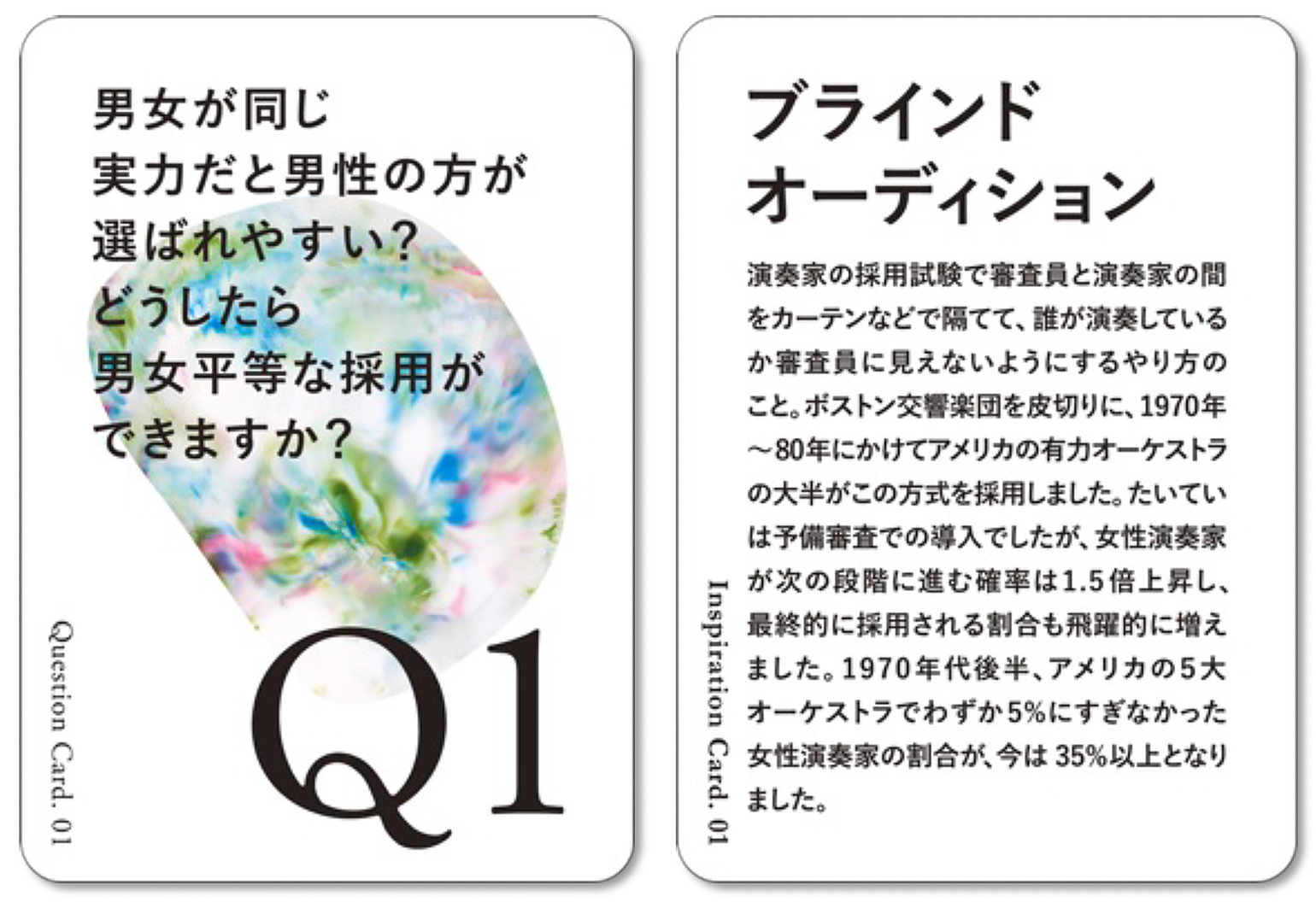
Suwa: The other set, “TALK DEI CARD,” consists of paired cards—one side features a DEI-related quiz with no set answer, while the other side provides examples or policies that serve as hints for that quiz.
For example, on a card where the front asks, “If men and women have the same qualifications, are men more likely to be selected? How can we achieve gender-equitable hiring?” the back features the example of “blind auditions” (*).
The aim of this project is to use these cards to engage with various DEI challenges through role-playing, thereby bringing individual insights and biases to light and helping participants develop creative thinking to solve DEI issues. Regarding the topics and case studies, we interviewed those directly involved, selected content based on factual information, and crafted the copy so that workshop participants could relate to the material on a personal level.
*This refers to a case from the 1970s and 1980s, when a method of concealing the identity of performers during auditions was introduced, resulting in a dramatic increase in the hiring rate of female musicians.
The marble patterns, representing a world inhabited by a diverse array of people, were created one by one using paintTALK DEI CARDS, designed as a pair of front and back cards
Monthly CX: Could you tell us what inspired this initiative?
Katsumata: At Dentsu Inc., we’re trying various approaches from a DEI perspective to solve our clients’ challenges. We also have an in-house study group called the “DEI Seminar,” and the idea came to me when I thought it might be interesting to summarize the insights gained there in the form of a card game as a way to provide feedback. From there, I teamed up with Mr. Suwa, and we began designing it as a card game.
Suwa: Simply putting up a poster that says “Let’s Think About DEI” isn’t likely to really move people. Rather than something passive like that, we thought that since we were taking a creative approach to DEI, we wanted to create something that was fun yet resonated deeply—something that would make people want to participate actively on their own.
Monthly CX: I thought the format that allows participants to actively role-play about DEI was brilliant.
Suwa: It takes a lot of courage to talk about DEI issues—whether they involve race, ethnicity, gender, or disabilities. But when you fully immerse yourself in the role of someone else, biases you weren’t even aware of tend to surface. We hoped that by doing this, participants would be able to identify their own biases and gain insights for solving these issues.
Katsumata: We conducted numerous interviews with people directly affected by these issues and spent over a year trial and error figuring out which DEI challenges to incorporate into the card game and how to do so. Since I wasn’t familiar with card games myself, it was a very fresh experience to create one while thinking about the unique enjoyment they offer.
Treating not only others’ answers but also your own as “N=1,” rather than seeking “correctness”
Monthly CX: What were the reactions of people who actually tried “DEI CARD”?
Katsumata: It’s been very well received. I was particularly struck by positive reactions like, “I didn’t realize you could engage with DEI this way,” and “I think I can apply this to my work.” Reactions to the cards varied depending on the participants’ backgrounds—for example, healthcare professionals showed interest in medical topics, while salespeople spoke up confidently about their opinions. We’ve been continuously refining and adapting the cards based on these different demographics.
Also, the workshop is structured around teams of seven. When we held one at a certain company, we had participants form teams with people they’d never met before—people of different job titles and ages. We even heard some surprising feedback that, through the workshop, they shared their values, got to know each other’s personalities, and became friends.
Monthly CX: Were there any particularly memorable reactions to the cards?
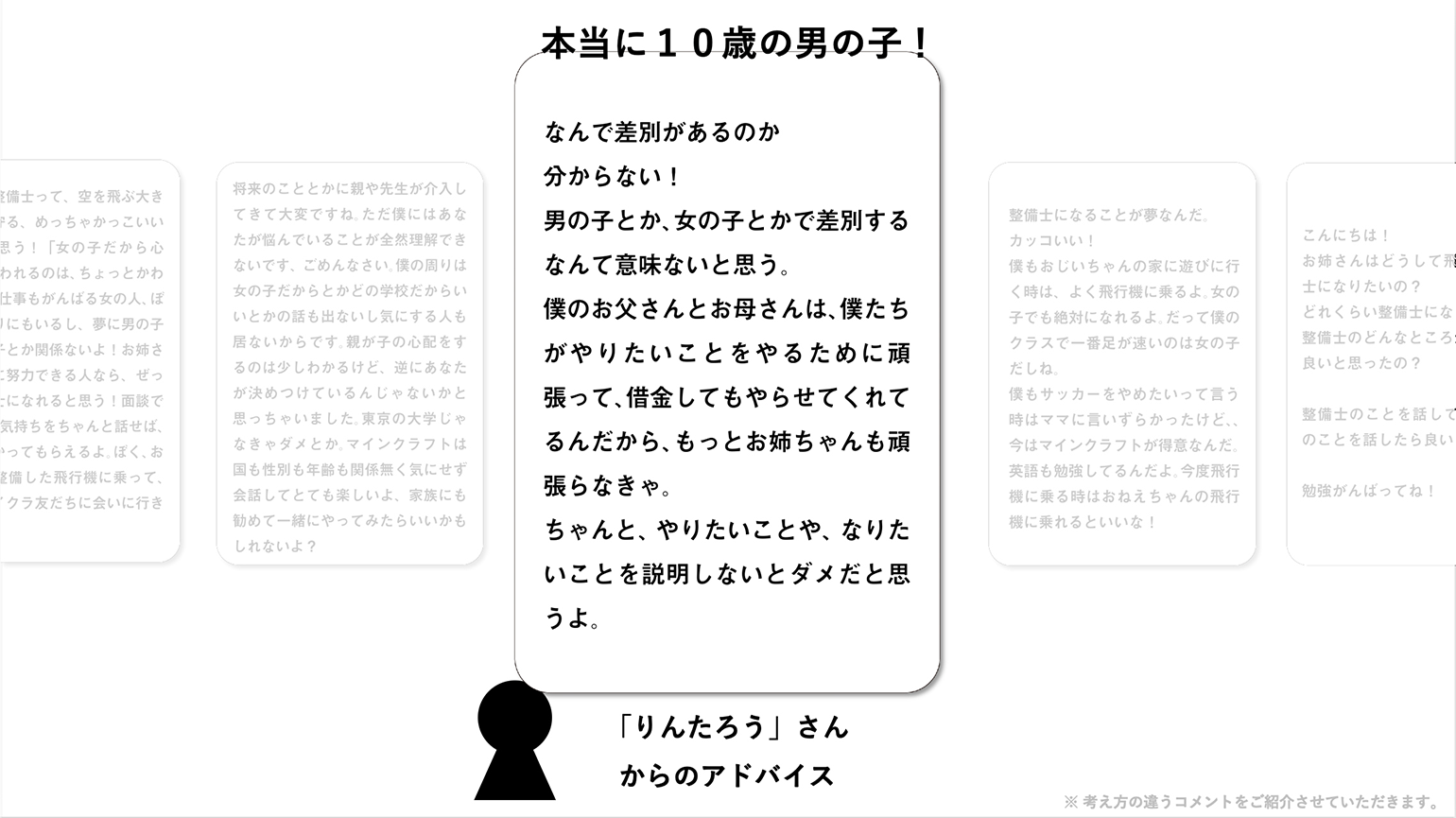
Suwa: The “role-playing cards,” where participants imagine themselves as a 10-year-old boy, generated a lot of conversation. It’s an easy-to-understand persona, and I got the impression that many people spoke as if thinking, “This is what a 10-year-old would say.” However, when we shared comments we’d gathered from an actual 10-year-old boy, the content was so realistic that gasps of surprise went through the room.Children are living their lives earnestly from their own perspectives, yet as adults, we tend to overlook that. Overall, the reactions we intended were generated, and I felt a real sense of accomplishment.
Real advice from a real 10-year-old boy to a 17-year-old high school girl struggling because her parents oppose her plans to go to college
Monthly CX: When addressing DEI topics, I think there’s also a risk of creating and perpetuating biases. I’d like to ask if there were any specific points you focused on during the experience design.
Katsumata: We went through numerous rounds of trial and error and carefully fine-tuned how the output was received. By having participants explain the reasoning behind their comments, we aimed to help them become aware of their own biases. We were careful not to present the “optimal solution” ourselves or steer them toward any particular conclusion.
I hoped they would realize that everyone’s answers—including their own—are “N=1,” and that it’s not a matter of right or wrong, but that all perspectives are valid.
Monthly CX: What about you, Mr. Suwa?
Suwa: I was careful about the distance between the DEI concerns addressed on the cards and the participants. For example, if we held a workshop where only college students discussed the DEI concerns that college students face, I think their answers would come solely from their own personal experiences rather than from a persona’s perspective. Speaking based on “my experience” strays from the original purpose of DEI. I designed the workshop while constantly thinking about how to get participants to imagine and speak from the perspective of people in different situations.
Continuously reflecting on “what bias is” leads to the discovery of insights
Monthly CX: Looking back on this initiative, what are your thoughts?
Katsumata: First of all, presenting ideas in front of a large group is incredibly difficult. Even now, I still have to muster all my courage before planning meetings—I get so nervous my face goes pale. The “DEI CARD” was designed to encourage that kind of speaking, and I was truly impressed by how clearly everyone articulated their own thoughts.
I was also very happy that everyone was able to experience the creative thinking process we always engage in—learning about case studies through the cards to come up with new ideas, researching other examples to gain input, and then producing something new. As an art director, it was also extremely meaningful to be involved with the theme of DEI.
Suwa: People have various desires and biases, and I’m always mindful of these when creating advertisements. The “DEI CARD” was designed to spark activation by having participants step into someone else’s shoes, thereby stimulating insights they might not have realized on their own. I felt a real sense of accomplishment from being able to create the kind of work I love.
On the other hand, I do regret not being able to fully answer a participant’s question: “What exactly is bias?” I explained that bias refers to preconceptions, and that it’s important to realize there are people we overlook when imagining the biases that various individuals face—but I wonder if there might have been another way to answer that. I feel that I, too, need to continue reflecting on this going forward.
Monthly CX: Please tell us about the future prospects for “DEI CARD.”
Katsumata: We’re hoping to pioneer new business models utilizing “DEI CARD.” At one point, we considered selling the cards as a standalone product, but we’ve put that on hold for now. That’s because what we really want to do is identify the challenges faced by participants and take action on DEI together with them. We plan to expand our activities alongside the people we’ve connected with through the workshops and continue moving forward with this “cards plus workshops” format.
Suwa: I feel the same way as Katsumata—nothing would make me happier than if “DEI CARD” serves as a catalyst for participants and those directly affected to discover new insights and move to the next stage. I hope we can continue to create exciting, creative projects that help solve the challenges people face in society.
(Editor’s Note) I felt that “DEI CARD,” which encourages active thinking about DEI, is an outstanding creative tool for uncovering insights from a DEI perspective—one that is indispensable in modern society. I also believe that the experiential design—which eases the psychological barriers to speaking up by allowing participants to fully immerse themselves in a role—was a crucial element for gathering voices from a wide range of people.
If you have any requests regarding topics or case studies you’d like us to cover in the future, please send a message to the Monthly CX editorial team via the contact page below. Thank you as always for your continued readership.
Monthly CX Editorial Department Dentsu Inc. CXCC: Kihata, Koike, Otani, Okumura, Kosugi, Yi, Saito, Oda, Takakusaki, Kanasaka
I work with numerous clients, focusing on product development, in-store and mass communications, and VI development, and contribute to solving clients’ challenges by visualizing their purpose. I also conduct new product development workshops using generative AI and promote DEI both internally and externally through workshops using the “DEI CARD,” which is being developed by a group of volunteers.
After joining the company, I worked in business production and marketing before moving into a creative role. From 2016 to 2017, I worked at North Kingdom in Sweden, and after returning to Japan, I joined the Customer Experience & Creative Center in January 2021.He handles a wide range of projects, from product and service development to branding communications, working under the motto, “Develop strong concepts that transcend a single domain!” His major awards include Cannes Lions, D&AD, The One Show, AD STARS, Spikes, ADFEST, NYADC, TOKYO ADC, and ACC.
The editorial team for "Monthly CX," a series where members of Dentsu Inc.'s CX-specialized division "CXCC" share insights on CX and creativity. By covering outstanding CX creative success stories within the agency or company, we unravel the essence and potential of CX creativity. Core members are Yoko Kibata, Hiroshi Koike, Nao Otani, Hirono Okumura, Yutaro Kosugi, Espin, Keisuke Saito, Kenji Oda, Hirozumi Takakusagi, and Motofumi Kanasaka, all belonging to CXCC.

 Monthly CX [39/39]