Note: This website was automatically translated, so some terms or nuances may not be completely accurate.
 DENTSU DESIRE DESIGN's Approach to Marketing Reconstruction Based on "Theory of Desire" [39/40]
Do People Prefer Talking to AI Over Other People!? The Current State of Consumers and Generative AI
Dentsu Inc. Desire Design (DDD) is an organization that develops various solutions and disseminates information based on the relationship between consumption and desire. In this series, we analyze the “Survey on Consumption That Moves the Heart,” which DDD conducts periodically, and share the insights and findings derived from the survey results.
Conversational generative AI has rapidly become a familiar part of consumers’ lives over the past few years.
AI has evolved from the 2000s—when it was a system that understood our preferences and purchasing habits without our knowledge and used algorithms to provide optimal solutions—into a conversational companion we can interact with easily, and further into an entity capable of handling various tasks.
We’ve seen a shift in behavior from “searching for information yourself” to “asking AI,” and phrases like “Why don’t you ask AI?” have become commonplace in everyday conversation.
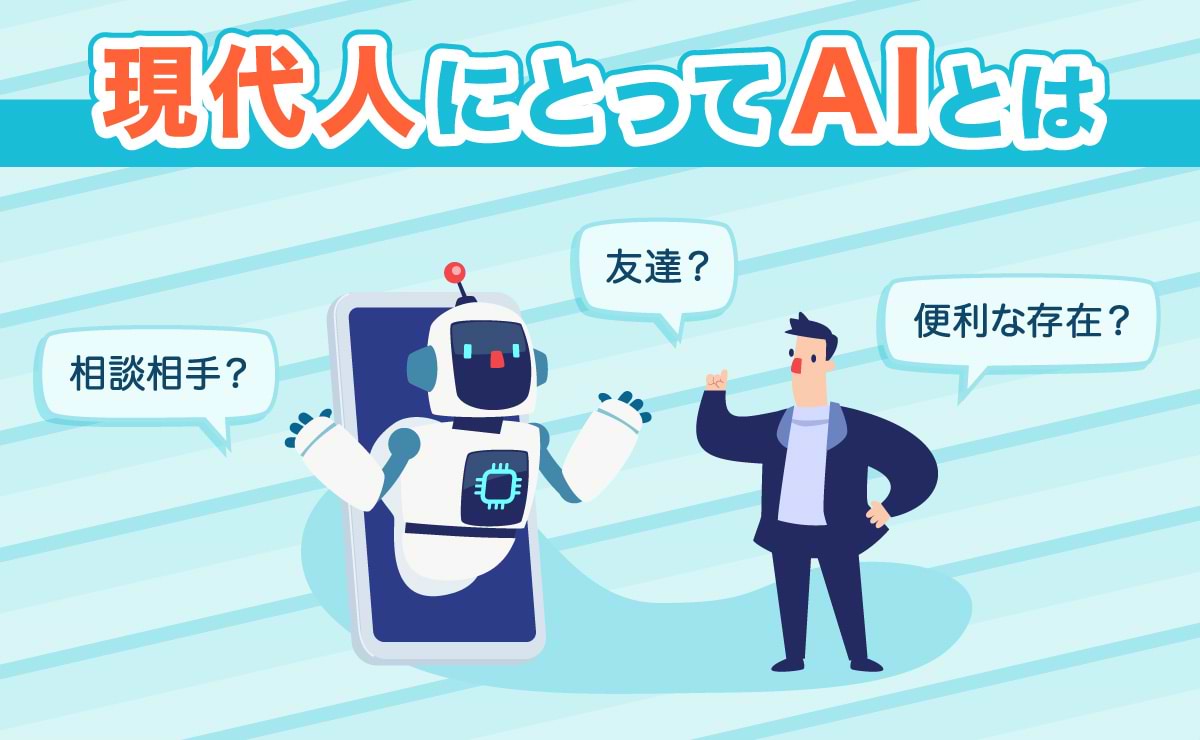
So, what role does AI actually play in the lives of today’s consumers?
Eriko Onoe of DDD offers her insights based on the results regarding consumers’ perceptions of AI from the 12th “Survey on Emotionally Driven Consumption,” conducted in May 2026.
<Table of Contents>
▼Over 60% of 15- to 19-year-olds say they “consult AI frequently these days.” AI has become a go-to advisor for consumers.
▼Is AI just like a friend!? While people listen to its “opinions,” they still prioritize their “own intuition” when making decisions.
▼People in their 40s are more likely to trust AI’s opinions over their own intuition.
▼43.6% of the “AI consultation group”“prefer talking to AI over talking to people”
▼In the future, AI may evolve into entities with “personality” and “roles”
▼While the “AI consultation group” enjoys socializing, they also find “greater peace of mind in interacting with digital technology”
Over 60% of 15- to 19-year-olds say they “have been consulting AI frequently lately.” AI is becoming a confidant for consumers
First, looking at the results for the question “Do you consult AI often these days?”, the overall “Agree (Total)” (the sum of “Agree” and “Somewhat Agree”) was 33.9%. Among them, teenagers had the highest percentage, with “Agree (Total)” at 61.5%—more than half. This percentage decreases gradually as the age group increases.
“That’s less than I expected!” “That’s more than I expected!” How do you feel about these results?
Is AI Like a Friend!? People Listen to Its “Opinions,” but Ultimately Prioritize Their “Own Intuition”
So, do people who answered that they “consult AI frequently these days” actually heed whatever opinion (response) the AI gives?
For the question in Figure 1, we’ll analyze the group that answered “I agree” or “I somewhat agree” to “I’ve been consulting AI quite often lately” as the “AI Consultation Group.”
When asked about the statement “I often think AI’s opinions or judgments are wrong,” a staggering 70.6% of the “AI Consultation Group” answered “I agree” or “I somewhat agree.”
This figure exceeded 70% among respondents in their teens through 40s, and the “I agree” rate (total) was highest among teens—the age group with the highest “proportion of AI consultations”—reaching as high as 83.5%.
Figure 3 summarizes the responses to the questions: “[A] I tend to trust my own intuition more than AI’s opinions” and “[B] I tend to trust AI’s opinions more than my own intuition.”
Here as well, among the “AI consultation group,” 64.0%—more than half—responded that they “tend to trust their own intuition more than AI’s opinion.” In other words, this reveals the reality that consumers “first seek AI’s opinion, but ultimately prioritize their own intuition.”
This mindset can be seen as similar to how people react to the opinions of human friends. For example, don’t you recall that familiar scenario where you vent to a friend about your partner, asking, “What do you think?”—but even if they advise, “If that’s the case, just break up with them!” you still don’t actually end the relationship?
Even if people are consulting AI about complex or specialized topics they wouldn’t feel comfortable discussing with a friend, the fact that they listen to the AI’s opinion but ultimately value their own intuition suggests they’re using it as an extension of their real-life friendships.
People in their 40s are more likely to trust AI’s opinion over their own intuition
On the other hand, we found that among people in their 40s, 46.8% trust AI’s opinions—more than 10 percentage points higher than the “AI consultation group” as a whole.
To verify this, we analyzed the “AI-consulting group in their 40s” to identify those who “often think AI’s opinions or judgments are wrong.” Among them, 44.0% answered that they “tend to trust AI’s opinions more than their own intuition.”
It turns out that even among those who believe AI often makes mistakes, just under half end up trusting the AI’s opinion over their own.
Although this is only a hypothesis due to a lack of data, it may be that people in their 40s—even if they think they understand intellectually that AI makes mistakes—tend to unconsciously trust AI’s opinions in areas where they lack confidence in their own intuition… suggesting a tendency toward blind faith. People in their 40s are said to have reached the “age of no confusion,” but it was a surprising discovery that nearly half of them do not prioritize their own intuition above all else.
43.6% of “AI Consultation Users” Prefer “Talking to AI Over Talking to People”
Next, to explore attitudes toward conversing with AI itself, let’s look at the results for the statement, “I prefer talking to AI over talking to people.”
Among the “AI consultation group,” 43.6% responded that they “prefer talking to AI over talking to people.” By age group, those in their 30s had the highest percentage at 50.5%, followed by those in their 40s, with those in their 20s in the high 40s. It appears that just under half of the AI consultation group now prefers talking to AI over talking to people.
The potential for AI to evolve into an entity with a “personality” and a “role”
We also conducted a simple survey of 350 people—ranging from their teens to their 60s—asking them to freely describe what AI means to them, regardless of whether they currently use AI or not.
While “a convenient tool” was the most common response, we also saw descriptions such as “someone to confide in,” “partner or sidekick,” “friend,” “best friend,” “assistant,” “teacher,” “lover,” and “boyfriend.” Many of the terms used went beyond simply describing functional value to express a sense of relationship.
Some respondents even remarked, “I feel like AI is gradually evolving from a convenient tool into a friend.” Looking at these results, it seems that for some people, AI is no longer merely a systematic entity but is becoming an entity with a “personality” or a specific “role” for the user.
Recently, services have emerged that allow users to create “AI lovers” or “AI friends” using interactive AI apps where they can design AI characters to their liking, nurture them, and engage in conversation. Furthermore, there are apps that let users converse with AI avatars modeled after anime and manga characters, historical figures, real-life celebrities, and video game characters, enabling conversations with AI entities programmed with a wide variety of “personalities.” Additionally, an increasing number of people are utilizing autonomous AI that thinks and acts on its own without the need for prompts.
As generative AI technology continues to evolve and relationships with consumers grow stronger, elements such as “personality” and “character” may become increasingly important.
In a future where each AI surrounding consumers possesses its own unique personality and character, it is entirely conceivable that the AI systems companies and brands use to communicate directly with customers will also need symbolic personalities and characters that are easy for people to remember.
The “AI Consultation Group” consists of people who, while “enjoying social interaction,” also find “greater peace of mind in engaging with digital technology.”
From here on, we will explore the mindset of those within the “AI Consultation Group” who responded that they “prefer conversing with AI rather than with people.”
Hereafter, we will refer to this segment as the “AI Consultation Group Who Prefer Conversing with AI.”
First, looking at gender and age, there is a relatively high proportion of young people. Compared to the “overall” group, the percentages of “males in their teens to 40s” and “females in their teens to 30s” are higher, and when considering gender alone, there are slightly more men (red box in Figure 6).
Since they prefer conversing with AI over people, one might assume they do not enjoy “socializing.” However, when we examined the values related to socializing, we found surprising results.
For the item “I want to meet people and share experiences with friends,” the percentage of respondents who answered “I agree (total)” was more than 10 points higher than the overall average, and more than 5 points higher than among the “AI consultation group who prefer conversing with AI over people.”
Furthermore, in the question asking whether they preferred either “[A] I prefer to do things with others” or “[B] I prefer to do things alone,” the “I prefer to do things with others” option showed a similarly higher preference.
In light of these findings, the fact that they “prefer conversing with AI over talking to people” does not mean they dislike socializing; rather, it suggests they actually enjoy it.
On the other hand, regarding the statement “I feel more at peace interacting with the digital world than with the real world,” the percentage of respondents who “agree (total)” was more than 30 points higher compared to the “overall” group and the “AI consultation group” that prefers conversing with people. This is a distinctive result, even considering the high proportion of younger respondents.
These results seem to reveal the complex mindset of modern consumers: they enjoy interacting with people, but find that engaging with the digital world brings them greater peace of mind than dealing with reality. In other words, precisely because they enjoy interacting with people, they can sometimes become exhausted by having to sense others’ feelings or “read the room.” It can also make them feel uncomfortable at times. Therefore, they may find that conversing with AI—which doesn’t require them to read the room—allows them to feel more at ease.
Going forward, as consumers navigate the challenges of real life, won’t they increasingly seek out AI that acts as a life companion—someone who supports them, shares their values, and helps them maintain a sense of peace of mind?
[Survey Overview]
〈Overview of the 12th “Emotionally Resonant Consumer Survey”〉
・Target Area: All of Japan
・Eligibility Criteria: Men and women aged 15–74
・Sample Size: 3,000 respondents total (allocated according to population proportions across 7 age groups—15–19, 20s–60s, and 70–74—and 2 gender categories)
・Survey Method: Online survey
・Survey Period: May 12 (Tue) – May 17 (Sun), 2026
・Survey Sponsor: Dentsu Inc., DENTSU DESIRE DESIGN
・Survey Agency: Dentsu Macromill Insight, Inc.
Was this article helpful?
Share this article


Newsletter registration is here
We select and publish important news every day
For inquiries about this article
Back Numbers


Author

Eriko Ono
Dentsu Inc.
Solution Creation Center Future Insights Department Future Business Creation Research Division Future Forecasting Support Lab