Note: This website was automatically translated, so some terms or nuances may not be completely accurate.
 DENTSU DESIRE DESIGN's Approach to Marketing Reconstruction Based on "Theory of Desire" [38/40]
What Kind of People Don’t Mind Waiting in Line? Examining Japanese Consumers’ “Plans” and “Reservations”
Dentsu Inc. Desire Design (DDD) is an organization that develops various solutions and disseminates information based on the relationship between consumption and desire. In this series, we share insights and findings derived from the results of DDD’s “Survey on Consumption That Moves the Heart.”
In this installment, based on the results of the 11th survey conducted in November 2025 ( click here for the survey overview ), Yasuaki Matsumoto of DDD analyzes insights regarding Japanese people’s “plans” and “reservations.”
<Table of Contents>
▼“Plans” and “Reservations” in the Lives of Modern People
▼Younger Generations Tend to Dislike “Plans” Slightly
▼Over Half of Seniors Prefer to “Plan Their Schedules Thoroughly”
▼While 90% Prefer “Advance Reservations,” Do “Physical Stamina” Factors Influence Response Trends by Gender and Age Group?
▼What Kind of People Choose to “Waitin Linefor Long Periods”?
▼What Modern Desires Do “Long-Line Waiters” Harbor?
▼Toward a Flexible Society That Embraces “Spontaneous Actions”
“Schedules” and “Reservations” in Modern Life
This year’s Golden Week offered a relatively long break according to the calendar. With this rare opportunity for an extended vacation—which is usually hard to come by—many people likely enjoyed traveling and going out.
Nowadays, making reservations for transportation and facilities has become the “norm” when it comes to travel and outings. While reserving seats on public transportation has been common for a long time, the range of situations where reservations are made has expanded beyond that.
At theme parks and popular attractions, it has become common to enter at a specific time slot rather than just dropping by on the day of your visit. It’s also becoming more common to reserve seats in advance for movie screenings. Even at restaurants where advance reservations aren’t required, it’s increasingly common to find machines at the entrance for queue registration. Recently, appointments may even be required for procedures at banks and cell phone shops.
A major reason for the increase in these reservation systems compared to the past is likely the widespread adoption of smartphones, which has made reservations via apps and websites the norm. Furthermore, from a societal perspective, the need to monitor the flow of people during the COVID-19 pandemic is another contributing factor.
Furthermore, restaurants and other facilities sometimes implement reservation systems to enhance the customer experience, as they cannot provide adequate service when they become too crowded. The benefit for consumers is the ability to use a service exactly when they want to. This system also aligns with modern people’s preference for time efficiency.
On the other hand, in modern Japan, even when people spot attractive events or venues while out and about, it has become increasingly difficult to “just drop by.” Many people have likely experienced having to wait for a long time for a holiday lunch because they didn’t make a reservation in advance, or the disappointment of not being able to get into the restaurant they had their heart set on.
Furthermore, even when people want to make a reservation, if they have to do so via a smartphone app, the process can be cumbersome enough to make them give up—leading to more instances of people joining long lines on the day of their visit or opting for a different establishment instead.
Making a reservation, of course, goes hand in hand with “making plans.”
Given these circumstances surrounding reservations, let’s examine the results of the 11th “Consumer Survey on What Moves the Heart” to understand how modern consumers feel about “making plans” and “making reservations.”
Younger Generations Tend to Be Slightly Averse to “Making Plans”
First, regarding attitudes toward making plans themselves, we examined whether response [A] or [B] was more common. (See [Figure 1])
“[A] I don’t mind making detailed plans and following them”
“[B] I find it a hassle to plan my schedule in detail”
Overall, roughly 60% of respondents (those closer to [A]) said they “don’t mind” making detailed plans, while 40% (those closer to [B]) found it “troublesome.” The gender breakdown is largely similar, though among men, the proportion of those who “don’t mind” is higher among those in their 60s and older. On the other hand, a slightly higher proportion of younger people seem to find it “troublesome.”
Over Half of Seniors Are in the “Careful Scheduling” Camp
Next, let’s look at how people plan their daily schedules. [Figure 2] shows the results of asking respondents which of the following two options best describes them.
“[A] I tend to plan my daily schedule thoroughly in advance” (Thorough Planners)
“[B] I prefer to decide my daily schedule based on how I feel that day” (Go-with-the-flow group)
Overall, 60% are in the “meticulous planners” group (those closer to A), while 40% are in the “go-with-the-flow” group (those closer to B). Among both men and women, nearly half of those in their teens and 20s fall into the “go-with-the-flow” group. On the other hand, nearly 70% of men in their 60s and 70s are in the “meticulous planners” group.
It seems that younger people, whose schedules are often filled with work or school, have a strong desire not to be tied down by plans, while the senior generation, who are beginning to retire from work, “want to plan their schedules carefully” just as they did when they were still working.
While 90% prefer “advance reservations,” could “physical stamina” be influencing the response trends by gender and age group?
We also asked about attitudes toward “reservations.”
“[A] For events or facilities I want to visit, it’s better to make an advance reservation than to wait in line for a long time on the day of the event” (Advance Reservation Camp)
“[B] For events or facilities I want to visit, I’d rather wait in line for a long time on the day of the event than have advance reservations be mandatory” (Long-Line Camp)
The results of asking respondents to choose the option that best matched their preference from these two are shown in [Figure 3].
There was a significant difference in the results. Overall, the “Advance Reservation Required” camp (those closer to A) accounted for about 90%, while the “Long Line” camp (those closer to B) remained at around 10%.
One notable characteristic is the significant gender difference: while 84.6% of men belong to the “advance reservation required” group, 90.0% of women do, a difference of more than 5 percentage points. Additionally, the proportion of “advance reservation required” supporters tends to increase with age; among men in their teens through 30s, this group remains in the 70% range. Based on these results, it can be inferred that men and younger people, who tend to have more stamina, may be less averse to waiting in line.
We also asked about travel preparations. [Figure 4] summarizes the responses to the question, “Is it fun to do all the shopping and make various reservations for a trip?”
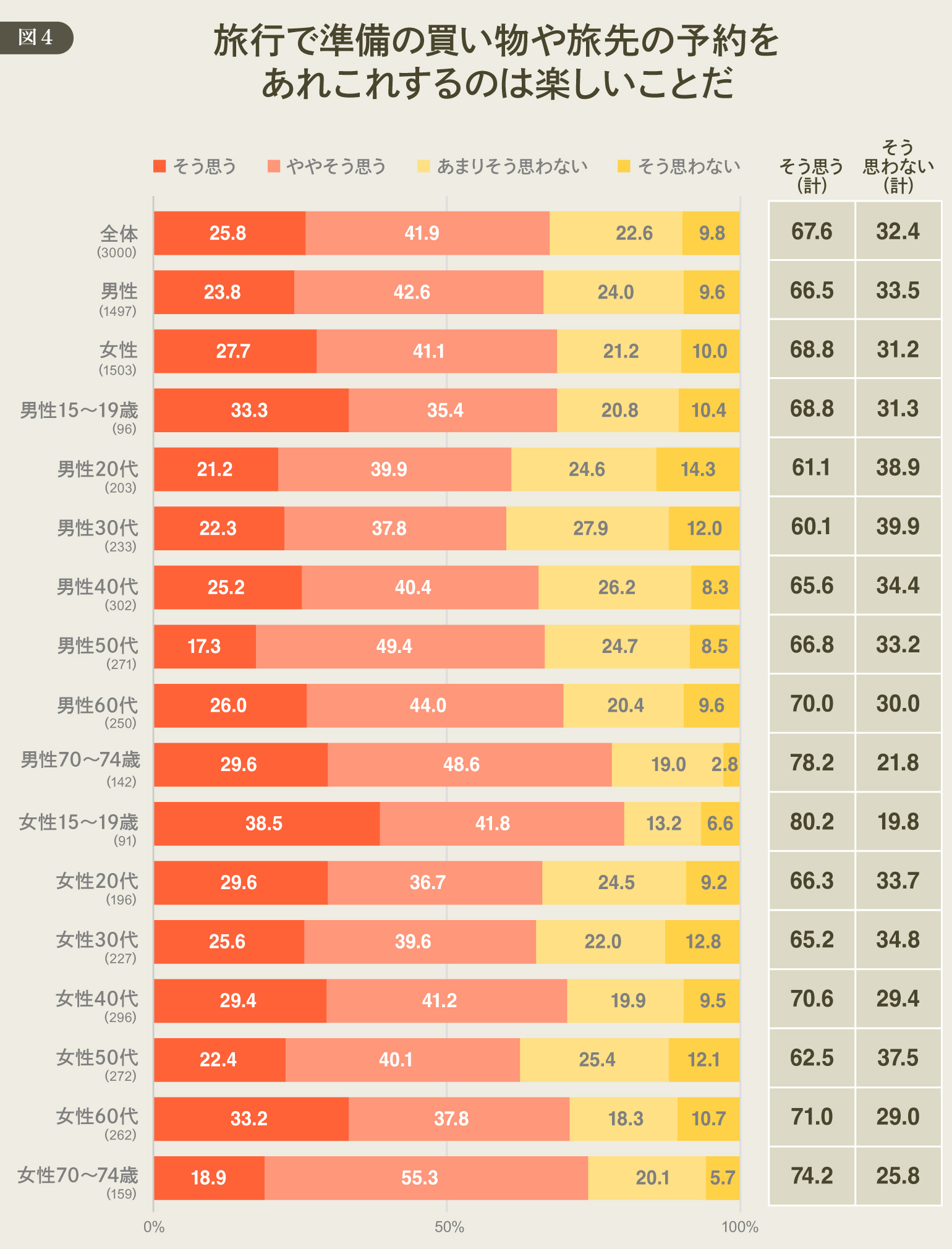
While 67.6% answered “I agree (total),” 32.4% answered “I disagree (total).” For this item as well, younger people in their 20s and 30s tend to be slightly less likely to agree. The hassle involved in the various preparations for travel may be one factor contributing to the often-cited trend of “young people turning away from travel” in recent years.
Looking at the trends across the four questions examined so far, it appears that today’s consumers do not particularly dislike making plans or making reservations. However, a slight tendency to dislike planning and making reservations is evident among younger people. While this may seem surprising given the time-saving mindset often associated with younger people, since the percentage for younger people does not exceed 50% on any of the items, it seems that, when considering the overall trend among this demographic, planning and reservations are not disliked.
What Kind of People Choose to “Wait in Line for a Long Time”?
So far, we’ve seen that modern consumers do not particularly dislike making plans or reservations. Generally, modern consumer trends are often elucidated by analyzing the majority—those who “make reservations”—but by examining the minority—those who “wait in line”—we may be able to uncover blind spots in society that have gone unnoticed until now. Furthermore, analyzing this minority can lead to new perspectives for the development of products and services.
Therefore, I’d like to examine the characteristics of the minority who choose to wait in line rather than make a reservation.
I’d like to delve deeper into the respondents in the “Advance Reservation Required” and “Long Wait” groups introduced earlier in [Figure 3]. Although the number of “Long Wait” respondents is somewhat small, we have secured a valid sample size, so it is possible to identify trends.
First, let’s look at the results of a cross-tabulation of the responses to the questions regarding reservations and scheduling—as asked in [Figures 1 and 2] and [Figure 4]—for the “Advance Reservation Camp” and the “Long-Line Camp” respectively.
Among the “Long-Line Camp,” there is a high tendency to agree with statements such as “I prefer to decide my daily plans based on how I feel that day” and “It’s a hassle to plan my schedule in detail,” while there is a low tendency to agree with “I enjoy shopping for travel essentials and making various reservations at my destination.” It seems they simply do not like planning their activities in the first place.
What Kind of Modern Desires Do “Long-Line Standers” Have?
Next, let’s examine differences by gender and age group.
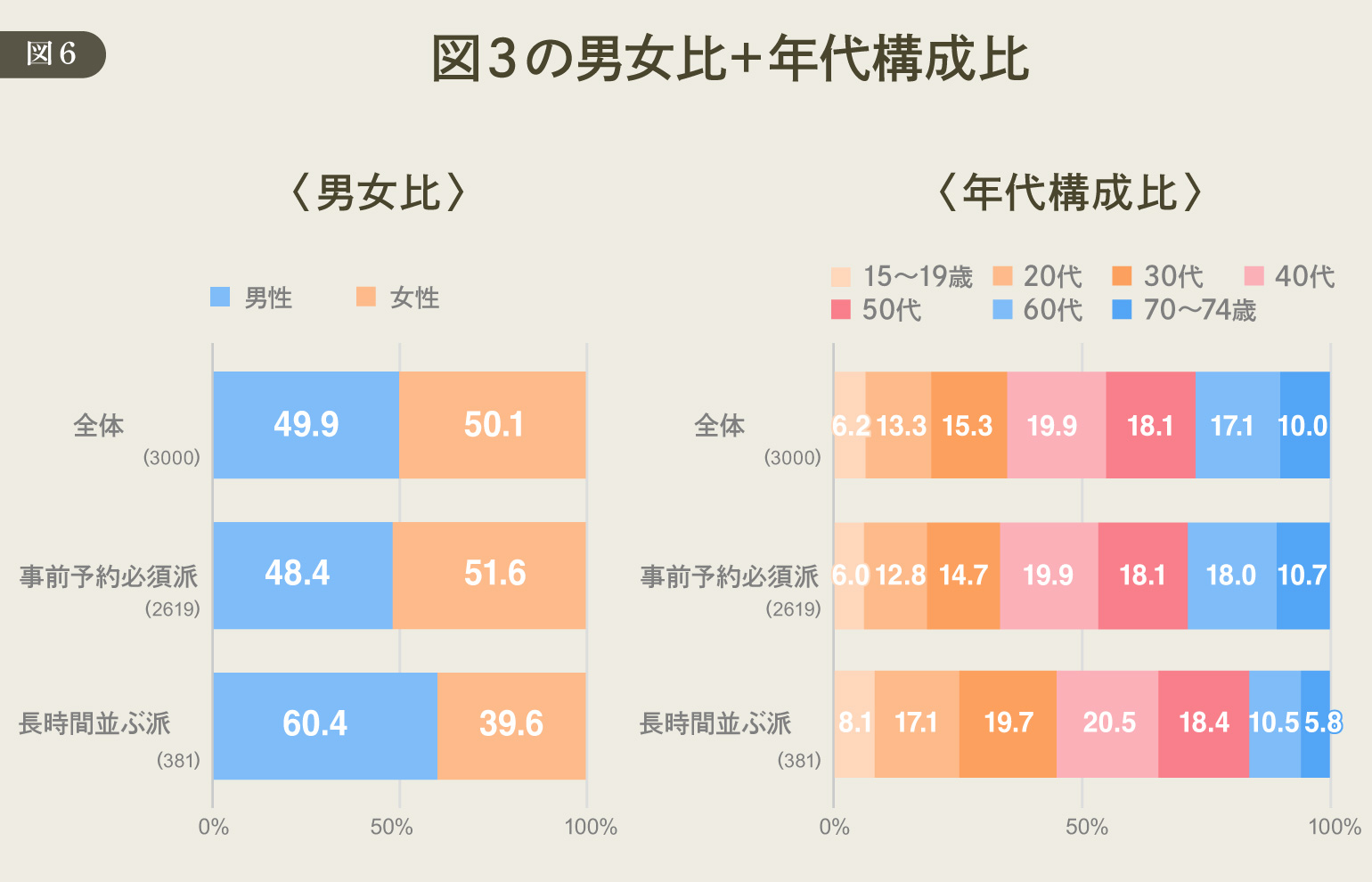
As we saw earlier, the “Long-Line Camp” has a slightly higher proportion of men than the overall group, accounting for 60%. The proportion of younger age groups is high, and among those in their teens through 30s, there is a gap of more than 10 percentage points compared to the “Advance Reservation Essential Camp.” Perhaps they are in the “Long-Line Camp” precisely because they have both the time and the stamina to wait in line.
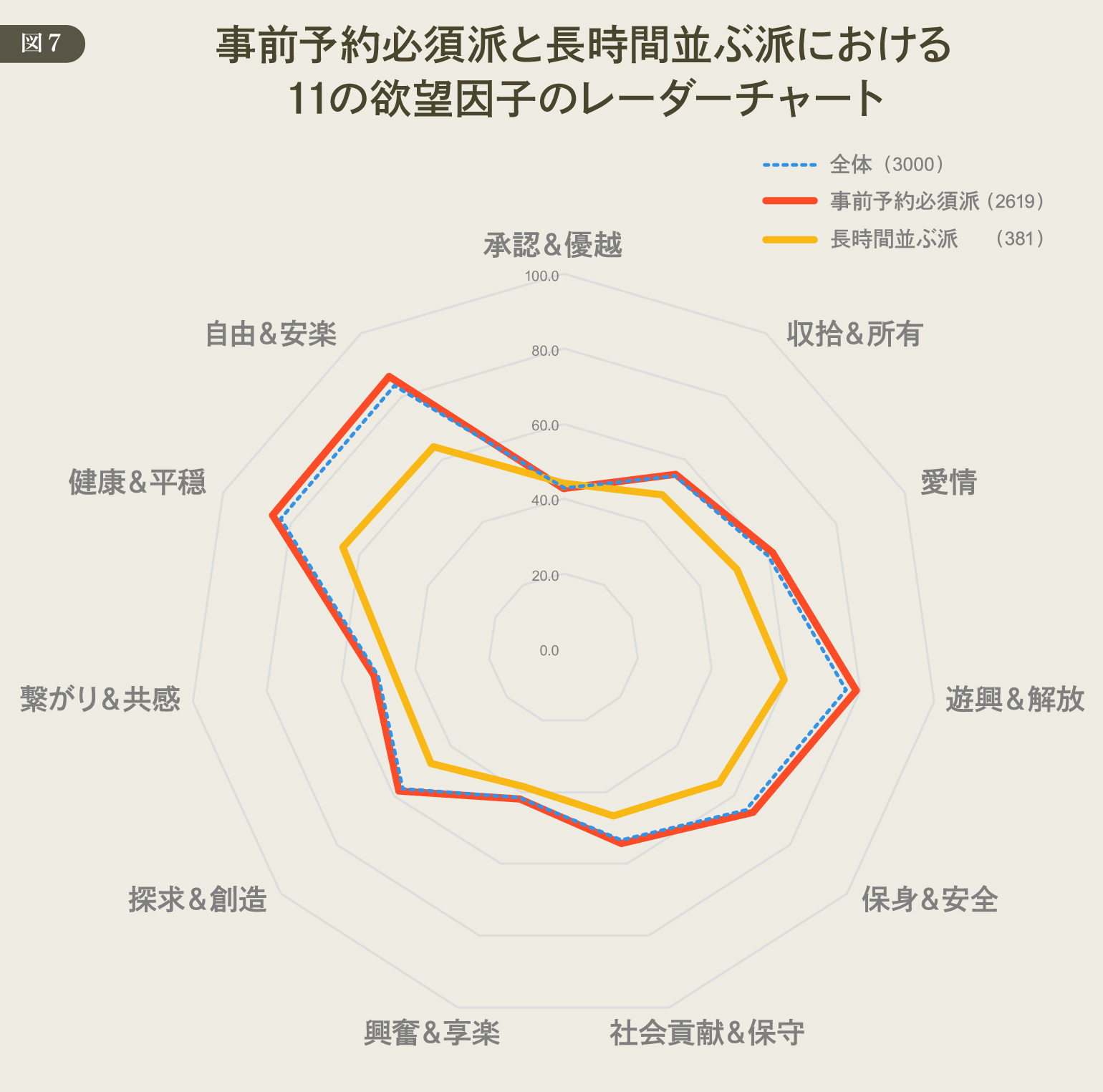
Furthermore, looking at the scores for the desire factors related to the “11 Desires” proposed by DDD (see [Figure 7]), we can see that, compared to the “overall” group and the “advance reservation required” group, the “long-line” group tends to have lower scores across the board—with the exception of “Recognition & Superiority.” Although not shown in the figure, since scores for these 11 desire factors tend to be higher among younger age groups in general, age does not appear to have much influence on the tendencies of the “long-line” group.
For more details on the “11 Desires,” please see here.
・“Naming New Desires” (Web Dentsu-ho)
・DENTSU DESIRE DESIGN Announces the 2024 Edition of the “11 Desires” That Influence Human Consumer Behavior
Furthermore, looking at the scores for the desire items underlying the 11 desire factors (see [Figure 8]), the “Long-Line Camp” significantly outperforms the “Advance Reservation Required Camp” in three items: “Want to influence or control others,” “Want status or privileges,” and “Want a sexy experience.”
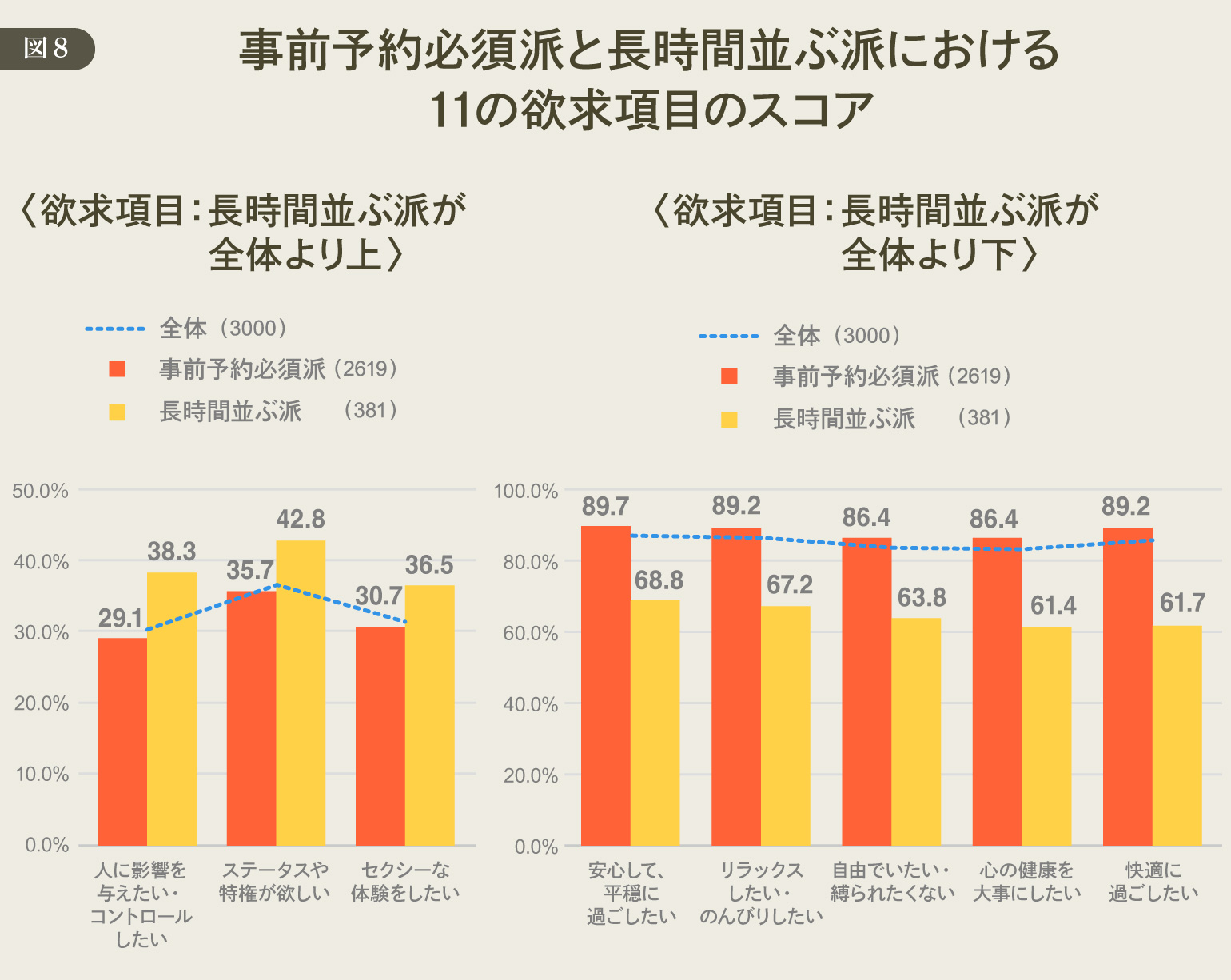
On the other hand, when examining the items where the “Long-Line Camp” scores significantly lower, we see items such as “Wanting to be comfortable,” “Wanting to prioritize mental health,” “Wanting to be free and not restricted,” “Wanting to relax and take it easy,” and “Wanting to live with peace of mind and tranquility.” Overall, it appears that the desire for a stable and secure life is low, while the desire to influence others is high.
This desire to influence others is also evident in the values category, as shown in [Figure 9].
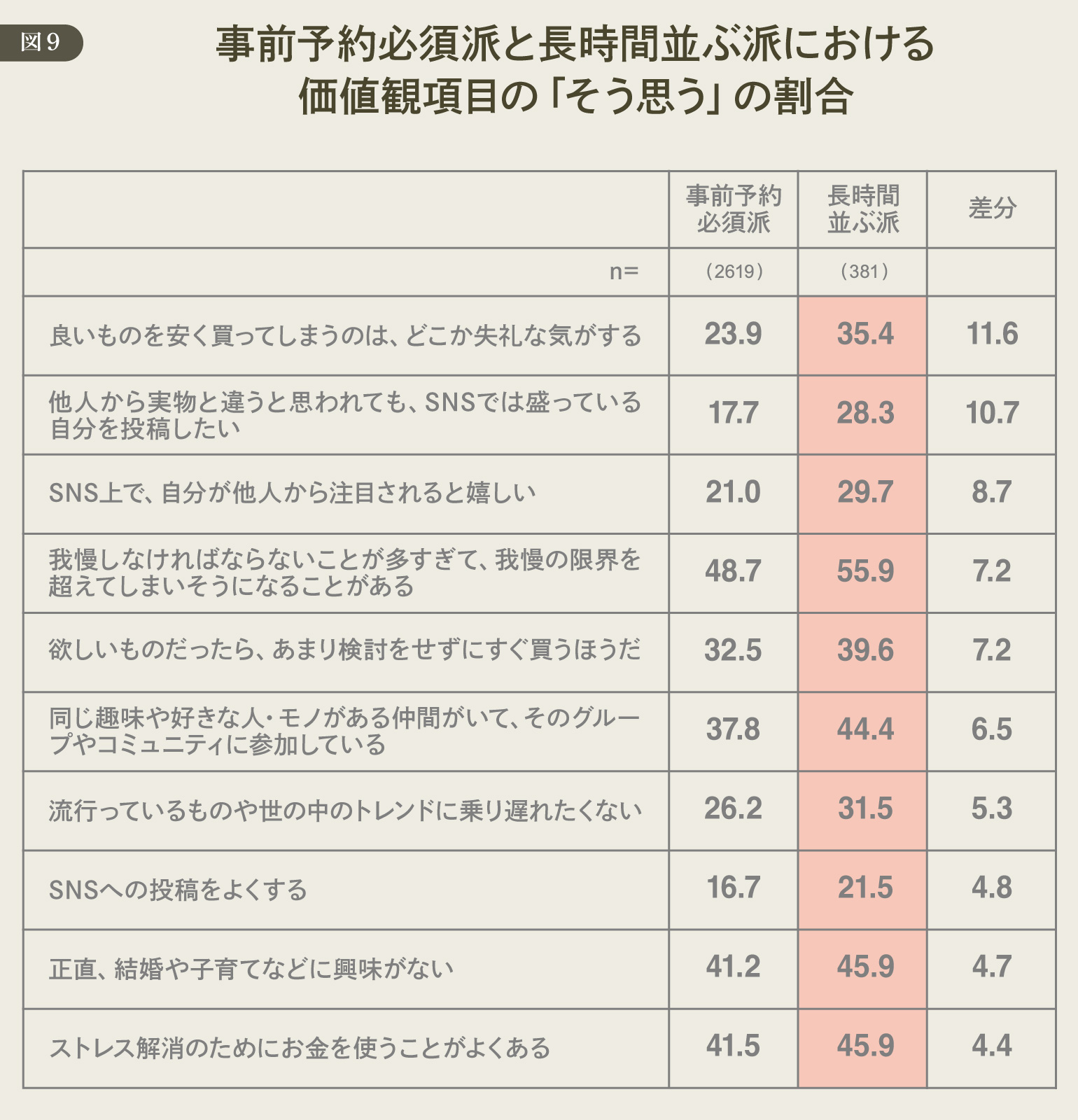
Looking at the values where the “long-line camp” significantly outnumbers the “advance-reservation-required camp,” many items related to the desire for validation on social media stand out.
● Even if others think it doesn’t match reality, I want to post a glamorous version of myself on social media
● I feel happy when others pay attention to me on social media
● Having friends who share the same hobbies or interests, and participating in those groups or communities
● I frequently post on social media
On the other hand, the following items were also cited in the consumption-related category:
● I feel it’s somewhat disrespectful to buy high-quality items at a low price
● If it’s something I want, I tend to buy it right away without giving it much thought
● I don’t want to fall behind on what’s popular or current trends
● I sometimes spend money to relieve stress
Considering these two tendencies together, it seems this group is the type that relieves stress by making impulse purchases or buying items that are the talk of the town, and then sharing those experiences. It may be that their consumption behavior itself has become a form of self-expression.
You also scored high on the item that states, “There are so many things I have to hold back on that I sometimes feel like I’m about to reach my limit.”
It’s an interesting point that, precisely because you’re honest with your inner impulses, you choose to wait for a long time rather than make a reservation in advance. Indeed, the concept of making a reservation is the furthest thing from impulse buying. At first glance, standing in line for a long time and impulse buying may seem like opposites, but in reality, they are two sides of the same coin—both stemming from the same desire.
Toward a Flexible Society That Embraces “Spontaneous Actions”
Looking solely at the number of respondents, the “long-line camp” accounts for only 10% of the total, so at first glance, this might seem like something that could be overlooked. However, the perspective changes when we view this behavior as one aspect of “impulse buying.”
In today’s society, where concepts like “value for money” and “time efficiency” have become the norm—and with the ongoing rise in prices—impulse buying is becoming increasingly difficult. That is precisely why preserving space in society for impulse buying and waiting in line contributes to our society’s flexibility and resilience.
If you see a long line forming in the city, why not take a moment to check what it’s for? If something that catches your eye is being sold, why not be flexible enough to try waiting in line just to see?
[Survey Overview]
〈Overview of the 11th “Survey on Consumption That Moves the Heart”〉
・Target Area: All of Japan
・Respondent Criteria: Men and women aged 15–74
・Sample Size: 3,000 respondents total (allocated according to population proportions across 7 age groups—15–19, 20s–60s, and 70–74—and 2 gender categories)
・Survey Method: Online survey
・Survey Period: November 7 (Fri) – November 12 (Wed), 2025
・Survey Sponsor: Dentsu Inc., DENTSU DESIRE DESIGN
・Survey Agency: Dentsu Macromill Insight, Inc.
Was this article helpful?
Share this article


Newsletter registration is here
We select and publish important news every day
For inquiries about this article
Back Numbers
Author

Yasuaki Matsumoto
Dentsu Inc.
第2マーケティング局
Principal Researcher