Note: This website was automatically translated, so some terms or nuances may not be completely accurate.
 DENTSU DESIRE DESIGN's Approach to Marketing Reconstruction Based on "Theory of Desire" [37/40]
"Kidult" Manifests in a New Form!? The Reconstruction of "Heisei-Era Girls'" Desires Becomes a Consumer Trend
Dentsu Inc. Desire Design (DDD) is an organization that develops various solutions and disseminates information based on the relationship between consumption and desire.
In this series, we analyze the “Emotionally Driven Consumption Survey” conducted periodically by DDD and share the insights and findings derived from the survey results.
This installment focuses on the relationship between “Kidults” (Kids × Adults)—adults who haven’t forgotten their “childlike spirit”—and the “Heisei-era Girls Boom.” DDD’s Yukito Kanazawa examines the characteristics of consumer behavior in the toy market, drawing on the results of the 11th survey conducted in November 2025 ( see here for survey overview ).
Has “Kidult” Become a Social Phenomenon!?
The “Heisei Girl Boom” Can’t Be Explained by Nostalgia Consumption Alone.
In the 26th article, we examined adult consumption of hobbies and games through the lens of the keyword “Kidult.”
In my view, the sense that “Kidult” was “seeping into” society at the time was often discussed in the context of relatively “masculine hobbies” like video games, plastic models, and trading cards. I suspect that the impression left by that article was strongly one of “men who retain a boyish spirit even as adults.”
Of course, I feel that this trend continues even now in 2026. However, there is another movement we must not overlook, one that I did not touch on last time. That is the “Heisei Girls’ Boom.”
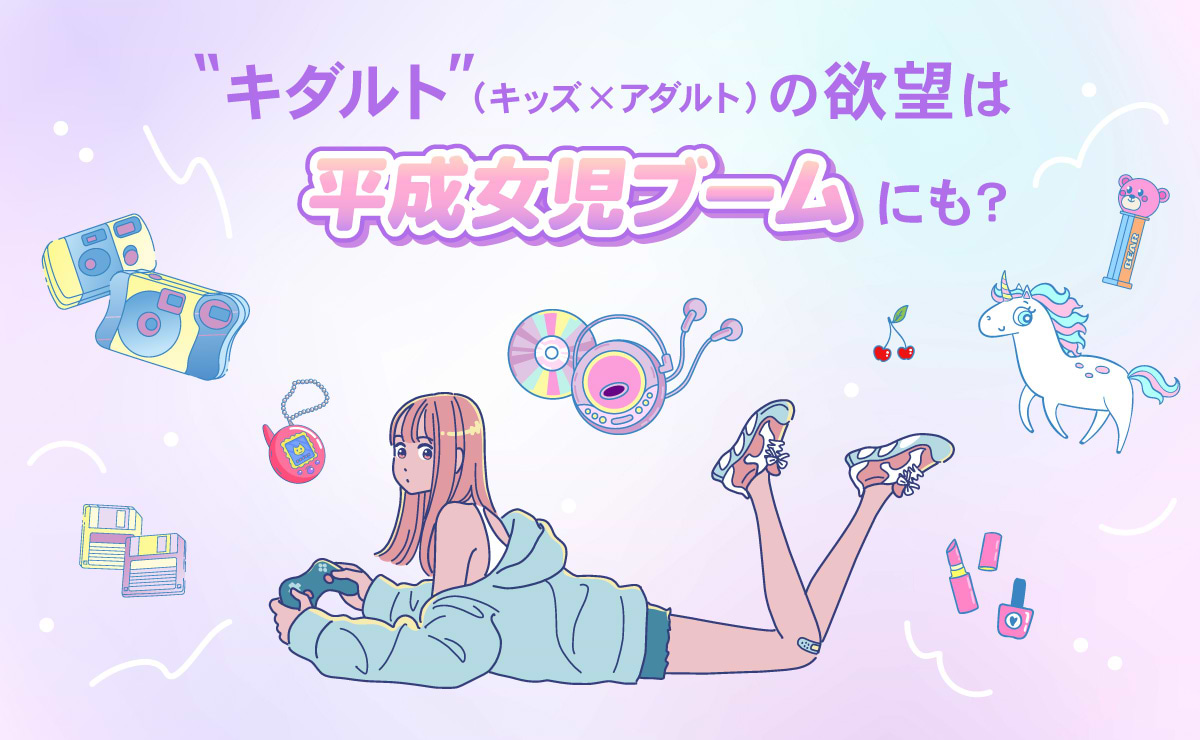
Playing nostalgic handheld simulation games. Collecting and trading Pukupuku stickers. Carrying cute dolls and character-themed accessories as charms.
I feel that an increasing number of women in their 20s and 30s are rediscovering and enjoying the worlds they loved during their elementary school years in the Heisei era, now through their own modern lens.
The key point of this boom is that they are “enjoying it anew.” If we view this not as mere nostalgia-driven consumption, but as a phenomenon where the desire for “kidult” culture has become visible primarily within women’s culture, it may begin to appear as a new set of values.
"Staying true to the things I loved as a child"
The “Heisei Girls Boom” is not a thing of the past, but an expression of values that is ongoing
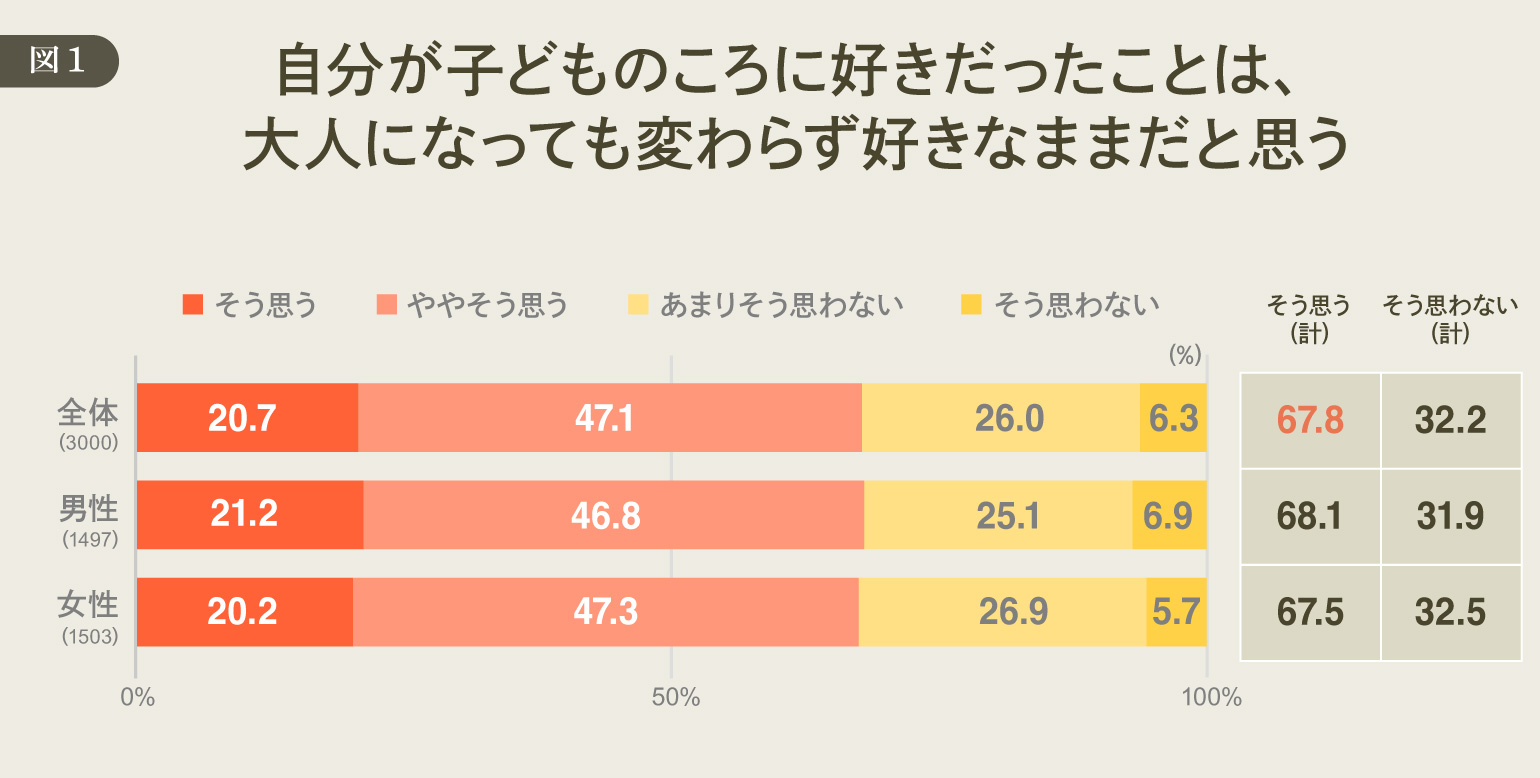
Interestingly, signs of the “Heisei Girl Boom” are also evident in DDD’s survey results. In response to the question, “Do you think the things you liked as a child remain the same even as an adult?”, the combined percentage of “Agree” and “Somewhat Agree” reached 67.8% overall. By gender, the figures were 67.5% for women and 68.1% for men, showing nearly identical levels.
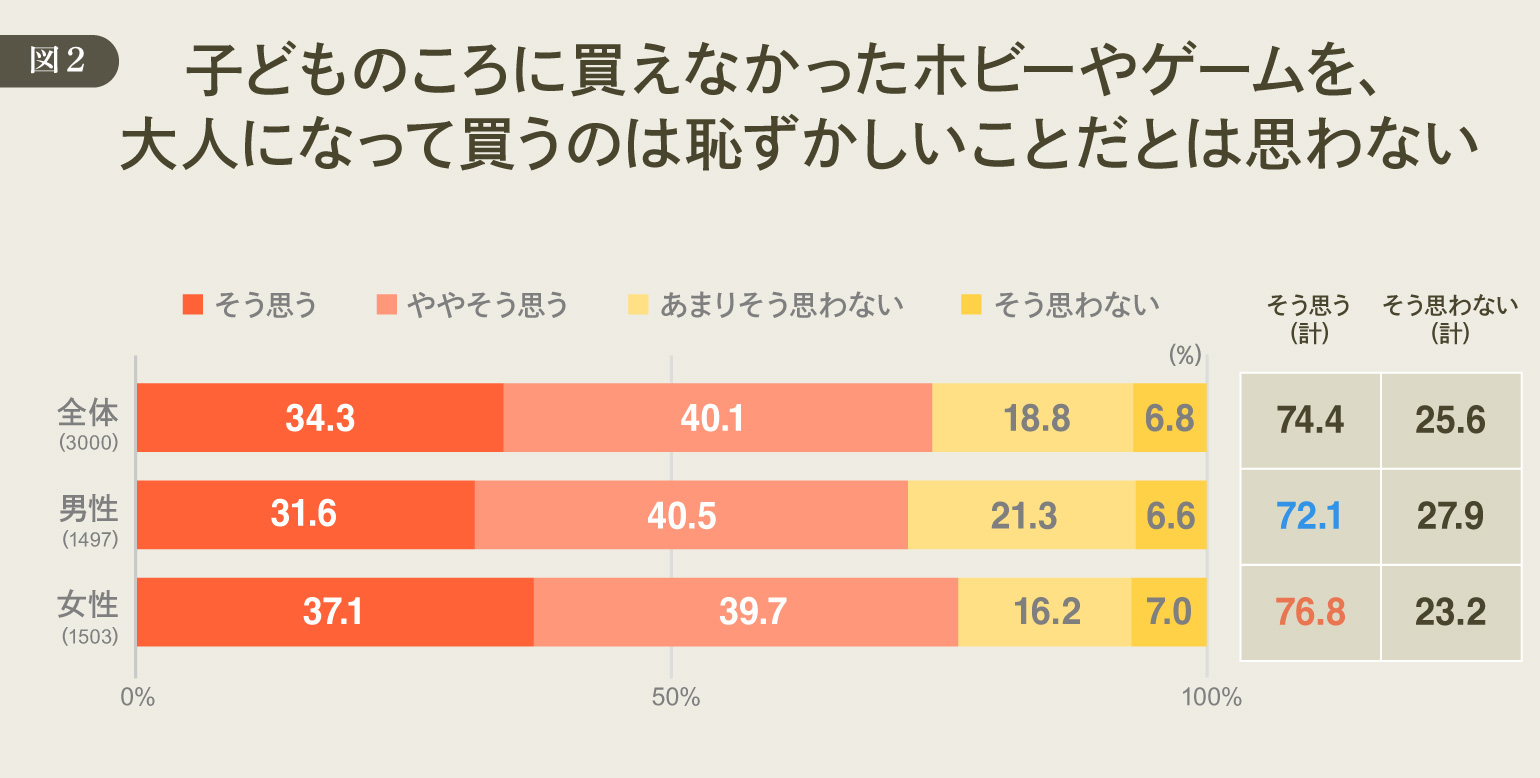
Furthermore, regarding the question, “I do not think it is embarrassing to buy hobbies or games as an adult that I could not afford as a child,” the “Agree” total for women was 76.8%, exceeding the 72.1% for men.
In the 26th article, the author defined “Kidult” in the context of “enjoying things with a childlike heart.” However, this concept has evolved, and today “Kidult” is increasingly being accepted as “remaining true to one’s own preferences—past, present, and future.”
I believe this shift is largely influenced by the ways people express themselves within the “culture of self-presentation” and “fan culture” unique to the social media era.
What is characteristic about the way the “Heisei Girls Boom” is being consumed is not simply “reproducing motifs from that era as they were” or “following the playstyles of that time exactly,” but rather that it is being re-edited and connected to new cultural trends.
For example,
・Using Pukupuku stickers not just for collecting or trading, but also for “decorating smartphone cases,” “decorating planners,” and “decorating trading card cases”
・Carrying around vintage handheld育成 games not just as games, but as “fashion accessories attached to bags”
・Wearing Y2K fashion not just as a recreation of the era, but by mixing it with Korean trends and "balletcore"
・Connecting vintage girls’ toys to “favorite idol colors” or “member colors” and turning them into merchandise for idol fandom
The list of examples goes on and on.
Furthermore, these new ways of engaging with these items are spreading not only among the generation that experienced them firsthand but also among younger people who didn’t experience them in real time.
In other words, the “Heisei Girl Boom” has evolved into a “consumption style that is currently in progress,” going beyond mere nostalgia-driven consumption.
Is the “Heisei Girls Boom” a backlash against cost-performance and time-performance?
A soothing escape found within irrationality
So, why has a segment of the “Kidult” demographic manifested as the “Heisei Girl Boom” right now?
This is just a hypothesis, but I believe the background involves a backlash against a daily life that is constantly becoming more efficient and demands constant decision-making. While the volume of information has exploded and we might expect choosing products and services to become more convenient, conversely, the number of people who find it difficult to make choices because they cannot process the vast amount of information—in other words, those suffering from “decision fatigue”—is on the rise.
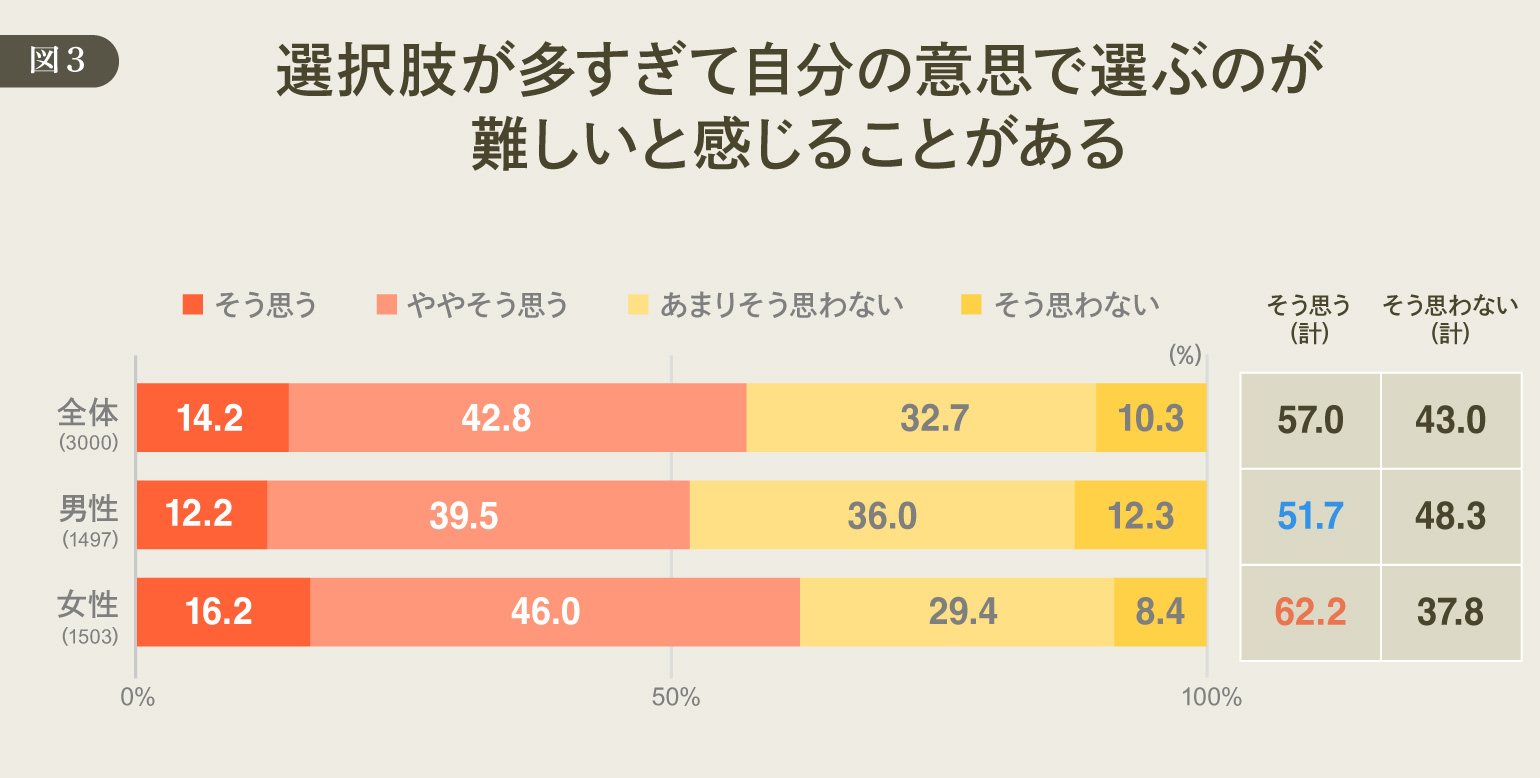
I get the impression this is particularly pronounced among women.
In this context, touching plump stickers, arranging character trinkets, and simply collecting things you find “cute”—immersing yourself in enjoyment by following your inner “origin”—may seem irrational at first glance in a modern world obsessed with time efficiency and cost-effectiveness. However, in reality, doesn’t this function as “time to reexamine what is truly important to oneself”?
Practicality aside, isn’t it okay to have things where the feeling of “liking” takes priority? Now that we’re adults, perhaps by picking up such items again, we’re regaining the “sense of being able to say we truly like something.”
The rapidly evolving concept of “Kidult” is expanding to encompass a wide range of values
Until now, the term “Kidult” has primarily evoked male-oriented hobbies such as video games, figurines, robots, and collectibles. However, a similar trend is now emerging in women’s hobbies. This can be seen as an expansion of the values and desires associated with the “Kidult” phenomenon.
In other words, regardless of gender, people are beginning to reinterpret these hobbies in line with current values, while never forgetting to “remain true to what they love—past, present, and future.” The results of this reinterpretation extend beyond toys into various fields, including fashion, lifestyle goods, entertainment, spatial design, and social media communication.
In the past, toys were seen as something for children, and becoming an adult was viewed as graduating from childhood. But now, people are growing up while continuing to hold onto the things they loved. In fact, that allows them to be more true to themselves. The spread of the “Kidult” desire and the “Heisei Girl” boom may symbolize this new perspective on maturity.
[Survey Overview]
〈Overview of the 11th "Emotionally Driven Consumption Survey"〉
・Target Area: All of Japan
・Eligibility: Men and women aged 15–74
・Sample Size: 3,000 respondents total (allocated according to population demographics across 7 age groups—15–19, 20s–60s, and 70–74—and 2 gender categories)
・Survey Method: Online survey
・Survey Period: November 7 (Fri) – November 12 (Wed), 2025
・Survey Sponsor: Dentsu Inc., DENTSU DESIRE DESIGN
・Survey Agency: Dentsu Macromill Insight, Inc.
Was this article helpful?
Share this article


Newsletter registration is here
We select and publish important news every day
For inquiries about this article
Back Numbers
Author
Yukito Kanazawa
Dentsu Inc.
Planner