Note: This website was automatically translated, so some terms or nuances may not be completely accurate.
 DENTSU DESIRE DESIGN's Approach to Marketing Reconstruction Based on "Theory of Desire" [40/40]
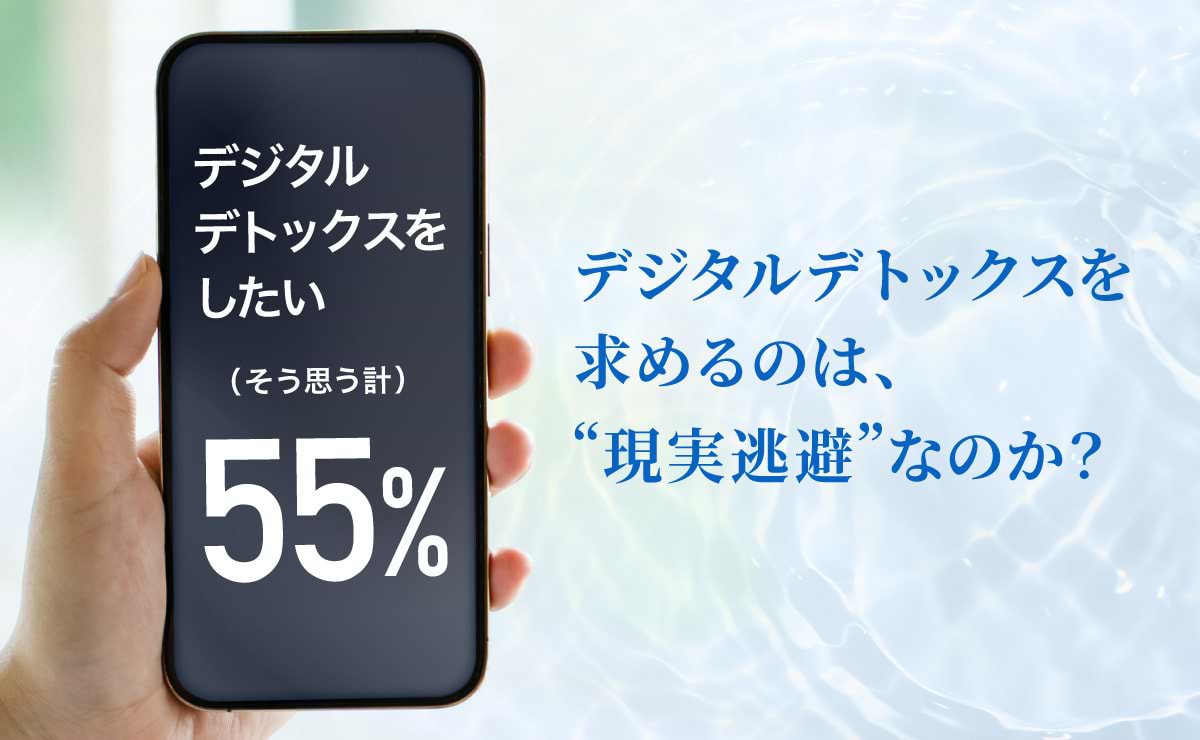
A majority of Japanese people are seeking a “digital detox”
Dentsu Inc. Desire Design (DDD) is an organization that develops various solutions and disseminates information based on the relationship between consumption and desire.
In this article, we analyze DDD’s “Survey on Consumption That Moves the Heart” ( see here for a survey overview ) and present the insights and findings derived from the results. Based on the results of the 12th survey conducted in May 2026, Takashi Chiba of DDD examines the findings under the theme of “Digital Detox and Reality.”
<Table of Contents>
▼55.0% of people “want to spend time away from digital devices”
▼The fear of “facing reality” tends to be more prevalent among younger people
▼ Is There a Connection Between the Desire for Digital Detox and the “Fear of Facing Reality”?
▼The reasons people seek a digital detox are not uniform
55.0% of People Want to Spend Time Away from Digital Devices
“I’d like to spend at least a little time without touching my smartphone.” Many people have probably thought this at least once. Just as the term “digital detox” has become widespread, in today’s “always-connected society,” there are surely quite a few people who want to have “time away from digital devices that provide information.”
In response to the question, “Do you want to spend time away from digital devices (digital detox)?,” “Agree (total)” (the combined total of “Agree” [18.6%] and “Somewhat agree” [36.4%]) accounted for 55.0% of the total.On the other hand, only 12.6% answered “No.” These results show that, at the very least, a majority of Japanese people feel there is a need for “digital detox.”
Now, what kind of image do you have of this “digital detox”? Is it about stepping away from the digital world and turning your attention to the real world? Or is it an image of escapism—a desire to look away from “content that confronts you with reality,” particularly on social media?
The fear of “facing reality” tends to be more common among younger people
In response to the question, “Are you afraid to face reality?”, 47.2% of the total respondents answered “Yes (total)” (the combined total of “Yes” [13.0%] and “Somewhat yes” [34.2%]). When broken down by gender and age group, this trend is particularly noticeable among younger men and women.
In particular, among both males and females aged 15–19, the percentage of those who “agree” exceeded 30%, suggesting a significant difference based on age. Looking at other age groups, from those in their 30s to those in their 70s, the percentage of those who “agree” tends to decrease with age, indicating a correlation with age.
When examining the differences in the “11 Desires” held by those who “agree” and those who “disagree” with the statement “I’m afraid to face reality,” the results are shown in Figure 3.
■ For more details on the “11 Desires,”please clickhere.
・“ We’re giving names to new desires.” (Web Dentsu-ho)
・DENTSU DESIRE DESIGN Announces the 2024 Edition of the “11 Desires” That Influence Human Consumption Behavior
Overall, people who feel “it’s scary to face reality” tend to score higher on all 11 desires. The difference is particularly pronounced for the following desires (factors):
- Wanting to be recognized by others and seen as superior ⇒ “Recognition & Superiority”
- Not wanting to stand out in a bad way or be an outlier ⇒ “Self-Preservation & Safety”
- Wanting to have fun and spend money as one pleases ⇒ “Recreation & Liberation”
- Wanting to collect things I like and immerse myself in my passions ⇒ “Collecting & Immersion”
It may be that precisely because people feel such strong anxiety about reality, their desires—such as “wanting to be recognized by others,” “wanting a safe place,” and “wanting to immerse themselves in something to feel temporarily liberated”—become so intense. The desire to escape reality can be viewed not merely as “escapism,” but rather as a desire to maintain one’s own emotional balance.
Is There a Connection Between the Desire for a Digital Detox and the “Fear of Facing Reality”?
Now, let’s examine the data using a four-quadrant chart with the X-axis representing “Wanting to spend time away from digital devices (digital detox)” (Agree/Disagree) and the Y-axis representing “Fear of facing reality” (Agree/Disagree).
The “Fear of Reality × Digital Detox Intention” segment—those who answered “Agree” to both questions—accounted for 29.1%, while the “Acceptance of Reality × Digital Affinity” segment—those who answered “Disagree” to both—accounted for 26.9%.
The “Fear of Reality × Digital Affinity” segment—those who are “afraid to face reality” but do not desire a “digital detox”—accounted for 18.1%, while the “Pure Digital Detox Intention” segment—those who are “not afraid to face reality” and desire a “digital detox”—accounted for 25.9%.
These results suggest that while there is a “statistically significant correlation,” the “association is not particularly strong.” In other words, while the trend shows that people who find “facing reality” frightening are more likely to want to “go on a digital detox,” this group—though growing—remains a relatively small minority.
However, it is important to note that what “reality” actually refers to varies from person to person.
For some people, “reality” may refer to the analog, real-world environment of family, friends, and work. On the other hand, for those who interact with social media daily via their smartphones, the lives and opinions of others they see there, as well as social events, may also have become part of their “reality.”
When viewed this way, a digital detox isn’t necessarily an act of distancing oneself from reality. Rather, it can be seen as a way to temporarily distance oneself from the “reality one doesn’t want to see” that flows into one’s smartphone. A key perspective when considering these results is that the very definition of “reality” is changing depending on generation, values, and how people engage with digital technology.
Given that all four quadrants account for a significant percentage of the total, in the next section, we will examine the differences and commonalities among them.
The reasons people seek a digital detox are not uniform
Let’s examine the four types by highlighting the differences observed across several survey questions.
When comparing the four types, the first thing that stands out is the characteristics of the two groups that feel “afraid to face reality.” The percentage of respondents who answered that “dealing with the digital world brings me more peace of mind than dealing with reality” reached approximately half in both the “Afraid of Reality × Intends to Do a Digital Detox” group (51.9%) and the “Afraid of Reality × Digital-Affinity” group (52.3%).
In contrast, among the two groups that do not feel “afraid to face reality,” this figure remains around 25%. It may be that there is some connection between “how one feels about facing reality” and mental peace in the digital space, even more so than whether or not one desires a digital detox.
Conversely, among the “Pure Digital Detox Intention” segment, 71.5% said they “consider themselves happy,” 81.9% said they “value real-life experiences over simulated ones,” and 70.4% said they “set aside time in their daily lives to reflect on themselves”—all significantly higher than in other groups.Based on these results, it seems that the desire to distance oneself from digital media does not stem solely from “anxiety about reality,” as mentioned earlier. It is likely that some people consciously try to distance themselves from digital media in order to value real-life experiences and time for self-reflection.
Even among those who express a desire to “go on a digital detox,” there are those who want to disconnect from digital media because they “fear facing reality,” while others seek time away from digital media despite having relatively little fear of reality. Considering this, simply viewing a digital detox as either a “return to reality” or an “escape from reality” may not fully capture consumers’ actual experiences.
In a previous article, we presented the perspective that “analog and digital are not a binary opposition.” The differences in how the term “reality” is perceived, as revealed by this survey, seem to be an extension of that idea. Just as the boundary between analog and digital is becoming blurred, isn’t the definition of “what constitutes reality” also becoming less uniform?
A digital detox may not be a simple act of “stepping away from the digital world to return to reality,” but rather an effort to adjust one’s own relationship with multiple versions of “reality.”
For companies in the digital sector as well, it may become increasingly important in the future to design services that allow consumers to proactively choose both “time spent connected” and “time spent disconnected,” rather than simply aiming to increase usage time of their own services. It appears that consumers’ desires are not solely directed toward constant connectivity but are also shifting toward a desire to pause from time to time and selectively engage with both reality and the digital world in their own way.
[Survey Overview]
〈Overview of the 12th “Survey on Consumption That Moves the Heart”〉
・Target Area: All of Japan
・Respondent Criteria: Men and women aged 15–74
・Sample Size: 3,000 respondents total (allocated according to demographic proportions across 7 age groups—15–19, 20s–60s, and 70–74—and 2 gender groups)
・Survey Method: Online survey
・Survey Period: Tuesday, May 12, 2026 – Sunday, May 17, 2026
・Survey Sponsor: Dentsu Inc., DENTSU DESIRE DESIGN
・Survey Agency: Dentsu Macromill Insight, Inc.
Was this article helpful?
Share this article


Newsletter registration is here
We select and publish important news every day
For inquiries about this article
Back Numbers

Author

Takashi Chiba
Dentsu Inc.
第4マーケティング局
Producer
Exploring Pathways from the "Quality of Society Survey" to a "Society" Where People Find Meaning in LifeCurrent State of Public Awareness and Values as Seen in the "Quality of Society Annual Survey 2021"DENTSU DESIRE DESIGN's Approach to Marketing Reconstruction Based on "Theory of Desire"The starting point is "desire"; product development that moves the heart