
Note: This website was automatically translated, so some terms or nuances may not be completely accurate.
What Are People Aged 45 and Older Watching on YouTube? Three Rules for Driving Purchases

Aya Yamakawa
Dentsu Inc.

Tomoko Sano
Ebily Co., Ltd.

Did you know? Amid ongoing concerns about Japan’s declining birthrate and aging population, one in every two people in Japan is now 50 or older.
Digital media—which has long been regarded as the go-to channel for reaching younger audiences—is now seeing a dramatic surge in viewership among middle-aged and older adults.
Of particular note is YouTube viewing among the middle-aged and senior demographic aged 45 and older. Among all content platforms, YouTube has the highest viewership rate among this demographic.
Consequently, Influencer Terminal—a specialized team within Dentsu Inc. focused on influencers—and Ebily, which supports corporate video strategies through distribution and analysis, jointly analyzed YouTube viewing trends among those aged 45 and older ( click here for the survey overview).
The survey utilized “kamui tracker,” one of Japan’s largest YouTube data analysis tools developed by Ebily. The results revealed that this generation consists of what could be called “digital middle-aged and seniors”—a group characterized by a particularly strong desire to learn and an active participation in posting comments.
YouTube functions as an extremely “active and economically valuable” medium that directly addresses the challenges and desires of this demographic, opening up new possibilities.
In this article, Aya Yamakawa of Dentsu Inc. and Tomoko Sano of Ebily explain the “Strategies for Reaching Digital Middle Seniors”—insights derived from the analysis that can be leveraged in marketing activities.
“5 Types of Content” That Capture the Desire for Self-Actualization
We found that the value middle-aged and senior viewers aged 45 and older seek on YouTube goes beyond mere category boundaries and can be summarized into the following five “pillars” that address psychological and emotional needs.
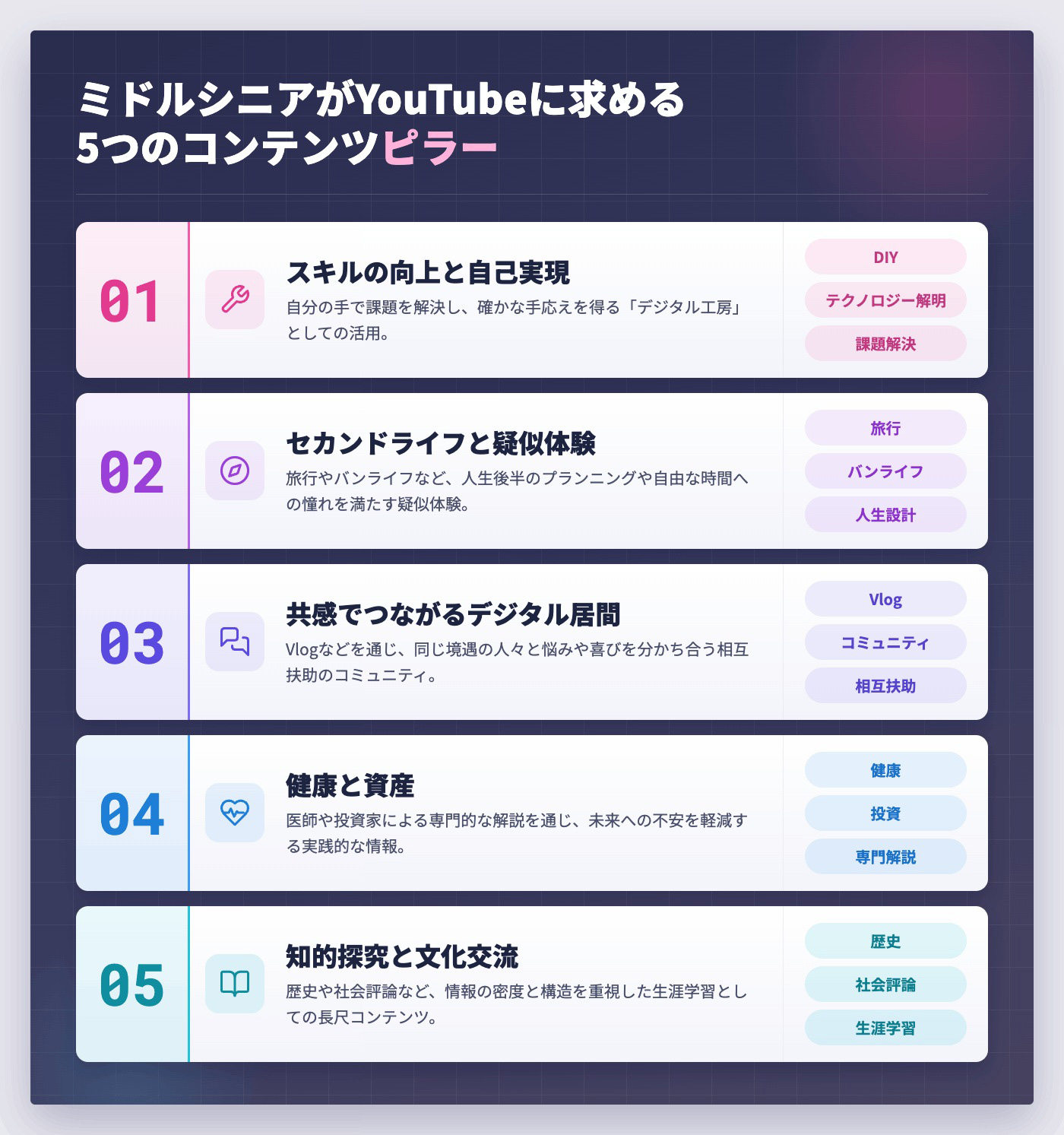
01 “Skill Development and Self-Actualization”: Using YouTube as a “digital workshop” to solve problems with one’s own hands—such as through DIY projects or exploring technology—and gain a tangible sense of accomplishment.
02 “Second Life and Virtual Experiences”: This involves research for planning the second half of life—such as travel and van life—as well as virtual experiences that satisfy the longing for free time.
03 “A Digital Living Room Connected by Empathy”: Through vlogs and other means, there are mutual-aid communities where people in similar circumstances share their worries and joys.
04 “Health and Wealth”: Practical information provided through expert commentary by doctors and investors is crucial for alleviating anxiety about the future.
05 “Intellectual Exploration and Cultural Exchange”: Long-form content focused on lifelong learning—such as history and social commentary—that emphasizes the density and structure of information is highly favored.
What these types of content have in common is not merely information, but the creators’ “real-world wisdom based on experience.” It can be said that viewers place unwavering trust in creators, viewing them as “approachable mentors.” Additionally, there was a noticeable tendency for viewers to perceive YouTube channels as a place where they can feel a sense of belonging.
What’s the Difference Between Young People and Middle-Aged and Senior Adults?
Next, we’ll explore the differences between younger audiences and middle-aged and older adults. Their “expectations” of YouTube differ significantly. While younger audiences prioritize entertainment in digital spaces—such as VTubers and game commentary—and a sense of belonging to fan communities, middle-aged and older adults focus on whether the content “directly relates to real-life experiences and learning.”
To put this difference in a nutshell: young people prioritize “who is speaking,” while middle-aged and older adults prioritize “what is being said.”
Since younger audiences base their viewing habits on empathy toward the creators themselves and fan psychology, viewers tend to follow creators even when they try out a variety of new concepts. This is likely one reason why “try-it-out” projects are popular among younger audiences. On the other hand, middle-aged and older viewers begin watching out of interest in the topic itself. As a result, it is not uncommon for highly specialized niche channels to gain stronger support than large-scale entertainment channels.
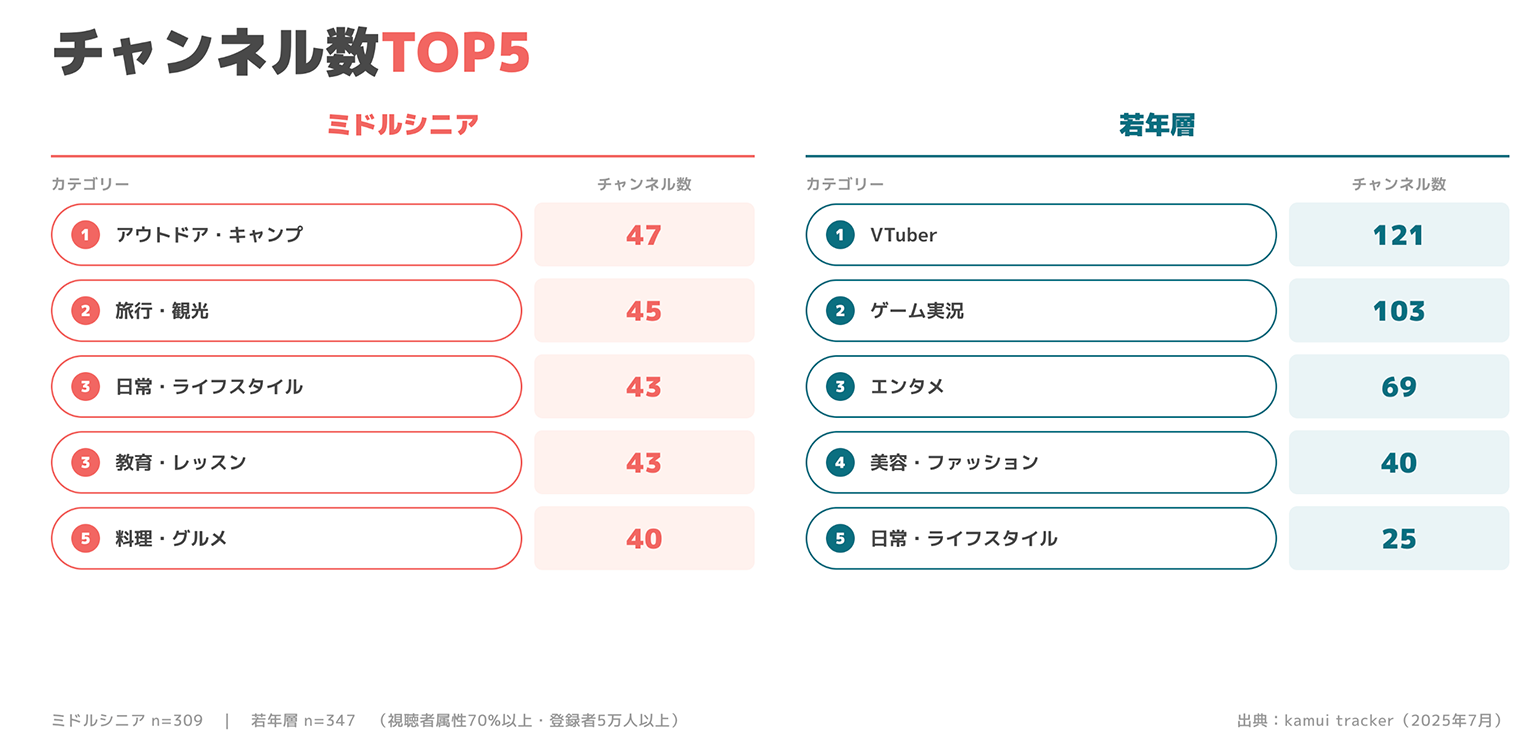
For example, the table above categorizes the channels preferred by middle-aged and senior audiences and younger audiences by genre and tallies the number of channels in each category. Younger audiences tend to prefer formats unique to YouTube, such as VTubers and game playthroughs. In contrast, the channels frequently viewed by middle-aged and senior audiences are notable for their focus on hobbies and learning.
From an advertising and marketing perspective, this difference is extremely important. To reiterate, in campaigns targeting younger audiences, the influencer’s personal popularity determines the results, whereas in campaigns targeting middle-aged and older adults, “what topics are covered and how deeply they are discussed” determines the results.
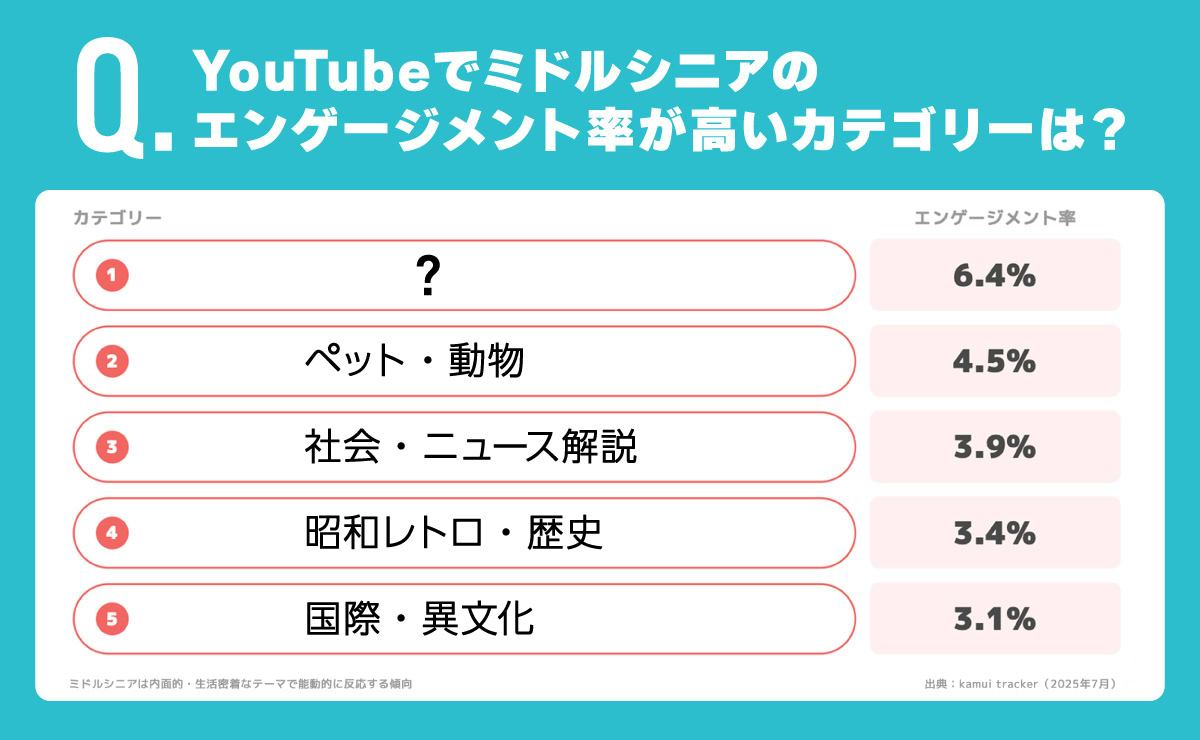
Furthermore, engagement rates are particularly interesting.
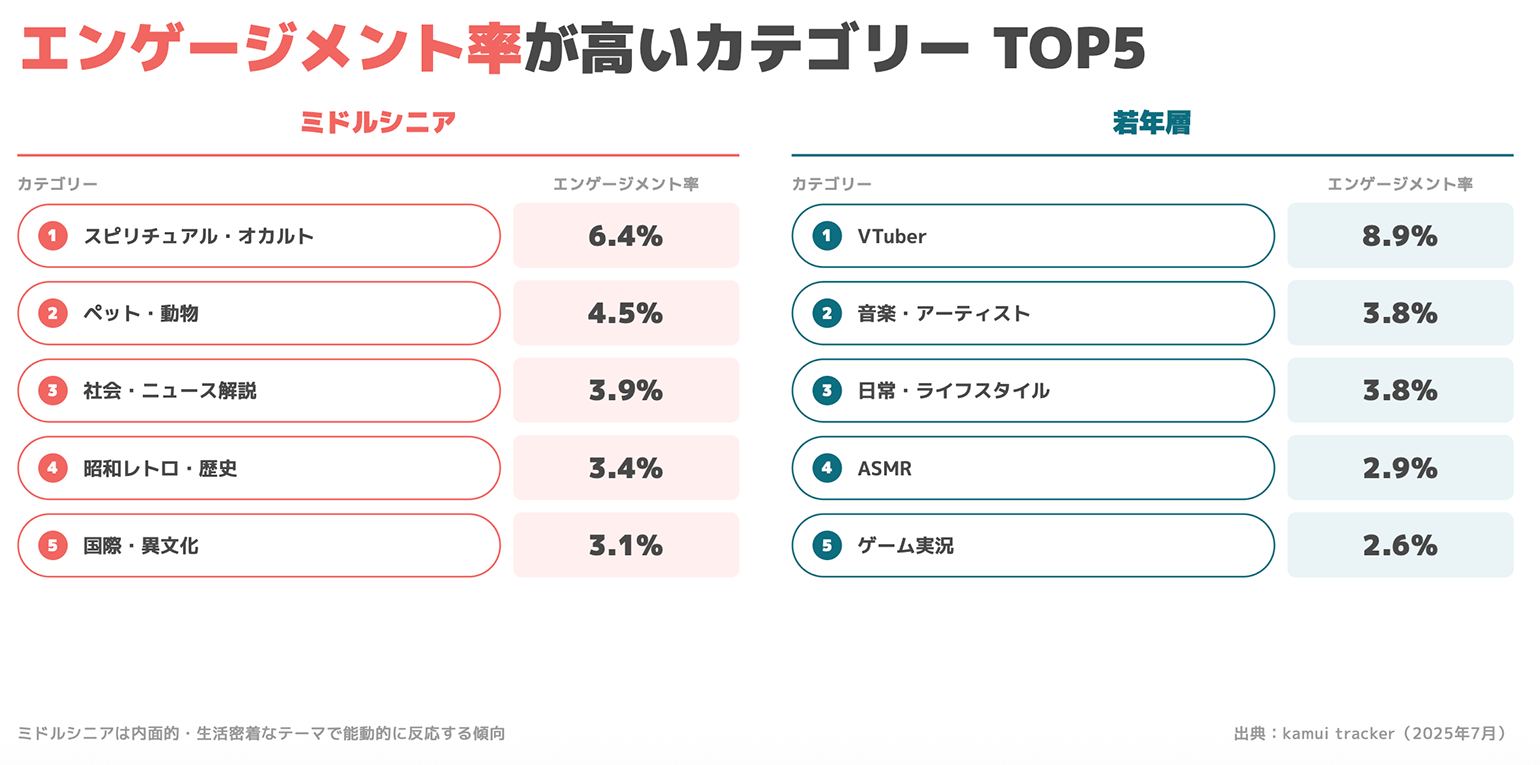
Among middle-aged and older viewers, the highest engagement rates are seen in Spirituality & the Occult (6.4%), Pets & Animals (4.5%), and Social Issues & News Analysis (3.9%). This suggests that, in addition to educational content, they are drawn to topics like spirituality and the therapeutic value of pet videos. In contrast, among younger audiences, VTubers stand out with a top engagement rate of 8.9%, and overall, they tend to engage more with content that has a strong entertainment focus.
When planning sponsored posts targeting middle-aged and senior audiences, it is important—unlike with younger demographics—to carefully assess not only subscriber counts or trending accounts but also the compatibility of the content with the target audience’s interests.
Deep Engagement Reflected in the Comments Section
An interesting difference is also evident in the “comments section,” which reflects the viewers’ enthusiasm. When comparing videos in the same category (apparel), comments from younger audiences consist mainly of short, one-sentence impressions such as “cute” or “this is helpful.” In contrast, comments from middle-aged and older adults are surprisingly long and specific.
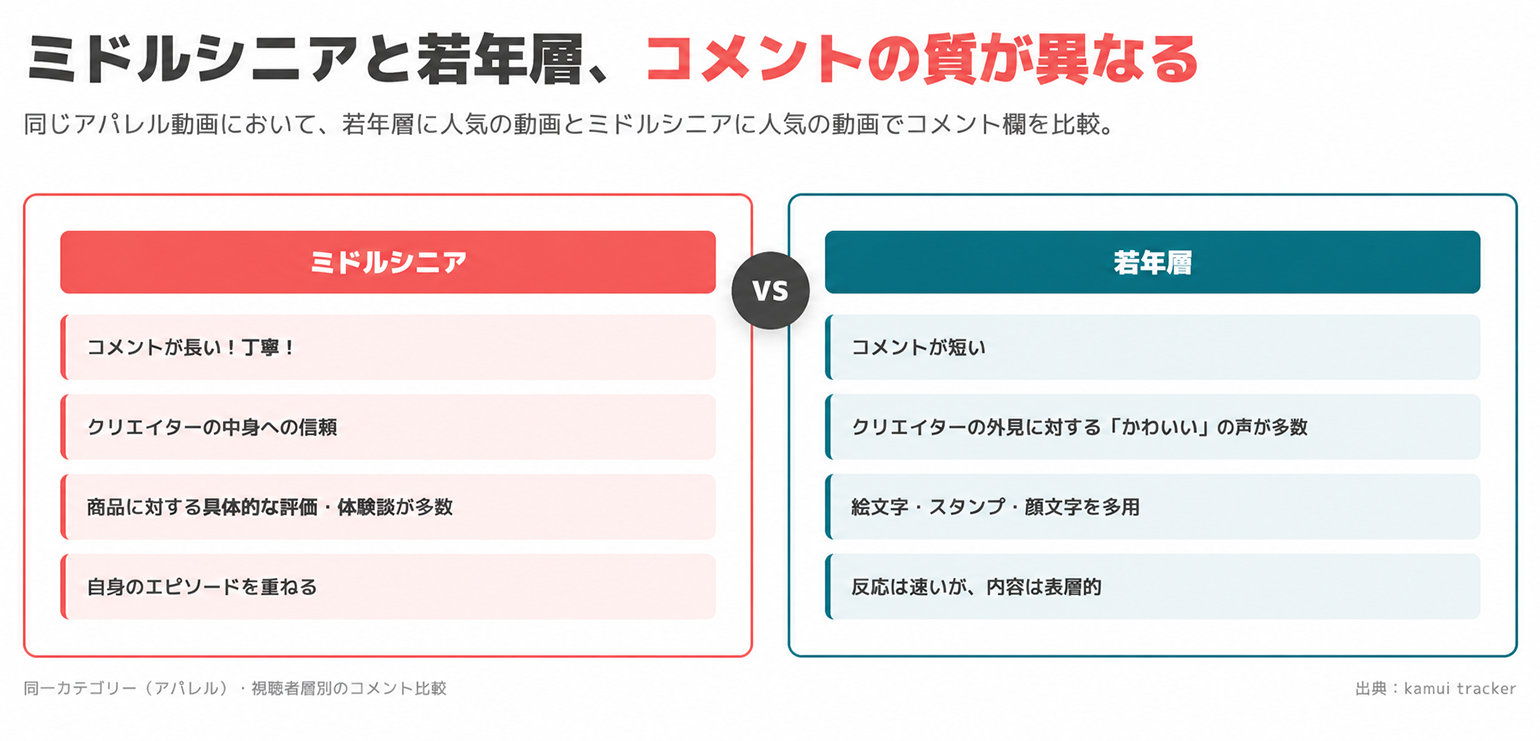
It’s not uncommon for them to go beyond simply sharing their thoughts on the video to discussing their own experiences, life stories, and even past events.
For example, in a video about jewelry remodeling, viewers share specific personal details such as, “I have a ring I inherited from my mother,” “This made me want to seek advice myself,” or “I don’t have the courage to go to a store.” These aren’t mere impressions; they’re using the video as a starting point to share their own life stories.
In other words, the comment section for middle-aged and senior viewers is also a treasure trove of consumer insights. What resonated with them? What concerns do they have? What kind of future are they envisioning? These aspects are visualized in extremely high detail.
For marketers, the comments section may be a place to view not merely as an engagement metric, but as “research data for understanding consumers’ lives.”
It is precisely this passion that leads directly to purchasing behavior.
From “Watch and Forget” to “Action-Driven” Design
For middle-aged and senior viewers, YouTube isn’t just a medium where they passively watch for entertainment and then move on. It’s a medium that goes a step further—one where they actively learn, empathize, write thoughtful comments, sometimes interact with other viewers, and can even be expected to convert.
Based on this analysis, I’ve summarized three principles for driving purchases among middle-aged and senior consumers.
Principle 1: “Creator Selection”
Creators with deep specialized knowledge who embody experiences that middle-aged and senior viewers would rarely have the chance to experience themselves are capturing their hearts. Rather than selecting creators based solely on trends or subscriber counts, we recommend creators with expertise that earns the trust of this demographic.
Principle 2: “Content Selection”
Middle-aged and senior audiences have two major areas of interest: “health” and “assets.” While content addressing these issues is essential, the key to content creation lies in a context that “can enrich the rest of their lives”—such as ways to enjoy hobbies and stories that evoke empathy.
Rule 3: “Opening the Comments Section”
A defining feature of the comment sections for middle-aged and senior audiences is that comments from peers facing similar challenges provide “encouragement.” Since they can receive endorsements from other buyers and even negative opinions are valued as authentic feedback, keeping the comment section open can lead to higher conversion rates.
Isn’t the middle-aged and senior demographic watching YouTube a market that hasn’t yet been seriously tapped? On YouTube, comments from this demographic tend to be longer and more thoughtful than those from younger audiences, and they often contain elements that are more likely to lead to purchases.
For middle-aged and senior viewers, the key is to select trustworthy creators, deliver content that resonates with their lives, and ignite a sense of community. This approach transforms viewing that “ends with just watching” into an experience that “leads to action.” YouTube is evolving from a “media platform for young people” to one that “also generates high engagement among middle-aged and senior viewers.” We strongly encourage you to consider this as the starting point for your next marketing campaign.
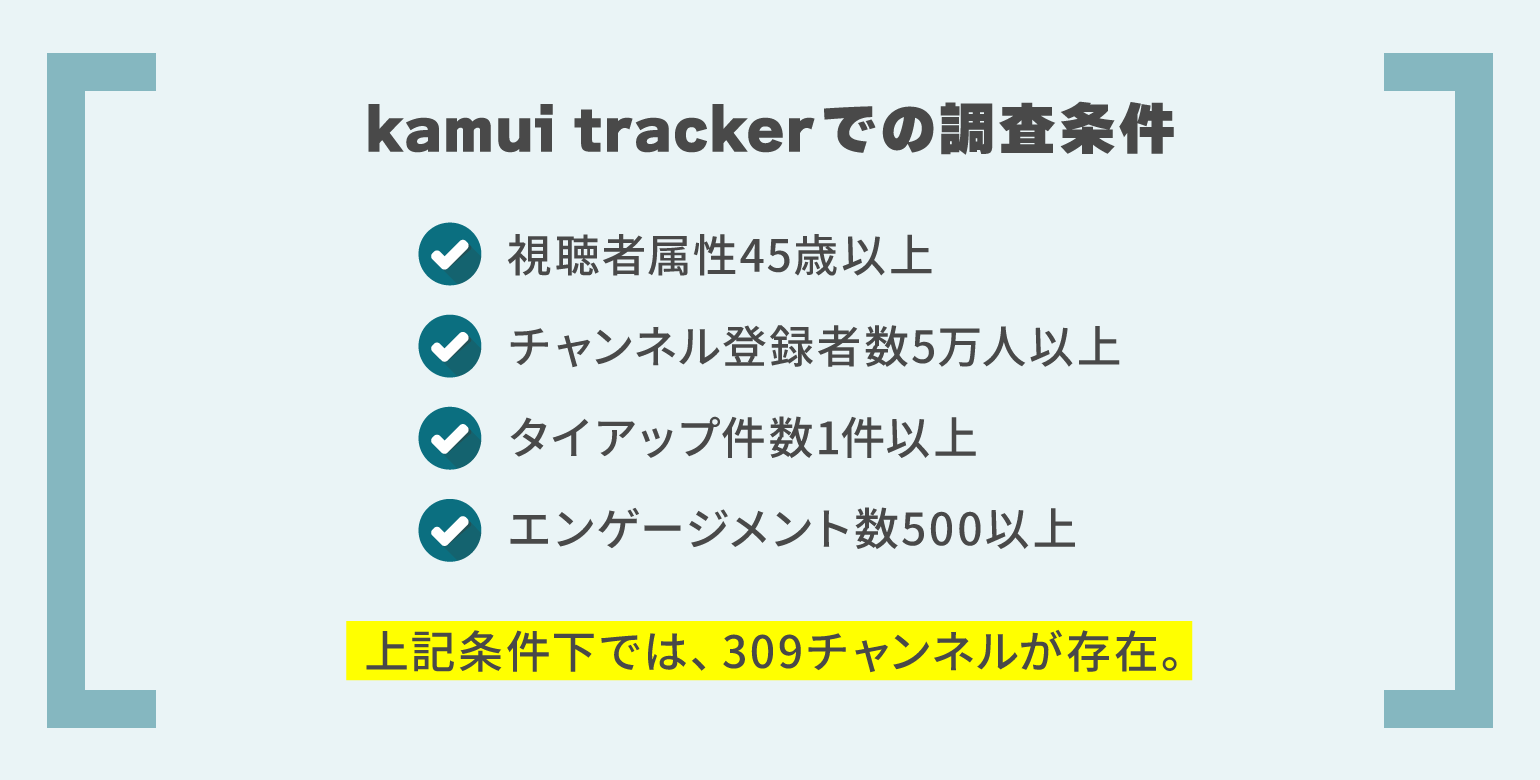
[Survey Overview]
YouTube Channels Included in the Survey:
① Channels where viewers aged 45 and older account for 70% or more
② 50,000 or more subscribers
③ Engagement count (total of likes and comments) of 500 or more
④ At least one sponsored collaboration
309 channels that meet criteria ①–④
Survey Method: Kamui Tracker
Survey Date: July 2025
Survey Sponsor: Ebily
Was this article helpful?
Share this article


Newsletter registration is here
We select and publish important news every day
For inquiries about this article
Author
Aya Yamakawa
Dentsu Inc.
CX Creative Center, Experience Neutral Design Division 2
Copywriter/Planner
Articles by this person
Tomoko Sano
Ebily Co., Ltd.
Corporate Headquarters, Human Resources and General Affairs Department, Public Relations Group