Note: This website was automatically translated, so some terms or nuances may not be completely accurate.
 Information Media White Paper ~ The Forefront of Planning 2026: “Connection Planning in the AI Era” ~ [1/1]
From “Reaching” to “Being Chosen”: What Is Media Strategy in the AI Era?
In this series, as part of the “Frontiers of Planning” section of the “Information Media White Paper 2026,” we will explore the theme of “Connection Planning in the AI Era.”
As the media landscape and advertising market undergo significant changes due to the emergence of generative AI, planners active on the front lines will explain the current state of affairs and strategies for responding to these changes.
In the first installment, Isao Asada of Marketing Division 4—who has worked as a media planner at Dentsu Inc. for many years—discusses what the media environment of the AI era looks like and the underlying structure that supports it.
Information Media White Paper 2026
Connection Planning: The integrated design of various touchpoints between companies, brands, and consumers—encompassing not only traditional media and customer touchpoints but also the flow of information mediated by generative AI.
*Unless otherwise noted, the figures and data appearing in this series are based on the survey results from the “Information Media White Paper 2026.”
<Table of Contents>
▼The Collapse of Media Planning: “How to Deliver” No Longer Works
▼AI, the “Gatekeeper,” Stands Before Information
▼The Concept of “Menpa”: Consumers Have Begun Relying on AI Due to “Search Fatigue”
▼TV Viewership Is Declining, but Digital Is Not the Enemy
▼The Importance of “Unprompted Recall” and AI as a Replacement for “Understanding-Based Initiatives”
▼Three Pillars Serving as a Compass for Planning in the AI Era
▼Rethinking the Value of Advertising Features—What Kind of Content Is Cited by AI?
▼From “Buying Ads” to “Co-Creating Experiences”—A Content-Driven Approach
▼Impact Varies by Genre—The Importance of Category-Specific Strategies
▼Summary—From “Designing Delivery” to “Designing Selection”
The Collapse of Media Planning: “How to Deliver” No Longer Works
Introduction—As I work with clients day in and day out, I can’t shake a certain sense of unease.
For over a decade,
I’ve believed that a media planner’s job is to
has been the job of a media planner. But now, that very premise is beginning to crumble.
By 2025, the monthly usage rate of generative AI among the general population will reach 35.6%, and among teenagers, it will exceed 80% for both males and females (*). For them, AI is no longer a “special tool,” but rather “everyday infrastructure” they use as naturally as breathing.
*Source: Dentsu Inc.’s large-scale original survey “Tunes 2025 Spring”
This shift is not merely about changes in how people allocate their time across different media. The fundamental structure of how people encounter information, what they believe, and how they arrive at purchasing decisions is undergoing a transformation.
In this article, I would like to discuss the fundamental challenges of the AI era and the direction in which planning is evolving, from the perspective of a media planner.
AI, the “gatekeeper,” now stands before the information
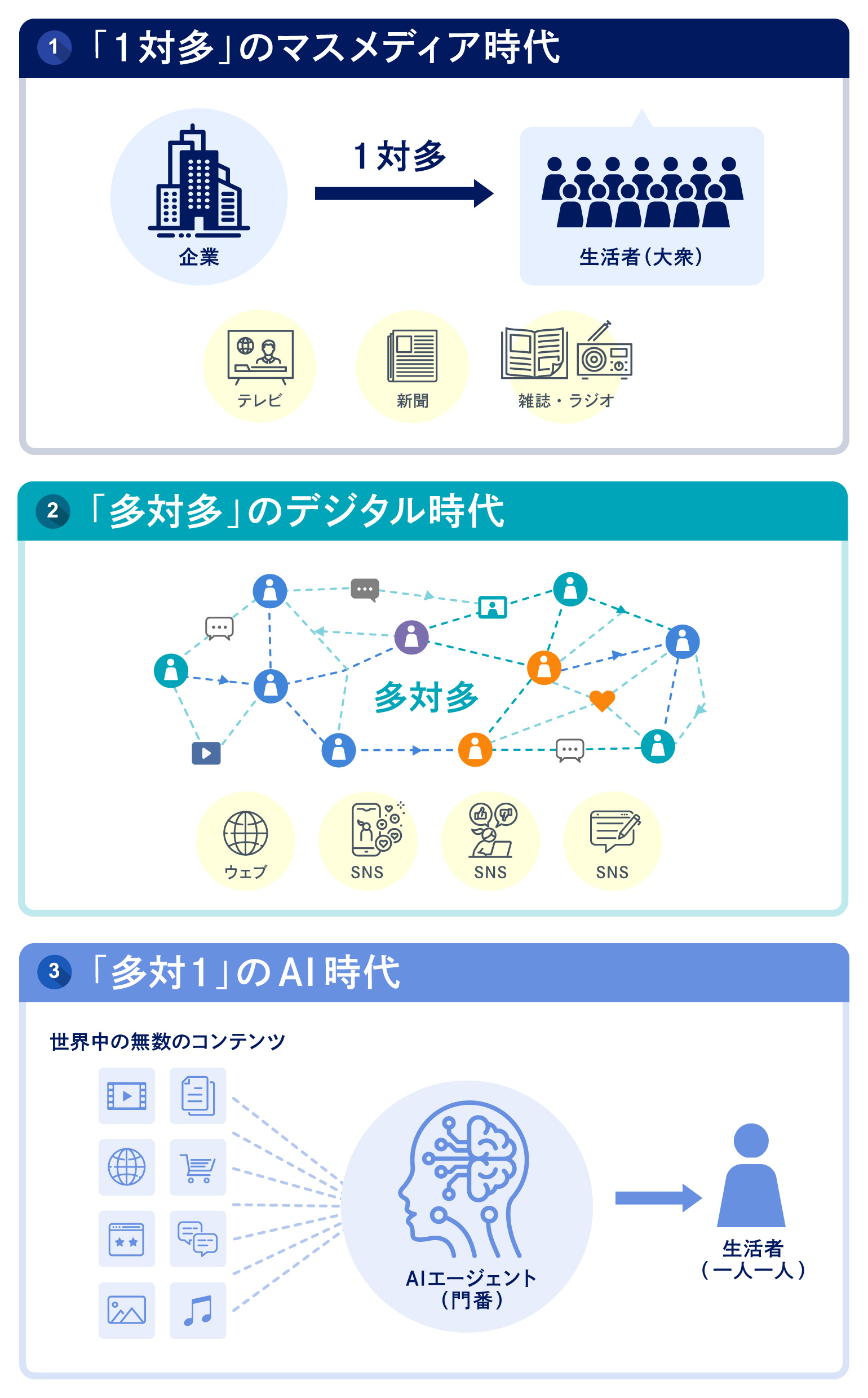
Over the past 30 years, the relationship between media and people has gone through three major stages.
The first stage was the era of “one-to-many” mass media, centered on television and newspapers.
Information flow from companies to consumers was one-way, and the standard approach to planning was to maximize reach by accumulating GRPs (Gross Rating Points). Advertising was aimed above all at “raising awareness,” and television commercials, as a single tool, held overwhelming power.
The second stage is the “many-to-many” digital era, driven by the spread of the internet and social media.
Everyone became an information source, and word-of-mouth and UGC (user-generated content) began to influence a brand’s reputation. While more sophisticated targeting technologies made it possible to deliver information “to the right people at the right time,” the volume of information exploded, and consumers began to drown in a sea of noise.
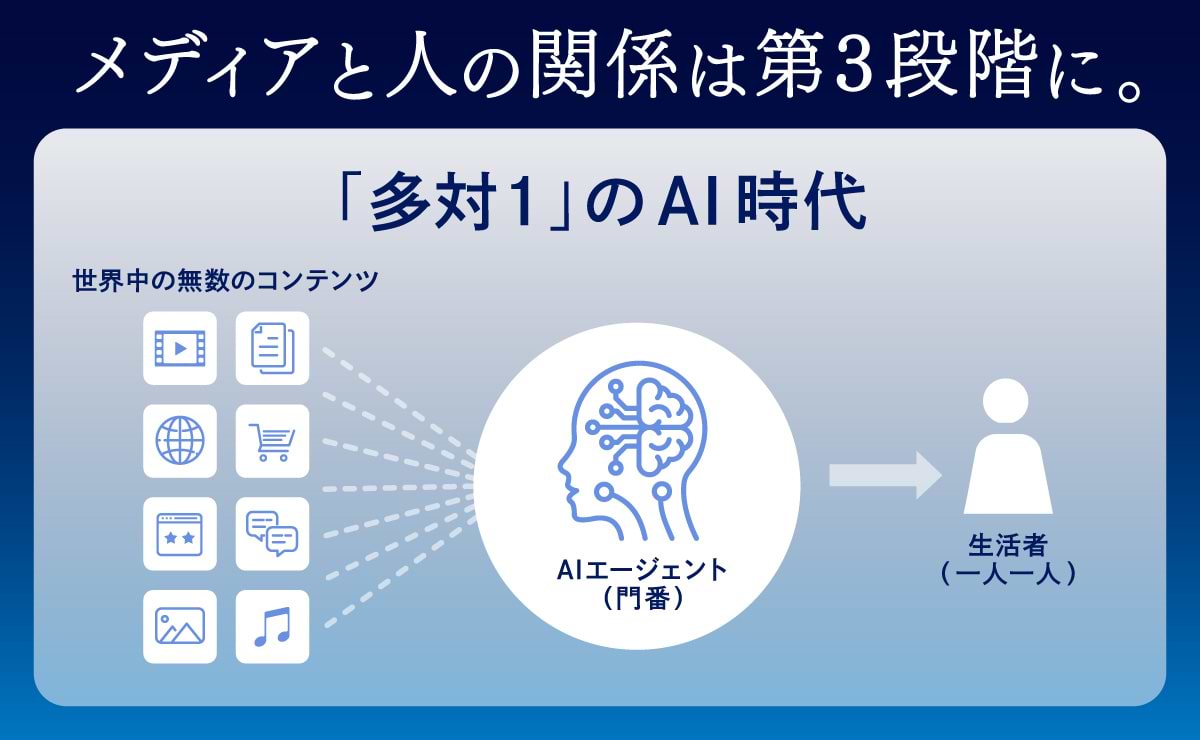
And now, the third stage is beginning: the “many-to-one” era.
We are moving toward a world where AI learns from and organizes countless pieces of information and content from around the globe to provide each individual with the optimal answer. Consumers no longer need to actively seek out information themselves. Information disseminated by companies is first vetted by the consumer’s “AI agent”—a gatekeeper—which determines whether it reaches the consumer’s eyes (note that the degree of AI’s influence varies by category; more on this later).
The premise of “how to deliver” is crumbling. Now, the question “Is this a brand that AI will select?” is becoming the starting point for planning.
The Concept of “Menpa”: Consumers Have Begun Relying on AI Due to “Search Fatigue”
The key to understanding consumers in the AI era lies in the concept of “Menta-pa,” or “mental performance.”
People today do not live in an era of information scarcity, but rather one of information overload. Search results number in the millions, and new information constantly floods social media. The result is the triple burden of “search fatigue,” “comparison fatigue,” and “decision fatigue.”
The real reason AI is rapidly gaining traction isn’t simply because it’s convenient—it’s because it takes the cognitive load off people’s shoulders.
Data showing that 47.1% of users employ generative AI to “replace searching” and 30.9% to “organize their thoughts” clearly illustrates this essence. In other words, AI is not merely a tool for streamlining information retrieval; it is an entity that stabilizes human mental performance.
*From Dentsu Inc.’s large-scale original survey, “Tunes 2025 Spring”
Going forward, consumers will increasingly shift toward “leaving it to AI” rather than “searching for themselves.” Furthermore, as a reaction to being constantly overwhelmed by new information, “trend detox”—the practice of deliberately avoiding trends and solidifying one’s own “staples”—is also gaining traction. An era is dawning in which brands that establish “what is a staple for me” rather than “novelty” will possess long-term competitiveness.
TV Viewing Is on the Decline. But Digital Is Not the Enemy
In the world of media planning, the term “turning away from television” has often been discussed. Daily television viewing time has been on a downward trend, falling from 181.3 minutes in 2015 to 105.3 minutes in 2025, and future trends remain uncertain (*).
*Source: Video Research Ltd. “MCR/ex” 2015 and 2025 data (October–December surveys) / Tokyo 50-km radius / General population (men and women aged 12–69)
/ Daily Activity Analysis (weekly average; daily activities recorded in 15-minute intervals in diary format for a specific week)
However, we must be careful here. It is not simply a matter of “switching to digital because TV has lost its appeal.” The essence lies in the fact that all forms of media are being integrated into a new point of contact: AI.
In the past, consumers gathered information by crossing multiple media platforms—such as “TV → social media → Google search → YouTube reviews.” From now on, all they’ll need to do is ask AI, “What’s a good air purifier?” This is because AI learns across all information sources and presents the optimal solution.
The number of media platforms consumers interact with will decrease. However, behind the scenes, the number of information sources AI interacts with will increase exponentially. This is the media structure of the AI era.
In television, for example, there are techniques—such as “post-drama commercials,” which reach viewers while they’re still immersed immediately after a drama ends—that link a brand to the object of their enthusiasm, and the value of such approaches is expected to rise.
Paradoxically, OOH (out-of-home advertising) is also being reevaluated. Ads that suddenly catch your eye on the street create “chance encounters” where AI agents cannot intervene. As a medium that continues to exist outside AI filters, traditional advertising methods are gaining new value.
The Importance of “Unprompted Recall” and the Replacement of “Comprehension-Based Initiatives” by AI
The core of the shift in media planning in the AI era lies in two major transformations.
The first shift is the growing importance of “unprompted recall” over product awareness.
Awareness is a passive metric—it measures whether someone “has seen an ad.” In contrast, unprompted recall is an active metric—it measures whether “a brand name spontaneously comes to mind the moment a specific need arises.” If a brand does not rank among the top recalls in consumers’ minds, it cannot even be considered a potential purchase option.
This becomes even more critical in the AI era, as brands must be recalled not only by consumers but also by AI.
When AI agents intervene in purchasing decisions, they create recommendation lists using signals such as the number of mentions on social media, search volume, the amount of UGC (user-generated content), and the quality of reviews. For example, analysis of the property and casualty insurance category has confirmed that a brand’s appearance rate correlates strongly with its recall rate.
In other words, the structure “AI recall × human recall = final choice” holds true. The brands that are included in the AI’s recommendation list and also rank as the first choice in people’s minds are the ones that will ultimately be selected.
The second shift is the replacement of “explanatory media strategies” with AI.
Comparison articles, review articles, ranking sites, SEO content, and how-to videos—all of these were media designed to “promote understanding.” However, in an era where AI reads, summarizes, and returns this information as a single answer, initiatives aimed at “facilitating understanding” will become areas where AI takes over. Advertising must shift its focus from promoting understanding to creating lasting memories.
The Three Pillars Serving as the Compass for Planning in the AI Era
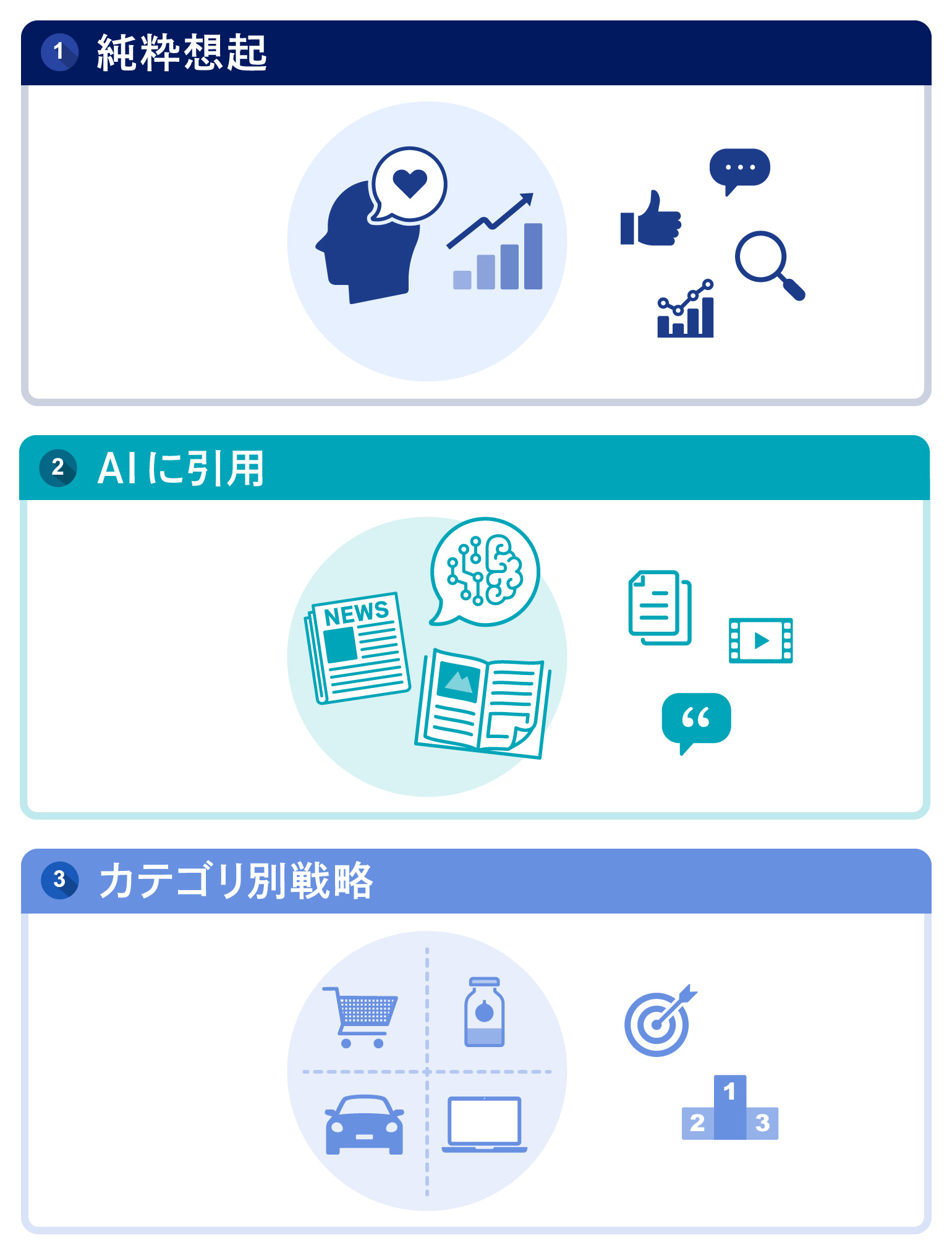
The compass for planning in the AI era can be summarized along three axes.
The first axis is the strategic building of pure recall.
We must reorient our KPIs to prioritize recall rate over awareness rate. It is essential to explicitly state that the goal of media investment is to increase online mentions, UGC, and search volume—which serve as signals for AI-generated recommendation lists.
The second axis is maximizing the likelihood of being cited by AI.
“The context in which the brand is mentioned” becomes the core of value. We must reaffirm the value of primary media such as newspapers and magazines and accelerate a content-driven approach.
The third pillar is the differentiation of strategic design based on category characteristics.
For low-involvement products, we will simultaneously design for “serendipity” and “establishment as a staple”; for durable goods and high-value products, we will build a pure recall strategy with the primary goal of “ranking high on AI recommendation lists.”
Based on these three pillars, in an era where unaided recall is crucial for both people and AI, it is no longer enough to simply be remembered; brands must be remembered (or recalled) in conjunction with the “context (meaning)” that connects them to people.
To that end, the author is focusing on “advertising features in newspapers and magazines” and “content tie-ins with television and other media” as promising new strategies.
Rethinking the Value of Advertising Features—What Kind of Content Does AI Cite?
In media planning for the AI era, the focus is not only on “how much reach was achieved,” but also on “how much information assets were accumulated that AI would want to recommend.”
Traditional KPIs have centered on metrics such as reach, frequency, and CTR (click-through rate). Going forward, factors such as brand consistency, highly credible third-party evaluations, specialized owned media, social trust built through PR, structured content, and AIO (AI optimization) will grow in importance.
This brings us back to the value of “advertorial features” in newspapers and magazines.
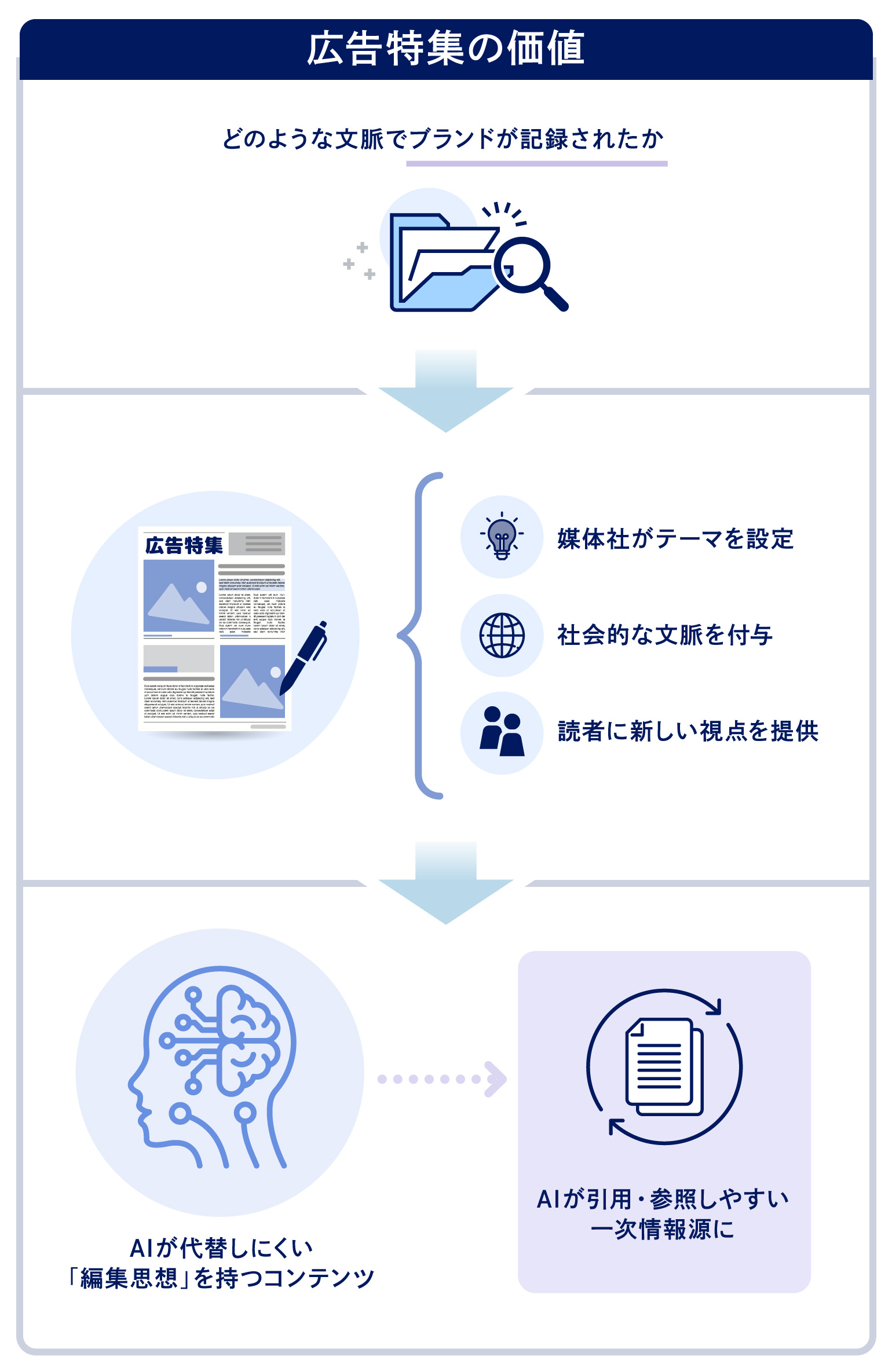
In an era where value centers not on “how many people were reached” but on “the context in which the brand was documented,” advertising special features—in which media companies set themes, provide a social context, and offer readers new perspectives—constitute content with an “editorial philosophy” that is difficult for AI to replicate. Since newspapers and magazines possess editorial responsibility, fact-checking capabilities, and networks of experts, they are highly likely to become primary sources of information that AI can easily cite and reference.
Furthermore, rather than building a brand through advertising alone, it is essential to clarify the roles of PESO (Paid, Earned, Shared, Owned) and design each to function as an “information asset that AI can learn from.”
From “Buying Ads” to “Co-Creating Experiences”—A Content-Driven Approach
In the AI era, the focus of advertising will shift from “delivering ads” to “creating information that AI wants to reference.” Taking this concept a step further leads to the “content-driven approach.”
The core of this new approach lies in designing experiences that “blend the brand into the immersive moments of ‘enjoyment.’” This means existing naturally—not as an advertisement, but as “part of the experience”—within the content, communities, and experiences that consumers are engrossed in.
For example, as mentioned earlier, there are “post-drama commercials” that reach viewers while they’re still immersed immediately after finishing a drama; brand experiences that blend into a game’s UI; and techniques that link a brand with “objects of passion”—such as specific sports or music—so they’re remembered together.
These approaches leave a strong impression of the brand while psychological receptivity is heightened, directly leading to increased unaided brand recall. This contextual association—where people think, “When I think of [X], I think of this brand”—can also serve as a signal for AI when making recommendations in specific situations.
Advertisements are consumed. However, high-quality content becomes a brand asset that continues to be referenced by both AI and consumers. Moving beyond the traditional “seller-buyer” relationship between advertisers and media, and establishing a position as a “beloved business partner” to creators and content platforms is the approach brands will need to adopt in the future.
The Impact Varies by Genre—The Importance of Category-Specific Strategies
Not all product categories are affected by AI at the same pace.
For low-involvement products such as beverages and food, purchasing decisions are often made within seconds in front of the shelf, so the scope for AI intervention remains limited for the time being. For these products, designing real-world touchpoints—such as “serendipity” (chance encounters), in-store experiences, and OOH—will continue to be crucial.
On the other hand, for high-involvement products—such as home appliances, travel, housing, automobiles, insurance, finance, and B2B services—the impact of AI is growing rapidly and significantly. This is because these sectors feature significant information asymmetry, making AI’s value in assisting with the evaluation of conditions, comparisons, and risk avoidance extremely high. For these products, the top priority is to ensure that “your brand is the first one listed by AI.”
Rather than all brands adopting the same AI strategy, designing strategies tailored to the purchasing behavior of their specific category will be essential for future planning.
Summary—From “Designing Delivery” to “Designing Selection”
If we were to describe media planning in the AI era in a single phrase, it would be the shift from “designing how to reach consumers” to “designing how to be chosen.”
AI will not eliminate advertising. What it will change is the role of advertising—shifting from investment aimed at gaining awareness to investment aimed at building recall. When the brands recommended by AI align with the brands people naturally recall, that brand secures the strongest position.
Media planning in the AI era is not merely about selecting media outlets. It is the process of carving out a “reserved seat” for the brand within both the consumer’s memory and AI’s knowledge, based on the premise of AI as a new infrastructure for information distribution.
The role expected of media planners in the future will evolve from that of “ad space buyers” to “information architects who ensure brands continue to be chosen in the AI era.” I am becoming increasingly convinced of this as I grapple with the sense of dissonance I feel on the front lines.
Was this article helpful?
Share this article


Newsletter registration is here
We select and publish important news every day
For inquiries about this article
Author

Isao Asada
Dentsu Inc.
Marketing Division 4
Media Planner