Note: This website was automatically translated, so some terms or nuances may not be completely accurate.
 The Case for “Freelance” Careers [1/1]
Corporate Employee × NPO × Research × Street Ukulele Performances?
Takuya Kagata’s Approach to Work
Now that there is no single “right” way to work,
It’s not uncommon for people to be active in multiple spheres rather than limiting themselves to a single job title. In this series, we’ll visit people who are embracing new ways of working and living to hear the stories behind their choices.

For the first installment, we spoke with Takuya Kagata. While working as a Business Design Director at Dentsu Inc., he is also active in multiple spheres, including performing ukulele street performances, volunteering with an NPO, and conducting research at a university.
At first glance, these activities may seem unrelated. But as we spoke with him, it became clear that each one is connected by a common thread that is uniquely “Kagata.”
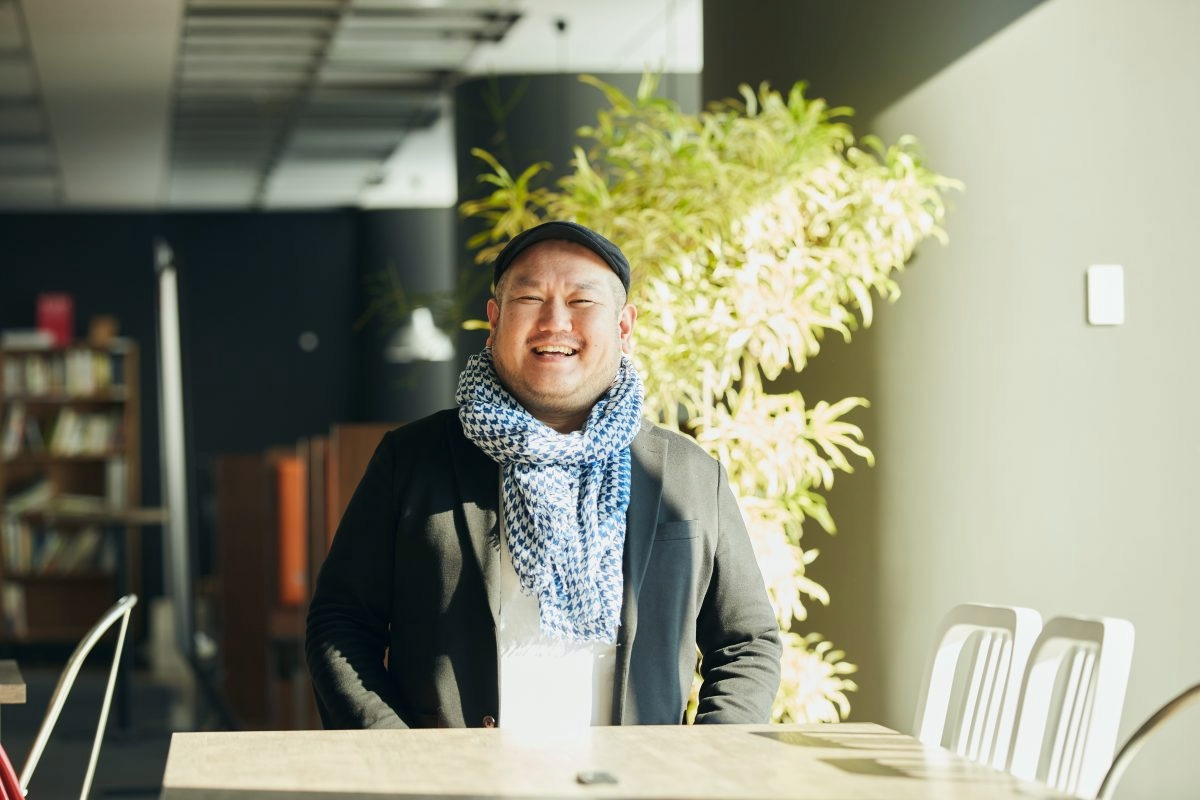
Takuya Kagata
Dentsu Inc. Business Design Director supporting corporate business planning and purpose design. Co-Editor-in-Chief of “Dentsu Future Mandala ” (Japan, India, China, Indonesia, Thailand). Representative of the NPO a-con (providing marketing support to NPOs). Principal Researcher at the University of Tokyo Institute for Advanced Studies × Dentsu Group Co-Creation Innovation Lab. Member of the Heisei Nagashi (ukulele group ). Director of the NPO Japan Beach Sumo Association. Captain of the Dentsu Sumo Club. Uses the “migi-yotsu” grip. Leads a dual-base lifestyle, spending weekdays in Tokyo and weekends in Miura.
<TABLE of Contents>
▼I Intended Dentsu Inc. to Be Just a Stepping Stone
▼Envisioning the Future by Day, Hopping from Bar to Bar by Night
▼Creating a Place to Belong Outside the Company
▼What I Discovered Beyond a Major Setback
▼Continuing to Dive into Unknown Worlds
▼You Don’t Need Just One Place to Belong
I Intended Dentsu Inc. to Be Just a Stepping Stone
Right after we met, Mr. Kagata said something a bit unexpected.
Kagata studied development economics in college and had considered working for the United Nations or JICA. He also did an internship with an NGO working in rural areas of India and Indonesia.
A woman from Sarajevo whom she met during her college years influenced that way of thinking.
I intended it to be just a stepping stone, but before I knew it, I’d been there for over 20 years.
Looking back, perhaps the people I met and the work I did during that time are what took me to all those different places.
Envisioning the future by day, hopping from bar to bar by night
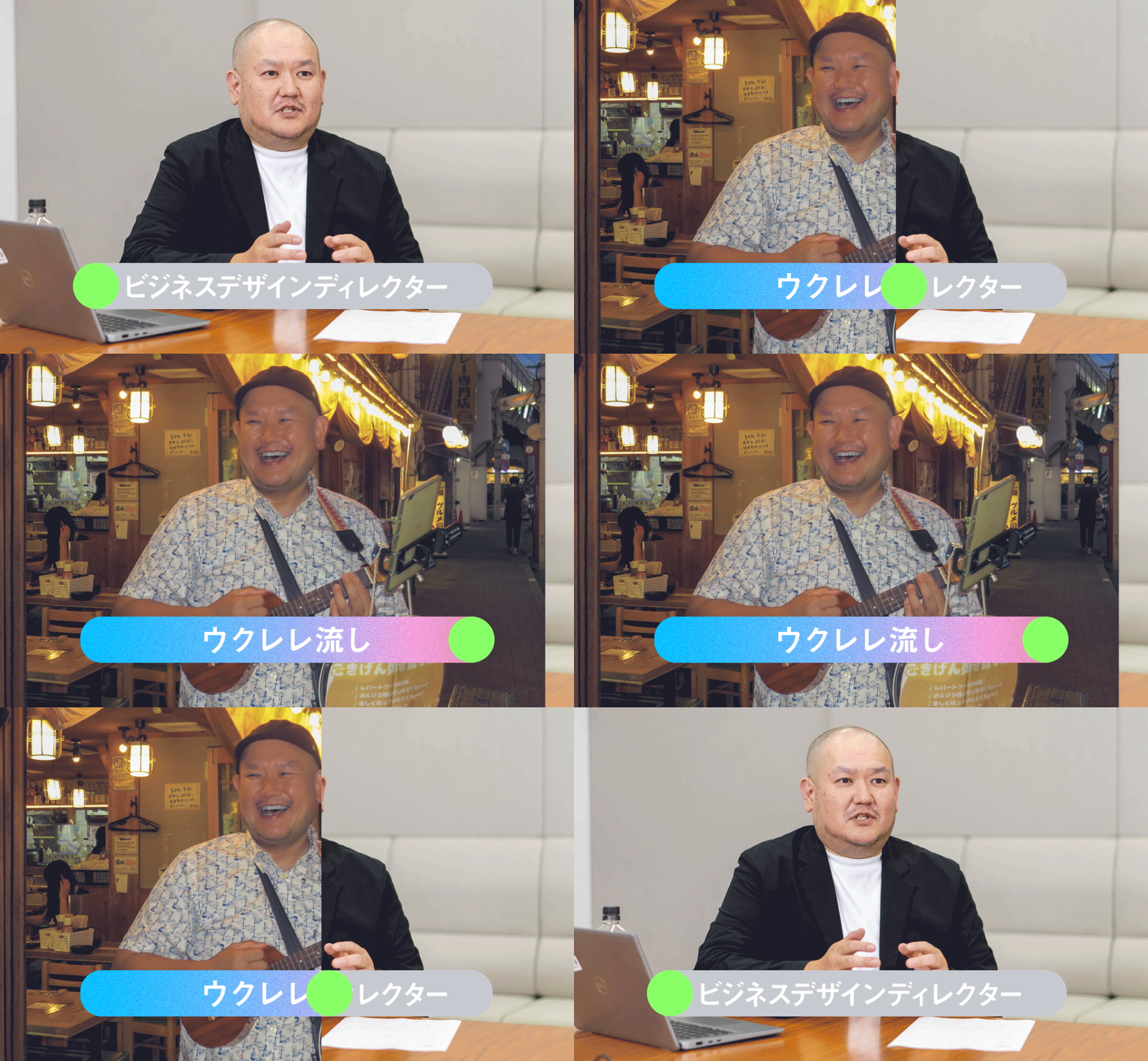
Mr. Kagata’s main job at Dentsu Inc. is to work with companies to envision their “unseen future.” While supporting new business ventures and product development, he works backward from the question, “What kind of company do you want to be in 10 years?” to determine what needs to be done now.
In recent years, Mr. Kagata has also been working on expanding the “Dentsu Inc. Future Mandala” project with members overseas.
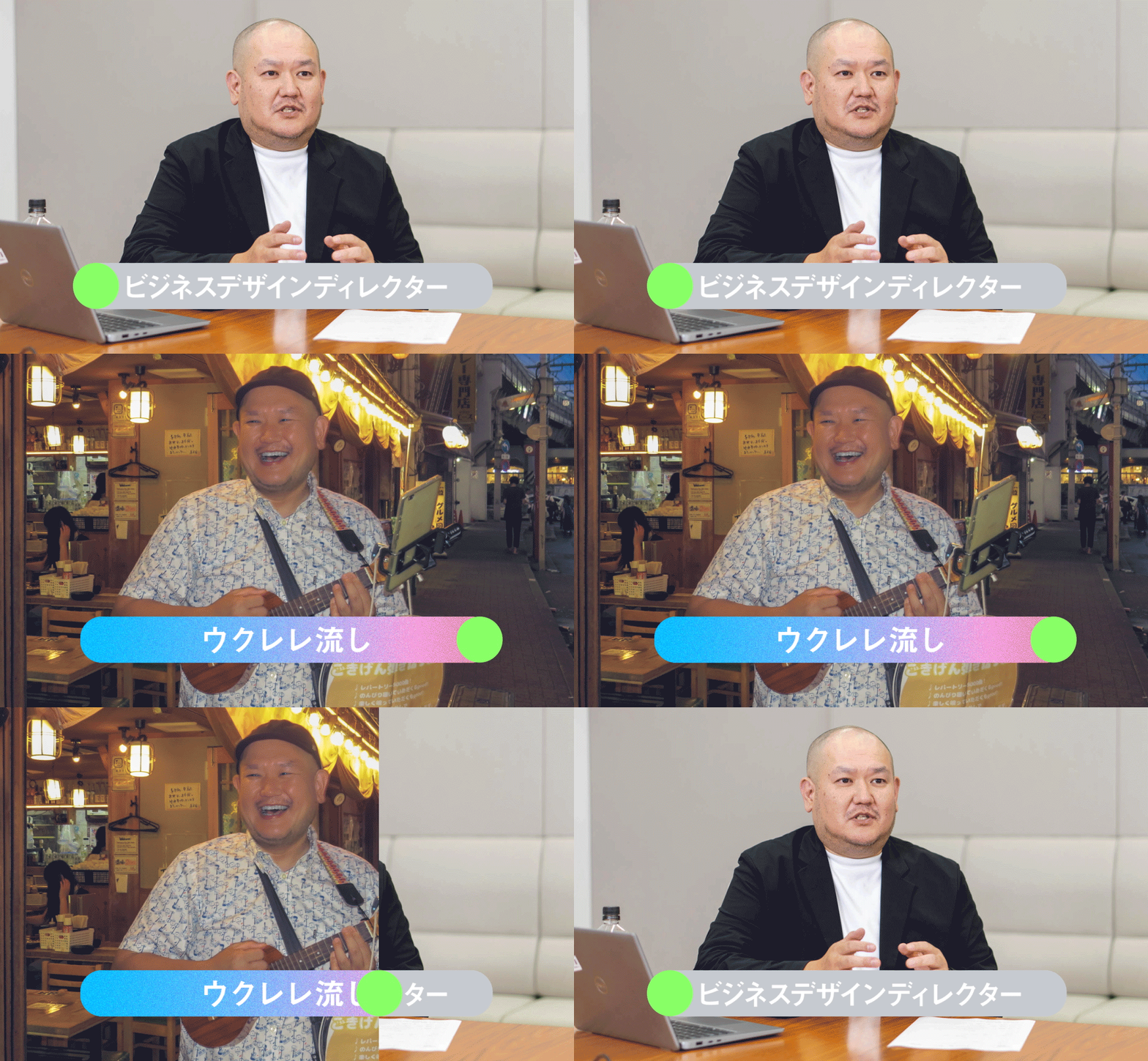
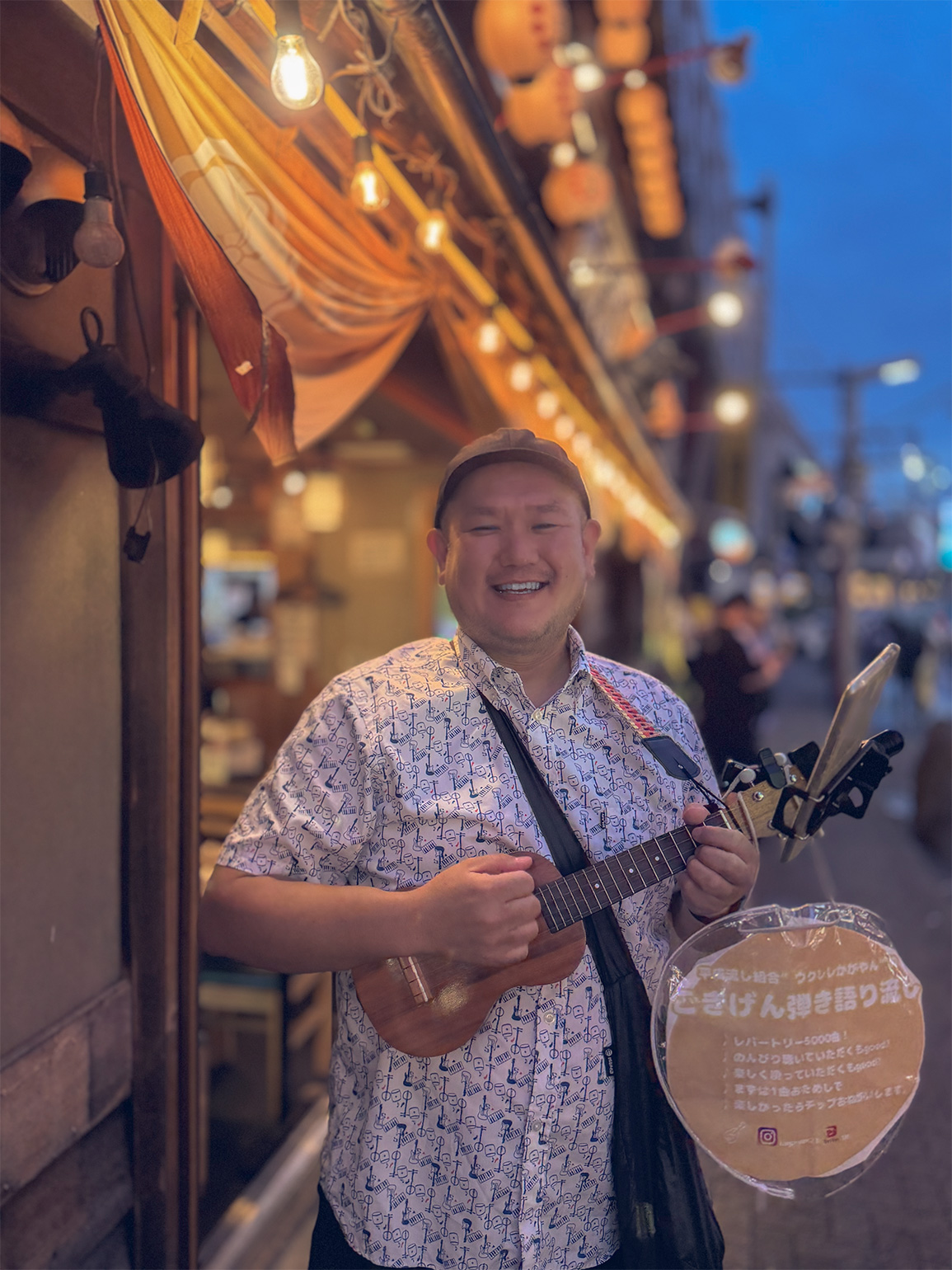
And when night falls, Kagata slings his ukulele over his shoulder and heads to a bar.

“Nagashi” refers to a cultural tradition where musicians visit bars with their instruments and play songs requested by customers. Kagata belongs to the “Heisei Nagashi Association,” which carries this tradition into the modern era, and he makes the rounds at bars in Ueno, Yurakucho, and other areas two or three times a month.
What got Mr. Kagata started on “nagashi” was the ukulele, which he’d been playing all along. Influenced by his music-loving father, he began playing the guitar in high school, and later, drawn to the culture of the South Seas that he loved, he also became familiar with the ukulele.
“I want to get good enough to play at bars on weekends someday,”
It was while he was talking about this that a friend from an NPO introduced him to the Heisei Street Musicians’ Association—and that’s how he first encountered street music.
On this day as well, Mr. Kagata glanced around the bar and suddenly began to play.
At first, the young customers were a bit hesitant, but as soon as the music started, their expressions naturally softened.
Before he knew it, the atmosphere in the shop had shifted slightly.
Mr. Kagata believes that, precisely because we live in this era, things that can only be experienced in person—like the atmosphere and the scent of a place—have become all the more important.
That’s surely the same reason he’s drawn to the sink. People are physically present, sharing time while sensing the atmosphere. He seemed to find fascination in that kind of physical interaction.
Creating a Place to Belong Outside the Company
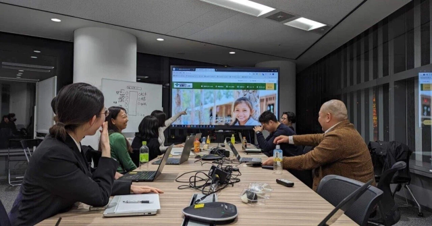
Around his fourth year at the company, Mr. Kagata launched a study group with a friend from his college days to support NPOs with communication and marketing. One day, while conducting interviews with various NPOs, he was told, “Stop just listening—come help us out.” That prompted him to actually get involved in providing support.
What I Discovered After a Major Setback
Mr. Kagata has found his place in various settings. However, his journey hasn’t been entirely smooth sailing.
I’m told there was a period afterward when I was adrift, without any work. But at that lowest point, Ms. Kagata discovered a different way of working.
Kagata says that every time she takes on a new project, she reads dozens of books. It was around this time that a colleague told her, “You really love studying, don’t you?” and she realized that this might actually be one of her strengths.
Sometimes, combinations that are hard to see when you’re confined to a single community become visible precisely because you’re involved in multiple different settings. It’s said that when people and ideas that wouldn’t normally intersect come together, it can lead to unexpected breakthroughs.
Continuing to Dive into Unknown Worlds
I felt that all of the activities Mr. Kagata continues to pursue share a common thread: “proactively diving into unknown worlds.”
One example of this was when he went back to graduate school at the University of Tokyo in his 40s to study urban engineering.
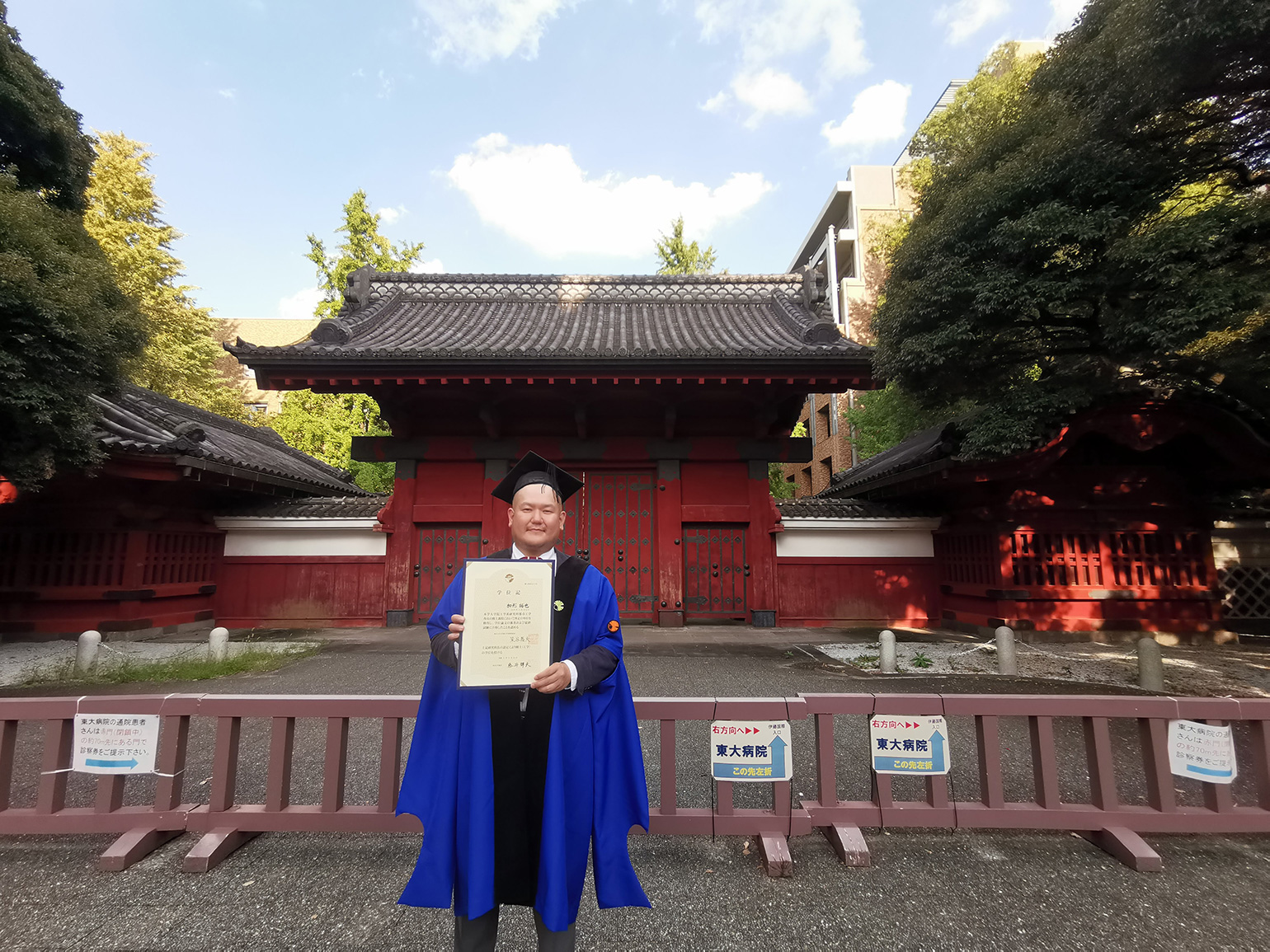
For Mr. Kagata, graduate school wasn’t just a place to acquire knowledge. He met people who attended night classes while working, and the number of people he respected grew. He said that this experience itself adds richness to his life.
You don’t need just one place to belong
Finally, Mr. Kagata shared this with us.
A short while after the interview, I received a message from Mr. Kagata.
Message After the Interview
“Wow—thank you so much. I was reflecting on it on the train ride home, thinking what a happy evening it was to have someone listen to me so intently.”
Somehow, I thought that was so typical of Mr. Kagata.
What really stuck with me from the interview was the depth of his gratitude toward people and his work. He naturally brought up stories about those who’ve helped him along the way, and he repeatedly expressed his appreciation for being entrusted with tasks. Rather than focusing on how he could excel personally, he was always thinking about how he could be of service to this community. That perspective felt consistent throughout.
You don’t have to have just one place to belong.
Whether inside or outside the company, she gradually increases the number of places where she can contribute in her own way. Perhaps it’s this accumulation of small steps that has shaped Ms. Kagata’s approach to work.
Next time, I’ll visit someone else who is living and working in their own unique way to hear their story.
Interviewee | |
| Works in public relations at Dentsu Japan. In her personal life, she moved from Kanagawa to Okinawa. “There should be more variety in both how we work and how we live.” Inspired by this belief, I’ve started this series. I’ll visit people I’d like to meet and conduct in-depth interviews with them. | |
Was this article helpful?
Share this article


Newsletter registration is here
We select and publish important news every day
For inquiries about this article
Author
Takuya Kagata
Dentsu Inc.
Global Business Center
Chief Business Design Director
Final Experience Guide: 4 Keywords to Avoid Missing OutCivic Tech: Solving Local Issues with TechnologyThinking with the Right Brain and Left Brain: The Future of Advertising Agencies and Consulting FirmsLocal "quirks" hold the key! How to build sustainable regional economiesDentsu Group's 72 Visions of the Future: "Future Mandala"The Case for “Freelance” Careers