Every region has its own unique “quirks.” These quirks manifest in a wide variety of ways and serve as the source of that region’s unique charm and potential.
*“Regional Quirks” refer to the “unconscious behavioral patterns” that underlie a region. This initiative aims to foster sustainable economic regions throughout Japan by uncovering the “quirks” that exist behind everything from local industries and tourism to regional specialties. For more details, please see Parts 1 and 2!
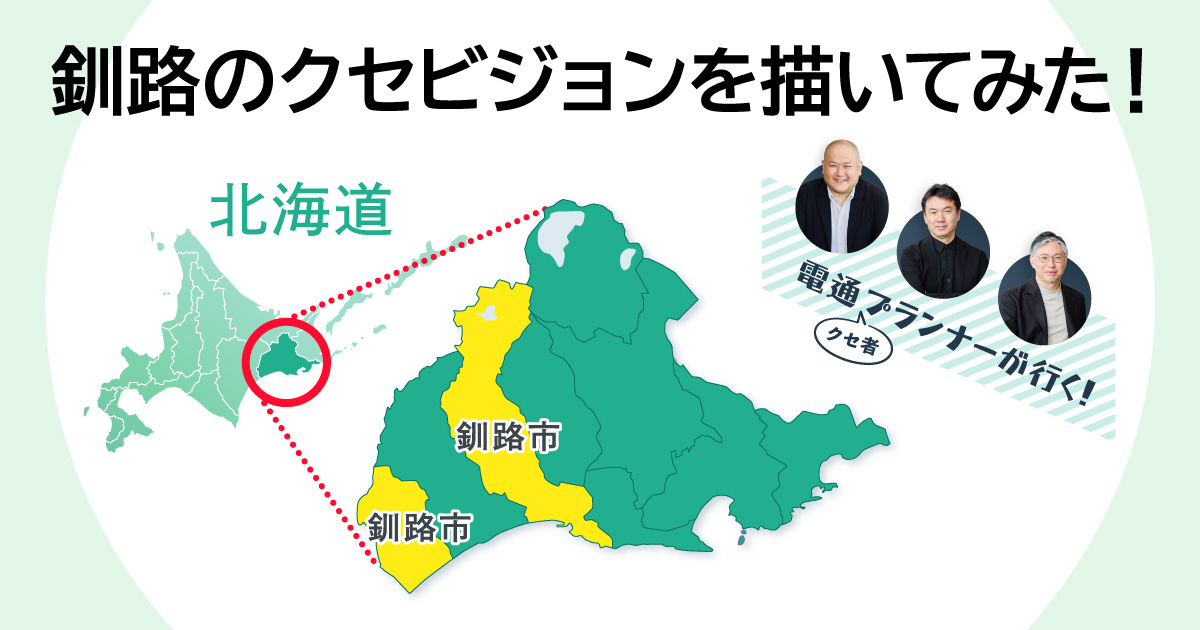
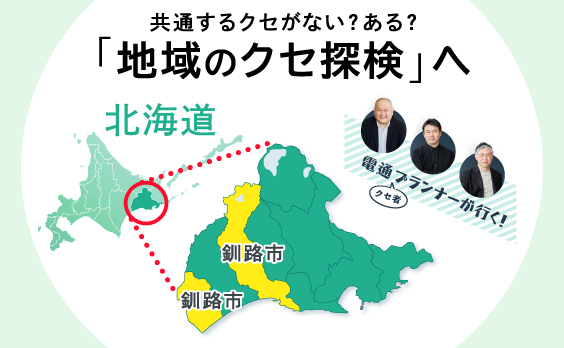
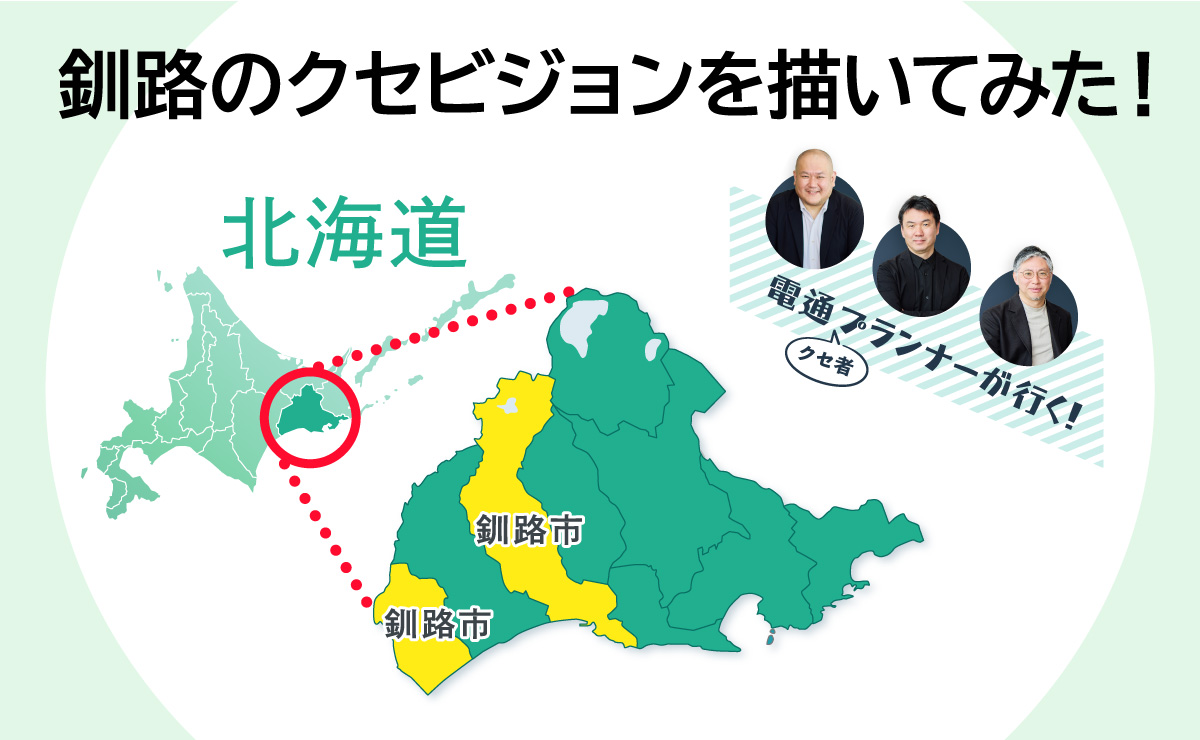
Following up on the previous installment, this installment takes place in Kushiro City, Hokkaido.
Using the interviews we conducted there as a starting point, we explored how we can expand our understanding of the region’s “quirks” to envision a “vision” for its future.
Furthermore, by organizing this process, we’ll explore a “method for creating Kuse-Vision” that can be applied to other regions as well.
This installment is brought to you by three “eccentrics”: Toshiaki Morio from Dentsu Inc. Media Services / Newspaper Division, Takuya Kagata from the Global Business Center, and Nobu Miyazaki from Dentsu Inc. Business Transformation Creative Center.
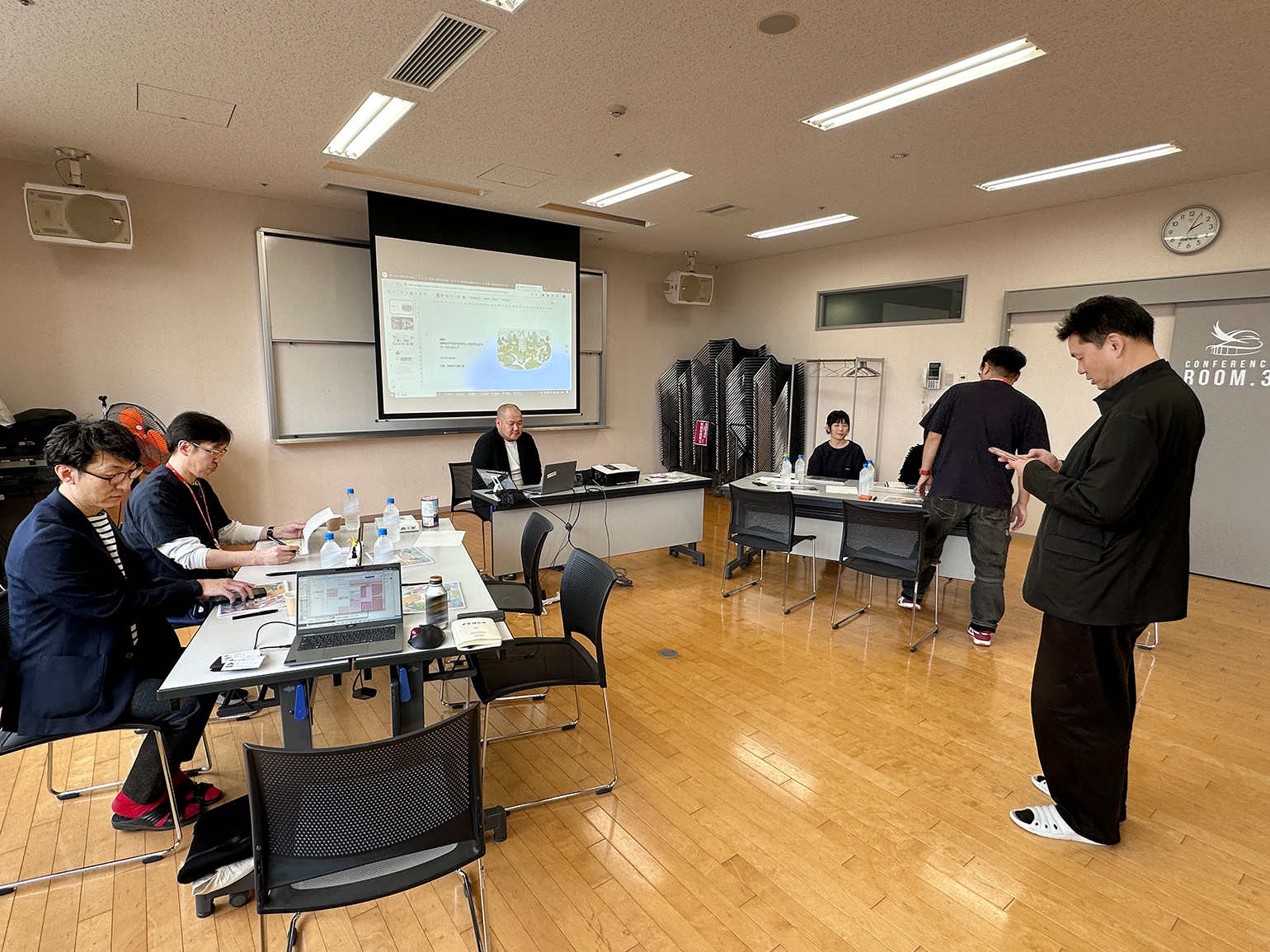
We held a workshop bringing together these three “quirky” planners from Dentsu Inc. and community development leaders from Kushiro. What kind of “Quirk Vision” emerged from that session?!
Turning Quirks into a Vision! Holding a Workshop with Kushiro’s Community Development Leaders
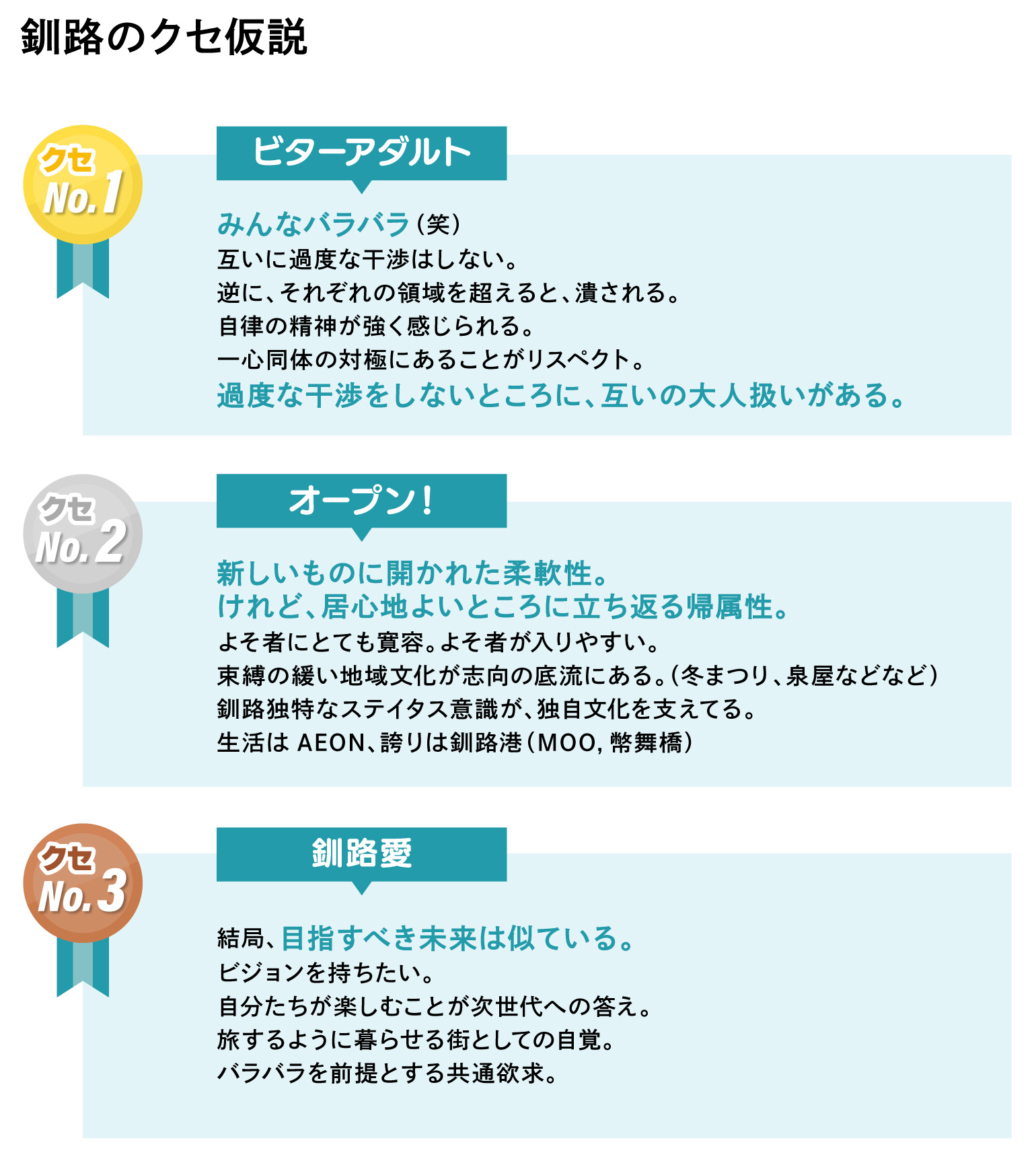
Morio: Last time, as part of our “behind-the-scenes” interviews, we spoke with three community development leaders in Kushiro and formulated what we called the “Quirk Hypothesis.”
Kagata: Compared to the people we spoke with previously in Omitama City ( Sessions3 and 4 ), even the atmosphere permeating the space was completely different, wasn’t it? Both Omitama and Kushiro share the characteristic of “residents having a strong sense of self-reliance,” but you can’t really capture a town’s unique character with such an abstract phrase. The way that sense of self-reliance manifests is entirely different. I felt that the clues to their “quirks” lay precisely in those differences.
And in Kushiro, I sensed the potential that if we build a vision for future community development based on the “quirks” we’ve identified, it could result in something truly unique and highly convincing.
Miyazaki: What kind of action ideas or visions will emerge if we expand on these “quirks”? I think this will be one of the outcomes of the hypothesis we’ve been exploring in this series: “revitalizing the local economy based on regional quirks.”
Morio: With precisely that intention in mind, we gathered the Kushiro stakeholders I introduced last time and held a workshop. We asked them what kinds of community development ideas lie beyond what makes Kushiro unique.
In our previous “Quirk Hypothesis,” the term “Bitter Adult” was meant to describe an attitude of facing the challenges of the “present” with flexibility—without giving up on one’s ideals—even while having experienced various things and facing a reality that doesn’t always go as planned. That attitude was clearly evident during the workshop as well.
We began by identifying “quirks” and setting “challenges”
Miyazaki: As for the workshop participants, we brought together key figures in Kushiro’s community development—including Katsuyuki Yoshida of Marukatsu Yoshida News Agency, members of the East Hokkaido Sports Commission, and Kana Harada—whom we had interviewed in our previous “Behind the Scenes” series.
In terms of content, we discussed ideas for solving local challenges and visions for the future—exploring just how far we could expand our thinking based on the region’s unique characteristics.
① Identifying Local Characteristics and Setting Challenges First, at the start of the workshop, we identified these “quirks” to some extent. However, since we had already conducted the “behind-the-scenes” interviews, the workshop discussion began using “hypotheses about local quirks”—which the three of us from Dentsu Inc. had summarized in advance—as our starting point.
Building on that, we defined the community’s “challenges.” We can think of these challenges as the specific targets that action ideas—whether aimed at solving local issues or leveraging the community’s unique characteristics—should address.
② Action Ideas for Successfully Tackling the Challenges In the middle of the workshop, participants freely brainstorm “action ideas” to solve local issues or achieve the challenges.
From these action ideas, we could see the “potential for growth” in the region—what it would look like once these ideas were realized. Rather than simply envisioning “how we want it to be,” we designed a vision—including numerical targets—of “what the region would look like if these ideas were implemented.”
The Development of the “Kuse Vision” Seen in “Tabi & Work”
Morio: One idea that emerged from this process was Kana Harada’s “Travel & Work” project. The “strategy” aspect of that project was particularly intriguing, wasn’t it?
Miyazaki: Yes. Ms. Harada’s field of activity is “tourism,” but the concept of attracting tourists here isn’t about short-term or one-time visits—it’s about the challenge of “getting people to stay” and “encouraging repeat visits.” Ms. Harada was devising concrete strategies aimed at achieving that.
In that case, who would be the target audience? Of course, people who’ve visited Kushiro at least once form the base, but we agreed that the real value lies in them having experienced “Kushiro’s charm” during that visit.
In any case, Kushiro is a “city that’s laughably cool.” He explained that as more and more people come here to escape the heat and establish a lifestyle where they work while using Kushiro as a base, this will naturally lead to longer stays and repeat visits.
Kagata: So, from our perspective as Dentsu Inc. planners, the question is, “Who will take what actions toward whom to achieve this challenge?” In other words, rather than focusing on one-time visits, we want to identify the key challenges necessary to achieve “longer stays” and “repeat visits,” and design actions aimed at addressing those challenges.
In this context, the “challenge” is to establish summer retreat work based on remote work as a permanent practice. To achieve this, we set the goal of continuously reinforcing the motivation to “escape the heat.”
Morio: I believe Mr. Harada’s “Travel & Work” idea was based on the idea that “it would be great if people from outside the region could forge a connection with the Kushiro community by making some kind of contribution themselves. That would lead to longer stays and repeat visits.”
Helping out at your travel destination to contribute to the local community—and earning a little extra money to help cover your stay. This also helps alleviate the labor shortage in Kushiro, so it’s a win-win situation. Furthermore, you envisioned that participating in the local community would foster a sense of attachment, leading to repeat visits.
Various Policy Options to Support the Expansion of Kuse Vision
Miyazaki: Mr. Nakajima of the East Hokkaido Sports Commission mentioned the challenge of “developing human resources through ice hockey.”
Ice hockey has always been very popular in Kushiro; there are many ice rinks and even training camps. Building on these resources, the question was, “Can we increase the number of people coming to Kushiro to learn ice hockey?”By creating opportunities to learn ice hockey both online and in person, we can cultivate “ice hockey talent” right here in Kushiro. That’s how we came up with the idea of taking action to connect Kushiro with the wider world.
Kagata: While focusing on character education through sports, and given that ice hockey is more popular overseas, we can also build connections with other countries. Add English education to the mix, and the challenge was to see if we could develop talent that would make Kushiro a “launchpad for spreading one’s wings overseas through ice hockey.”
Nationally, the number of ice hockey players is small, but we want people to first discover the excitement of ice hockey through online platforms. Once they’ve experienced that, we’ll invite them to Kushiro to show them the thrill of playing ice hockey in person. Beyond that, we aim to enhance their English skills and non-cognitive abilities. The idea is to dramatically transform how people encounter ice hockey through Kushiro.
Morio: We also had another guest join the workshop: Mr. Katsuyuki Yoshida from Marukatsu Yoshida News Agency.
As an example of his ideas, Mr. Yoshida spoke about “East Hokkaido Tsubugai Honpo,” a project he’s already working on. This initiative aims to raise awareness not only among people outside the region but also among Kushiro residents themselves by introducing them to Kushiro’s food culture through tsubugai (a type of shellfish).
For example, by creating “Tsubugeta”—a special plate stand designed specifically for whelks—he’s helping people rediscover that “whelks are part of our unique local culture.” He was fully committed to this kind of work.
What is the common thread running through these three community development leaders?
Moriō: When I interact with Mr. Harada, Mr. Nakajima, and Mr. Yoshida, it may seem at first glance that they are each pursuing completely different endeavors in isolation. However, there are commonalities among them—such as their tendencies in action and a shared sense of urgency regarding Kushiro’s future.
The key points in their efforts to revitalize Kushiro are “cultivating a connected population,” taking that a step further to “deepen people’s attachment to Kushiro, ” and, by promoting the region’s culture to the outside world, “further raising awareness from within.” I believe that at the very root of this, taken to its ultimate conclusion, there is a clear determination to “enrich the city of Kushiro” and “keep the lights of Kushiro burning.”
Miyazaki: As for how they carry this out, I felt that what they have in common is not so much “recruiting collaborators to work as a group,” but rather their determination to forge ahead on their own, driven by that strong sense of purpose.
Kagata: In Part 5 of this series, I discussed the concept of a “resource-expansion-type vision.” The people of Kushiro are engaged in very down-to-earth, practical planning, which embodies the very essence of this resource-expansion-type vision. When I say “resources,” I’m not simply referring to local industries; rather, an expansion-type vision is, so to speak, the “potential for growth” inherent in the region’s unique character. Please refer to Part 5 for more details.
Morio: The people of Kushiro had a strong sense of purpose as they moved forward with their feet firmly on the ground. They think about what they themselves want to achieve as individual players. The image is that by accumulating practical challenges based on resources—or “unique characteristics”—they gradually move closer to their vision.
Miyazaki: And the challenges each individual conceives are imbued with the proposer’s “will,” aren’t they? Realizing one’s own will through an approach that leverages local resources —isn’t the “regional vision” what lies beyond that?
If you’re serious about moving forward, you should make accurate projections based on “numbers”
Kagata: To truly realize a vision, it’s best to have a solid understanding of the “numbers” as well. To engage the community, it’s not enough for an idea to be appealing—you also have to quantify the specific benefits it will bring to the region once implemented. In other words, this goes hand in hand with the vision.
In this workshop, after the ideas were generated, we decided to try coming up with some figures right then and there, so we let our imaginations run wild. Of course, we’ll need to conduct research to verify the validity of the numbers and see what happens when we flesh them out in detail, but for now, we just wanted to get a rough sense of the scale right there on the spot.
Take, for example, the “Travel & Work” idea mentioned earlier. We were able to sketch out the story—“Visitors will lend a hand with the region’s primary industries and eventually settle here”—during the brainstorming phase, but we then considered what the scale of this initiative should be.
Whether we want 100 people or 10,000 to settle down makes a huge difference in how we’d launch the project. Also, it’s not simply a matter of being happy if 10,000 people come—it’s also related to Kushiro’s current capacity to accommodate new residents.
During the workshop, we considered various scenarios and tried to imagine how many people would need to embrace the idea for it to succeed. For “Travel & Work,”
if we could secure the support of about 50 company presidents involved in Kushiro’s primary industries or seafood processing by 2027, how many people could each company host per year? Assuming four people per company—meaning about 200 people would come to enjoy “Travel & Work”—that would have a significant impact on Kushiro.
That might be the kind of scenario we’re looking at.
By coming up with tentative figures, we can work backward to determine what needs to be in place by 2026 as a first step toward achieving this goal in 2027, and we can then refine the specifics of how to launch the business. In this way, coming up with tentative figures is extremely useful.
Miyazaki: Those numbers define the scale of the project and the degree to which it’s achieved. By coming up with hypothetical figures, we can establish a benchmark for deciding whether to implement a business idea—and if so, on what scale.
At this stage, rather than simply planning by backcasting from a grand goal, I think it’s also crucial to consider how far we can go by building on the region’s unique strengths—a “resource-expansion” approach—while using numbers to verify progress, all without losing sight of the original vision.
Morio: So, to create sustainable, tenacious initiatives, we need to visualize our “progress” toward the vision, and numbers are important as a yardstick for measuring that progress.
Miyazaki: Let’s take a closer look at how to develop a “Quirk Vision.” In this series so far, we’ve used “regional facts”—such as nature, history, and local livelihoods—as a starting point for exploring regional quirks. By articulating regional quirks based on these facts, we can bring out the region’s unique and fascinating character.
Kagata: However, our discussions so far have been somewhat inward-looking—focusing on developing visions and ideas based on local facts and local quirks. But I do believe that “market needs” are important to a certain extent.
How much profit can be generated by promoting the region’s appeal nationwide? In other words,
“How well will the challenges we aim to undertake—based on the region’s unique character—actually perform when viewed within the context of broader societal trends?”
—that’s what we need to verify as we move forward.
Steps for Creating a “Kuse Vision”
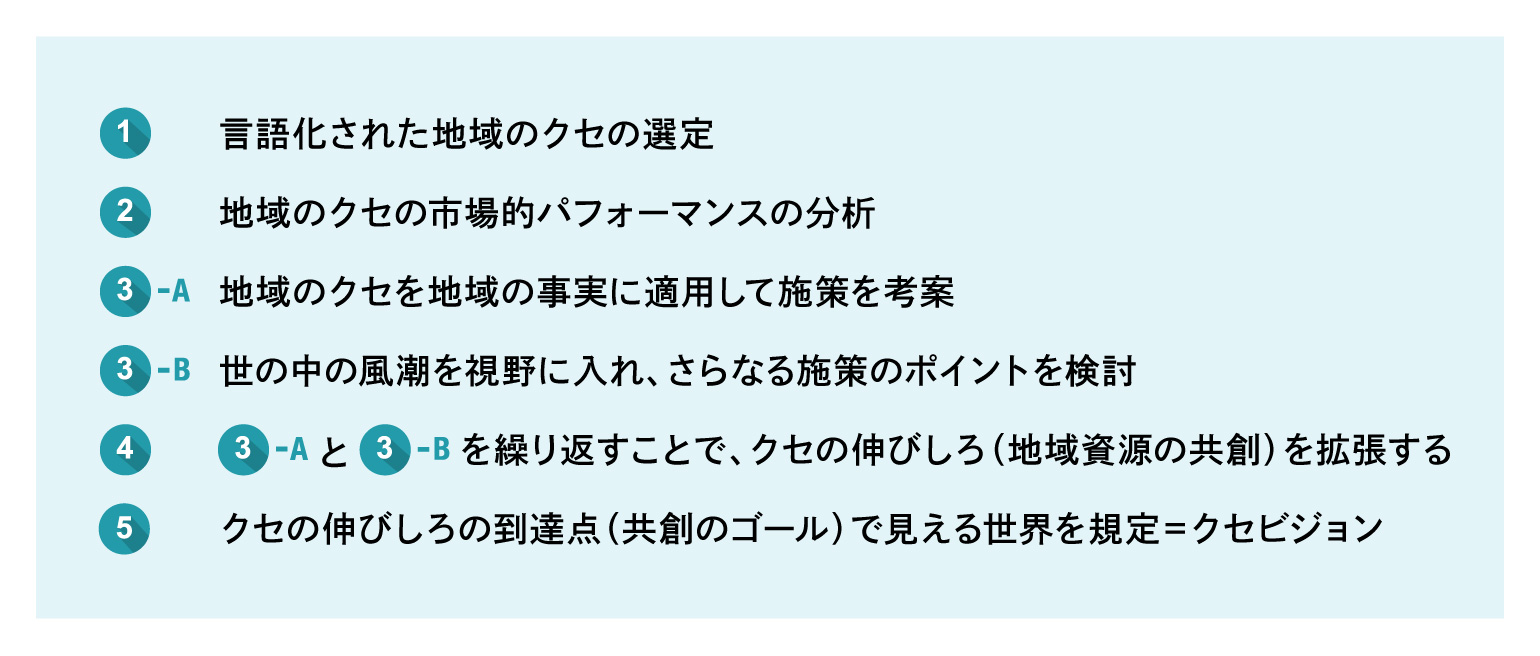
Kagata: From here on, we’ll refer to the “Regional Expansion Vision” as “Kuse Vision” for simplicity. When considering the steps to create a Kuse Vision, there are the following five steps.
These steps were also discussed in my conversation with tourism creator Kana Harada. If we organize the “Travel & Work” idea using the above steps, it breaks down as follows:
1. The Region’s “Open-Mindedness” Shaped by the rise and fall of industries. As industries come and go, various outsiders arrive and then leave. This has fostered a mindset of “welcoming those who come and not chasing after those who leave.”
2. Analysis of Market Performance: “A Society with a Declining Population” This characteristic provides a foundation for smoothly accepting not only natural population growth but also “social growth.” It offers the potential to flexibly expand the pool of economic contributors—our community members.
3-A: Regional Reality: “Abundance of Natural Resources” By creating opportunities for deeper engagement with the area’s tourist attractions, we can implement measures to foster greater loyalty to Kushiro. For example, deepening communication with visitors through nature guides.
3-B Global Trends: “Remote Work” By creating an environment where visitors can continue their regular work while staying here, they can enjoy their time in Kushiro without any worries.
3-A Regional Fact: “Refreshingly Cool Weather” Kushiro’s “cool climate” is a local asset that provides a rational justification for remote work in Kushiro, such as improved productivity.
3-B: Global Trend: “Fulfilling the Need for Recognition at Your Destination” Through “contributions” such as kelp fishing, participants can establish entry points for building relationships within Kushiro society. Working up a sweat alongside peers helps them find a sense of purpose.
3-A Regional Fact: “Kombu Fishing, etc.” Addressing the labor shortage from a local perspective. Enhancing local production and consumption capacity.
4. Expanding the Concept: “Travel & Work Programs” The open-mindedness nurtured by history validates visitors’ sense of purpose and provides them with a second workplace and place to live. When visitors lend a hand, local productivity increases. Furthermore, their extended stays boost local consumption.
Miyazaki: A town frequented by a new breed of seasonal workers. Kushiro’s foundational “habit” was an “open-mindedness” forged by the rise and fall of various industries throughout its history. Along with the dynamic turnover of industries, a mindset of “welcoming those who come and not chasing after those who leave” was formed.
This also serves as a response to a society facing population decline. This “open-mindedness” provides the foundation for smoothly accommodating natural population growth. Could it be that the very fabric of the region’s character inherently contains the soil necessary to flexibly expand the ranks of those who drive the local economy?
Morio: “Regional realities” also play a role. The abundance of natural resources is a prime example. At sites like the Kushiro Marshes—designated under the Ramsar Convention—the extraordinary allure of the natural environment interacts with the human connections and sense of belonging fostered by part-time work, mutually reinforcing each other and deepening loyalty to Kushiro.
Kagata: Then there’s remote work, which has now become the norm. By creating an environment where people can work while staying here, they can spend time in Kushiro without any reservations. Furthermore, the region’s “laughably cool” climate also plays a role. This provides a rational justification for remote work. It’s a “travel & work” model built on a variety of interlocking interactions.
And so, the hypothesis we arrived at: What is Kushiro’s “Kuse Vision”?
Morio: As a result, visitors themselves blend into Kushiro’s society through their work, and as individuals, they gain recognition from that community. The “reasons to settle down” accumulate over time.
Miyazaki: Mr. Harada’s hope was that, if the tourism industry could contribute to resolving the region’s labor shortage in this way, that would be even better. The open-mindedness—a “Kuse” nurtured by history—provides visitors with a second workplace and a place to live, while simultaneously boosting local productivity.
Kagata: Ultimately, a vision for expanding Kushiro’s resources began to take shape : “a city frequented by a new type of seasonal worker—the remote worker.” It could also be described as a “pioneering hub for new ways of living.”
Morio: In the sense of offering lifestyle choices, we could also call it an “Alternative Life Place.” I can also envision a future where this new way of living helps expand Kushiro’s community.
The people of Kushiro may seem disparate at first glance, but that very sense of diversity is creating a wide range of lifestyle choices. When viewed in this light, couldn’t we see this “Alternative Life Place” —a pioneer in new ways of living—as a shared vision for Kushiro?
Miyazaki: Even regional quirks that seem difficult to leverage at first glance reveal keywords for solving challenges when considered in conjunction with local realities and broader societal trends. The key is to weave these regional quirks into policy initiatives. By doing so, I believe we can develop initiatives that are both highly convincing and exciting for the local community.
Morio: And as we integrate these various ideas, a “Kuse Vision”—a bottom-up, resource-expanding vision that maximizes growth potential—begins to emerge. By nurturing this vision, rather than adopting a uniform style across all of Japan, we’ll come to appreciate that “it’s the region’s quirks that make it interesting.”
Kagata: Next time, building on everyone’s ideas, we’ll explore how to bring “Kuse Vision” to life. Using the methods of “Experience Chain Design” and “Experience Design,” I’d like to unravel the key points for achieving this.
We’ll continue to rely on the cooperation of Mr. Nakajima and Mr. Harada from Kushiro throughout this process. Stay tuned!
<Summary of This Session>
The key to creating a “Regional Quirk Vision” is “Regional Quirks” × “Regional Facts” × “Global Trends.”
Based on these three elements, let’s mass-produce “challenges” that are driven by a strong sense of purpose (will).
To ensure the success of these challenges, it’s crucial to have a firm grasp of the “numbers.”
After serving as a strategic planner at Dentsu Inc., he engaged in regional solutions, including participation in the Tohoku Reconstruction Support Network. He served as an Industrial Creation Advisor for Iwate Prefecture and as Director of DMO Promotion at the NPO Akan Tourism Association Town Development Promotion Organization. Subsequently, he served as an expert/advisor at the Japan Tourism Agency, the Ministry of Agriculture, Forestry and Fisheries, and the Japan Patent Office. His primary areas of expertise are regional product branding, tourism promotion, and industrial development.
After joining Dentsu Inc., I leveraged my experience in magazine publishing to collaborate with editors on content development and campaign planning for clients across diverse industries. Since 2018, I have participated in the "Dentsu abic project," an industry-academia collaboration supporting regional branding, serving as its representative since 2022. I plan and drive projects that re-edit regional assets from Hokkaido to Kyushu, branding them through collaboration and co-creation with local players.
Supports corporate business design at Dentsu Marketing Division ~ Dentsu Digital Inc. ~ Dentsu Consulting Inc., including an insurance company's 2050 vision, an automaker's smart city concept, and a food company's new ventures. Currently involved in business planning and service design in Japan, India, ASEAN, China, and Taiwan. Specializes in consulting with an urban engineering background and facilitation that breaks down silos. Captain of the Dentsu Sumo Club. Right-handed. Signature move: Ushiro Nage (back throw).

 Local "quirks" hold the key! How to build sustainable regional economies [7/7]