Note: This website was automatically translated, so some terms or nuances may not be completely accurate.
Published Date: 2026/10/26
Improving the Resolution of Insights for 44 Million LINE Friends and Users Without Linked Accounts! DHC’s Challenge: Integrated Analysis and Campaign Design
DHC’s official LINE account, launched in 2013, surpassed 44 million friends in April 2026. Through this channel—which facilitates communication that goes beyond mere sales promotion—the company is leveraging the “SynWA Project,” a joint analytics initiative promoted by LINE Yahoo and the Dentsu Group in Japan, to further advance its CRM capabilities.
We spoke with the person in charge to learn more about the integrated analysis using first-party data and the effective delivery strategies made possible by it.
How Did DHC, With 44 Million LINE Friends, Approach Users Who Had Not Yet Linked Their LINE Accounts?
MarkeZine Editorial Department (hereinafter MZ): Today, we’d like to hear about DHC’s LINE-centered initiatives. First, what role does the official LINE account play in DHC’s marketing strategy?
Kameda: We launched our official LINE account in 2013, and currently have over 44 million users who have added us as friends. As one of our key customer touchpoints, we use it not only to share product and campaign information but also to engage in communication aimed at building lasting relationships.
From the perspective of our overall marketing strategy, the official LINE account is not merely a sales promotion channel but an indispensable channel for advancing CRM. It plays a role in supporting the entire customer journey—from attracting new customers to driving repeat purchases and fostering brand loyalty—and we aim to deliver the necessary information at the right time based on each user’s attributes and behavior.
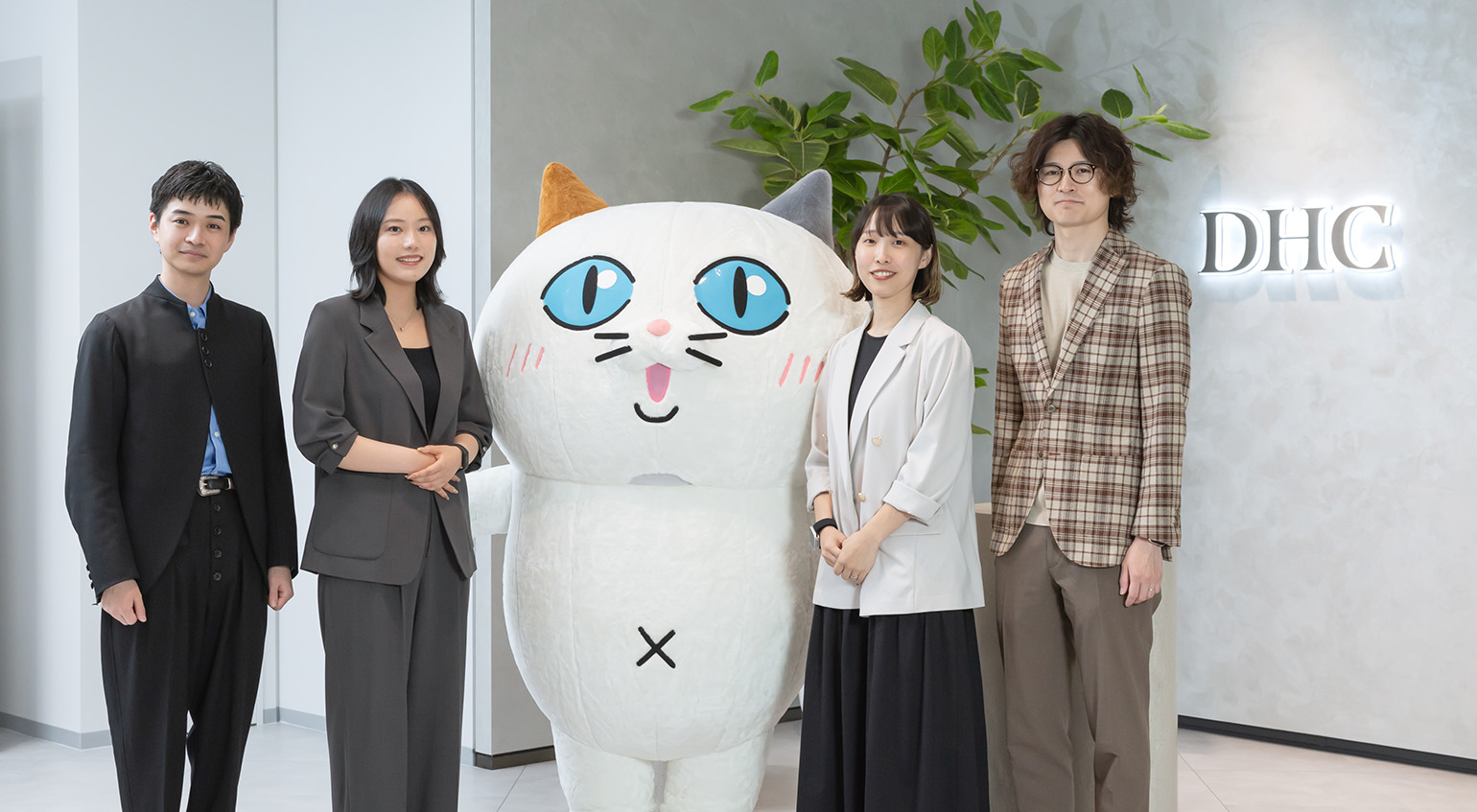
Ms. Hazuki Kameda, Marketing Promotion Group, DX & E-commerce Business Unit, DHC. She is responsible for content creation for the online store and the management of the official LINE account and email newsletters. In this initiative, she is focusing on deepening her understanding of customers to ensure communications better align with their needs.
MZ: What challenges led to this initiative?
Suda: By 2025, DHC was already working to optimize our communications and enhance personalization, and these efforts were steadily contributing to increased sales. However, while managing such a large-scale account, we felt that to achieve even more precise personalized communications, we needed to deepen our understanding of our customers even further.
Jun Suda, Marketing Promotion Group, DX & E-commerce Business Unit, DHC. He is responsible for operating the online store and for everything from strategy development to operations for the official LINE account and email newsletters. In this initiative, from the business operator’s perspective, he was tasked with organizing the data and challenges necessary for analysis and determining how to apply the resulting insights to specific measures.
Suda: “We had been conducting segmented campaigns based on purchase history and member attributes, but that was limited to customers who had linked their DHC member IDs with their LINE accounts. The challenge lay with customers who had not linked their LINE accounts, and we believed that how accurately we could understand this segment would determine our next steps.”
That’s why, starting in August 2025, we began utilizing the “SynWA project,” which allows us to analyze our first-party data by combining it with behavioral and interest data from LINE, as well as data held and linked by Dentsu Inc. and Dentsu Digital Inc.Our goal was to enhance our understanding of customers and use that insight to develop more precise targeting and messaging strategies. In addition to key performance indicators such as conversion rates (CVR) and sales, we placed a strong emphasis on improving response rates to messages and engagement levels. We launched this initiative with the key objective of advancing personalized messaging based on a deep understanding of our customers.
The “SynWA Project” Enables Analysis by Combining Various Data Sets
MZ: Could Dentsu Digital Inc., which is supporting this initiative, please explain the strategy for addressing this challenge and the “SynWA Project”?
Kim: DHC has a very large base of friends on its official LINE account, but simply delivering the same information to all customers risks not aligning with each individual’s interests and potentially leading to them blocking the account. While we could send messages utilizing member information to customers who had linked their accounts, the data available for customers who hadn’t linked their accounts was limited, so we inevitably had to rely on broad segmentation for our messaging.
Kim Hyun-ji, Group 1, LINE Planning Department, Social Engagement Design Division, Dentsu Digital Inc. This division focuses on solving challenges through social media and is responsible for planning and operational support in the CRM domain, centered on LINE Official Accounts. She has been supporting DHC since August 2024 and, in this project, served as the project manager, responsible for identifying and organizing challenges and needs, designing analysis themes, and planning verification strategies.
Kim: To deepen our understanding of customers—including those who had not yet engaged with the brand—and to explore new segments, we proposed utilizing the “SynWA project.”
This is a joint analysis project by LINE Yahoo, Dentsu Inc., and Dentsu Digital Inc. It enables multifaceted analysis by cross-referencing LINE Yahoo’s web behavioral data, the Dentsu Group’s television viewership data (*STADIA360) and location data, and the client’s own first-party data—all within a secure environment that safeguards privacy.
*STADIA360: An integrated marketing platform that enables the delivery and effectiveness verification of digital ads based on viewing data sourced from TV manufacturers—obtained with user consent—from 15.6 million connected TVs (TV sets connected to the internet) in Japan.
“SynWA Project” Concept Diagram
Kim: This initiative marks the first instance in the “SynWA project” where we utilized a client’s first-party data, allowing us to conduct analysis from a perspective unique to DHC.
What Are the Two Types of Integrated Analysis That Significantly Improved the Resolution of Customer Interests and Behavior?
MZ: How exactly did you proceed with the integrated analysis using the “SynWA project”?
Harahara: With the goal of deriving insights for ad delivery, we first conducted two types of analysis. The first was a persona analysis targeting friends of DHC’s official LINE account. In addition to segmenting users by membership status—such as high-frequency and low-frequency buyers, as well as new and dormant members—we also classified them by purchase category, such as cosmetics, health foods, and fashion, to analyze their respective interests and behavioral characteristics.
A key feature of this analysis was that by cross-referencing DHC’s customer data with LINE Yahoo’s data on interests, purchase intent, attributes, and life events, we were able to gain a deeper understanding of the friends of the LINE Official Account. The analysis revealed clear differences in interest trends depending on customer status and purchase category.
Furthermore, by analyzing the data from multiple angles—including how trends vary based on usage frequency—we were able to capture the multifaceted characteristics of customers. By using DHC’s data to identify “what kind of customers they are” and combining that with LINE Yahoo’s data, we believe we were able to gain a comprehensive, three-dimensional understanding of “what those customers are interested in and what their behavioral tendencies are.” This led to a deeper understanding of the customers.
Chihiro Haribara, Platform Data Division 1, Data & Technology Center, Dentsu Inc. At Dentsu Inc.’s Data & Technology Center, she is responsible for analysis and solution development utilizing data from platform operators, including LINE Yahoo. In this initiative, as an analyst, she was responsible for analyzing customer insights and designing segments using machine learning models by cross-referencing DHC’s first-party data with LINE Yahoo’s data.
Harahara: The second area is journey analysis. We analyzed the search behavior before and after purchase among customers who bought products via LINE Official Accounts. The results revealed that while searches related to specific products increased immediately before purchase, earlier stages showed a wide range of search behavior aimed at gathering information and comparing options.
By capturing these changes in information-seeking behavior leading up to a purchase, we were able to gain insights into when and what kind of information we should deliver based on the customer’s stage in the decision-making process.
Kameda: We hadn’t really conducted analyses from this perspective at our company before. It was a very educational experience—I realized, “So this is the kind of behavior we can observe when looking at it this way”—and I feel this initiative holds great potential.
Response Rates Improved! We narrowed down the “non-linked LINE account users” to identify those most likely to link their accounts, allowing us to approach them efficiently
MZ: How did you incorporate these analysis results into your campaign design and initiatives?
Kameda: We designed our campaigns around two main themes. The first was “promoting account linking.” Through analysis, we identified user profiles most likely to link their accounts and focused our messaging on that segment. Previously, we had sent the same message to a broad audience of users who hadn’t linked their accounts, but by narrowing our focus to those with a high intent to link, we were able to take a more efficient approach.
Harahara: Specifically, we utilized DHC’s first-party data to build a predictive model using customers who had already linked their accounts or those who had reached a certain threshold for purchase amount or frequency as training data. We then used interest and search behavior data held by LINE Yahoo as explanatory variables.
Using the model we built, we score user groups eligible for message delivery via the LINE Official Account to identify “users highly likely to link their accounts in the future” and “users highly likely to make a purchase in the future.” We infer the profiles of customers who have completed account linking from various data sources, assign a probability of linking to the unlinked group, and then deliver messages to the targeted users.
Conceptual Diagram of the Predictive Model
Kameda: The second theme is “Increasing Purchase Value.” Even among customers who purchase items in the same product category, the factors they prioritize when shopping vary from person to person. Therefore, based on insights gained from our analysis, we optimized messages and creative content for each segment. We designed the creative to resonate with the target audience by addressing their specific concerns, and Dentsu Digital Inc. has been involved in the production process as well.
As a result of these efforts, delivery efficiency and response rates have improved compared to traditional blanket campaigns, leading to higher-value communications that reduce unnecessary information from the customer’s perspective.
Integrated Design of “Who to Target and What to Deliver” Based on Analysis Results
MZ: What kind of results and feedback have you seen from this series of initiatives?
Suda: What gave me the greatest sense of accomplishment was the significant improvement in the depth of our customer understanding. Previously, we relied mainly on explicit data such as purchase history, but by combining interest data with our first-party data, we’ve become able to predict customer profiles that were previously invisible to us. I feel we’ve deepened our understanding of customers beyond the scope of member account integration and raised the precision of our campaign design to a whole new level.
Kameda: A major achievement was not just conducting the analysis, but actually applying those results to our campaigns. The “SynWA Project” was an initiative that seamlessly connected everything from customer understanding to the execution of initiatives. Precisely because so many customers have added LINE as a friend, I realized once again how important it is to design “who to reach” and “what to deliver” as a unified whole.
MZ: From the perspective of Dentsu Inc. and Dentsu Digital Inc., could you share your insights on what led to these results?
Kim: There are two key points to this initiative. The first is the ability to design approaches to customer understanding tailored to the client’s specific challenges. Since the objective this time was to “analyze customers with a high likelihood of purchase and refine our segmentation,” we designed the process with the end goal in mind right from the definition stage.
By leveraging DHC’s first-party data, we were able to visualize customer profiles based on the membership statuses and purchasing patterns that DHC typically monitors—such as “What interests do customers who purchase cosmetics have?” and “What differences exist in search behavior and areas of interest between high-ranking members and other customers?”—and analyze them from various perspectives.
Another benefit is the ability to predict similar users based on selected users and utilize them as an audience for advertising and LINE message delivery. As Mr. Kameda mentioned, the strength of the “SynWA Project” lies not just in visualization, but in the ability to implement delivery strategies aligned with specific objectives and create a cycle where the results of these initiatives are leveraged for future improvements.
Haribara: First-party data is crucial for gaining a deep understanding of customers, but it has its limitations when it comes to capturing the full picture of consumers. On the other hand, while utilizing data held by LINE Yahoo! allows for a broad analysis of consumers’ interests and behavioral characteristics, there are certain constraints when conducting analyses based on the customer profiles that clients prioritize.
In this initiative, by combining DHC’s first-party data with LINE Yahoo’s data, we were able to conduct a more multifaceted analysis based on the customer profiles that are important to DHC. Furthermore, a key feature of this initiative is that it goes beyond retargeting based solely on attributes and past behavior history; it now captures even latent needs and potential future behaviors that are not yet evident as clear actions, and utilizes these insights for targeting.
Building Long-Term Relationships Based on Customer Understanding
MZ: Finally, could you share your outlook for the future?
Suda: Through this initiative, I’ve once again realized that data-driven customer understanding has the potential to lead not only to improvements in campaign design but also to the evolution of our overall CRM strategy. Moving forward, we will further expand the scope of our analysis and the scenarios in which we apply it to gain a deeper understanding of our customers and continue building long-term relationships based on that understanding.
Kameda: Through this initiative, I sensed the potential to gain insights into customer profiles that were difficult to discern based solely on overt data. By applying the insights we’ve gained to our daily operations, we will continue to strive to deliver valuable information to customers at the optimal time, aiming for communications that yield even higher satisfaction.
Kim: Based on the insights we’ve gained, I want to deliver proposals that are valuable to customers and use them to foster an ongoing relationship with DHC and improve LTV. I intend to continue supporting DHC end-to-end—from analysis to execution and improvement—to realize communications that deliver value to both customers and DHC.
Haribara: By combining first-party data with platform data, we’ve gained confidence that we can design a seamless process—from customer understanding to campaign delivery. Moving forward, we’ll conduct repeated validation, including delivery results and purchasing behavior, to enable more precise predictions and segment design. While tracking changes in customer interests and membership status, we aim to achieve a deeper understanding of customers and design more effective communications through both analysis and strategic initiatives.
DX & E-commerce Business Unit, Marketing Promotion Group
Jun Suda
DHC Co., Ltd.
DX & E-commerce Business Unit, Marketing Promotion Group
Kim Hyun-ji
Dentsu Digital Inc.
Social Engagement Design Division, LINE Planning Department
Planner
After gaining experience in planning and implementing marketing strategies for retail financial products at a financial institution, he joined Dentsu Digital Inc. There, he was engaged in planning and proposal development in the CRM field, primarily for the finance and insurance industries. Currently, in the LINE Planning Department, he is responsible for designing communication strategies tailored to client challenges—regardless of industry—covering everything from account and tool implementation to utilization, lead generation, and campaign planning and execution.
Since joining Dentsu Inc., he has been responsible for verifying advertising effectiveness and developing solutions using data from platform operators. Currently, he is also engaged in data-driven sports marketing, including demonstrating the value of sports sponsorships and supporting sports organizations in their use of data.
Improving the Resolution of Insights for 44 Million LINE Friends and Users Without Linked Accounts! DHC’s Challenge: Integrated Analysis and Campaign Design