In Japan, where population decline is accelerating, recruiting and developing talent—particularly for regional companies—is a serious challenge. Meanwhile, rapidly evolving AI has the potential not only to address labor shortages but also to transform recruitment, training, and the very nature of organizations.
In this article, experts in regional revitalization and professionals in AI development for talent management exchanged views on the theme, “Regional Talent Recruitment and Development in an Era of Population Decline: What Does the Future Hold with the Use of AI?”
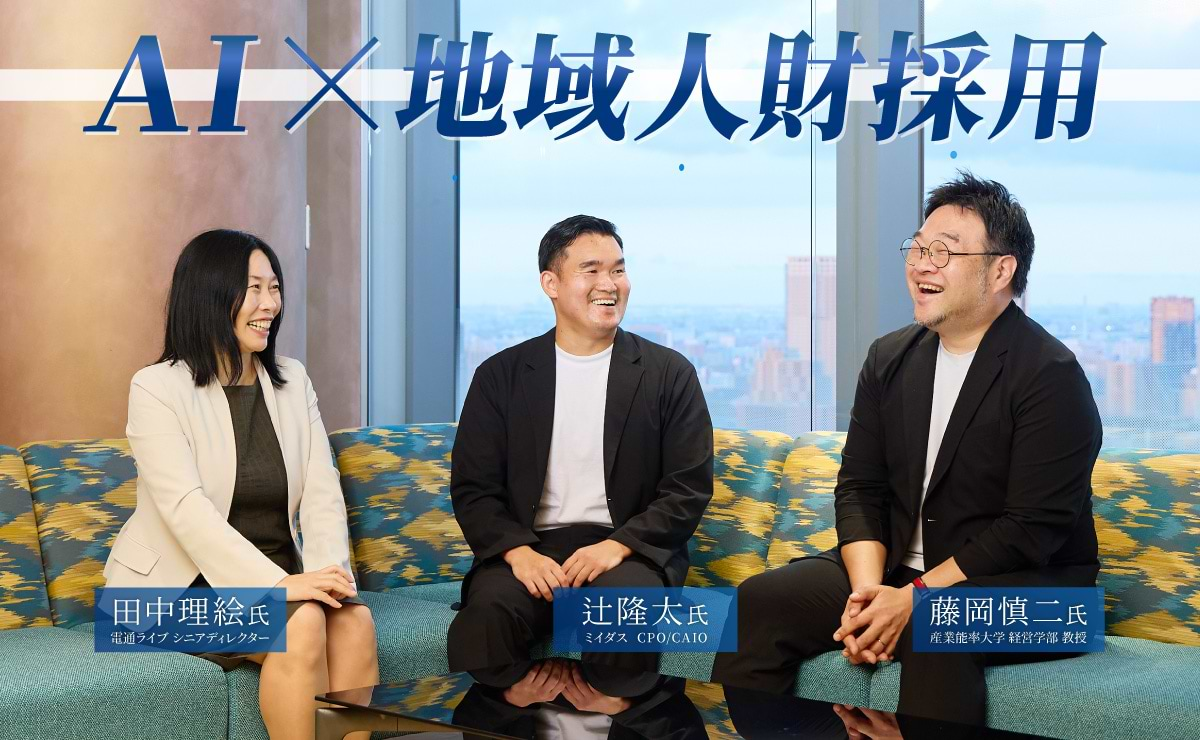
The guests were Professor Shinji Fujioka of the Japan Institute of Industrial and Management Engineers, who serves as a Regional Vitality Creation Advisor for the Ministry of Internal Affairs and Communications and a Regional Revitalization Evangelist for the Cabinet Office, and Ryuta Tsuji, CPO (Chief Product Officer) and CAIO (Chief AI Officer) at Midas (*1), a company that leverages AI and data to support talent recruitment and organizational strategy. The moderator was Rie Tanaka of Dentsu Live Inc.They discussed the challenges faced by regional recruitment teams and the value of “people” and “organizations” that is particularly sought after in the age of AI.
*1 Midas: A provider of career transition and recruitment support services. Utilizing big data from approximately 450,000 companies (as of May 2026) and AI, Midas offers “Midas AI Buddy,” a recruitment OS that streamlines all specialized recruitment tasks end-to-end using AI. As its first offering, “Midas AI Recruitment Buddy,” a service specialized for recruitment, was launched in June 2026.
The “High School Revitalization Project” to Protect Local High Schools
Tanaka: Professor Fujioka, how did you come to be involved in regional revitalization?
Fujioka: It all started in 2009 with a project in Ama Town, a remote island in Shimane Prefecture. The town had only one public high school, and if the school were to close due to declining enrollment caused by the declining birthrate and aging population, the region’s population decline would accelerate even further. So, we launched the “High School Revitalization Project ” to revitalize the entire region by revitalizing the high school. I moved there myself and worked on the project for six years, during which time student enrollment made a V-shaped recovery.Since then, this initiative has spread nationwide.
Tanaka: What exactly does this initiative entail?
Fujioka: It’s an effort to transform local public high schools into places where students want to attend, parents want their children to attend, and the community wants to keep them open. We create a supportive learning environment through publicly operated tutoring centers, develop curricula unique to the region, and establish extracurricular clubs that highlight local characteristics. Furthermore, we recruit students from across the country, inviting students from urban areas to study in our region. For local students, this also provides an opportunity to engage with diverse values.
Tanaka: When there are no longer any public high schools within commuting distance of their homes, there are cases where students—and their parents—leave the community altogether when they go on to higher education. In light of population decline, how to nurture young talent locally and how to create connections between them and the community and local businesses are crucial issues.
Professor Shinji Fujioka of the Faculty of Business Administration at Sanno University. His areas of expertise include business strategy, organizational theory, leadership, regional revitalization, and social innovation.
From “Hiring for Immediate Impact” to “Hiring for Potential”
Tanaka: Mr. Tsuji, as CPO/CAIO at Midas and the lead developer of AI-powered recruitment and training products, I imagine you have deep insights into the challenges faced by various companies. As population decline makes it increasingly difficult for companies to recruit young talent, what changes are taking place at small and medium-sized enterprises (SMEs) in local communities?
Tsuji: One major change is the trend toward “redefining the candidate persona.” In the past, there was a tendency to seek candidates who met “ideal” criteria—such as young college graduates with relevant certifications and experience. However, given current demographic trends, it’s becoming difficult to continue hiring only such candidates. Consequently, more and more companies are shifting toward “potential-based hiring,” which involves assessing not only current skills and experience but also a candidate’s personal traits and potential, with the intention of developing them after they join the company.To assess this potential, companies are utilizing competency assessments based on the “behavioral characteristics (competencies)” (*2) of their own high-performing employees. Rather than focusing on skills or background, these assessments identify “reproducible behaviors” and “cultural fit” to prevent mismatches after hiring.
*2 Behavioral characteristics (competencies): A recruitment method based on “behavioral characteristics necessary to properly perform a specific job (job type),” such as carrying out tasks accurately and reliably without errors and working collaboratively with others—rather than just skills and experience.
Tanaka: So there’s a trend among small and medium-sized enterprises in regional areas not only to hire candidates who can contribute immediately but also to develop talent in-house. On the other hand, training does involve costs.
Fujioka: That’s right. I’m also involved in recruiting, training, and managing talent moving from urban areas to rural regions, but “high school revitalization” is a specialized field where much of the learning happens through hands-on, on-the-job training (OJT), so it inevitably takes time.
Tanaka: Can AI help streamline the challenges associated with training costs?
Fujioka: I think so. Knowledge acquisition can be streamlined through online learning materials and interactions with AI.
Tsuji: It’s not uncommon for small and medium-sized enterprises in rural areas to lack dedicated HR or general affairs staff. By leveraging AI, we can supplement that specialized knowledge and reduce training costs. Furthermore, if we can use AI to accumulate employees’ knowledge and know-how, it becomes easier to pass that information on to the next person even if the current staff member leaves the company.
Ryuta Tsuji, CPO/CAIO of Miidas. “Miidas AI Buddy,” which he developed and oversees, uses AI to replicate the work of a team of recruitment experts—including HR strategy leads, recruiters, data analysts, recruitment communications specialists, recruitment marketers, onboarding specialists, and field managers—and provides these services to small and medium-sized enterprises on a single platform.
Introducing AI to Local Companies Requires “People”
Tanaka: That said, isn’t AI still a distant concept for regional SMEs?
Tsuji: It’s still quite a ways off. Even large corporations haven’t fully advanced to the point where they can tangibly feel the benefits of AI, and among small and medium-sized enterprises, there are even more companies that aren’t utilizing it at all. In particular, small and medium-sized enterprises often don’t have the resources to hire specialized personnel for each role—such as those who devise recruitment strategies, search for candidates, conduct interviews, or support new hires’ success and retention after they join. We believe that AI can supplement these specialized functions and help “democratize recruitment consulting.”
Tanaka: However, I’ve also heard that even if a company implements an AI service, it won’t take root unless there are people who know how to use it effectively.
Tsuji: That’s a crucial point. Once a company adopts our service, we don’t just provide the system and walk away. We actually send staff into the company to work alongside them—helping them figure out how to integrate the AI into their workflows and how frontline staff should use it—and we stay with them until the system is functioning properly.
We believe this “support” is particularly important for regional companies. Many companies lack in-house experts in AI or digital technology, so simply handing them the tool and saying, “Please use this feature,” won’t get the ball rolling. In some cases, we need to start by identifying the root challenges and determining which tasks can be delegated to AI.
I personally visit about 10 regional companies each month. Online conversations alone don’t reveal the reality of the situation—such as what processes are still handled on paper, who is handling which tasks, or where talent is needed. I go into the company, observe the front lines, and work together to transform their operations. I believe it’s especially important for regional companies that we support them not just in “introducing” AI, but in getting it to “actually work.”
Fujioka: It’s like the role of a so-called FDE (Forward Deployed Engineer). You go out into the field and provide support on how to use and implement the technology.
Tsuji: Exactly. As AI becomes more advanced, the technology itself will become accessible to many companies. That’s precisely why I believe the role of someone who can connect it to on-the-ground challenges is so important.
Rie Tanaka, who served as an HR Management Director (HRMD) at Dentsu Inc.’s Sustainability Consulting Office and is currently in charge of business development for initiatives such as “Emotion LABO” at Dentsu Live Inc.
How Will AI Change Recruitment?
Tanaka: So, how can AI be utilized at the very beginning of the recruitment process?
Tsuji: If matching is based solely on skills and experience, the pool of candidates becomes limited—especially for small and medium-sized enterprises in regional areas. That’s why our service, “Midas AI Recruitment Buddy,” identifies a company’s strengths and areas for improvement through an understanding of its business and comparative analysis within the industry. From creating candidate personas to designing job postings, outreach messages, and interview criteria, all the way to recruitment PR, we provide comprehensive support for every step necessary for successful hiring through a combination of “AI and people.”
Specifically, all a recruiter needs to do is enter their company’s website URL into the AI, and it will analyze the business and hiring situation to propose a personalized, optimal recruitment strategy.
In the future, by combining this with data accumulated in the company’s internal talent management system, we aim to build a system where AI agents can handle the entire process—from formulating recruitment strategies to scouting, responding to applications, conducting interviews, and handling post-hire procedures, HR operations, and personnel tasks—by analyzing trends such as “What kind of work did people who successfully transitioned from different industries do previously?” and “What competencies do high performers possess?”By entrusting tasks previously handled by multiple HR specialists to AI, we enable people to focus on “decision-making that only humans can do.”
Tanaka: In other words, this means that the question of “what kind of person would thrive at our company”—which executives and recruiters have traditionally answered based on experience and intuition—can now be visualized using AI and data.
Tsuji: That’s right. Especially in small and medium-sized enterprises, there are cases where companies start recruiting without fully defining their hiring criteria, thinking, “Someone quit, so we just have to fill the position.” In such situations, AI can provide an objective perspective.
Fujioka: I run a company myself, and since we don’t have a dedicated HR staff member, each business division handles its own hiring. Frontline employees conduct the interviews and decide, “Do I want to work with this person?” I imagine this kind of hiring is quite common even among small and medium-sized businesses in the region.
Tsuji: I think that’s quite common. While the on-the-ground perspective is certainly important, combining it with objective data provides additional information to inform hiring decisions. It’s crucial to define the ideal candidate profile based on which business areas the company wants to grow in the future and what kind of people are currently excelling within the organization.
Can AI Assess “Compatibility with the Organization”?
Fujioka: Let me ask a couple of slightly tricky questions. First, how does AI identify talent with capabilities that don’t yet exist within the company—such as the ability to create new businesses? Second, can executives in their 70s and 80s truly understand and accept the objective data presented by AI?
Tsuji: When it comes to new business ventures, it’s important to incorporate not only current data but also future plans—specifically, “what kind of business do we want to pursue going forward?” For companies that find it difficult to articulate their business plans, a human must conduct interviews and work with them to organize their thoughts.
Furthermore, if you bring up AI with executives right from the start, they often won’t understand it. You should begin by addressing the challenge of “struggling with recruitment” and gradually deliver results. It’s important to communicate in this order: “New hires leave soon after being hired. AI is one way to fill that gap.”
Fujioka: May I ask one more question? The key point is that work performance isn’t determined solely by an individual’s abilities. No matter how talented the people you hire are, it’s meaningless if the organizational culture doesn’t allow them to utilize those abilities. People work within organizations and interpersonal relationships. Will AI-based recruitment—which focuses on quantifying individual abilities—function effectively when those individuals enter a complex organizational environment?
Tsuji: That’s a crucial point. The essence of AI-driven recruitment isn’t merely measuring individual abilities; it lies in identifying the conditions under which those abilities can be fully realized within the organization and scientifically assessing the fit between the individual and the organization. This can be achieved by creating an AI-based data lake (Note 3).
*3 Data lake: An integrated platform capable of centrally managing large volumes of data, regardless of whether it is structured or unstructured.
It’s important to consider “what we want to achieve”
Tanaka: While the scope of what can be digitized is expanding, there’s also the power of the “moment”—something that can’t be put into words.
Fujioka: When I participated in Kagura in Ama Town or joined the volunteer fire department in Kanazawa, no one explained everything to me in words. I learned by using my five senses to pick up on the movements, rhythms, and atmosphere around me. This kind of physical learning can only be gained in the moment.
Tanaka: By entrusting the areas that can be digitized to AI, humans will be able to devote more energy to those analog domains.
Fujioka: Exactly. I think it’s best to use digital technology as a gateway. Jumping straight into learning Kagura is a high hurdle, but if people can have a mini-experience through video or AI, it might broaden the base of participants.
Tsuji: Ultimately, I think we’ll move toward entrusting AI with tasks that can be quantified as data or delegated to it, allowing people to focus on the work they’re truly meant to do. However, there’s still a gap in understanding between AI researchers and those working on the front lines. We need to discuss “where to apply AI and what people should be doing” across industry, government, and academia.
Fujioka: Precisely because AI has expanded the range of “what is possible,” both individuals and organizations are now being asked, “So, what do we actually want to do?” Rather than being a source of competitive advantage in and of itself, AI is a tool for amplifying the inherent value that an organization already possesses. What is our value? Whether a company is capable of confronting this question will determine its future growth, and people will naturally want to work for such companies.
In the Age of AI, the Focus Shifts to “Humanity”
Tanaka: AI holds great potential for addressing the challenges regional companies face in recruiting and developing talent—specifically, “how to fill the gaps” and “how to lighten the load each individual carries.” On the other hand, simply introducing AI won’t solve everything; it’s also necessary for people to be on the ground, identifying the organization’s values and challenges. Finally, please share a closing thought each.
Tsuji: I believe technology exists to enrich people’s lives.The essence of AI utilization lies not only in streamlining existing work but also in changing the “very premises of work” so that we can maximize human potential. I’d like to give back that insight to local communities and small and medium-sized enterprises, and help build a society where people can focus on the work they truly need to tackle. Precisely because our coexistence with AI is still in a transitional phase, I believe the key to the future lies in AI utilization that considers both technology and the human heart—not just pursuing efficiency, but also paying attention to the psychological strain caused by change.
Fujioka: The age of AI is an era that places even greater emphasis on “humanity.” Precisely because AI has expanded what is possible, we must confront more fundamental questions. What is the unique value of our organization that cannot be replaced by AI? How do we create that value, and how do we communicate it during the recruitment process? I believe that this mindset will be the key to talent acquisition going forward, regardless of whether the organization is a large corporation or a small and medium-sized enterprise.
Professor, School of Business Administration, Sanno University / Representative Director, Prima Pingino Co., Ltd.
He holds a degree from the Graduate School of Policy and Media Studies at Keio University. While engaged in education and research on regional revitalization and social innovation at Sanno University, he has also served as a Regional Strength Creation Advisor for the Ministry of Internal Affairs and Communications, a Regional Revitalization Evangelist for the Cabinet Office, a Senior Researcher at the Keio University SFC Research Institute, and a Collaborative Researcher for the OECD Japan Innovation Education Network, working across the fields of education policy and regional policy.Since 2009, he has participated in the Shimane Prefectural Oki-Shimae High School Attractiveness Project, which served as a pioneering initiative nationwide. Rather than merely pursuing school reform, the project is dedicated to “regional revitalization centered on education.”
Ryuta Tsuji
Midas Co., Ltd.
CPO (Chief Product Officer) / CAIO (Chief AI Officer)
While studying in the United States during high school and college, I witnessed firsthand the moments when technology transforms society, which led me to pursue a career in creating products that solve social issues. After experiencing rapid-growth product development and an IPO at Mercari during my student years, I led new business and product development—primarily in the areas of recruitment and AI—at Recruit, Indeed, and Rakuten. Currently, as CPO/CAIO at Midas, I am responsible for formulating product strategy, driving company-wide AI initiatives, and overseeing the product organization.
Rie Tanaka
株式会社電通ライブ
シニアディレクター
After working at a telecommunications company, I joined Dentsu Inc. In 2026, I was seconded to Dentsu Live Inc. After establishing insight research teams such as “Dentsu Wakamon” and the “Dietary Habits Lab,” I was seconded to Dentsu Digital Inc. in 2016 and to the data science department of a consumer goods manufacturer in 2017.Upon returning to Dentsu Inc., he led international research, branding, and consulting at the Global Business Center, while concurrently serving in the Dentsu Group and the Sustainability Consulting Office. Since 2022, he has served as Executive Coordinator at Kanazawa University’s Organization for the Promotion of Advanced Science and Social Co-creation. Since 2024, he has been a partner at the Certified NPO Service Grant.