Note: This website was automatically translated, so some terms or nuances may not be completely accurate.
 How to Find That One Phrase [3/10]
Not writing, but "finding."
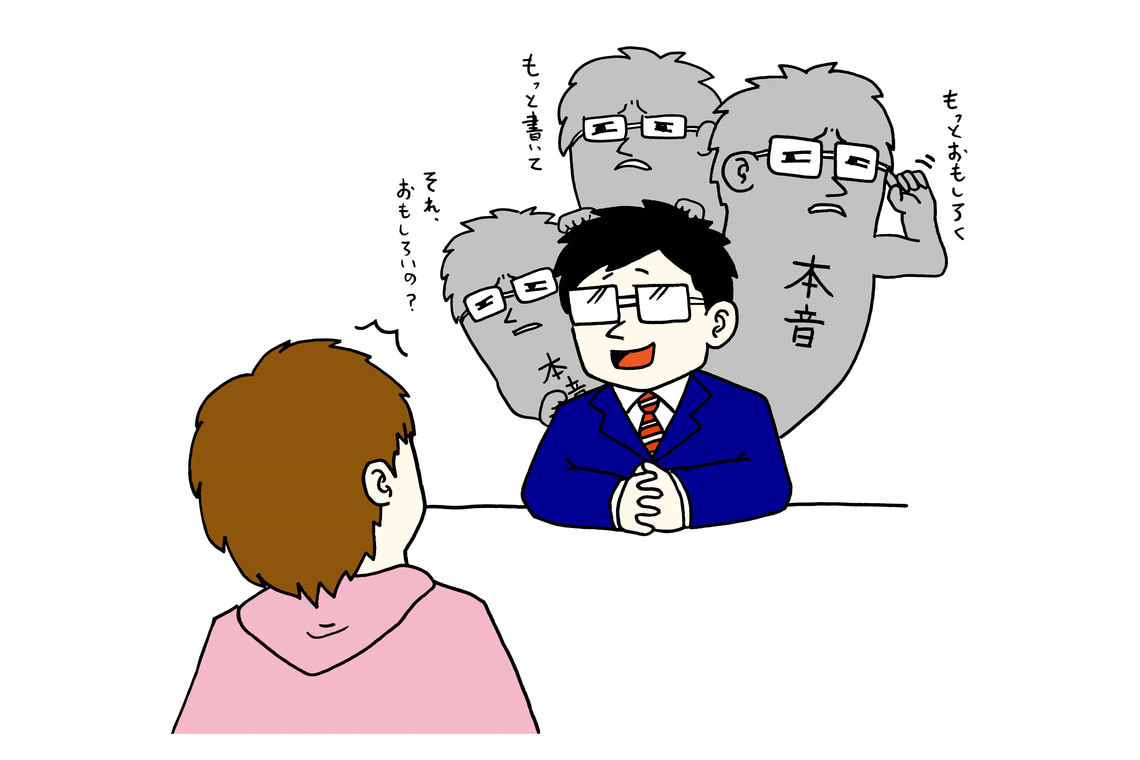
When I introduce myself as a copywriter at Dentsu Inc., I'm often asked questions like, "How do you come up with words as a copywriter?" or "How do ideas just pop into your head?"
But I don't think ideas spring from within or just pop out instantly. It feels more like "finding" them.
The copywriter's job isn't to develop a product's value themselves, but to go out and discover what that value is by looking at it from various angles.
This is somewhat similar to finding the right angle. When you find a good angle, good copy naturally follows. It's not about thinking, "I need to write something clever," but rather, "Can I find something valuable? Can I uncover a compelling fact?"
I believe this "treasure hunt" mentality—the search for something only you might discover—is the key to writing that people actually want to read.
If I had to sum up the copywriter's job in one phrase,
"someone who writes what everyone thinks, but in words different from everyone else's."
If you write something no one else is thinking, no one will understand
If you write about things nobody thinks, nobody will understand you.
But if you can write what everyone is thinking in words that are different from everyone else's, it becomes, "Ah, that's exactly how I wanted it said!" The person who can write that is a copywriter.
The key is not to invent these "things everyone thinks," but to discover them as facts. It's about finding the right angle.
Once you find it, the copywriter's job begins: figuring out how to express it. You think of slightly fresh writing using words nobody else uses, expressions that aren't hackneyed.
I think that's what makes words truly resonate with people. Looking back at the previous concept of "the multiplication of angle and expression,"
What everyone is thinking (angle)

Writing with words different from everyone else (expression)

Words that resonate with people (copy)
That's the idea.
So, what specific training should we do to "find" this?
I make it a habit to think about why something catches my attention. That's because it gives me a chance to consider, "What do other people think about this?"
For example, when hearing news or reading magazines, I ask, "Why is this trending now?" When watching movies or TV dramas, I think about why I found it interesting and try to articulate reasons others might share. When I pick up something unusual in a store, I imagine, "Why was this product created?" By constantly seeking reasons like this, your imagination starts working on "what everyone is thinking," and your repertoire of perspectives should expand.
In my case, by consciously practicing this kind of training daily, it eventually became a habit. Now, no matter what I'm doing, I naturally find myself thinking about the reasons behind things.
Come to think of it, Mother Teresa once said,
"Watch your actions, for they will become your habits."
The process of finding that reason is incredibly tough. It's exhausting enough to make
The process of finding it is truly grueling. It's grueling enough to make you want to throw up. But you will find it. Once you do, you're just a little bit away from words that truly reach people.
|
|
Illustration: Daisaku Maeda (Dentsu Inc., Creative Planning Division 4) |
Was this article helpful?
Share this article


Newsletter registration is here
We select and publish important news every day
For inquiries about this article
Back Numbers

Author

Yosuke Watanabe
Dentsu Inc.
4th CR Planning Bureau (on assignment to Dentsu Inc. Isobar)