
Note: This website was automatically translated, so some terms or nuances may not be completely accurate.
 Digital Fabrication Transforming Manufacturing [1/1]
In an era where anyone can create things, 3D printers are changing the world.

Tsuyoshi Mizukawa
In a previous series I wrote titled "Communication Technology Connecting Individuals and Companies," I introduced the use of 3D printers and innovation. Dentsu Inc. also launched an internal project (the D3D Project) late last year. (That series led to my being selected as one of the members!)
While 3D printers are increasingly featured not only in industry-focused news but also in general media, they are not just a technology with a promising future—they have already become part of our everyday lives. Drawing on such real-world examples, I will introduce the current state of manufacturing using 3D printers, which are becoming synonymous with digital fabrication.
The Era of Everyone Being Able to Make Things with 3D Printers Has Arrived
The devices and technology that form the basis of what we now call 3D printers first appeared in the 1980s. While overseas manufacturers are now the major players, Japanese researchers and manufacturers were also announcing advanced technologies back then. As is often the case with new technologies, patent applications were filed alongside research, creating a situation that made it difficult to advance product development involving the entire industry.
By 2009, patents held by the major US manufacturer Stratasys for its FDM (Fused Deposition Modeling) technology expired. This patent expiration made it possible to manufacture the products now called "home 3D printers" (the counterpart being commercial 3D printers) at a low cost.
Following FDM, patents for laser sintering—a cutting-edge 3D printing technology—began expiring in 2014. That year saw numerous magazine features dedicated to 3D printers, driven by this very development. The expiration of laser sintering patents has spurred increased manufacturer participation, and the market is predicted to grow even more vibrant from here on out.
※ As objective data, Gartner's "Hype Cycle for Emerging Technologies: 2014," published last August, states that "3D Scanners" and "Enterprise 3D Printing" have moved beyond the market's "Peak of Inflated Expectations" and "Trough of Disillusionment" phases into the "Slope of Enlightenment." It predicts these technologies will be adopted as mainstream within 2 to 5 years. (Reference: Gartner "Hype Cycle for Emerging Technologies, 2014" http://www.gartner.co.jp/press/html/pr20140903-01.html )
Even this?! Everyday Products "Printed"
Since printer patents only recently expired, is this technology still out of reach for consumers? Not at all. Products "printed" with 3D printers are gradually spreading throughout the world.
Take apparel, for example. Printed clothing and shoes are being showcased at events like Paris Fashion Week. The photo on the left shows one such shoe. As you can see, it features an extremely complex design. Yet, with just CAD or CG data, a 3D printer can output it without any assembly or sewing.
Beyond collection pieces, US manufacturers are selling sports shoes utilizing 3D printing. The upper part is made from printed resin material, achieving a design that supports intense movements during exercise. Material flexibility is increasing year by year. Printers compatible with filaments (the equivalent of ink in 2D printers) made from materials like wood and nylon are being developed. Most recently, a watch utilizing this technology was released.
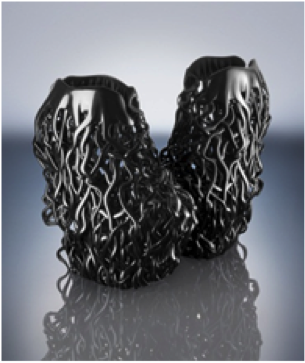
Before printed clothing becomes more widespread, challenges remain: developing surface finishing techniques for texture and feel, ensuring comfort as everyday wear, achieving durability for washing, and creating printable materials. Once these hurdles are overcome, an era will arrive where each person can scan their own body and obtain literally perfect-fitting clothes without trying them on. In stores, when stock runs out, they'll simply print more, so the day we nostalgically recall "special orders" may be near.
Heavy Industry Goes "Printing"!?
While fashion items are a familiar example, various efforts are underway across other industries to make digital fabrication practical. The automotive sector is one such example. Last year, the IMTS manufacturing trade show was held in the US. Local Motors, an exhibiting company, made headlines by printing an electric vehicle (strictly speaking, the body and chassis) at their booth during the event and even driving it around the venue. Honda's US subsidiary is also publicly sharing 3D data for cars they sell online.
Attempts are also underway to create objects larger and more expensive than cars using 3D printers. In Amsterdam, the Netherlands, a project is progressing to construct entire canal houses along the waterways using digital fabrication. Since printers large enough to output an entire house in one piece don't yet exist, they plan to build rooms and other sections in multiple parts. Incidentally, another Dutch architect gained attention by designing a residence based on the Möbius strip—known for its ∞ symbol—as a "house without a beginning or end." This home is also planned to be printed using a 3D printer, with construction expected to take a year and a half.
Is data creation the key?
We've introduced the current state of digital fabrication through various examples, but what will be key to the future development of 3D printers? One factor is operating technology. As mentioned earlier, preparing CAD or CG data is essential for 3D printing. Of course, so-called "home-use" 3D printers are already available today. However, for true household adoption—like printing replacement parts for broken furniture, or purchasing data to print items yourself instead of having them delivered via e-commerce—mastering the output data is essential. It remains to be seen whether services enabling easy data creation will gain popularity, or if the market value of 3D data operators will rise to match that of today's smartphone app programmers. But the demand in this field is undeniable.
Recently, digital fabrication services are increasing, including facilities like FabCafe where you can experience digital fabrication in a broad sense, including 3D printing, and online services like rinkak, operated by kabuku, a member of the D3D project. If reading this article has sparked your interest in digital fabrication, why not dive into this new world of making things?
Was this article helpful?
Share this article


Newsletter registration is here
We select and publish important news every day
For inquiries about this article
Author