
Note: This website was automatically translated, so some terms or nuances may not be completely accurate.
 Japan Study Talk [1/2]
Japan and Life: What an 85-Year-Old Master Told Me in New York (Part 1)
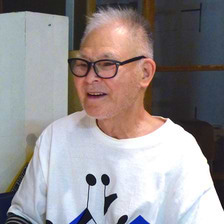
Takeshi Kawashima
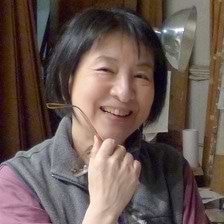
Junko Kawashima
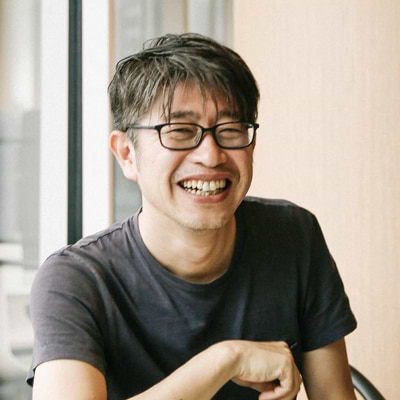
Hidetoshi Kurashige
Creative Project Base Co., Ltd.
What should Japan look like in 2020 and beyond? What is the essence of Japan's originality? DENTSU SOKEN INC. Japan Study Group presents a new series exploring hints for Japan's future through Talk (=interview) with Japanese individuals active in various fields overseas. For the first installment, DENTSU SOKEN INC. Creative Director Hidetoshi Kurashige visited the Soho studio of artist Takeshi Kawashima and his wife Junko, who have been active in New York for nearly 50 years.
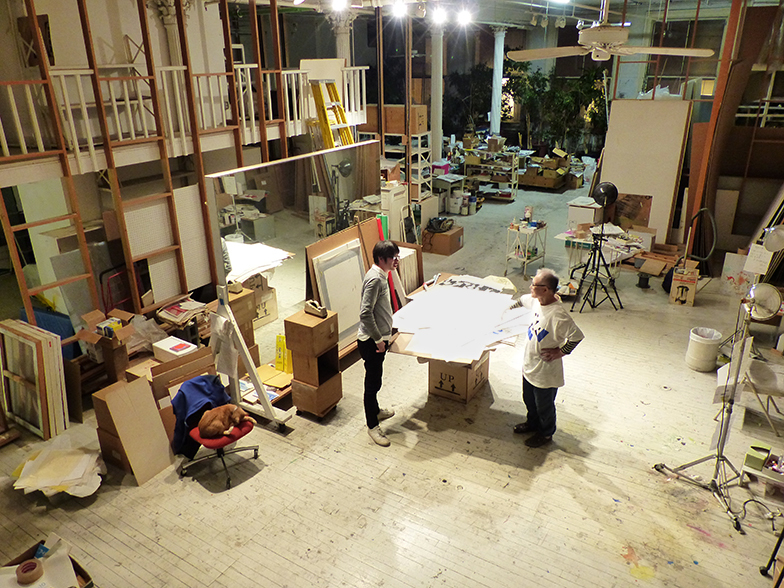
From Takamatsu to New York. The keyword: Anti-Status.
Kurashige: When did you come to New York?
Kawashima: 1963. The year Kennedy was assassinated. I was 33. Japanese people couldn't come to America back then. Because we were the enemy nation in the war. But then restrictions lifted, and once people could come for tourism or whatever, I jumped at the chance. When I first came to New York, sure enough, people called me "Jap." "Hey, Jap!" Walking alone was dangerous. Even going to parties or events, you had to go with two or three friends, or it was risky.
Kurashige: Why New York?
Kawashima: Because everyone went to Paris. Frankly, it was like Tokyo University—I didn't want to go somewhere that carried status. Plus, I was an outsider. I wasn't part of any group, organization, or university. I was a lone wolf, so I had no interest in those places. Even if I went, I wouldn't have any seniors there. That's why I wanted to go to a new country.
Up until then, everyone went to Paris and London. New York came much later. To be blunt, New York was just a place where rich people fled from all over the world (because of the war, etc.), so it had no status. Many people stopped over in New York before going to Paris and stayed there. So, somehow, the image was that New York City had this huge complex, so they threw everything they had into culture and art. That's what changed America.
For example, buildings like this one in Soho? Lindsay (John Lindsay, former Mayor of New York) preserved them. Manhattan, you see, went all skyscraper. These are historic preservation buildings, where only artists approved by the city are allowed to live. People gathered there who did things completely different from the norm—different clothes, different food, detached from the usual capitalist society. So Soho became this special zone. And that made it even more... well, weird, or rather, a precious place.
Junko: My husband was probably one of the first people to buy a loft in Soho. The Museum of Modern Art (MoMA) bought his work, so New York City gave him an Artist Certificate. That's how he was able to buy it.
Kurashige: So he liked painting since he was a child?
Kawashima: Well, liking painting was just a given. But it was an era when painting held no status. Japan's culture is multifaceted, right? There's tea ceremony, dance, Japanese painting, Western-style painting—it's all diversified. Art was seen as a hobby, and people would say, "You're so privileged." Painting incomprehensible pictures, spending money, making a living off it—the ultimate disobedient child, you know. In the countryside, that image still lingered back then.
Well, if you were an art teacher, won a newcomer's prize in a contest, or belonged to an art group, that carried status, so my parents did lend me money. I was invited to join art groups too, but even if you joined, only one or two people ever became famous. So, I ended up coming to New York.
Kurashina: So you went to what's now Musashino Art University, right?
Kawashima: I didn't want to go, but if I didn't, my parents wouldn't send me money. They could tell the neighbors and relatives, "Our Takeshi is going to art school." He's the eldest son, right? He's left home. Just saying "he's painting" makes him a disobedient son, but art school is an excuse.
Kurashiro: (Flipping through the portfolio) Look at this page—there's a nude figure, and then suddenly you jump to this abstract painting. What happened in between?

Kawashima: Well, I think I just wanted to paint what I liked. Plus, I didn't have any money, so I used pen on white paper. This looks yellow now, but it was white paper. But even the paper was cheap stuff.
Junko: This kind of thing was already being done in Japan. So it wasn't like I suddenly jumped to it.
Kurashige: Do you ever think Kawashima-san's work is an expression only possible because he's Japanese?
Kawashima: I've never thought about that.
Kurashige: Do people ever say things like, "Ah, this feels Japanese"?
Kawashima: Saying something is "Japanese" or whatever is just the crow's prerogative. People's perspectives are as varied as the preferences of the opposite sex. I just wanted to paint pictures that would influence people here, as a Japanese artist creating Japanese work. You see, everyone just copies avant-garde artists from Europe or America—Picasso, Matisse, Renoir, and so on. So I didn't want to do that. I decided to go in the opposite direction.
Junko: Should I tell them that story? Right after you came to New York, you didn't go to museums or galleries at all. For like half a year—a really long time. Basically, because seeing things would influence you. You said, "Before I get influenced, I'll just paint my own work." That's why you came to New York. Usually, people go see things right away when they arrive. At least galleries or something.
Kurashige: Well, you'd do market research first, right?
Junko: But he didn't do any of that. He just painted. And those paintings from that time? They're in MoMA's permanent collection.
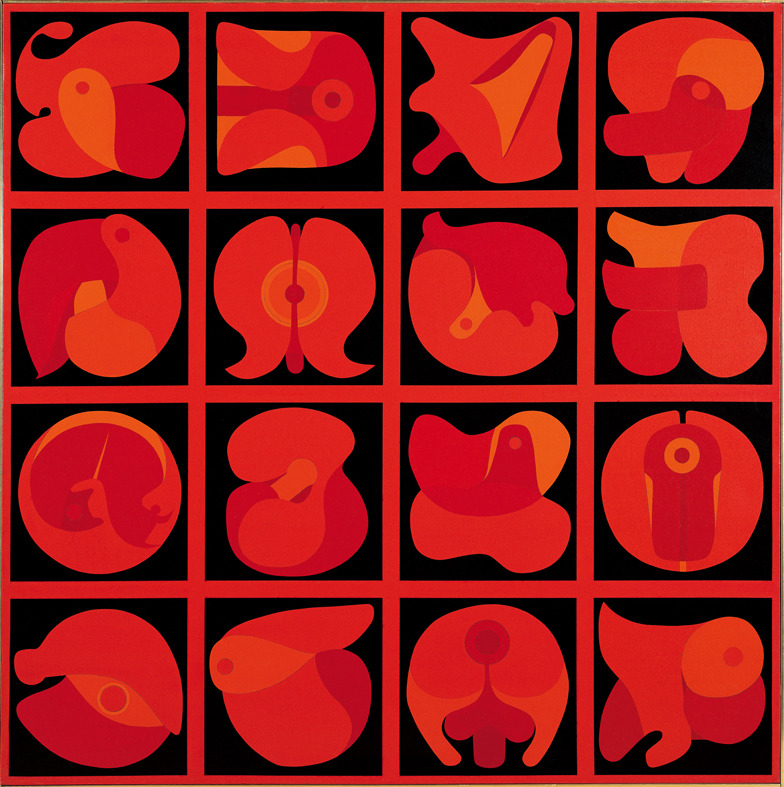
"New Symbolism – Red and Black," 1964, part of MoMA's permanent collection
Junko: So he wasn't influenced at all. He had this strong conviction about it.
Kawashima: It wasn't that he thought "I mustn't be influenced." It was more like, before being influenced, he wanted to do the work he'd been doing in Japan.
What brought the two of them together was "what they were thinking and what they were trying to do."
Kurashige: When did you come, Junko?
Junko: I came in 1972. The year Japan and China normalized relations. The year Okinawa reverted to Japan.
Kurashige: Why did you come to New York?
Junko: (Pointing at Kawashima) You, of course. Or something like that (laughs).
Kawashima: Ah, I met her in Japan and brought her here.
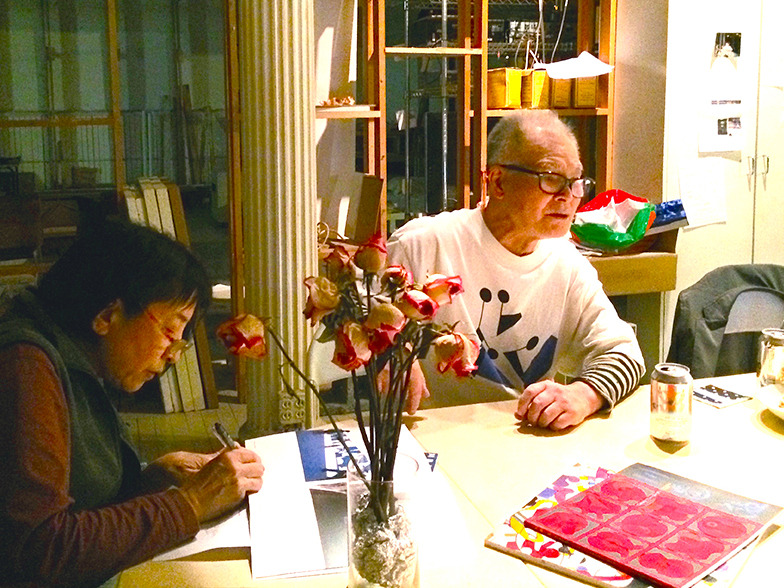
Junko: There was this huge, super popular gallery in Tokyo's Aoyama called the Pinar Gallery, and I was working there. The owner of the Pinar Gallery told me, "There's this guy named Takeshi Kawashima who's been making waves in New York. He's back home after seven years, doing an exhibition in Kagawa Prefecture. I'm thinking of doing one at our gallery too. What do you think?" That was the start. At the time, I only saw the artwork, and I was just stunned. "Whoa, is this painting?" I thought. I wondered what kind of person could create this, and when I met him a few days later, it was him.
So my husband always says, "She didn't fall for me, she fell for the paintings." He says things like, "Isn't that just the best?" (laughs). When I look at people, I can't help but look deep inside them. What they're interested in, what they're trying to do.
Kurashige: Now that you mention it, I feel like the emails and letters I got from Junko-san were probing my inner self (laugh).
(※This was Mr. Kurashige's third meeting with the Kawashima couple; he had even stayed overnight at the studio where this interview took place)
Junko: I just have to see that part, you know? People always say things like, "Do you want someone tall?" or "Do you want someone kind?" Or "What about income? What about their job?" But honestly, who cares about that stuff? What matters is what they're thinking and what they're trying to do.
Kawashima: Flattery. (laugh)
(Continued in the second half )
Notice:
Saturday, April 18, 2015 - Wednesday, April 29, 2015
An exhibition by Takeshi Kawashima will be held at Gallery Shimada in Kobe City.
Details here: http://gallery-shimada.com/
Was this article helpful?
Share this article


Newsletter registration is here
We select and publish important news every day
For inquiries about this article
Author
Takeshi Kawashima
Artist
Junko Kawashima
Hidetoshi Kurashige
Creative Project Base Co., Ltd.
Representative Director/Creative Project Director