Note: This website was automatically translated, so some terms or nuances may not be completely accurate.
 Human Flow Analyzed Through Location-Based Big Data [2/7]
Blue Bottle Coffee Through Location Data: Part 2
This is Akimoto, a researcher at Dentsu Inc.'s "Human Flow Lab." This is the second installment in our series, "Let's Examine Customer Flow at Blue Bottle Coffee Kiyosumi-Shirakawa Using Mobile Phone Location Big Data."
Please refer to the first article here
Blue Bottle Coffee Through Location Data - Part 1
This series is produced in collaboration with the NewsPicks editorial team, who are serializing "Coffee 3.0."
View NewsPicks' Blue Bottle Coffee-related articles here.
[Data in Slides] Where Did Blue Bottle Draw Its Customers From?
https://newspicks.com/news/1036877
[Data in Slides] Which age groups responded to Blue Bottle?
https://newspicks.com/news/1034236
[Data in Slides] Is Blue Bottle's Popularity Real?
https://newspicks.com/news/1033380
Last time, we examined visitor trends over approximately two months from opening day to confirm the peak of excitement and the degree of establishment.
The summary of the previous analysis is as follows.
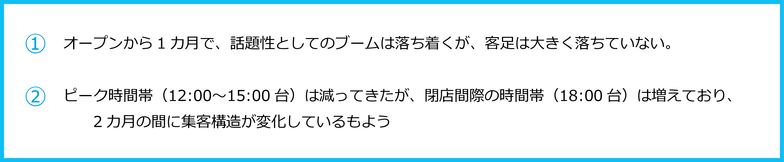
This time, we'll delve deeper into point ②.
By examining visitors during peak hours (12:00 PM to 3:00 PM) and just before closing (6:00 PM), broken down by gender, age, and residence, we aim to gain a deeper understanding of changes in the customer attraction structure.
Women in their 20s: Quick to heat up, quick to cool down
Let's examine the trend in external visitor growth every Friday from the opening day, February 6th (Friday), to two months later on April 10th (Friday), focusing specifically on women who visited between 12:00 PM and 3:00 PM.
For the data collection criteria, please refer to the previous article.
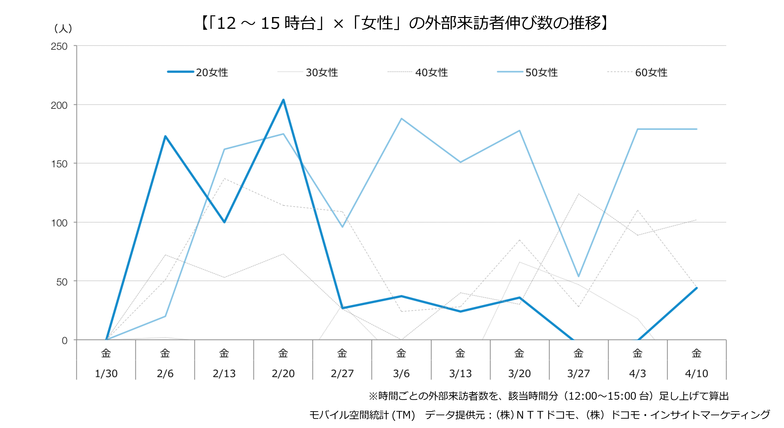
The first thing that catches the eye is the movement of women in their 20s.
Their behavior perfectly fits the phrase "quick to heat up and cool down," as they became the driving force behind the boom only to see a sharp decline within a month.
In contrast, women in their 50s show a peak rising one week later, followed by sustained visits thereafter.
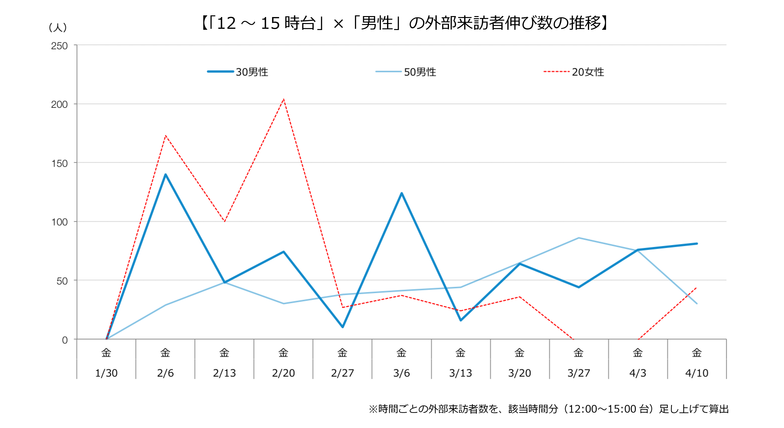
During this period, male visits were fewer compared to female visits, so we isolated the distinctive groups of men in their 30s and 50s.
Surprisingly, it wasn't men in their 20s who showed the most fad-driven, jump-on-the-bandwagon behavior at the opening; it was men in their 30s.
Visits by men in their 50s are also gradually increasing.
Residents of Setagaya and Adachi wards, whose patterns overlap with women in their 20s
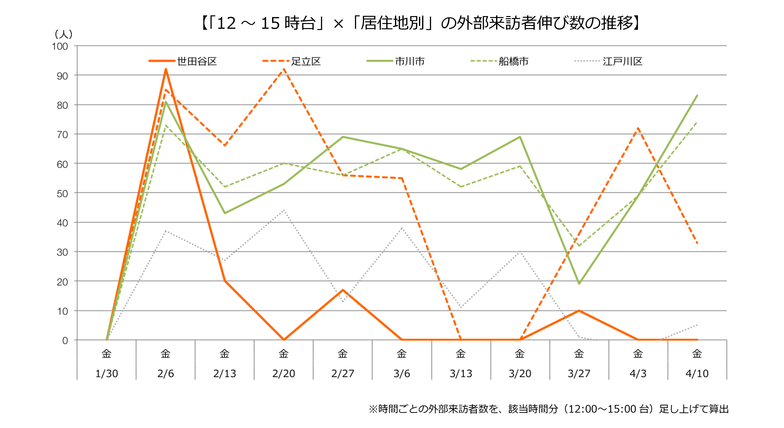
Now, let's look at visitors between 12:00 PM and 3:00 PM by residential area.
Since the residential areas are diverse, we've highlighted municipalities with a significant increase in visitors and notable characteristics.
Residents of Setagaya and Adachi wards concentrated their visits early in the opening period.
In contrast, visitors from Ichikawa City and Funabashi City continued steadily without extreme drops.
Considering this alongside gender and age trends, we can imagine that initially, the store successfully attracted women in their 20s and men in their 30s living in Setagaya and Adachi. Subsequently, it appears to have consistently drawn women in their 50s residing in Ichikawa and Funabashi.
The increase in external visitors represents the change compared to before opening, excluding local Koto Ward residents. In reality, we believe a large number of Koto Ward residents and residents from neighboring wards (Edogawa Ward, Sumida Ward) visited. However, it seems safe to say that the opening of Blue Bottle Coffee has created a previously unseen flow of people from farther away.
"Purposeful visits" and "incidental visits." Incidental visits will continue.
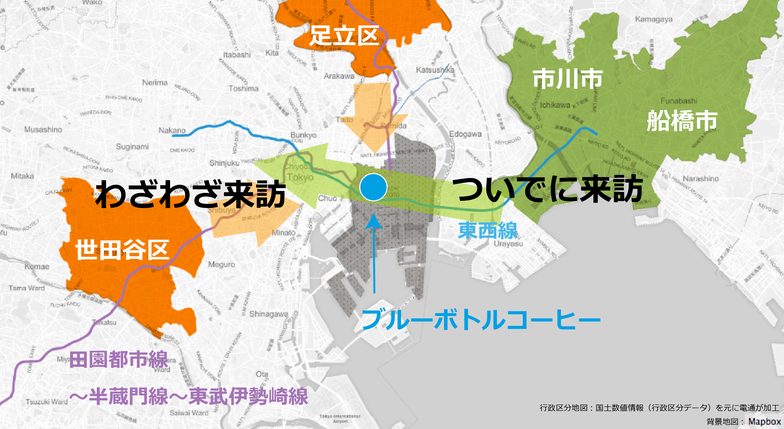
Let's examine the earlier movement on a map.
Although Setagaya Ward and Adachi Ward are not adjacent to Koto Ward, where the Blue Bottle Coffee Kiyosumi-Shirakawa store is located, the Den-en-toshi Line and Hanzomon Line, as well as the Isesaki Line and Hanzomon Line, connect, allowing direct access to Kiyosumi-Shirakawa Station without transfers.
At the opening, numerous "special trips" were made by trend-conscious women in their 20s and men in their 30s residing in both wards, likely leading to the long lines.
Meanwhile, Ichikawa City and Funabashi City connect to Monzen-Nakacho Station, another nearby station, via the Tozai Line.
From the perspective of Ichikawa City and Funabashi City residents, Monzen-Nakacho serves as a stop en route to central Tokyo.
It's likely that people, primarily women in their 50s, with business in the city center are stopping by Blue Bottle Coffee on their way to and from their destinations.
This "convenient stop" pattern has persisted even after two months, in stark contrast to the significant decline in "deliberate visits."
Closing time sees "visits on the way home" by men from the adjacent ward
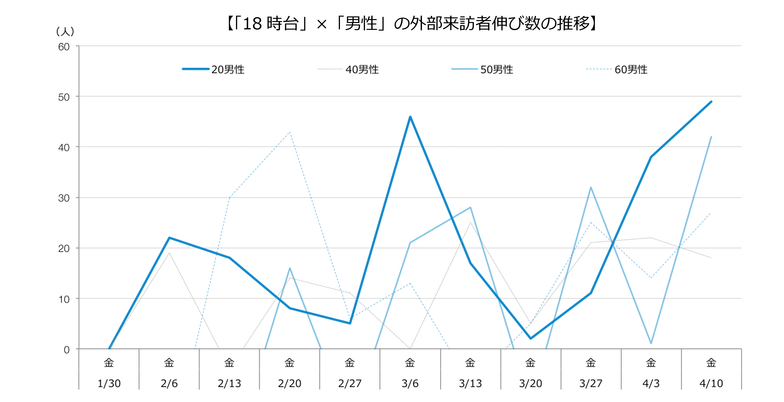
Similarly, let's examine the visitor attributes around 6:00 PM, just before closing.
Since there were few female visitors during this time, we focused on the generation with distinctive characteristics among the male visitors.
While there are fluctuations across each age group, from around March 6th—about a month after opening—visitor numbers gradually increased across a wide age range.
It's easy to imagine coffee-loving men timing their visits to just before closing, once the crowds have died down.
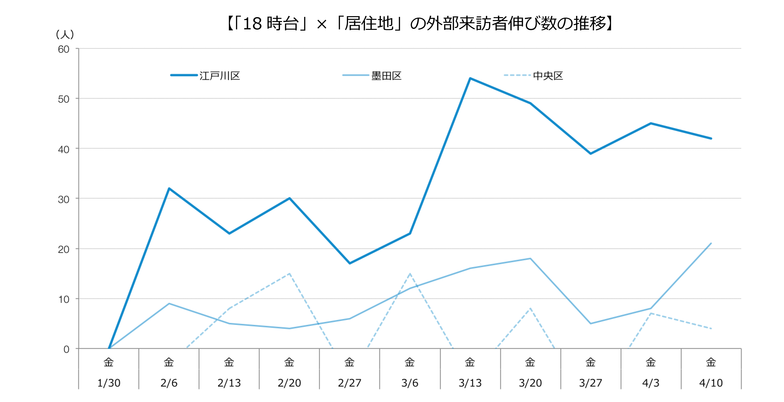
Significant visitor growth was only confirmed in the adjacent wards.
Among the adjacent wards, Edogawa and Sumida are showing growth, but Chuo Ward is trending downward.
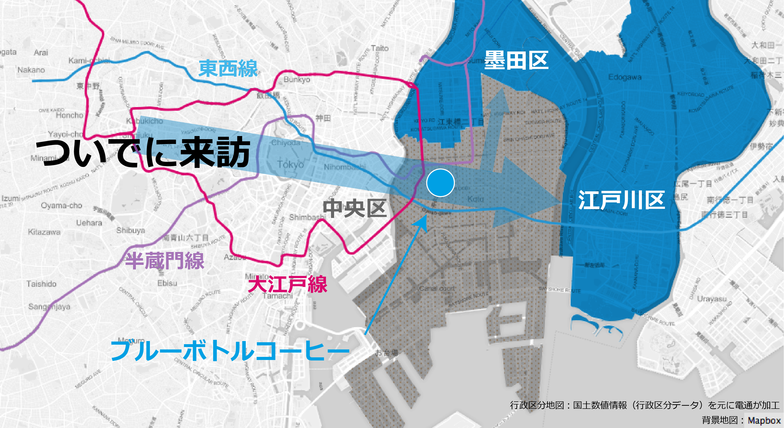
For residents of Edogawa and Sumida wards who work in central Tokyo, Kiyosumi-Shirakawa Station and Monzen-Nakacho Station are stations on their way home. On the other hand, residents of Chuo Ward need to pass their nearest station to get there.
It appears that "incidental visits" by residents of Edogawa and Sumida wards are increasing, while "deliberate visits" by residents of Chuo ward are decreasing.
Summary
What did you think of this look at Blue Bottle Coffee using location-based big data?
Here's a summary of this analysis.
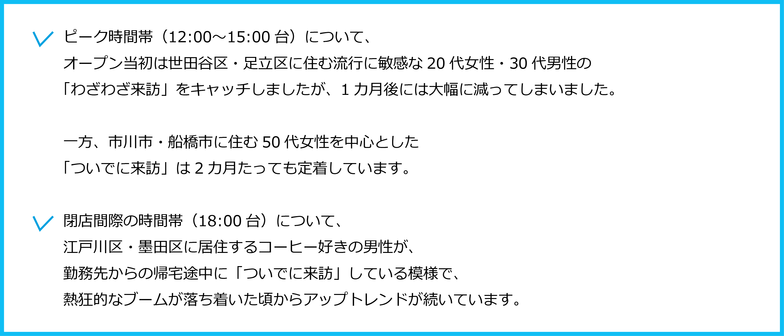
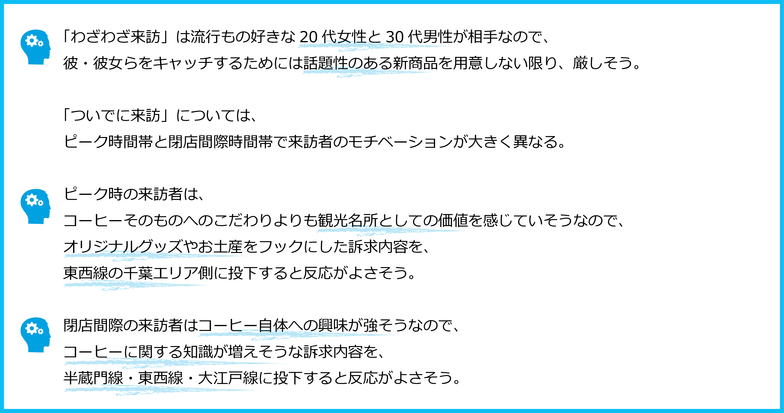
When boosting customer traffic, communication design must align with visitors' motivations and daily routes. Leveraging location-based big data enhances the accuracy of design hypotheses.
For example, in this case, based on hypotheses like the following, you can quickly set the appeal content and target area.
In the final installment next time, we'll analyze whether Blue Bottle Coffee's branding was accepted as intended, using location-based big data and social media post data.
NewsPicks: NewsPicks offers original articles created by Japan's top infographic editors, providing easy-to-understand business insights.

Mobile Spatial Statistics is population statistical information created using NTT DOCOMO's mobile phone network system. "Mobile Spatial Statistics" is a trademark of NTT DOCOMO.

Contact: Dentsu Inc. Human Flow Lab
contact@hitononagarelab.jp

Was this article helpful?
Share this article


Newsletter registration is here
We select and publish important news every day
For inquiries about this article
Author

Ken Akimoto
Dentsu Inc.
Data Technology Center Geodata Solutions Department