
Note: This website was automatically translated, so some terms or nuances may not be completely accurate.
 Behind the Scenes of "Expressions That Resonate" [7/18]
Interview with Tomohiro Tachi, Assistant Professor at the University of Tokyo Graduate School "The Future of Origami as Envisioned by Researchers"
Tomohiro Tachi
Behind the Scenes of "Effective Expression"
We focus on and hear from "promoters of successful expressive activities" across various fields.
Today, the world of origami is not only pursued in the realms of art and design but has also become a research subject spanning various academic disciplines. International conferences are held, attracting diverse talent from fields ranging from design theory, engineering, and mathematics to education and the arts. While my primary specialty is architecture, my activities extend beyond engineering applications to include research on micro-scale structures and geometry, as well as software development.
This rabbit is origami made from a single sheet of paper. I spent ten hours painstakingly folding it by hand. However, three-dimensional pieces like this can't be created by folding randomly; you need to think backwards about how to achieve this shape. The design method in origami involves envisioning the final form and then planning the folding sequence to achieve it.
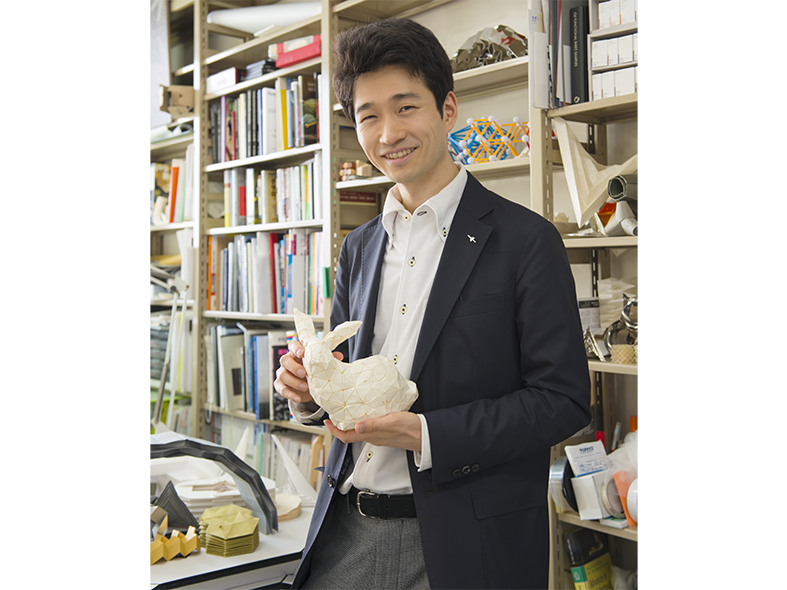
Of course, some artists create by visualizing everything in their minds, but three-dimensional pieces are quite challenging. After much trial and error, I realized that to work backwards from a 3D object to a 2D paper pattern, you ultimately need to use a computer to solve the geometric calculations. Initially, I designed each piece by hand, calculating everything manually. But as I worked, I realized: Couldn't we create a software system that generates the 2D folding pattern for any 3D object? Well, let's try it. That's how "Origamizer" was born—software that automatically creates a 2D folded net when you input the 3D shape you want to make. Currently, we offer three types of software online: the "Freeform Origami" and "Rigid Origami Simulator" have been added. It seems to be used overseas for design education purposes as well.
Applications of origami technology are already advancing. The "Miura fold," devised over 40 years ago by Professor Emeritus Kōsuke Miura of the University of Tokyo, is widely used for storing and deploying solar panels on artificial satellites. The bellows-like structural material I announced last year is also made by folding a flat surface, but while it can be easily extended and retracted, any other deformation requires 400 times the force of extension and retraction. In fact, this structure also uses the "Miura fold" technique.
My ultimate goal now is to create a mechanism that folds itself. This is the concept of "self-folding." For example, if we can create a mechanism that continuously transforms itself by skillfully combining materials with different expansion rates on the front and back surfaces, or materials that change shape depending on heat and light conditions, it will greatly reduce human labor.
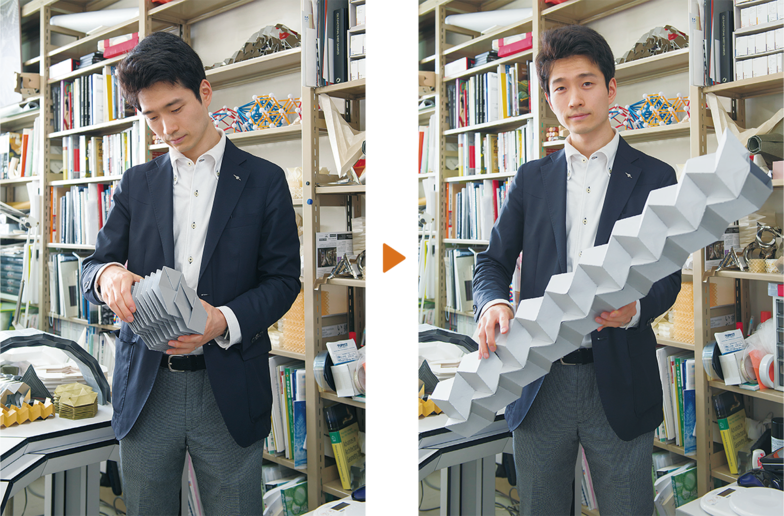
How will manufacturing change in the 21st century? Of course, existing manufacturing methods will remain, but I believe there will be new forms of manufacturing, such as self-folding, where the material folds itself. For example, living organisms are not assembled by machines. Instead, the material itself, DNA, contains the design information and works on its own to create form. It's an analogy of that kind of thing. 3D printers are also a new way of thinking about manufacturing, but the good thing about folding is that everything can be done on a flat surface. I expect that the concept of making things by unfolding something that has been folded flat will develop so that it can be realized not only with paper but also with various materials and on various scales, such as the architectural scale. Origami holds unknown possibilities.
Was this article helpful?
Share this article


Newsletter registration is here
We select and publish important news every day
For inquiries about this article
Back Numbers

Author
Tomohiro Tachi
Assistant Professor, Department of Interdisciplinary Systems Science, Graduate School of Arts and Sciences, The University of Tokyo