
Note: This website was automatically translated, so some terms or nuances may not be completely accurate.
 Evolving E-Commerce: What Does the New Era Look Like? [1/4]
"Cheap, Fast, and Long Tail Are Not Added Value, but the Standard" - Analysis of Japan's E-Commerce Market
Japan's e-commerce market has now grown to exceed 13 trillion yen. Advances in communication infrastructure and devices have made e-commerce accessible to many, gradually transforming our lifestyles and values. In this series, moderated by Junichi Kamino of Dentsu Inc., we explore the future of e-commerce. In Part 1, Mr. Kaneno, Ms. Naoko Ozaki, and Mr. Takanori Iwai from Dentsu Inc. Promotion & Design Bureau analyze a survey they conducted on the e-commerce market.
Part 3:Amazon: Embodiment of "The Most Customer-Centric Company on Earth"
Part 4:Opening Purchase Data, Product Design... The Future of EC Created Through Co-Creation Between LOHACO and Manufacturers
Kanno: This time, as a preliminary step before interviewing key industry players, we aim to clarify the current state of Japan's e-commerce market through an examination of a survey conducted independently by Dentsu Inc.'s Promotion & Design Bureau.
Survey Overview
Purpose: To understand actual e-commerce usage and consumer attitudes
Method: Web survey
Area: Nationwide
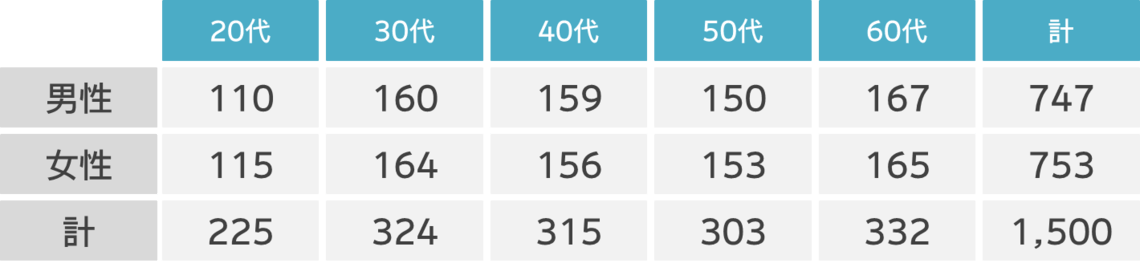
Subjects: Users of e-commerce sites within the past year (※Used any of Amazon, Rakuten Ichiba, Yahoo! Shopping, LOHACO, or Yodobashi.com within the past year) Total: 1,500 respondents. Sample sizes by gender and age group are shown in the table below.
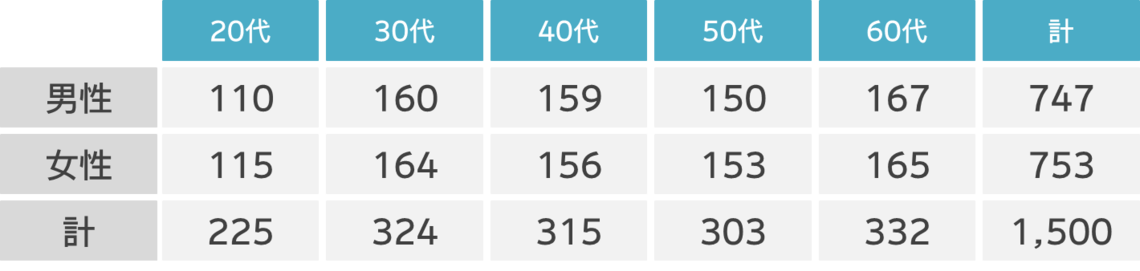
Schedule: May 19, 2016 (Thu) - Screening, May 23, 2016 (Mon) - Main Survey
Ozaki: According to data from the Ministry of Economy, Trade and Industry, the size of Japan's domestic e-commerce market in 2015 was over 13.7 trillion yen. Although there are differences by category, the market size is growing steadily and has surpassed the total sales of department stores and supermarkets. Next year marks 20 years since Rakuten Ichiba launched in Japan. The e-commerce market, which has become deeply ingrained in daily life, is expected to continue growing and further permeate everyday activities.

Ministry of Economy, Trade and Industry: Fiscal Year 2015 Infrastructure Development for the Informatization and Servitization of Japan's Economy and Society (Market Survey on Electronic Commerce) - Longitudinal Trends in BtoC-EC Market Size and EC Penetration Rate

Ministry of Economy, Trade and Industry: FY2015 Infrastructure Development for Informatization and Servitization of Japan's Economy and Society (Market Survey on Electronic Commerce) - BtoC-EC Market Size and EC Penetration Rate Over Time
Kamiya: On the other hand, I sense a shift in the market landscape. While growth has historically been driven by improvements in price, product selection, and delivery speed, I feel this growth engine fueled by such "fundamental capabilities" has reached its end.
I believe Amazon created this situation. With its overwhelming product selection, low prices, and speed delivery at the next-day or even one-hour level, it's no exaggeration to say that the company, while leading the industry, has established a certain standard among e-commerce users. Amazon's next-day delivery coverage in Japan exceeds 95% nationwide, meaning this "standard" has been raised to a sufficiently high level. In this sense, differentiation among e-commerce players going forward will increasingly depend less on competing on these core elements and more on the direction of value-added services and corporate branding.
Iwai: Looking at the recent business scale of major players, Amazon truly stands out. Its sales last year were nearly ¥1 trillion, and SimilarWeb data shows its May visitor count approached 400 million.
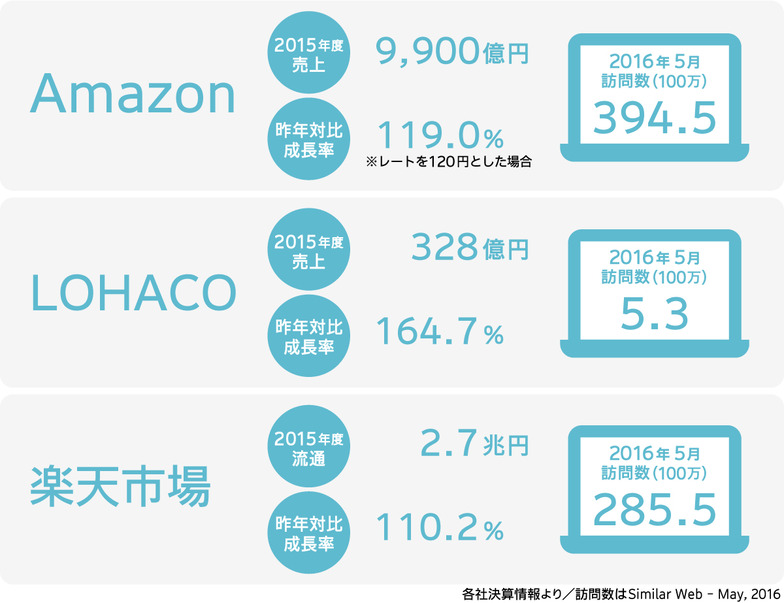
Simultaneously, recent earnings reports show Yahoo and LOHACO also posting significant year-over-year sales growth of 140% and 165% respectively, indicating robust market-wide activity.
Kanno: Comparing dwell time and page views is also interesting. While some suggested Rakuten might have higher dwell time and page views compared to Amazon, which prioritizes high convenience, versus Rakuten's mall-style approach emphasizing browsing, the May comparison between Amazon and Rakuten shows almost no difference between the two.

Iwai: In surveys of e-commerce users, Amazon ranked top among major players on items related to site image, such as "trustworthy" and "wide product selection." Furthermore, considering that Amazon scored higher than other services in "information prioritized on the site" for "product details," "product reviews," and "recommended products," it seems users are utilizing it not only as a place to buy but also as a place to learn about products.

Ozaki: While LOHACO's scale still lags behind the top two players, it notably ranked first in brand image items like "good taste," "unique," and "stylish." I believe its initiatives—such as collaborative product development with manufacturers centered on "designs that blend into daily life" and content-driven appeals like Style LOHACO—are effectively building a loyal fanbase.
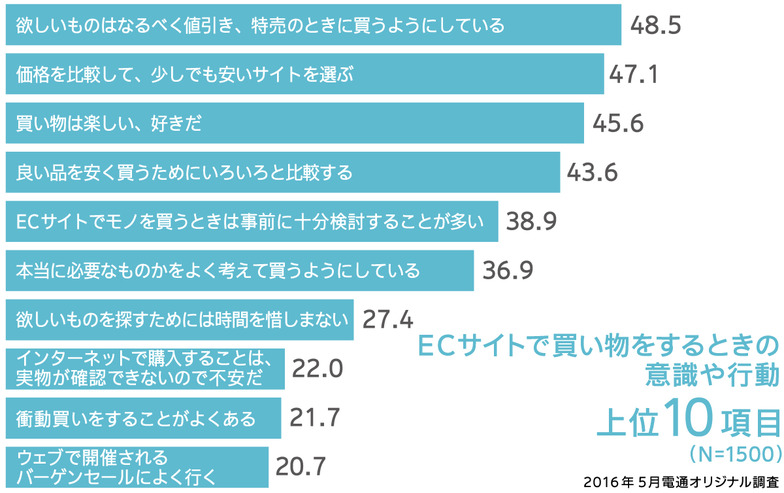
Kanno: From the shopping mindset of e-commerce users, we see a tendency to "enjoy shopping, compare products thoroughly, and seek smart ways to buy at a good value." This suggests they aren't just looking for the cheapest option, but want to shop smartly. While LOHACO runs sales, its store design, as Ozaki mentioned, focuses on creating a "beautiful lifestyle" – perhaps that's why it's gaining support.
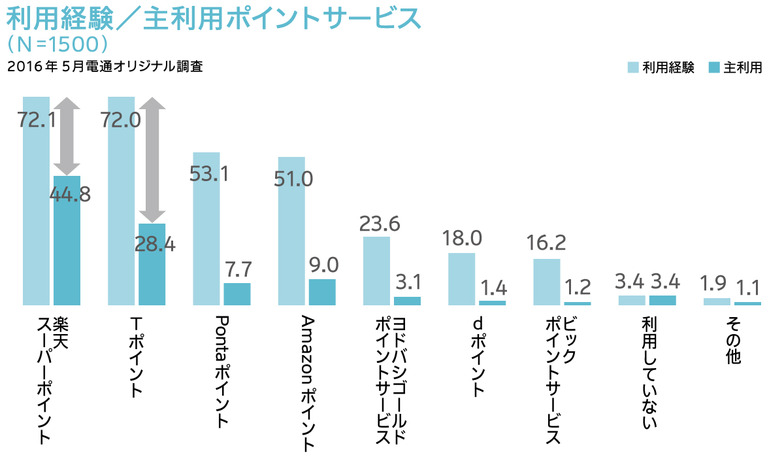
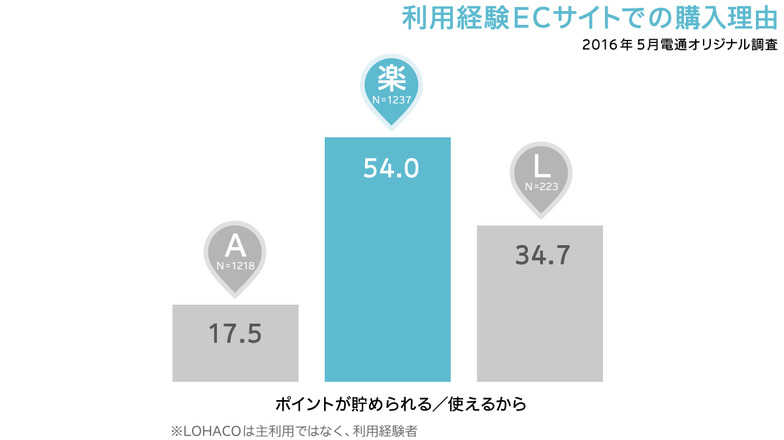
Ozaki: Regarding the perspective of seeking value, Rakuten is overwhelmingly dominant in point-related surveys. While T Point and Rakuten are the two major players in point service usage experience, Rakuten Super Points significantly outpace competitors as the primary point service used. Furthermore, Rakuten users cite point services as a reason for purchasing on the site.
Iwai: Regarding points, the survey on where people earn and spend them yielded interesting results. While earning locations are diverse, including physical stores, e-commerce sites are by far the most popular place for spending points.
Kanno: When considering e-commerce, it seems increasingly important not to focus solely on e-commerce itself, but to consider the whole lifestyle. It makes sense that Rakuten, operating a mall-style business, is diversifying its operations centered around points. Recently, at its earnings announcements, Rakuten has been promoting the phrase "No.1 Membership Company," clearly articulating this strategy.
Iwai: It's about building an ecosystem and enhancing penetration into daily life. To increase that penetration, I believe it's increasingly important to consider convenience across all usage scenarios, keeping in mind the growing number of smartphone users.
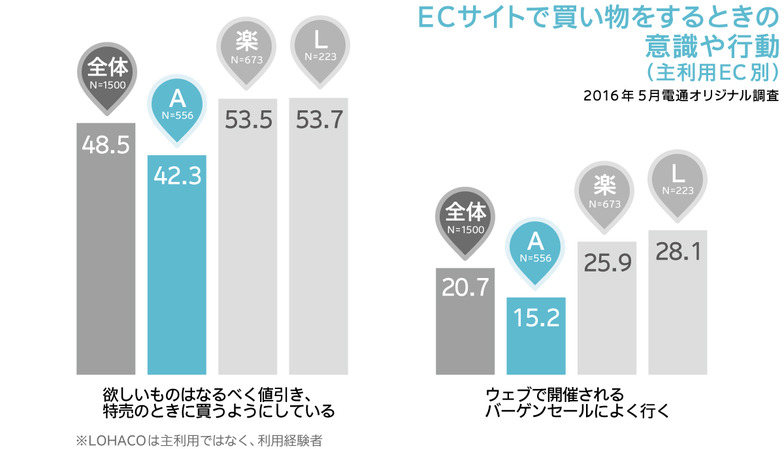
Kanno: Rakuten dominates with its points system, and it has also frequently run sales. On the other hand, the relatively low awareness of discounts and sales among Amazon users is a noteworthy point highlighting the difference between the two companies.
Ozaki: In this survey, we asked about usage intentions for various services. It was striking that the highest demand was for services allowing specified delivery dates and times. Regarding delivery time, preference scores decreased in this order: specified date/time > next day > within 3 days > same day > within 1 hour > within 20 minutes.
Of course, the "I want it now" need will persist. But at the same time, this likely shows a stronger demand, as Iwai-san also pointed out, for services that fit one's lifestyle. It will be interesting to see how consumer needs evolve as ultra-fast delivery options like within one hour become more commonplace.
Kanno: I believe consumers' criteria for choosing services are shifting from uniform scale expansion and efficiency toward whether a service provides what suits them personally.
Starting next time, we'll explore the future of e-commerce through interviews with key industry players—Rakuten, Amazon, and Lohaco—whose business foundations are entirely different despite appearing similar at first glance.
Was this article helpful?
Share this article


Newsletter registration is here
We select and publish important news every day
For inquiries about this article
Author

Junichi Kanno

Naoko Ozaki
Dentsu Inc.
Promotion Design Bureau
Planning Manager

Takanori Iwai
Dentsu Inc.
Second Integrated Solutions Bureau
Strategic Planner