Note: This website was automatically translated, so some terms or nuances may not be completely accurate.
 Why Companies Invest in Experience Design [2/2]
Questioning ideas everyone agrees on: What's essential for innovative experience design
" Experience design " is a problem-solving approach centered on the user experience. In the first part, we explained why experience design has started gaining attention in areas like website and app design.
In this second part, we continue our conversation with Mr. Noriaki Okada of Dentsu Inc. Experience Design Department, exploring the hurdles to achieving innovative experience design and how to approach the work.
Ideas that everyone finds "interesting" are boring
――Are there any real-world examples you consider innovative experience design?
Services provided by companies are becoming increasingly complex. Simply focusing on a single element makes it difficult to create truly innovative services. I believe that for a product or service to be innovative, it must incorporate three essential elements: "user experience," "business," and "technology."
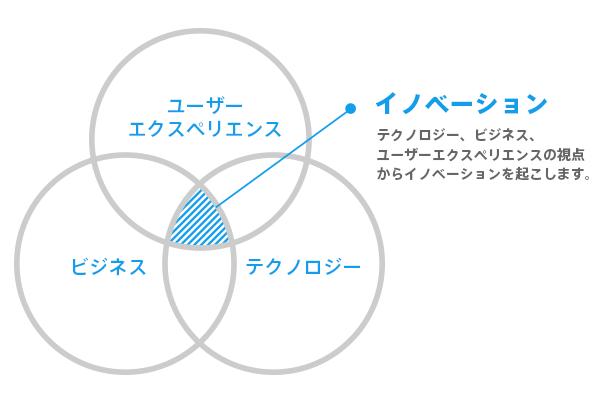
Sharing services like Uber (ride-hailing) and Airbnb (private lodging) are clear examples of innovative experience design.
In Uber's case, three elements come together: the business ingenuity of utilizing ordinary drivers who previously weren't a resource; the technological application of a ride-hailing app; and providing users with a smooth, stress-free transportation experience.
Airbnb also created a new business model by matching hosts worldwide who want to rent out their vacant rooms with travelers seeking accommodations. Travelers can easily select lodging tailored to their needs—whether for vacations or business trips—using the app or web service. Furthermore, since last year, hosts have been able to sell experiences like guided tours in addition to lodging.
Another recent example is Amazon's voice recognition service, Alexa. It offers a conversational shopping experience using voice recognition and AI technology. Opening its API to gather data is a bold business move typical of Amazon, and its efforts to collaborate with third parties to create diverse user experiences are truly impressive.
However, innovative ideas often spark debate, making it difficult to push them forward within a company. A common scenario is that even when ideas are proposed, many people counter them, making it hard to gain internal buy-in.
To realize something innovative, the first success condition is convincing the company internally and breaking through resistance. Uber and Airbnb would likely have been shot down based on their proposals alone, so actually bringing them to life is truly impressive.
――Innovative ideas are difficult to gain understanding for precisely because they are unprecedented and revolutionary. What is necessary for internal coordination?
Whether within the company or among client contacts, people vary greatly. You need to tailor your communication strategy to each person: "Explain this one quantitatively with data , " or "Appeal to that one's intuition." I make an effort to adapt my approach to each person to make the idea easier to accept.
However, ideas that everyone immediately finds "interesting" often turn out dull when actually implemented as a service. I believe something isn't truly interesting unless it sparks debate, and it isn't truly innovative unless a certain number of people oppose it.
Are brand guidelines becoming outdated?
――I understand ideas are crucial for experience design. Are there other themes gaining attention within the industry?
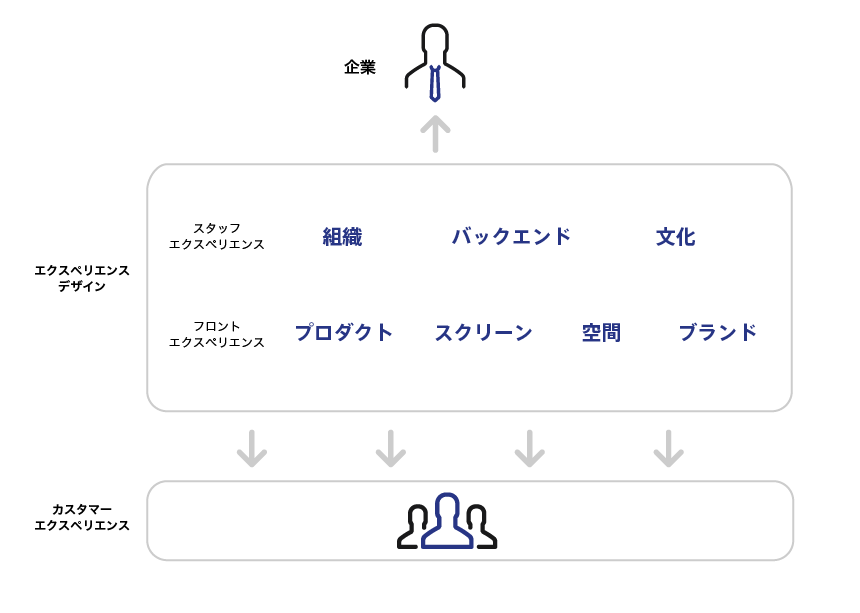
While this falls outside the realm of innovation, initiatives that improve end-user experiences by enhancing organizational structures, backend operations, and company culture are gaining industry-wide attention.
On the other hand, one increasingly common task is establishing design guidelines. In Japan, many companies still use guidelines created during the post-bubble CI/VI (Corporate Identity/Visual Identity) boom, largely unchanged.
One company's guidelines, despite being read by various job roles, were about 100 pages long in PDF format. It was impossible to know where to find the information you needed. People often skimmed through it, and because they didn't understand, they ended up interpreting things themselves and creating their own designs. This inevitably led to a lack of consistency.
For example, most companies define brand colors. However, while CMYK values for print are meticulously defined, RGB values for smartphones and monitors might be based on arbitrary conversions from CMYK, or only web-safe colors might be specified.
With on-screen devices like smartphones becoming the primary customer touchpoint in recent years, outdated guidelines designed for print need updating.
In Europe and the US, logos are evolving to be simpler, optimized for on-screen display, not just for web services. Mastercard is one example, and AT&T's logo, compared to before, has reduced the number of colors and simplified its design to look better on small screens.
They are optimizing for where they need maximum exposure today. Guidelines are also being updated to reflect the diversification of current customer touchpoints. Furthermore, improving the usability of guidelines ultimately enhances the end-user experience.
Experience design truly comes to life when implemented in services and products
――So refining brand guidelines is also part of experience design, right?
Proposals on how to consider the end-user experience through brand guidelines are also increasing recently. Even for the same client, the proposal content changes depending on the department requesting it, such as "service development," "brand guideline development," or "marketing support." We often coordinate with various departments.
Regardless, I believe experience design isn't just about strategizing and conceptualizing; it's crucial to actually create the final service or product.
The strength of implementing experience design within an advertising agency lies in our ability to handle the entire process: from ideas and service/product design, through commercialization, to how we promote and generate buzz around the finished product.

――What are some challenges you face when advancing experience design?
A single project can take one to two years to reach final release. It requires coordination across departments, and the client's internal environment changes, so honestly, it's quite challenging. Communication is extremely important because issues sometimes get sent back multiple times without resolution within the responsible department, or integration with core systems might not be achievable.
――Are there any tips for facilitating effective internal communication?
Holding an initial workshop is effective. It helps shift stakeholders' mindset toward customer-centricity and fosters a shared understanding of the project's challenges.
By involving people from other departments, not just one, we build shared understanding. Participants from other departments become evangelists, making subsequent project progress smoother.
Workshop design varies depending on the challenge. Some workshops focus on aggregating and visualizing hard-to-articulate corporate issues, while others concentrate on developing concepts. For the latter, we sometimes start with a prepared hypothesis concept and refine it during the workshop.
In any case, since people within the company know their own organization best, we become skilled listeners. We help them effectively utilize the database in their minds, shaping concepts and ideas through a collaborative process with the client.
――What do you hope to achieve with experience design going forward?
We're currently working on launching a new service, which we view as a labor-intensive undertaking comparable to starting a new venture company. It requires thinking holistically about not just creating the core service concept, but also experience design, business development, ROI, and even the background business flows and operations.
Furthermore, how we disseminate the resulting product or service is crucial. While integrated campaign direction centered around mass advertising is one benchmark for advertising agencies, we view this current project as integrated direction encompassing all areas centered around service development. It's incredibly rewarding.
Of course, Dentsu Inc. doesn't handle everything alone. I believe that only by dividing roles with the client and seeing everything through to completion can we achieve truly excellent experience design. I'm eager to create such a case study soon.
This article is also published on the Web Manager Forum.
http://web-tan.forum.impressrd.jp/e/2017/05/11/25595
Was this article helpful?
Share this article


Newsletter registration is here
We select and publish important news every day
For inquiries about this article
Author

Noriaki Okada
Dentsu Inc.
CDC Experience Design Department
Creative Director