Note: This website was automatically translated, so some terms or nuances may not be completely accurate.
 Why Companies Invest in Experience Design [1/2]
What is Experience Design? How does it differ from UX?
"Experience Design" literally means "designing (the user's) experience," but it remains a vague and abstract concept that is difficult to visualize.
As the era shifts from consuming "things" to consuming "experiences," experience design—which centers customer experiences when developing services and products—is gaining attention in website and app design.
Why are companies now focusing on experience design? We asked Mr. Noriaki Okada of Dentsu Inc.'s Experience Design Department about the mindset for solving challenges through experience design.
Experience design begins with defining the problem
――When I hear "experience design," I have a general idea, but is there a clear definition?
Experience design is one problem-solving approach centered on the user experience.
Today, advertising agencies receive requests not only for traditional campaigns but also for web services, brand development, and sometimes even future-oriented prototyping – essentially, all kinds of corporate challenges.
The challenges companies need to solve are broad, encompassing business challenges, staff challenges, and customer challenges. Experience design refers to the process of defining the specific challenge to be solved within this scope, determining what kind of experience should be provided to whom to solve it, and then implementing that solution.
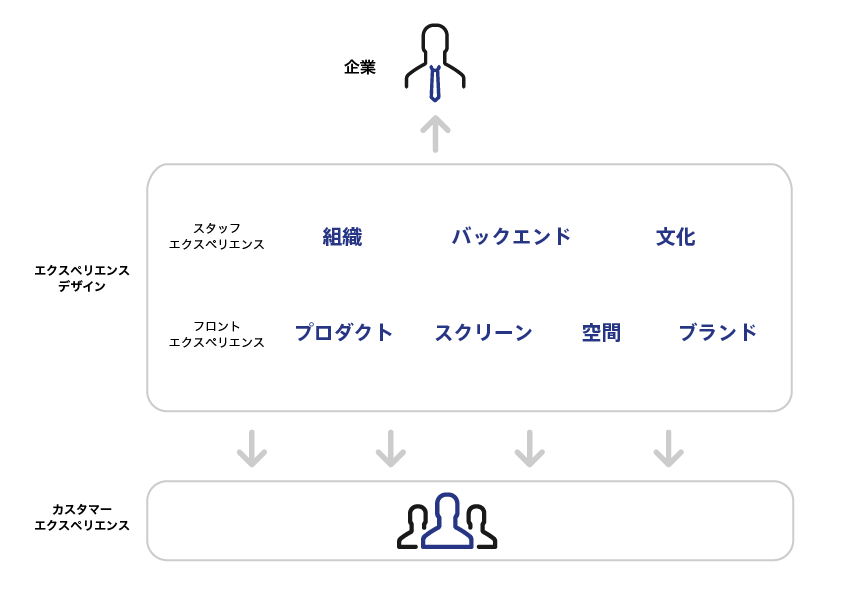
When we talk about experience design, people often think only of the front-end experience that users directly touch or interact with. But it's not just that. As shown in Figure 1, we broadly consider it divided into the "staff experience" for internal personnel and the "front-end experience" for customers.
For example, when considering experience design for a mobile app, it's common to start by creating a customer journey (the path to converting users into customers) to visualize touchpoints. The next step often focuses primarily on the front-end aspects like "information architecture" and "UI design."
However, when actually implementing these optimally, it's often crucial to consider backend dashboards and staff operations.
Depending on the challenge, the primary focus might shift to fundamental aspects like redefining the business, establishing specialized teams, or defining the brand. Ultimately, through this series of activities, the goal is to improve the end-user experience.
The term "experience design" covers such a broad scope that it's often lumped together indiscriminately. However, the required actions differ significantly between product experience design and web service experience design.
For products, front-end design and developing new operations based on that design are crucial. Conversely, for web services, optimizing performance or creating CMS dashboards might be the key focus. Even under the umbrella term "experience design," the specific tasks required differ.
What we prioritize is applying the appropriate mindset and methodologies for the specific experience design target, ultimately translating them into tangible products or services. While some experience design may end at the vision or concept stage, we believe that considering the end-user experience necessitates bringing it to its final form.
――So, experience design means defining business challenges from both the company's and customer's perspectives, determining what actions to take, and combining the optimal methods to improve the user experience?
Yes. Whether addressing corporate business challenges or customer issues, we believe having a wide range of methods is crucial for tackling diverse problems. Often, after defining the customer journey and visualizing touchpoints, we combine methods based on the challenges identified at each point.
For web services, we sometimes derive solutions from quantitative data analysis. However, when rethinking the service concept itself, we might start with qualitative design research. It's crucial to consider what best matches the challenge and balance qualitative and quantitative approaches.
Corporate challenges are rarely straightforward, so I believe we need to not only combine methods but also customize them.
More important than definition is how to solve the problem
――Can you share an improvement example?
For example, consider a smartphone app renewal in the travel industry. Before the renewal, the interface was very emotional and stylish, but it had the drawback of being difficult to use as a tool.
As the strategy for the smartphone app renewal, we prioritized making it convenient for "frequent users." We conducted information architecture by identifying what users needed and what would be convenient for them.
As a result, we revamped the app with a focus on functionality, unique operability, and visual design, leading to a more than tenfold increase in monthly sales generated by the app.
For the tablet app, we added a feature that displays personalized information tailored to users just before they depart on their trip.
Google refers to the behavior of searching for information on a device the moment one feels the urge to do something as a "micro-moment." In this case, we focused on designing the experience around these micro-moments—small contact points within the customer journey.
――What is the difference between experience design and UX or service design?
In terms of definitions, "UX" refers to designing the user experience, while "service design" covers creating services and designing their experience. While clearly defining terms might be useful for sharing knowledge with others, personally, I don't place much emphasis on the definitions themselves.
When creating new businesses or services from scratch, "service design" might be easier to understand, while "experience design" could imply a slightly narrower scope. However, I don't think one is "superior" to the other, and either term is fine.
Rather than focusing on definitional differences, what truly matters is how we solve problems. If a term like "UX" or "service design" intuitively conveys the concept more effectively, I'll choose to use it.
Thinking about what kind of experience to provide, rather than just functions or services
――Why is experience design gaining attention now?
Experience design isn't a new term or concept. The recent focus stems from the fact that what a company provides using its products and technology is increasingly becoming the deciding factor in its success, rather than the products or technology themselves.
Today, we're overwhelmed with too many features and information; just organizing it all is a challenge. The "too many buttons on a remote control" is a clear example. Rather than covering every possible function, the focus has shifted to organizing essential features and determining how to present them to users through the interface. For large corporations offering numerous services, it becomes crucial how to design new services and integrate them with existing ones.
Integration with external services is also becoming impossible to ignore. For example, for today's youth, integrating with Instagram is far more user-centric than planning a photo-saving feature from scratch.
It's becoming necessary to combine existing service ecosystems to create a unified customer experience. Rather than building everything from scratch, companies need a perspective focused on how to deliver experiences through combinations.
This integration isn't limited to services; it also involves partner companies and external APIs. Combining the optimal elements for the service being offered at any given time creates something new.
Furthermore, I believe companies must increasingly prioritize providing sustainable experiential value—such as support and care—that accompanies the products they offer.
Star Players Dominate in Japan, Teamwork in the US
――Recently, Dentsu Inc. announced a partnership with frog, a US design firm. frog is active globally, but what kind of company is it?
frog is one of the world's largest design firms. We visited about 15 production facilities in the US while searching for a partner company. What made frog stand out to us was, first, that it was founded by the legendary product designer Hartmut Esslinger※1, and that DNA continues to be carried forward today.
*1 A world-renowned product designer who, alongside Jobs in the 1980s, created numerous designs that became the driving force behind Apple's current brand.
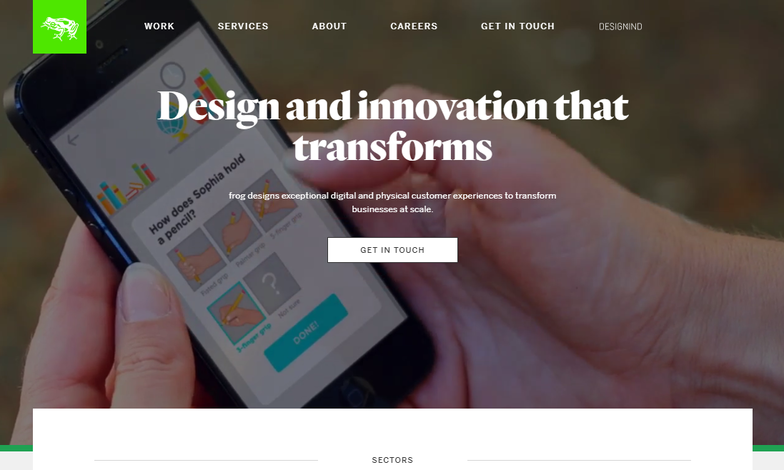
For product designers, a user-centered approach is fundamental. Hartmut Esslinger, while grounded in this design foundation, extends user-centered thinking—akin to design thinking—into business and planning domains. This creates a balanced approach to designing both products and experiences.
Unfortunately, many companies in Japan advocating experience design often focus solely on functional aspects. However, frog seems to be a company with a balanced approach, emphasizing both functional and emotional experience design.
Furthermore, frog frequently tackles challenges across various industries using technology, which I believe creates synergy with Dentsu Inc.
A well-known example of frog's work is the wristband for theme park visitors. By having guests wear a wearable device wristband, it enabled various functions—entry/exit management, cashless payments, and attraction experiences using the wristband—all through a single device, enhancing the customer experience.
Additionally, since last year, they have designed "LQD-PALO," a communication hub with free Wi-Fi installed throughout New York City.
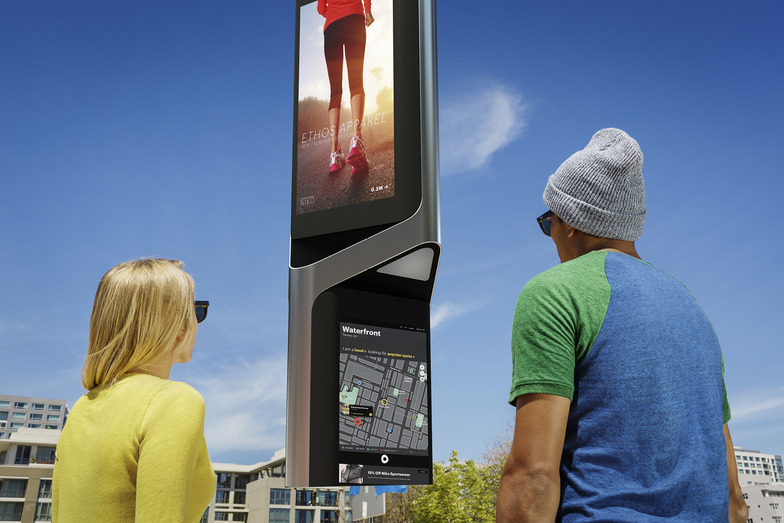
Additionally, there's an investment mechanism for venture companies called frog Ventures. They invest resources, not money. frog employees command high rates for their work, but they join venture companies to co-create brand experiences and service experiences. One outcome of this was developing signage for connected cities that can provide various information. This was ultimately bought out by a telecommunications company.
――Are there differences between production in the US and Japan?
In the U.S., highly skilled creators with distinct roles form teams to work efficiently. In Japan, it's often the case that a skilled creator becomes the leader, and the work gets done around them.
I also feel that frog's members have a high overall average skill level. I think this is something we need to learn from, and we need a system where knowledge isn't concentrated in one person but can be shared across the team.
――Did you discover anything working with frog?
When they visited Japan recently, we did a client presentation together. Before the presentation, everyone was really busy working. At the same time, one of the senior product managers mentioned he would go on paternity leave right after finishing this project. It's a clear work-life balance where they work diligently and take proper time off.
Incidentally, frog has offices in 11 cities worldwide, each with separate financial reporting and distinct cultures. The team we're currently collaborating with on this project is based in San Francisco. They excel at working strategically, translating brand design and strategy into product development.
Individuals don't handle multiple projects simultaneously; they focus on one project at a time. For example, when a project starts, a project room is created, and members like the following come together to form a team:
Creative Lead: The creative director responsible for leading the team
Program Manager: Manages the program and serves as the point of contact
Interaction Designer: Develops user scenarios from research and designs interfaces
Design Technologist: A technologist with design expertise
Visual Designer: Designs visuals from a UI perspective
Since partnering, we've already started working on one project together. We're collaborating while discussing how to divide roles and advance the project in a way that's both reasonable and enhances quality, taking into account the respective strengths of Dentsu Inc. and frog.
Summary: What is Experience Design?
・A problem-solving approach centered on user experience
・Define the client's challenge, then determine the approach and combine methodologies to improve the user experience
・Users can include not only customers but also staff
・When selecting a design firm, choose one with skills in both product and service design
In the second part of the interview, we'll delve deeper into what's needed to achieve innovative experience design.
This article is also published on the Web Manager Forum.
http://web-tan.forum.impressrd.jp/e/2017/04/21/25481
Was this article helpful?
Share this article


Newsletter registration is here
We select and publish important news every day
For inquiries about this article
Author
Noriaki Okada
Dentsu Inc.
CDC Experience Design Department
Creative Director