
Note: This website was automatically translated, so some terms or nuances may not be completely accurate.
Evolving with Remote Work: Design Consulting for a New Era
The "design consulting" initiative developed through collaboration between the global design firm frog and Dentsu Inc. It is now showing even greater potential due to the increasing adoption of remote work, which has become established as a result of the COVID-19 pandemic.
What exactly is this "new design consulting" conducted in a remote environment? What possibilities have emerged precisely because of the distance and the digital nature? Mr. Noriaki Okada from Dentsu's CDC Experience Design Department, who is working on the project with frog, explains design consulting in the new normal era.
Remote work reduces the tendency to read between the lines. This enables flat, open discussions.
The "design consulting" we advocate is a broader problem-solving methodology encompassing design thinking and experience design. A design team—comprising art directors, business strategists, and others—participates from the upstream stages, such as vision and strategy development. We immerse ourselves within client companies, developing and implementing interaction models centered on "value for people," and maintain consistent involvement through subsequent marketing and advertising activities.
Remote work, which has become established during the pandemic, is particularly well-suited to these tasks, especially the upstream phases. Currently, we primarily use remote work for workshops to organize challenges, interviews, and hearings, leveraging tools like Microsoft Teams, Zoom, and the whiteboard app miro. We genuinely feel this approach yields results that are no less effective than face-to-face meetings, and sometimes even more so.
One reason remote work aligns well with the upstream phases of design consulting is that "remote work reduces the tendency to read between the lines." Web conferencing tools typically display screens equally. Whether you're the CEO or an employee, everyone must use the same tool and participate under the same conditions.
Another key point is that many participants join from home or other living spaces, allowing for relaxed discussions. Supervisors who wear sharp suits at the office might appear in casual clothes, or voices of children or partners might be heard in the background... Participants can express opinions in a flat, uninhibited manner, closer to their natural state.
This feels like an extension of the rules we emphasize in offline workshops: "Exchange opinions on equal footing, expand ideas without dismissing each other's views," and "Please participate in relaxed clothing, not suits."
Another major benefit is the ease of logging everything. Video, audio, and chat histories are instantly digitized, enabling clear, visual review. When working on outputs like development or design and wondering, "What was the consensus back then?" you can find the answer immediately.
Instead of digging through typed minutes or summaries like before, you can more easily return to raw, unprocessed statements. This facilitates smoother back-and-forth between upstream and downstream phases, creating consistency in the process that frog and Dentsu Inc. value—from experience strategy to actual design—and enabling efficient creation of high-quality work.
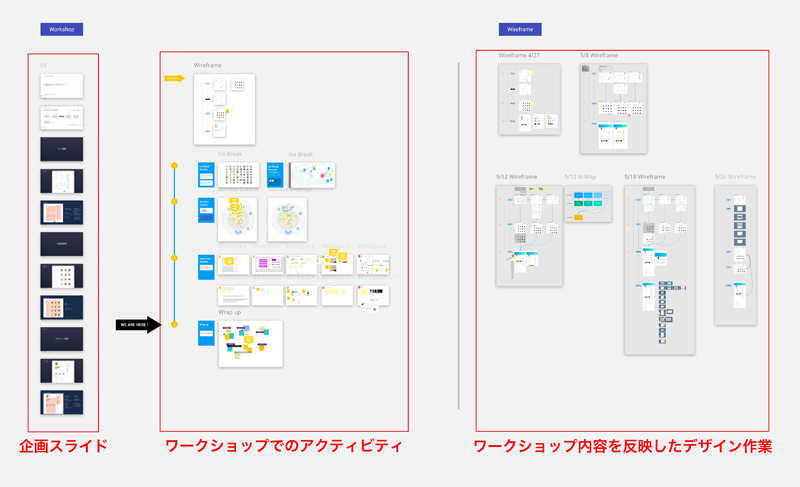
The reduced constraints of distance and time are also appealing. Stakeholders from all over—frog overseas, Dentsu Inc. domestically, and client company representatives working in various locations—can now easily gather in one place. We can even leverage time differences to advance work done by overseas teams while they sleep. This kind of collaboration has accelerated significantly with the shift to remote work.
As mentioned at the outset, design consulting is a consulting practice that focuses on human value and employs design thinking. It requires diverse individuals to engage in open, flat discussions and to access all information, repeatedly revisiting and refining it to get to the core. Design consulting, with these inherent qualities, is well-suited for the with-corona and post-corona world. I feel it is now demonstrating significant value amid society's shift to remote work.
What defines frog × Dentsu Inc.ならではの「効果的なオンラインワークショップ」とは?
frog and Dentsu Inc. always conduct workshops with meticulous preparation. We devise original programs tailored to each client, carefully refine the facilitation approach and content, precisely calculate the time for each step, and meticulously craft worksheets and tools... Rather than relying on improvisation with only a broad agenda, we have leveraged precision and structure as our strengths to engage clients in ideation and consensus building.
The expertise honed in these in-person workshops is now applied to online sessions. We meticulously organize and post the agenda and materials on "miro" beforehand so participants can see the workshop flow. We design each document and worksheet for ease of use. We also prepare an online "desk" called a frame for each participant, facilitating individual work.
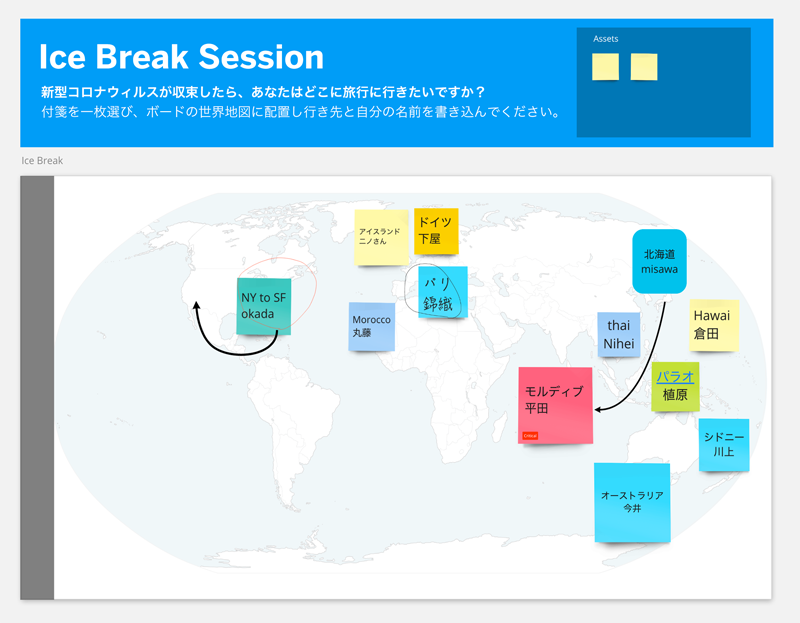
After thorough preparation, it's time to launch the online workshop. A key step is the icebreaker at the start. While self-introductions and interaction are common in face-to-face workshops, online sessions add the goal of "getting participants comfortable with the tools." In one workshop, participants were asked, "Where would you like to go once COVID-19 subsides?" They then placed sticky notes or wrote their names on a pre-prepared world map. This approach helped them learn how to use the tools while having fun.
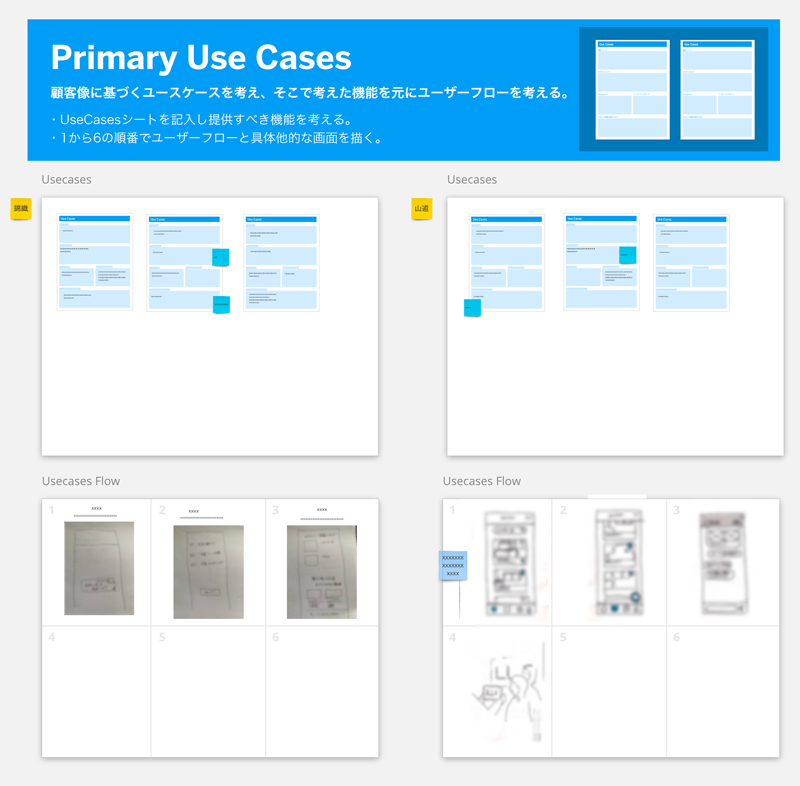
Subsequently, the workshop progressed to creating "Success Criteria" to define and organize success benchmarks. To establish the project's objectives, this case involved identifying success criteria by separating them into near-term and future success indicators. Similar to an in-person workshop, participants wrote related keywords and opinions on sticky notes, then stuck them onto "miro" to categorize ideas or place dot stickers to vote.

The advantage of online is that it allows us to save all the history as data—not just videos or audio, but also the created maps, success criteria, and everything else—in a state indistinguishable from the workshop's conclusion. Since all data is accessible on our local PCs, we can transition seamlessly and stress-free into actual production after the workshop.
Incidentally, "miro" was a tool already in use at frog before COVID-19. The combination of our proven track record with "miro," our meticulously developed in-person workshop expertise, and the strengths of remote work has given rise to a highly effective, unique online workshop format developed jointly by frog and Dentsu Inc.
Remote work × design consulting will continue to evolve!
Design consulting via remote work offers many strengths. However, challenges also exist.
One aspect I find challenging is visually understanding things. It's difficult to quickly summarize and share what was discussed, understood, or needs organizing in the workshop through illustrations or diagrams on the spot. In a face-to-face setting, sharing hand-drawn sketches works fine, but online, we need participants to draw images or diagrams within the tool or take photos of hand-drawn work and upload them.
Additionally, I feel that building empathy with people—a core part of design consulting—is somewhat harder. It's difficult to conduct behavioral observation, where you sense the other person's voice, expressions, subtle gestures, and even their breathing through your five senses. This often leaves us relying heavily on visual cues alone.
However, I anticipate these challenges will be addressed in some form, perhaps through new input devices or wearable technology. Remote design consulting is still in its developmental stage. It will continue to change and evolve. We intend to keep searching for the best approach through trial and error. By pooling the wisdom and experience of both frog and Dentsu Inc., we aim to pursue the future of design consulting.
Was this article helpful?
Share this article


