
Note: This website was automatically translated, so some terms or nuances may not be completely accurate.
 The Accelerating Evolution of E-Commerce: Lessons from Amazon and Rakuten's Business Models [1/2]
Focus on Amazon and Rakuten's "Customer Base Strategy"!

Junichi Kanno
Many clients have long been drawn to e-commerce (EC) for its high flexibility and ease of measuring effectiveness. Recently, however, companies are increasingly utilizing EC not just to sell products, but also for branding purposes. Why is this happening?
In this series, the author—who has supported the e-commerce strategies of numerous companies—explains the evolution of the e-commerce business model driving this trend.
This time, let's compare the strategies of Amazon and Rakuten, the major players in the domestic e-commerce market.
Table of Contents
▼Amazon and Rakuten: Japan's Top Two E-Commerce Players Continue to Grow Sales
▼ Amazon's Business Expansion Centered on Its Prime Members as Premium Customers
▼ An Era Where You Don't Even Need to Open the "Amazon" Site to Shop is Arriving
▼ Rakuten's Strategy Centered on Its Rakuten Super Points System
▼Rakuten Card and Financial Services, Continuing to Grow, Become the Engine Driving Cross-Usage
Amazon and Rakuten: Japan's Two E-Commerce Giants Continue to Grow
According to Ministry of Economy, Trade and Industry statistics, Japan's e-commerce market size has surpassed the 15 trillion yen mark. E-commerce, now an essential service in daily life, is expected to continue expanding. Driving this domestic e-commerce market are the two giants: "Amazon" and "Rakuten".
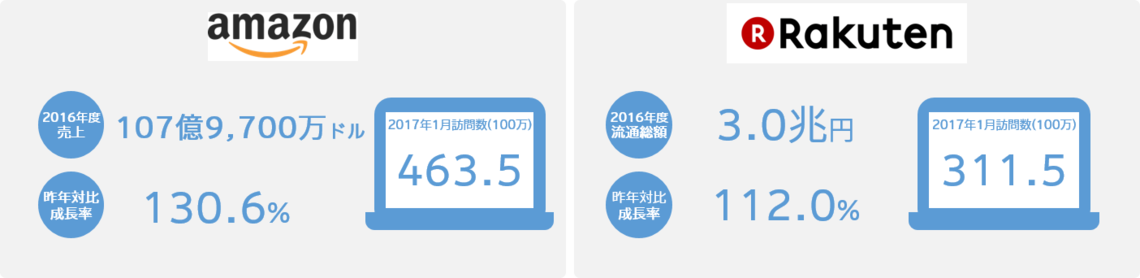
(Note) Visitor numbers for both companies are based on SimilarWeb measurements.
Regarding Amazon, a recent Nikkei report stated that its domestic sales in Japan exceeded ¥1 trillion in fiscal year 2016.
Rakuten, the other major player, announced it surpassed the 3 trillion yen mark in gross transaction volume. While Rakuten's transaction volume includes the combined sales of its 44,000 Rakuten Ichiba mall-type e-commerce storefronts, plus transaction volumes from non-Rakuten Ichiba businesses like Rakuten Travel, making a direct comparison with Amazon's sales figures difficult, its growth rate has shown some recovery, indicating a rebound.
While both companies continue to grow, their recent expansion extends beyond mere scale. Let's examine their strategies.
Amazon's Business Expansion Centered on Its Prime Members as Premium Customers
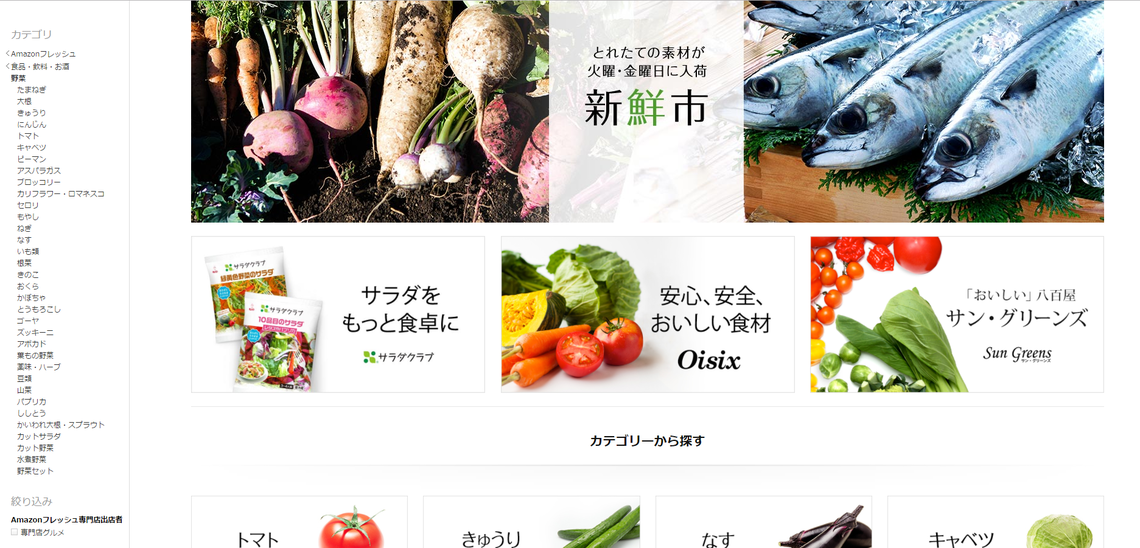
Amazon's recent moves clearly reveal a strategy to accelerate growth centered on its "Prime members" – its premium customers.
Beyond enhancing the benefits and services of "Amazon Prime" for Prime members, Amazon further strengthened the advantages of Prime membership by introducing shipping fees for non-Prime members starting April 2016. The annual fee of ¥3,900 (or the monthly fee of ¥400) is no longer a significant barrier.
Amazon Prime's benefits and services are extensive. Recently, it made headlines by enabling purchases of select department store and drugstore items through "Prime Now," a Prime member service delivering goods in as little as one hour. This development hints at the evolution of "Amazon as a logistics platform."
Additionally, Amazon offers services like "Amazon Pantry" and "Amazon Fresh" through its direct sales model. The key point for both services is that they are designed for "single-item purchases."
Traditional e-commerce rarely handled single-item sales of small daily necessities like detergent or seasonings, or food items. Even when available, customers had to buy multiple units of the same product in bulk ("case purchases"). Many items suited for frequent, small purchases didn't fit well with bulk buying, making this a category with historically low e-commerce adoption.
However, user survey data indicates high purchase intent for these categories online. Making single-item purchases easier could lower the barrier to entry, opening up significant market potential. Amazon Fresh, in particular, is noteworthy as it marks Amazon's entry into the high-frequency, massive market of fresh food.
These single-item purchase services and fresh food offerings are made possible by Amazon's various initiatives, but what particularly catches the author's attention is the company's sophisticated logistics infrastructure. Services like Amazon Pantry, which offer "one box, fill it up," are feasible because of precise "volume management" of handled products. Amazon Fresh is a service delivered using its proprietary delivery system.
Amazon's past investments have culminated in these high service levels. These services are only possible due to years of accumulated expertise and a strong operational foundation, potentially establishing a sustainable competitive advantage.
Speaking of logistics, newspaper reports indicate Amazon is addressing the much-discussed e-commerce delivery challenges by partnering with individual carriers to build its own delivery network. This move, turning a tough business environment into an opportunity for further strengthening its foundation, is noteworthy.
Other notable "Amazon Prime" benefits and services include digital entertainment offerings like "Amazon Prime Video," a streaming service providing unlimited access to popular movies, TV shows, and variety programs, and "Prime Music," a streaming service offering unlimited access to over a million songs. These services aim to create opportunities for Amazon usage beyond product sales.
The resulting diversity among Prime members contributes to Amazon's strength as a marketing tool, but I'll save that discussion for another time.
We're entering an era where you can shop without even opening the Amazon site.
One service that exemplifies Amazon's strategy and philosophy is the "Amazon Dash Button," which allows users to replenish favorite beverages or daily necessities with a single button press.
I was once told by someone from a toiletries manufacturer:
"You probably spend a fair amount of time each day thinking about what to eat for dinner. But how many minutes do you spend in a year, for example, thinking about what detergent to buy next?"
In other words, they're saying that creating a situation where "your own products are automatically replenished" will become increasingly important for certain products in the future.
Another key element when discussing Amazon today is its developed "Alexa." While not yet available in Japan, it's an artificial intelligence controlled by human voice. You can purchase products from Amazon simply by talking to Alexa-enabled home appliances.
The "Amazon Echo" speaker, featuring Alexa and launched ahead of schedule in the North American market, has reportedly already reached sales of around 10 million units in the US, according to reports like the Seattle Times.
At this year's CES (the U.S. consumer electronics and IT trade show), Alexa-enabled devices were announced by as many as 700 manufacturers. It is said that the day when the network of Alexa-equipped devices expands to around 100 million units is not far off. It can be considered a strong candidate for the de facto standard in "IoT commerce" utilizing devices like home appliances.
Amazon's business scope has expanded to the point where it can hardly be called just an e-commerce company anymore. In its 2016 fiscal year results, the operating profit from its cloud computing service, AWS (Amazon Web Services), exceeded that of its North American e-commerce business.
Furthermore, a recent major development is Amazon's acquisition of the upscale U.S. supermarket chain Whole Foods Market. While this expansion is focused on the U.S., it strongly suggests Amazon's move into "physical stores," making its future developments noteworthy.
Amazon's corporate motto is "The world's most customer-centric company." It rapidly launches new initiatives. Perhaps it's more accurate to describe Amazon not as "a company that sells things online," but as "a company that leverages technology to make life more convenient."
Rakuten's strategy centered around its Rakuten Super Points system
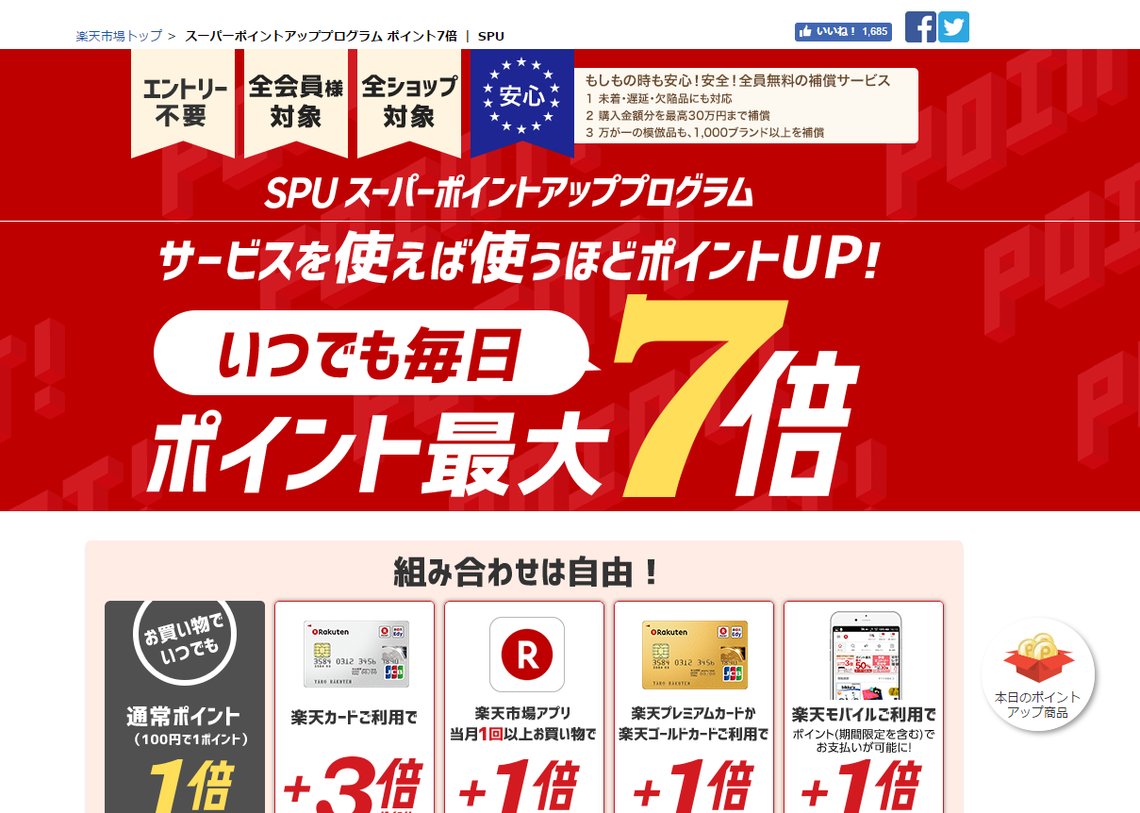
In Rakuten's FY2016 earnings announcement, they highlighted the "re-acceleration of domestic e-commerce gross merchandise volume." They explained this was driven by "continuing the SPU (Super Point Up Program) initiative" and "efforts to improve quality." Both points were also discussed during last year's series of interviews with Rakuten's Executive Officer, Nao Kono.
Ms. Kono described SPU—which rewards users the more they utilize Rakuten's various services—as "a program for building long-term customer relationships." It's clear Rakuten, like Amazon, aims to strengthen its customer base by "rewarding loyal customers."
In a sense, SPU represents a shift away from the traditional "HILO" (High-Low Price) strategy, which leveraged sales (special offers), towards introducing "EDLP" (Everyday Low Price) for premium customers.
Rakuten Ichiba is a mall-type site, and the actual product sales are handled by the individual stores operating within the mall. Since Rakuten itself cannot set product prices, it couldn't promote "EDLP".
Therefore, it pivoted its highly regarded "Rakuten Super Points" program to provide premium customers with consistent benefits (≈ EDLP).
Additionally, proactive improvements to UI/UX and quality enhancements through services like the "Page Diagnosis Service" for storefronts are likely contributing to steady results.
The growing Rakuten Card and financial services become the engine driving cross-usage
In Rakuten's FY2016 financial results, the "FinTech" segment—comprising "Rakuten Card," "Rakuten Bank," and "Rakuten Securities"—performed strongly, continuing the trend of recent years. Its operating profit surpassed that of the "Internet Services" segment, which includes "Rakuten Ichiba."
Within the FinTech segment, Rakuten Card performed particularly well, achieving an annual transaction volume of ¥5 trillion, a 20% increase year-on-year, ranking third in Japan by scale. Its growth rate significantly outpaced other card companies, and it is expected to become the top card issuer in Japan soon.
Perhaps due to the popular SPU program being based on "Rakuten Card ownership," the "payment ratio via Rakuten Card" within Rakuten Market transactions exceeded 50% in December 2016.
The core of Rakuten's "cross-usage of services" strategy (encouraging a single user to utilize various Rakuten services across platforms) has been its "points program," usable across all services. Going forward, "Rakuten Card usage" is expected to become a key driver for promoting cross-usage alongside the points program.
The cross-use rate reached 62% in December 2016 and continues to improve steadily.
Recently, Rakuten made a significant strategic decision: acquiring "Sokai Drug," a core store on Rakuten Ichiba that had won the "Rakuten Shop of the Year" Grand Prix for seven consecutive years. Rakuten has also announced the integration of Sokai Drug with "Kenko.com," which it acquired earlier. The new company formed by this integration will be named "Rakuten Direct."
While Rakuten Ichiba is globally recognized as a leading mall-type e-commerce platform, this move signals a direction toward strengthening its "direct sales model" for daily necessities. It will be interesting to see how Rakuten's focus on direct sales contributes to improving service levels.
Not only Amazon, but Rakuten too is striving to create better customer service. By expanding into financial services, strengthening its direct sales model, and transforming its own identity, Rakuten is evolving beyond a traditional e-commerce company into a "company involved in all aspects of daily life."
E-commerce has created a situation where people can buy anything they want anytime, anywhere, without visiting physical stores, fundamentally changing people's lives. This shift seems to be driving e-commerce operators toward an "anything goes" evolution.
How will people's lives change as Amazon and Rakuten transform?
Next time, we'll hear from Mizue Arakawa, General Manager of Amazon's Amazon Fresh division.
Was this article helpful?
Share this article


Newsletter registration is here
We select and publish important news every day
For inquiries about this article
Author
Junichi Kanno
After gaining experience managing e-commerce operations at a major IT company, I became convinced of the diversification of retail space value as a customer touchpoint and returned to Dentsu Inc. Leveraging my comprehensive experience in business valuation and other areas from a consulting firm, I currently work in the Promotion Design Bureau, where I develop and implement numerous sales promotion initiatives through reverse-engineering planning starting from the purchasing perspective. Holds an MBA from the Wharton School of the University of Pennsylvania. Left Dentsu Inc. at the end of December 2022.