
Note: This website was automatically translated, so some terms or nuances may not be completely accurate.
 ADWASIA 2017 Report [2/6]
Tencent, Facebook—Technology Liberates People: The Near Future Envisioned by IT Platform Giants

Advertising Week Asia 2017
Advertising Week, the marketing and communications festival that made its Asian debut last year, returned to Tokyo this year as Advertising Week Asia 2017. Over four days from May 29 to June 1, Tokyo Midtown gathered top executives and CMO-level leaders from around the world, focusing on a wide range of themes including brands, media, and technology. The number of partner companies and organizations increased from 50 last year to 64, with approximately 13,000 attendees.
Following Isobar's keynote, we present presentations from Tencent and Facebook. Both companies have established unshakable positions as platform providers—one in China, the other globally. As technology permeates beyond advanced users through smartphones, they command large user bases with highly functional yet universally accessible systems and interfaces. What do they envision as "the next big thing"?

Celebrities Influencing China's Youth
"The history of digital in China isn't that long. But digital is now having a huge impact on the lives of Chinese people," explains Steven Chan, Corporate Vice President at Tencent. Founded 19 years ago, the company launched its messenger service "Tencent QQ" the following year. Since then, it has grown its revenue in the social networking and gaming markets, fiercely competing with Alibaba Group for the top spot in Asia by market capitalization. It has also expanded into smartphone payments and cloud services, rising into the top 10 global companies by market cap in April this year.
It is also actively advancing into the AI field. "During the 2016 Rio Olympics, we worked on AI-powered article generation, releasing over 3,600 articles in 16 days," said Mr. Chan. This past May, it opened its second AI research institute outside China in Seattle, USA.
China's population now approaches 1.4 billion. Within this, the social networking app "Qzone" currently boasts 860 million users, while the identity-verified messenger app "WeChat" has 940 million users. "Even so, we've only reached about half the population," Zhang stated. With smartphone adoption continuing to grow, he remains enthusiastic about the untapped opportunities ahead. "We have social DNA, using technology to deliver content and connect people."

While SNS is primarily used for communicating with friends, it also significantly influences purchasing decisions, especially among younger generations. Data on purchasing decisions for those born after 1980 (Post80s) and after 1990 (Post90s), as introduced by Mr. Chan, shows that for both generations, the top factor is "I like it." and second place "Pricing" are the same for both generations. However, "Word-of-mouth" ranked third for Post80s but fourth for Post90s, while "Friends Recommendation" ranked third for Post90s but fourth for Post80s. Over 70% have actually made purchases via social media.
"Furthermore, in China, celebrities like talents and musicians wield significant influence as key opinion leaders for younger demographics, making them crucial in marketing. Additionally, while I'm unsure about Japan, parental recommendations also strongly influence purchasing decisions in China."

Tencent Aims for Dominance in Mobile Payments
Currently, Tencent serves numerous local and global brands as clients. "Through our platform, each brand can execute campaigns in a more real-time and relatable manner," emphasized Mr. Zhang. In recent years, multiple campaigns primarily utilizing WeChat have achieved remarkable results.
For example, cosmetics brand L'Oréal leveraged its status as an official sponsor of the Cannes Film Festival, where it annually showcases makeup trends, to launch a WeChat campaign in 2015. While Cannes wasn't a familiar theme for China's post-90s female demographic, the campaign delivered "Personal Voice Invitations" via WeChat timelines. Celebrity brand ambassadors shared messages like "I'm in Cannes right now!" in a conversational tone, as if they were friends. By directing users to its official account and offering real-time access to content from Cannes, the campaign doubled its fan base from 250,000 to 500,000 in just 10 days. Its image as a trendy brand for younger consumers improved by 42%, and e-commerce sales surged by 454%.
Another example of data utilization was Coca-Cola's Rio Olympics campaign "Golden Moments," which leveraged the massive photo data from the SNS app "QZone" to generate personalized retrospectives. He further stated, "Nowadays, everything can be socialized and become a medium for connecting people," citing Nike's "NIKE RUNNING RADIO" as an example, which utilizes the music platform "QQ Music." It provides music matched to the runner's pace, which can be shared with friends.
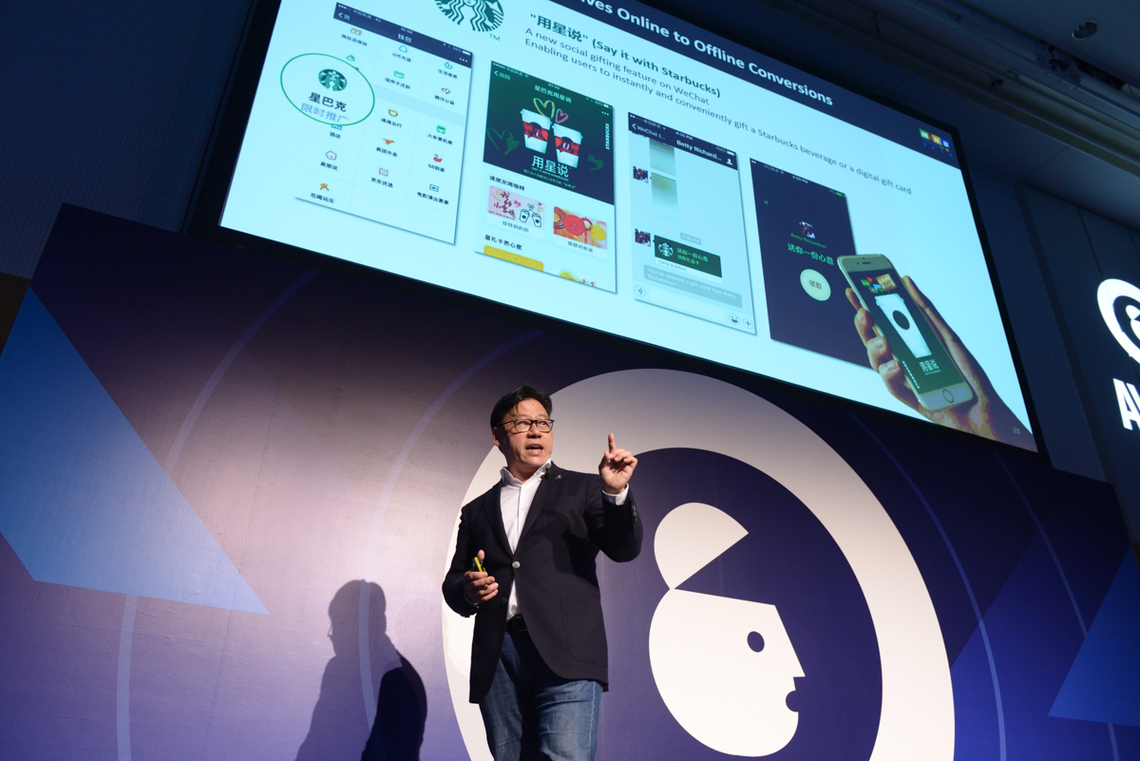
Furthermore, regarding the sharing economy now being promoted nationwide in China, Mr. Zhang stated, "It's being realized through 'WeChat Pay'." Showcasing Starbucks' campaign—the first initiative to utilize WeChat as a money platform—where users could exchange digital gift cards, he expressed confidence in becoming the leader, stating, "Mobile payments hold tremendous business potential."
Facebook's Focus on Visual Communication and AR
What will become the next standard in consumers' lives? Predicting this is no easy task. Chris Cox, Facebook's Chief Product Officer, recalled his first visit to the company in 2005 when he was a student at Stanford University. The company was then housed in a shared office space. "Android was in the same office. The Facebook team was probably thinking, 'Why are they building a mobile OS when we have BlackBerry?' And they were probably thinking, 'We have MySpace, so why do we need Facebook?'"
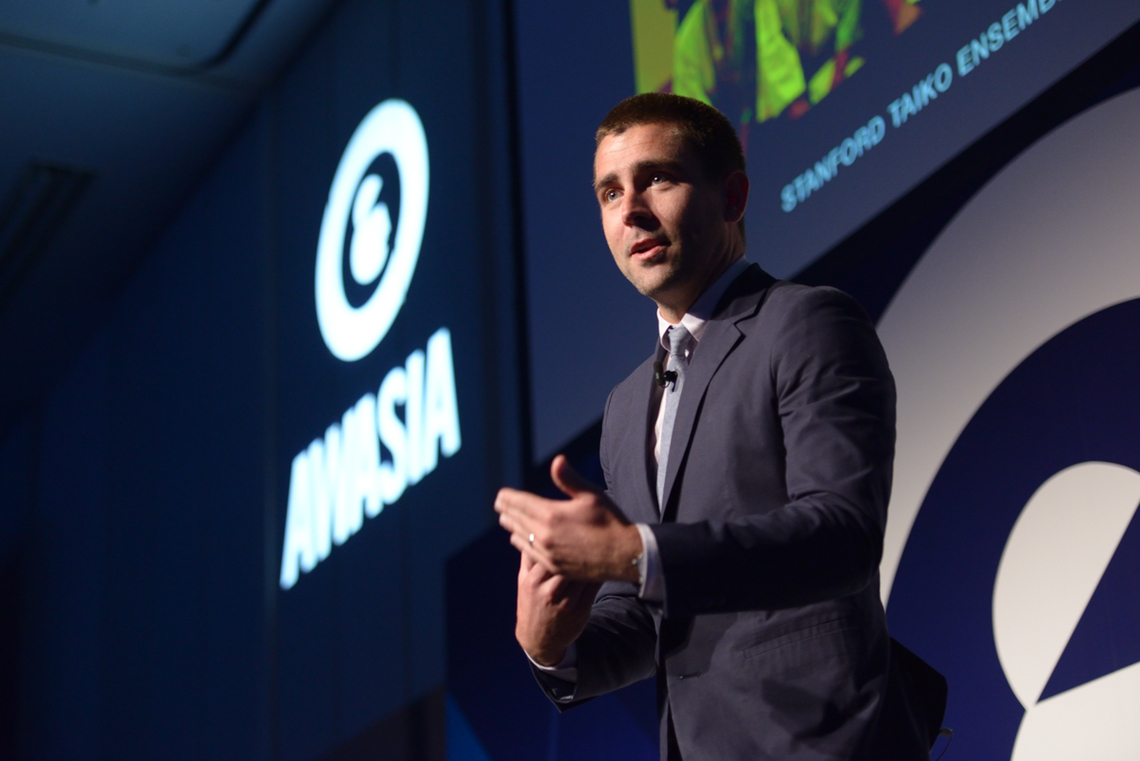
It's well known how Facebook, which started as a directory service for college students, has transformed. "Most recently, in 2016, we integrated various features like Facebook, Instagram, and Messenger into a seamless experience. As a result, for example, Facebook is now used worldwide for disaster safety checks."
The vision presented for the future is "the era of visual communication." Cox points out that video sharing will become standard this year. "Designers and engineers need to pay close attention to video being integrated into everything: games, shopping, recipes, messaging... We must eliminate all friction and design seamlessly for accessing video communication."
To help achieve this, Facebook is focusing on user-friendly formats for all new features and encouraging business adoption. For example, its Instant Articles news delivery service, available since 2015, allows anyone to intuitively create rich content. In Japan, Toyo Keizai Online has implemented it, improving site dwell time and increasing revenue by 40%.
"In another decade, we might not even be using mobile phones. Wearable devices like glasses could become mainstream. AR and VR will also expand as even more immersive methods than video," Cox stated. This spring, Facebook already added effects to its camera and launched the "Camera Effects Platform," allowing developers to create their own AR effects. "We've shown you part of our vision for using technology to connect people. These innovations are just around the corner," he said, heightening anticipation.

Was this article helpful?
Share this article


Newsletter registration is here
We select and publish important news every day
For inquiries about this article
Back Numbers
Author