
Note: This website was automatically translated, so some terms or nuances may not be completely accurate.
 Why Businesses Without Dialogue Fail [1/6]
Why "Dialogue" is Essential in the VUCA Era
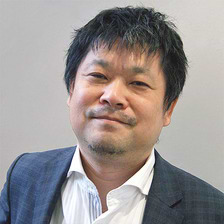
Hiroyuki Egami
Dentsu International Information Services, Inc. (ISID)
Hello, my name is Hiroyuki Egami. I work as a consultant at Dentsu Inc. International Information Services (ISID), primarily serving financial institutions. On July 3rd, I published a book titled "The Conversational Bank: The Future of Finance as Envisioned by Frontline Leaders" with the Institute for Financial and Fiscal Affairs.
While the book focuses on "finance" as its theme, as the title suggests, it explores the importance of dialogue—a concept applicable not only to the financial industry but to any business. Therefore, in this series, I will deliberately step away from the financial domain and discuss the importance of "dialogue" in complex business environments, spread over six installments.
This column is structured in three parts:
■Is There a "Right" Answer in the VUCA Era?
V: Volatility, U: Uncertainty, C: Complexity, A: Ambiguity
■How Do "Debate" and "Dialogue" Differ?
■What is Emergence that Manifests from Dialogue?
Is there such a thing as "right" in the VUCA era?
"VUCA" is an acronym for Volatility, Uncertainty, Complexity, and Ambiguity. It represents the contemporary understanding that today's business environment faces an extremely unpredictable situation due to these four factors.
In this VUCA era, the stakeholders surrounding our businesses are also diversifying. Amidst this, can a business strategy exist that everyone can definitively call "right"?
In fields like mathematics where axioms are established, the concept of "correct" does not vary from person to person. However, in business decision-making, "correct" exists in as many forms as there are people. Each person has their own unique position, experiences, and foundation of values they hold dear, and upon that rests their personal "correct." VUCA signifies that we are entering an even more complex era where this diversity of "correct" is increasing.
Fundamentally, it's only natural that each person's "right" is different. In fact, it's precisely because they differ and we can't always understand each other that business is interesting (it involves meeting people; your own life is like that too). Innovation occurs where each person's "right" mixes together, creating friction, and transforms into new forms. If everyone's "right" were the same and we could always understand each other, our business could be replaced by artificial intelligence and computers.
Our preconceptions about "right" also have a troublesome side. These notions often stem from fear—like the fear of "not wanting to be inferior to others." The feeling that "I have no value if I'm not right" manifests as resistance: "I must be right."
In reality, most opinions about "what is right" in business appear to be rationally explained by market research or management analysis on the surface. But at their core, they often stem from the human desire to be right and the underlying fear that drives it.
The stronger this fear becomes, the more intense the conflict grows between those asserting their "correctness" within an organization. This is only natural when individuals who don't want their sense of "rightness" challenged engage in conversation.
What's the difference between "debate" and "dialogue"?
Leaving conflict unresolved hinders business progress, so we strive to resolve it. The great physicist and philosopher David Bohm categorized these approaches into two types (see 'Dialogue', Eiji Press, 2007).
One is determining who is "right" by deciding a winner and loser. This is called "debate." In English, it's "discussion." The word "discussion" shares its root with "percussion," meaning "to strike" or "to break," implying "to defeat the other side."
Debate is a battle to prove one's own correctness. While it may sometimes end in a draw or compromise, a winner and loser are always determined. The loser either sheathes their "I am right" spear or pretends to do so, bringing the debate to a close. In truth, most of what we do in corporate or organizational meetings is this kind of debate. Even in seemingly calm meetings, victory or defeat is quietly decided on the spot.
The weapon always used in these debates is "analysis." We fight on the scoreboard of victory and defeat, the KPI (Key Performance Indicator), using the PDCA management method. It's the familiar way we're accustomed to. However, relying solely on this approach means something is lost.
Another way to resolve conflict is through "dialogue." The word "dialogue" is said to derive from "creating a flow of meaning or words (logos) across (dia)." Dialogue does not involve a battle where one person defeats another's "correctness." Dialogue is based on the idea that every opinion is a truth for the person holding it.
While there are various techniques for "dialogue," the fundamental practice remains the same: placing all opinions on the table, speaking, listening, and feeling. The "all" opinions placed on the table in dialogue refer to the opinions of every participant. But there is another meaning: "all" also means releasing the suppressed emotions that have been kept hidden within another part of oneself. In dialogue, not only surface opinions but even underlying emotions are brought to the table and shared.
Native Americans understood the effectiveness of dialogue in building sustainable societies. In their circle-shaped gatherings around the fire, the elders' opinions weren't automatically prioritized. When one person spoke, no one interrupted until they finished. Everyone stood on equal footing, advancing discussions to solve community challenges.
Emergence from Dialogue
As dialogue continues, qualities emerge that transcend the simple sum of each individual's original opinions. By standing in another's shoes and embracing diverse perspectives, one's view of things can shift dramatically. Even things one was desperately trying to prove can suddenly seem ridiculous—a paradigm shift occurs. Then, something new—a new meaning that didn't exist at the start—suddenly emerges. This phenomenon is called emergence. Crucially, this emergence absolutely cannot occur through mere repetition of "debate."
What emerges can be innovation—value transcending existing concepts—new organizational culture, or teamwork. The key difference between "debate" and "dialogue" lies in whether matters are resolved within the confines of participants' pre-existing perspectives, or whether something new emerges.

The reason "dialogue" is essential in today's VUCA era is that we have reached a point where we must "emerge" a future that is not merely an extension of the past. The "correctness" we sought to prove through "debate" is merely a concept built within the small vessel of my own past experiences as an individual. That way of thinking alone can only set a "future as an extension of the past" in the VUCA era. Within the scope of that "set future," we engage in business, fighting over a shrinking pie.
Unfortunately, however, the practice of "dialogue" has not taken root in the realm of Japanese business. In this column, I intend to explore the concept of "dialogue" within the business domain.
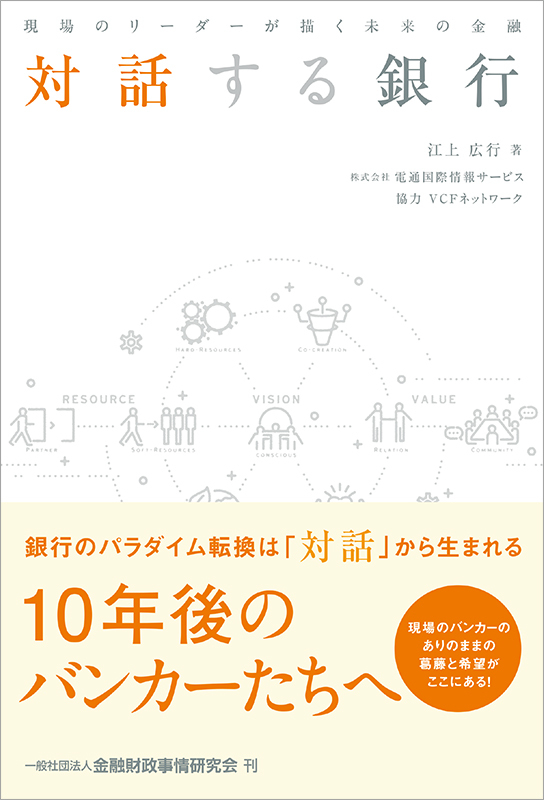
The author of this column, Hiroyuki Egami, depicts how a paradigm shift in the financial industry can be sparked through "dialogue" in his book published in July, 'The Bank That Engages in Dialogue: Future Finance as Envisioned by Frontline Leaders'. The themes explored in this "dialogue" are rich and varied, including "leadership," "decentralized management," and "the essence of money." Even if you are not involved in the financial industry, I highly recommend picking up a copy.
Was this article helpful?
Share this article


Newsletter registration is here
We select and publish important news every day
For inquiries about this article
Author
Hiroyuki Egami
Dentsu International Information Services, Inc. (ISID)
Financial Solutions Division Financial Business Strategy Department VCF Group
Marketing Professional