Note: This website was automatically translated, so some terms or nuances may not be completely accurate.
 Thinking About the Future of Advertising Agencies at Stanford [2/5]
Media Trends Observed at Stanford

Hello, everyone. Today's theme is "The American Media Industry."
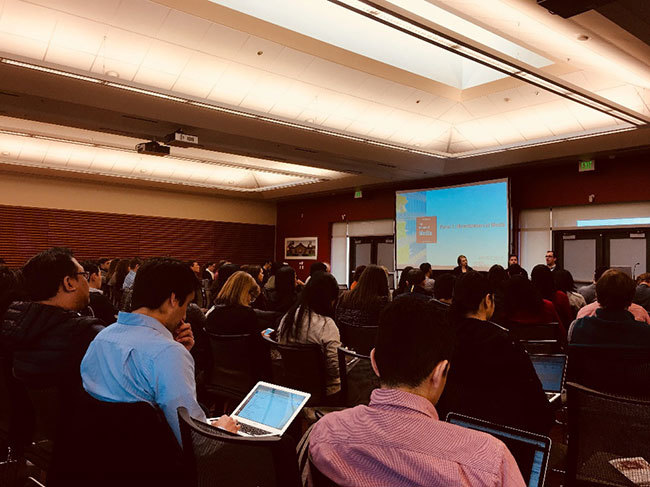
Stanford hosts an annual conference called the "Future of Media Conference," focusing on media and the industry. It's organized by the Arts, Media and Entertainment Club, a student club at Stanford Business School. Industry executives and journalists are invited for a full day of keynote speeches and panel discussions. Today, I'll share insights primarily from what I heard there.
What even counts as media anymore?
This question inevitably arises whenever media is discussed at Stanford and in Silicon Valley. Since the 2000s, "media" has been broadly defined as "traditional mass media + the internet." However, today sees the entry of an even more diverse array of players. Examples include: "Verizon, a mobile carrier, acquiring AOL and Yahoo!," "AT&T, a telephone company, moving to acquire Time Warner," "the rapid growth of Netflix," and "the expansion of video services like YouTube and RED under Google." Similarly, "Facebook's video service expansion via Facebook Watch," "Amazon's acquisition of The Washington Post and content distribution through Amazon Prime," "Apple's video service expansion," and "the growth of mid-sized digital media like Vice Media, Vox, and BuzzFeed" – all signify the industry's transformation into a complex ecosystem driven by the entry of companies from unrelated sectors.
A major trend emerging is that traditional media and telecom companies are countering the technology platform giants—Facebook, Google, Amazon, Apple, and Netflix—which reign supreme at an unprecedented scale, through acquisitions and consolidation.
Particularly shocking to traditional media players are Facebook and Google, which have effectively become the largest distributors of media content. Facebook boasts over 2 billion users (even more when including subsidiary services like Instagram and WhatsApp). Google's YouTube boasts over 1.5 billion users, making it arguably "the media platform with the largest reach on Earth." Their business model involves gathering audiences by distributing content—both their own and others'—and monetizing through ad delivery. To other media outlets, they are both partners distributing their content and rivals stealing their viewers.
"Aren't you media companies?" This is a question inevitably posed by attendees whenever they take the stage at conferences. On this point, both companies maintain their stance: "We are not media companies; we are technology platforms."
Quality Journalism: Creating Truly Valuable Information
Amidst major industry shifts, the conference primarily discussed news media from a journalism perspective. Journalists and business professionals with a sense of crisis are breaking away from traditional media to launch emerging digital outlets. Behind this lies a shift away from the long-dominant attention-centric mindset (where the goal is simply to be seen by many) towards "quality journalism" – creating information that truly holds value for the audience.
For example, The Information, an emerging media outlet featured at the conference, has successfully implemented a subscription model with a premium annual fee of $400 by providing exceptionally deep content focused on Silicon Valley tech companies and industry intelligence. Founder Jessica Lessin, a journalist with strong IT expertise from the prestigious Wall Street Journal, emphasized the importance of returning to the fundamentals of customer-centric business: "Focus on specific areas with strong reader demand and provide high-value information unavailable elsewhere to justify charging for content."
Meanwhile, the emerging media platform Medium has built a hub for creative talent like journalists and writers, using algorithms to match them with consumers. Unlike The Information, it crowdsources writers to meet a broad, diverse range of consumer needs. Founder Evan Williams is the creator of Blogger, which ignited the blog boom, and also served as co-founder, CEO, and Chairman of Twitter. His vision is for Medium to be "a place where you can get unique ideas and perspectives you can't get anywhere else. A place where you connect with great writers from around the world." Its business model relies entirely on subscription fees starting at $5 per month, with no advertising revenue.
Facebook and Google also appear to be strengthening their friendly and productive relationships with media, recognizing the importance of quality journalism. Through new organizations like the "Facebook Journalism Project" and "Google News Lab," they are actively recruiting journalists and business talent from traditional media, intensifying dialogue with media outlets, and seriously considering what support they can provide. Against the backdrop of fake news issues having a significant societal impact, it is conceivable they will build features to "ensure the reliability of content circulating on their platforms."
Implications for Japanese Media
Shift from attention to quality. Make subscription models—where readers pay for valuable content—the core revenue source. Upon reflection, these seem like perfectly obvious steps. Was it truly so difficult for America's traditional media to pivot sooner toward digitalization, to pursue value for readers and new ways of delivering content? Why couldn't they take the initiative in building relationships with Facebook and Google, leading the creation of a new media ecosystem?
At the root, I suspect there is a fear of new things and change. However, this is not limited to the media industry; it applies equally to finance, advertising, manufacturing (like the auto industry), and retail. Organizations that have scaled to their current size often enjoy profits thanks to successes achieved in the past. Consequently, adapting to new things or changing oneself frequently means voluntarily discarding past successes. Avoiding such choices, or conversely, becoming overly defensive, or having judgment dulled by fear of failure risk – this may be human nature.
Next time, I'd like to explore how organizations can adapt to new things and transform themselves. I'll focus on the theme of "innovation."
Was this article helpful?
Share this article


Newsletter registration is here
We select and publish important news every day
For inquiries about this article

Author
Sohei Yonomiya
Dentsu Inc.
Corporate Planning Division