
Note: This website was automatically translated, so some terms or nuances may not be completely accurate.
 Asian Women Today [6/6]
Analyzing Asian Women Through My Own Lens! Taiwanese Women: 80% Gal Style, Harizus (Japan-Obsessed) & Self-Improvement Oriented

Kano Juna
Dentsu Inc.
Taiwanese girls known as "Japanophiles"
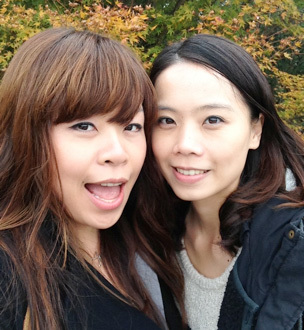
Taiwan has a strong pro-Japan image.
Taiwan's swift relief efforts and substantial donations following the Great East Japan Earthquake remain etched in many people's memories. Additionally, news emerged in April 2013 that the Takarazuka Revue's performance tour in Taiwan was a huge success.
In Taiwan, which feels psychologically close to Japan, "Japanophilia" has become such a social phenomenon that the term "Harizoku" (people who absolutely adore Japan) began spreading around the year 2000.
The cultural time difference between Taiwan and Japan is zero!
In Taiwan, people can watch Japanese TV in real time via cable, and they're constantly exposed to information about Japanese girls through magazines, dramas, and more.
This time, I'd like to take the liberty of analyzing these girls.
64.8% have a desire to dress up, using the internet and wholesale shops for decoration
According to the Asian Women Quantitative Survey, the desire to "dress up to look attractive rather than wear simple, comfortable clothes" was highest among the surveyed countries and regions, reaching 64.8%.
"I bulk buy online with friends or people I met on forums (to save on shipping), and I often go to night markets or wholesale stores where I can get things cheap. In the Wufengpu district, clothes made in Southeast Asia and China are sold by weight."
Among younger generations especially, they seem to prioritize the "number of items" over brand loyalty and focus on accessorizing.
Taiwanese women's online shopping usage rate of 67.6% is the highest among the seven surveyed countries and regions, possibly reflecting their strong 'deco' (dressing up) consciousness.
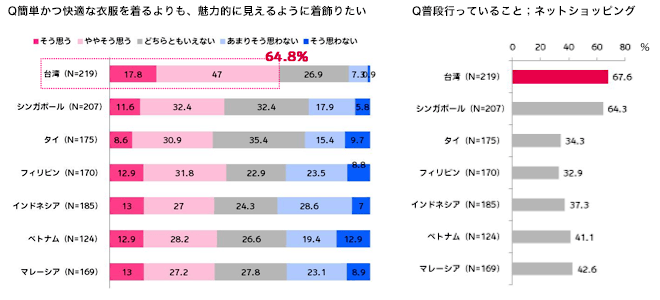 |
Source: Asian Women Survey |
Another characteristic is that Taiwanese women have a low life satisfaction rate of 35%. When asked why, they said:
"We love constantly improving ourselves. I think it's because we're never fully satisfied with who we are now and always strive to be better." The way Taiwanese women dress up is likely part of this self-improvement journey, a way to get a little closer to the icons they admire.
Taiwanese women are DSLR camera girls
According to JETRO, Taiwan possesses globally high international competitiveness in high-tech industries like semiconductors, LCD displays, and personal computers. Reports also indicate increasing investment from Japanese companies in recent years. The adoption of digital cameras seems to have been earlier than in Japan, and the ownership rate of digital SLR cameras reaches 31% (Source: Asian Women Survey).
"Taiwanese people have always loved photography. They often dress up and get photos taken at studios."
Compared to Japanese people, fewer Taiwanese feel hesitant about sharing their faces online. As a result, social media is flooded with candid shots, family photos, meals... and selfies featuring themselves!!
Since they use it as a personal life log, they reportedly don't experience the social media fatigue seen in other countries.
Taiwanese women's "gal-ness" level is 80% (with Japan's gal-ness set at 100%)
Once again, we're arbitrarily analyzing Taiwanese girls' gal-ness through three lenses: LOVE (Heart), DECO (Technique), and GUTS (Body).
Taiwanese girls' gal level = 80% (with Japanese gal level set at 100%)
We judge their gal level to be high because many girls have a strong desire for deco as part of self-improvement and watch Japanese girls' trends with "zero time difference".
However, according to Zhu:
"I feel like the gal level was around 90% about three years ago, but now Korean influence is stronger, so the Japanese feel seems to have weakened to about 80%. Along with that, not only fashion styles but also appliances like cameras and TVs seem to be increasingly replaced by Korean-made products."
Korean Wave entered Taiwan around the same time it started in Japan. Now, it's beginning to have a stronger presence than Japanese culture, and the term "Korean Wave fans" has emerged as a counterpart to "Japan fans."
Before the Korean Wave boom, Japan's image was embodied by figures like Namie Amuro and Ayumi Hamasaki—distant icons that seemed unattainable. This fueled the self-improvement desires of Taiwanese women.
However, today's Japan is represented by accessible idols like AKB48. They are now perceived as attainable rather than unreachable, potentially diminishing the desire for self-improvement. Meanwhile, Korean stars who entered Taiwan around the same time as Japan resonated with Taiwanese women as "stylish, enviable figures."
For Taiwanese women with a strong desire for self-improvement, what will become their next object of admiration?
Stay tuned!
Was this article helpful?
Share this article


Newsletter registration is here
We select and publish important news every day
For inquiries about this article
Back Numbers
Author
Kano Juna
Dentsu Inc.
Kansai Branch Office Marketing Design Bureau