
Note: This website was automatically translated, so some terms or nuances may not be completely accurate.
 Asian Women Today [5/6]
Analyzing Asian Women from My Own Unique Perspective! Shanghai Women: 50% Gal Level Individualistic & Brand-Obsessed
Kano Juna
Dentsu Inc.
Shanghai: China's Most Feminine City
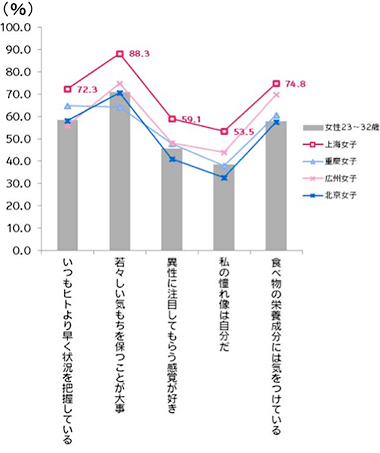
Characteristics of Women in Chinese Cities (Women Aged 23-32)
Dentsu Inc. Gal Lab Asia Survey
Shanghai, China's largest economic city.
In February 2013, Asia's largest LCC (low-cost carrier) began operations here, further boosting expectations for the exchange of people and trends within Asia.
Such is Shanghai. Beyond its economic strength, the city's women demonstrate remarkable trend sensitivity, showing significantly higher awareness compared to other regions in China.
Particularly noticeable is their strong desire to catch men's attention and maintain a youthful appearance!
This time, I'd like to take the liberty of analyzing these Shanghai women, who boast the highest level of feminine appeal in all of China.
Shanghai Women Are Overseas & Brand-Oriented
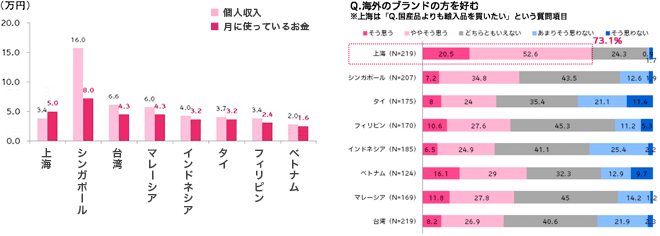
According to the Asian Women Survey, Shanghai women ranked as the biggest "big spenders" among all surveyed countries.
They spend ¥50,000 monthly despite having an average personal income of ¥34,000.
One reason for this may be their "high-end brand orientation."
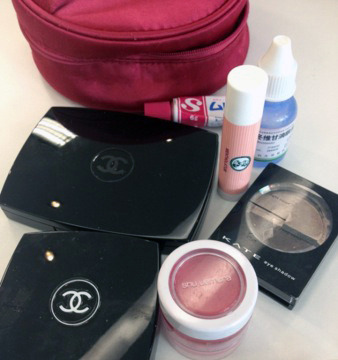
The contents of the pouch belonging to the Shanghai woman we interviewed.
Sure enough, there were overseas luxury brand items!
When it comes to cosmetics, she mentioned that she often asks friends or family to buy large quantities at duty-free shops when they travel abroad.
When it comes to cosmetics, they basically do bulk buying.

Medicine and food share the same origin—natural-minded Shanghai
Beauty awareness trends appear different from Japan's.
According to Bindi, whom we interviewed, "The keyword in Shanghai is definitely 'natural'.
Because it's a country where medicine and food share the same origin, there's a very strong focus on 'beautifying the body (its natural state).'"
Therefore, "Having beautiful bare skin is more important than makeup!
They spend over half of their 30-40 minute morning makeup routine on skincare."
Japanese women overwhelmingly spend much more time on makeup, especially eye makeup, devoting most of their makeup time to "enhancing" it. On the other hand, skincare follows a "time-saving" trend.
Especially in the morning, they might just use one toner, incorporate easy items like all-in-one cosmetics or BB cream, and focus on speed up until base makeup.
The "bare-faced" and "natural" look is also trending in Japan.
However, Shanghai women practice "beautifying the body (i.e., its natural state)" not as a trend, but as a cultural norm and habit. They place a much greater emphasis on skincare than Japanese women, which seems to be a significant difference.
Shanghai's "gal" level is 50% - Not swayed by trends
Once again, we're arbitrarily analyzing Shanghai girls' "gal-ness" through three perspectives: LOVE (Heart), DECO (Technique), and GUTS (Body).
Shanghai girls' gal level = 50% (with Japanese gal level set at 100%)
They don't wear deco accessories, their makeup is natural, and their appearance is cool, differing from Japanese gals.
However, this result stems from the feeling that their mindset—focusing on expressing individuality rather than being swept up by trends—aligns with the gal spirit.
"I don't get swept up in trends. When it comes to makeup, I don't compromise my own style by overthinking what men might think. I want people to judge me for who I am, not for my makeup," she states with remarkable coolness. The graph above also shows that "My ideal image is myself" scored over 50%, indicating a strong individualistic streak.
Now, regarding their impressions of Japan.
"Japanese products have a reputation for quality. For example, Japanese skincare brands have a very good image, but when it comes to makeup products, Western brands seem better than Japanese ones. I don't particularly imitate Japanese makeup styles or fashion."
However, even in Shanghai today, preferences seem to be shifting among the younger generation known as the "90后" (those born in the 1990s). They're doing eye makeup, curling their hair... girls appearing who are closer to the Japanese "KAWAII" aesthetic. It's possible that Shanghai girls born after the 90年代 might resonate with Japanese gal culture.
How to effectively reach them... this appears to be a challenge for the future.
Was this article helpful?
Share this article


Newsletter registration is here
We select and publish important news every day
For inquiries about this article
Back Numbers
Author
Kano Juna
Dentsu Inc.
Kansai Branch Office Marketing Design Bureau