
Note: This website was automatically translated, so some terms or nuances may not be completely accurate.
 Envisioning the Future 10 Years From Now! Future Prediction Support Lab [1/4]
What kind of future do consumers envision for 2028?
Tetsu Saito
Future Prediction Support Lab Launched
The Future Prediction Support Lab is a cross-functional team within Dentsu Inc. that compiles various future-related information into a database. We create future scenarios, imagine keywords for contemplating the future, and explore future business opportunities.
This time, we would like to share part of our "Survey on How Consumers Envision the Future in 2028."
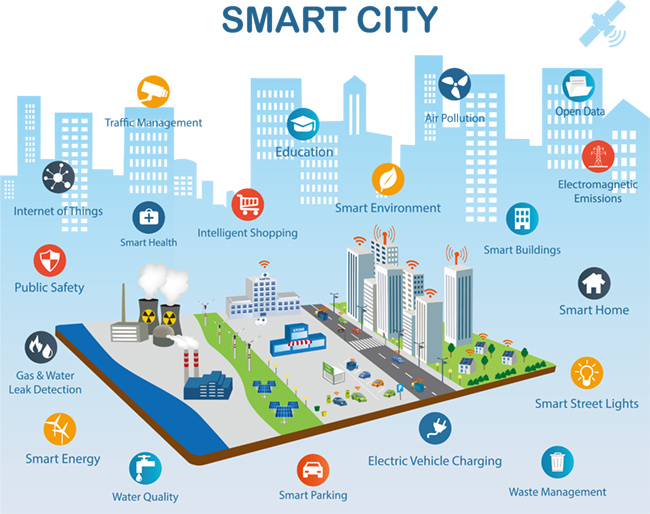
Discourse about the future surrounds us everywhere. Rapid technological innovation—often called the Fourth Industrial Revolution—encompassing AI, IoT, robotics, and fintech; global economic shifts symbolized by China and India's growth; and phenomena like global warming and extreme weather—all these factors are likely to transform our future lives.
Among factors unique to Japan, changes in social structure due to population decline and aging cannot be overlooked. Changes in household composition and work-style reforms are also expected to bring changes to our lives. The future society will be a complex system, realized through the intricate interplay of countless elements, including these. Accurately predicting it is not easy. The line between future forecasting and future prophecy is razor-thin.
On the other hand, it is an undeniable fact that we can shape the future with our imagination and power. Rather than passively accepting the future, we need to be creative and resourceful in building a better one. Through future forecasting, we aim to strategically construct pathways that effectively lead us toward a better future.
What is the top society people want to see in 10 years?
This survey explores how people currently envision the future society ten years from now. It's an attempt to uncover the "collective future" as imagined by the public.
What kind of society do people hope will be realized ten years from now, in 2028? Do they think it will be a society where women, young people, and the elderly can thrive? We asked about items such as whether people believe they can be happy.
This report is the first installment: "The Society We Want to See in 10 Years, and the Society We Think Will Exist." (See the end of the text for survey details.)
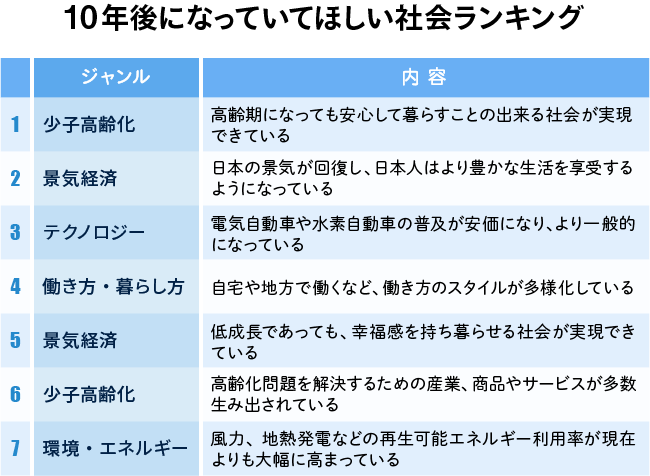
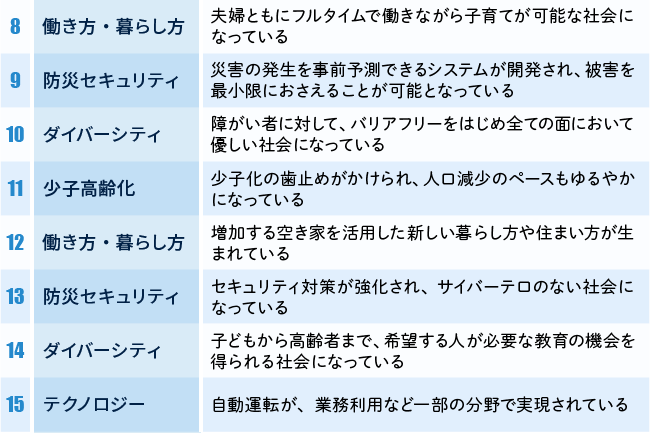
This survey asked lab members to list 60 items (including ideal scenarios) that they thought society might look like in 10 years. Respondents were then asked whether they hoped these items would be realized ("Hope") and whether they thought they would be realized ("Realization"). [Details of the 60 items are listed at the end of this document under Contact Information.]
Table 1 shows the top 15 rankings of "societies people hope will exist" as envisioned by consumers. The top-ranked items primarily centered on a society where the challenges of a declining birthrate and aging population are resolved, and a society where new ways of working and living are realized.

Regarding low birth rates and aging, top-ranked items included: "A society where people can live with peace of mind even in old age" (1st), "Industries, products, and services are being created to solve aging issues" (6th), and "The decline in birth rates is halted, and the pace of population decline slows" (11th).
Regarding work and lifestyle, top-ranked items included: "A society where work styles are diversified, such as working from home or in regional areas" (4th), "A society where people can live happily even with low growth" (5th), "A society where both spouses can work full-time while raising children" (8th), and "A society that is kind to people with disabilities in all aspects, starting with barrier-free access" (10th).
The society envisioned by consumers for the next decade, as revealed by these results, is not one where "labor productivity dramatically increases through work-style reform" (53rd) or "Japan regains its position as a global leader through the creation of new industries" (57th). Instead, it is a society where Japan's unique social challenges are largely resolved or mitigated. Even without high economic growth, it is a sustainable society where the elderly, women, people with disabilities, and children can live and work without discrimination, distributed across urban and rural areas, and where diverse ways of working and living are realized.
The Gap Between the Desired Society and the Existing Society
On the other hand, let's also look at what society might be like in ten years from the perspective of what it "actually is" (realistic), rather than what we "want it to be" (hope) (see Table 2).
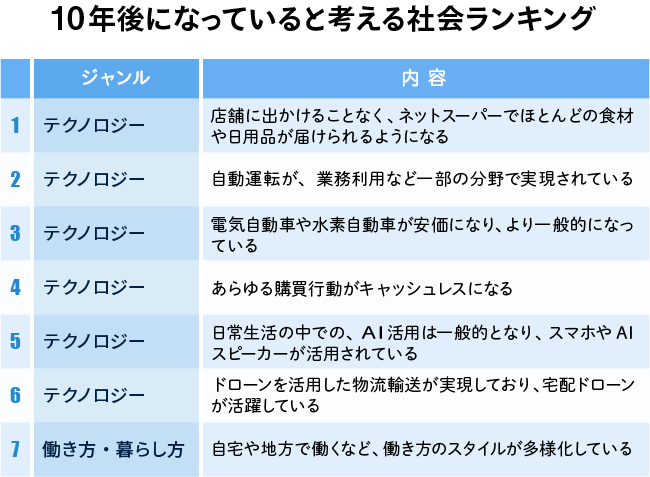
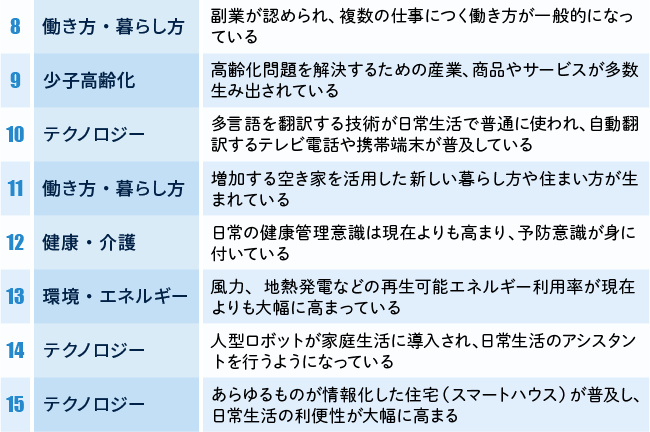
What this shows is that items like a society where the declining birthrate and aging population issues—which ranked high in the "Desired Society" ranking—have been resolved now rank lower. The top spots are occupied by societies enabled by technological innovation.
The top positions are occupied by: "Most groceries and daily necessities delivered via online supermarkets" (1st), "Autonomous driving partially realized for business use" (2nd), "Electric and hydrogen vehicles become more common" (3rd), "All purchasing actions become cashless" (4th), "AI use in daily life becomes commonplace" (5th), and "Drone-based logistics transportation is realized" (6th). Some of these items are already partially realized, indicating a realistic projection of the next decade based on current trends.
Viewed this way, we notice a significant gap exists between the "desired society" (hope) and the "actualized society" (realistic possibility). While the technological future is essentially a society realized solely through technological innovation, achieving the "desired society" (hope) requires overcoming numerous higher hurdles. These include generating new innovations to solve social issues and transforming the very structure of society itself.
To realize a prosperous future society, we must strive to bring the "existing society" closer to the "desired society." Only then can we truly achieve the "desired society" through our own efforts.
Next time, we will analyze in greater detail how to bridge this gap.
Contact: future@dentsu.co.jp
[Survey Overview]
Survey Title: "Survey on How Consumers Envision the Future in 2028"
Conducted: June 2018
Survey Method: Online Survey
Survey Participants: Men and women aged 20 to 69 living nationwide (1,000 samples)
Research Company: Dentsu Macromill Insight, Inc.
Was this article helpful?
Share this article


Newsletter registration is here
We select and publish important news every day
For inquiries about this article
Author