
Note: This website was automatically translated, so some terms or nuances may not be completely accurate.
 Envisioning the Future 10 Years From Now! Future Prediction Support Lab [2/4]
The society most anticipated by consumers for 2028 is "a society where electric and hydrogen vehicles are widespread."
Tetsu Saito
Last time, we looked at the top rankings for "The Society We Hope to See in 10 Years" and "The Society We Think Will Exist in 10 Years." These rankings were based on consumers' responses to a question asking them to rate 60 items (including ideal scenarios) on whether they "hope it will be that way" and whether they "think it will be that way." This time, we delve deeper into the ranking details.
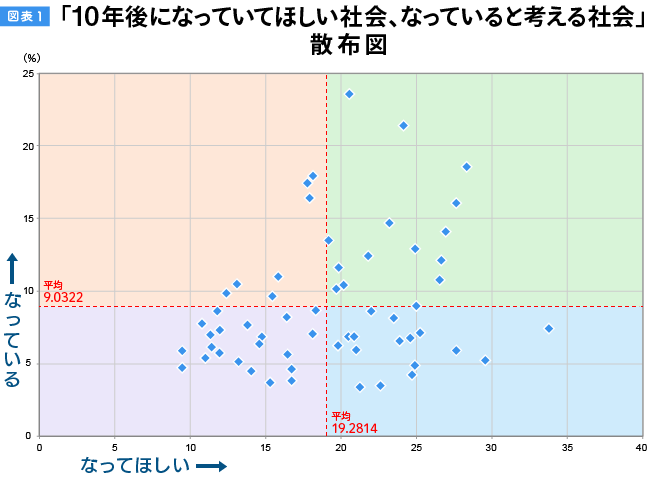
Plotting the 60 items surveyed on a scatter diagram—with "items people hope will exist" on the horizontal axis and "items people believe will exist" on the vertical axis—yields Figure 1. While a positive correlation generally exists, a significant downward skew is evident. Although some items are perceived as "existing (upper side)," it becomes clear that many questions are considered unlikely to be realized.
We calculated the average of the vertical and horizontal axes for this scatter plot and divided the graph into four quadrants. These can be organized as shown in Figure 2.
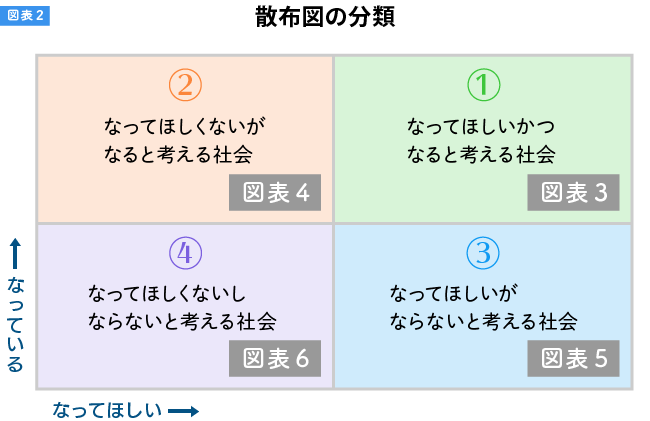
Figure 3 shows ① "The society we hope for and believe will be realized in 10 years." Items that consumers desire and believe have a high likelihood of being realized are plotted in this quadrant. Of the 60 total items, 14 are featured here.
Within this group, items perceived as both highly "desired (hope)" and highly "realized (achieved)" are primarily technology-related. Examples include: "Autonomous driving realized for business use," "Electric and hydrogen vehicles become widespread," "Daily shopping completed via online supermarkets," and "Humanoid robots assist with household life." These technologies are already realized, with some already in practical use, making their feasibility easy to envision as an extension of the present.
Next most numerous are items related to work styles and lifestyles. Items like "Diversification of work styles, such as working from home or in regional areas," "Multiple jobs becoming commonplace," "New lifestyles utilizing vacant homes becoming widespread," "Both spouses able to work full-time while raising children," and "Female management ratio exceeding 30%" are highly anticipated and also considered highly achievable within 10 years.
Additionally, in the area of aging society, items like "Numerous industries, products, and services addressing aging issues emerge" and "Daily health management and preventive awareness become widespread" were cited. Regarding the environment, items such as "Renewable energy sources like wind and geothermal power become widespread" and "Home energy generation, conservation, and storage systems like solar power become commonplace" were mentioned.
It is clear that all these items are perceived as having a positive impact on our lives ten years from now.
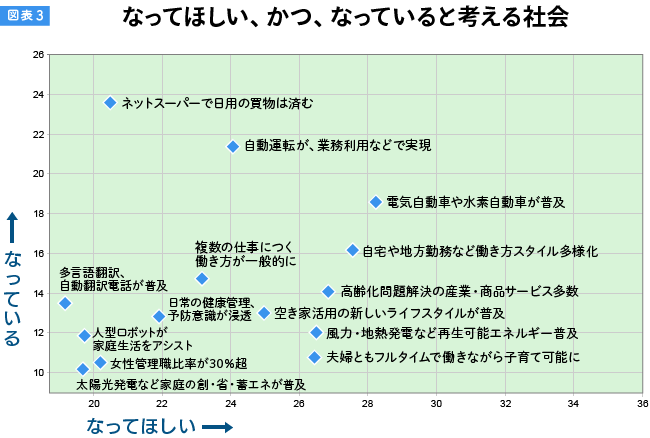
Figure 4 shows ② "Society we don't necessarily want, but expect to become." In other words, these are items considered highly likely to materialize, despite low public interest. There are eight items in total, not an overwhelming number. They are mostly technology-related.
Examples include: "All transactions becoming cashless," "Daily AI usage via smartphones and AI speakers," "Drone logistics becoming a reality with delivery drones in operation," "Widespread adoption of multilingual translation and automatic translation devices," and "Widespread adoption of highly informatized smart homes improving convenience."
In the industrial sector, items include: "Tourism becoming a major industry in Japan through increased visitor numbers" and "Japan's content, such as otaku culture and anime, becoming a major industry."
The items plotted here can be described as those "considered likely to be realized, but with relatively low expectations." New technologies, even if invented, cannot be considered realized unless they are accepted and adopted by people. History is full of cases where innovative inventions were made but never gained widespread adoption and faded into obscurity.
From this perspective, the challenge for the items listed here lies in how they can be recognized by consumers as technologies they truly desire to see realized, and in achieving the shift in acceptance perception required for that (moving into Quadrant 1).
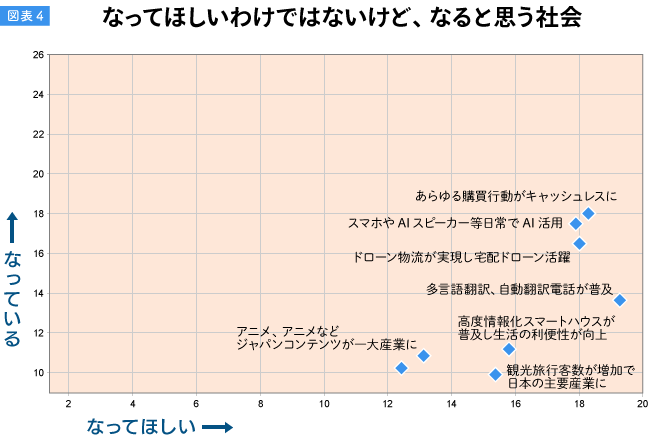
Figure 5 represents Quadrant ③: "Society We Want, But Don't Think Will Happen." Seventeen of the 60 items are plotted in this quadrant. Items here have high expectations but are considered unlikely to be realized for various reasons .
Items originating from Japan's unique social structure, current economic state, population decline, and aging-related challenges dominate this quadrant. Among these, "Japan's economy recovers, allowing people to enjoy affluent lives again," "A society where people can live with peace of mind in old age is realized," and "A society where people can live happily even with low growth is realized" are particularly highly desired items.
Additionally, diversity items such as "a society that is kind to people with disabilities, offering barrier-free access," "a society where no one feels resistance toward sexual minorities like LGBT individuals," and "a society free of gender discrimination that embraces diversity" are included in this quadrant. Work-related items like "choosing work based on personal passion rather than money" and "enabling diverse work styles without discrimination for the elderly in the era of 100-year lifespans" also fall here.
The items listed here cannot be achieved through technological progress alone; they require various social structural transformations and institutional reforms. Similar to the items in the second quadrant, it is crucial for us to strive to ensure that even a small portion of these are realized in ten years (transitioning to the first quadrant).
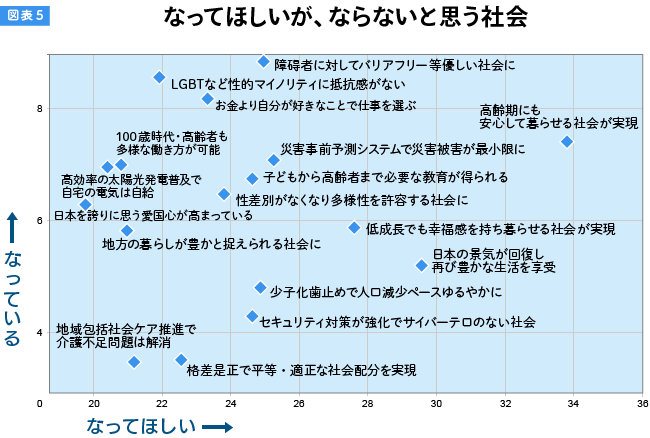
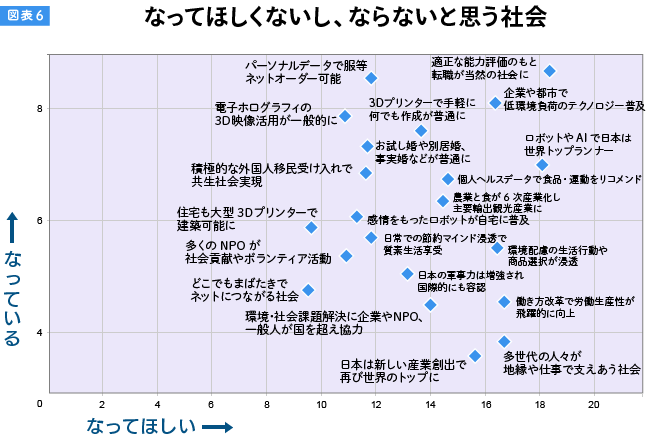
Figure 6 represents Quadrant ④: "Society We Neither Want to See Nor Believe Will Become Reality." It plots the 21 most numerous items. From the perspective of the respondents, these items generally have low expectations for feasibility and are perceived as having low likelihood of realization – essentially low-priority items. The content of these items is diverse.
The impression is that, compared to items in Quadrants 1 or 4—which involve technologies accessible to all generations or phenomena concerning the direction of Japanese society as a whole—this quadrant may contain relatively more items related to technologies or social phenomena targeting specific groups of people.
In any case, these items likely present significant challenges both in terms of future realization and the level of expectation among citizens.
Finally, Figure 7 combines the rankings for "The Society We Want to See" and "The Society We See" into a comprehensive ranking. To standardize the two rankings (desired society vs. existing society), we converted their respective percentages into z-scores and summed them to create a top 10 list.
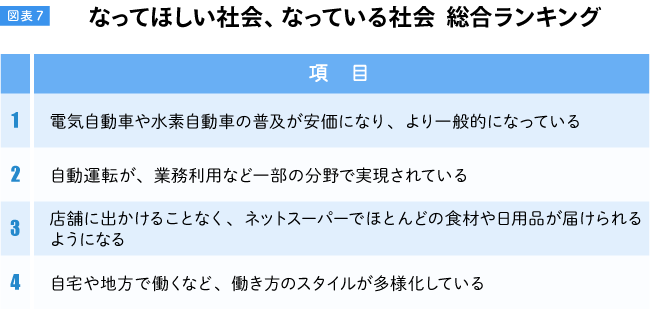
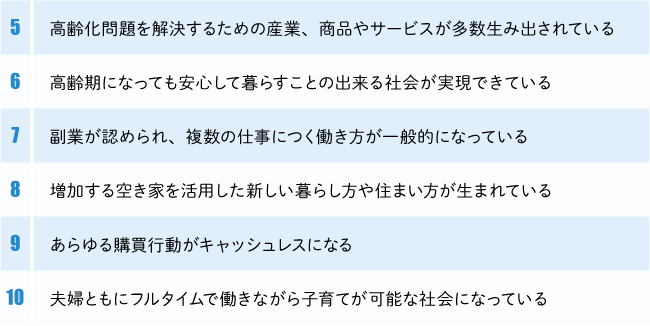
Looking at this, the top item was "Electric and hydrogen vehicles become affordable and more commonplace." Second place was "Autonomous driving is realized in certain fields, such as business use" – also automotive-related. This shows that automotive themes are highly interesting to consumers and are also perceived as having high feasibility.
Additionally, "online grocery shopping" and "cashless society" ranked third and ninth, respectively, showing that changes in purchasing behavior are also a major concern for consumers. Other themes ranking highly, such as aging society, child-rearing society, and diverse work styles, all seem to be viewed with high expectations and are considered likely to see significant change.
This concludes the explanation of "The Society We Want to See in 2028, The Society That Will Exist in 2028," which has been covered over the past two installments. Next time, we will shift focus slightly and consider the future ten years from now from three perspectives: "Women's Empowerment," "Youth Empowerment," and "Senior Empowerment."
Contact: future@dentsu.co.jp
[Survey Overview]
Survey Title: "Survey on How Consumers Envision the Future in 2028"
Conducted: June 2018
Survey Method: Online Survey
Survey Participants: Men and women aged 20 to 69 living nationwide (1,000 samples)
Research Company: Dentsu Macromill Insight, Inc.
Was this article helpful?
Share this article


Newsletter registration is here
We select and publish important news every day
For inquiries about this article
Author