
Note: This website was automatically translated, so some terms or nuances may not be completely accurate.
 Envisioning the Future 10 Years From Now! Future Prediction Support Lab [3/4]
Ten Years from Now: Will We See Greater Participation by Young People, Women, and Seniors?
Tetsu Saito
Is a Society Where Everyone Thrives Still Far Off? The Current State of a Society Where Youth, Women, and Seniors Thrive
Introducing the "Survey on How People Envision the Future in 2028." The theme of the third installment is "Empowering Youth, Women, and Seniors."
In Japan's society, facing long-term population decline, realizing a society where everyone can fully utilize their potential is a major challenge. At the same time, various invisible barriers currently exist in Japan that hinder this realization. For example, barriers for young people include transitioning from non-regular to regular employment; for women, balancing childcare and work and barriers to promotion to management positions; and for the elderly, mismatches between diverse employment needs and current job opportunities.
Removing these invisible institutional and customary barriers one by one is key to realizing a society where everyone can thrive. But how do people in their daily lives perceive the feasibility of achieving such a barrier-free, thriving society?
This survey focused on three main points. We asked about the current situation and projected progress in ten years for "gender equality and women's advancement," "older adults' participation," and "young people's participation," specifically inquiring whether people feel they are "given opportunities to participate."
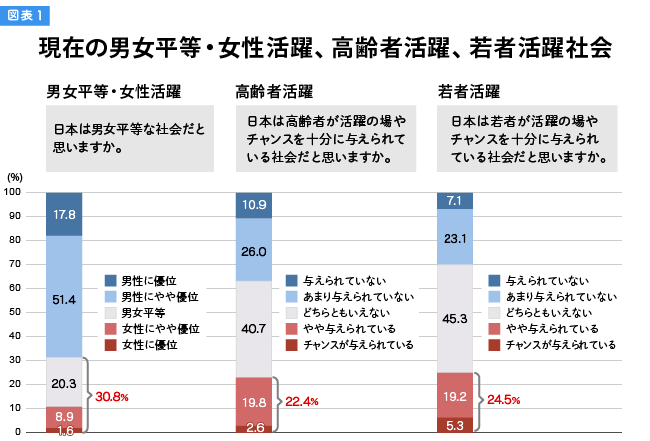
For all three areas, the combined percentage of respondents who answered "Opportunities to thrive are provided" or "Some opportunities are provided" remained between 20% and 30%. Even in "Gender Equality and Women's Participation" – perceived as the most advanced area – only 30.8% combined answered "Women have an advantage," "Women have a slight advantage," or "Gender equality exists." The reality is that nearly 70% of respondents still perceive a male-dominated society. Based on this alone, Japan is overwhelmingly seen as a "male-dominated society."
Regarding opportunities for the elderly and young people to thrive, over 40% of respondents answered "I can't say either way." Only 22.4% believe the elderly are given opportunities to thrive, and 24.5% believe young people are given opportunities to thrive – both figures are low.
Predicting the state of participation in 10 years! The area expected to advance the most is gender equality and women's participation.
So, how much improvement is expected in opportunities for each group by 2028, ten years from now?
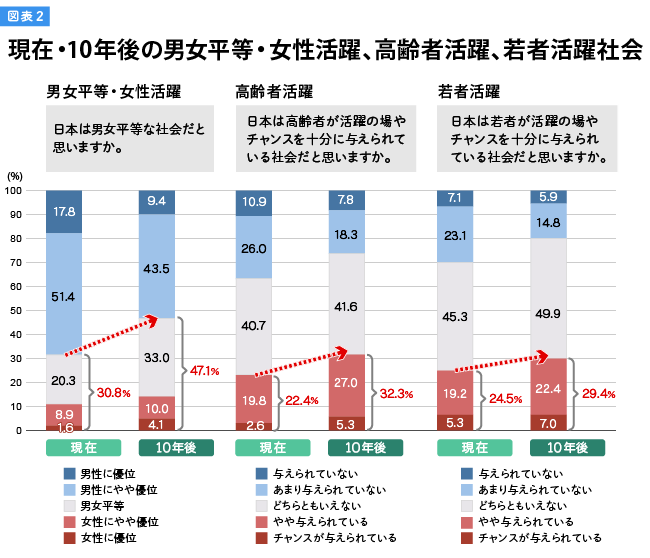
While direct comparison is difficult since only the gender equality/women's participation question differs, projections show: and youth participation is projected to rise from 24.5% to 29.4% (+4.9 points). Based solely on these figures, gender equality and women's empowerment appear poised for the most significant progress.
Regarding women's participation, the government has already set a target of eliminating waiting lists for childcare by the end of fiscal year 2020, with gradual progress becoming visible. Additionally, government policies such as aiming for 30% representation of women in leadership positions across all fields (Cabinet Office/Council for Gender Equality) may be influencing these results.
On the other hand, for the active participation of the elderly and young people, the projected progress rate in 10 years is less than 10 points from the current level for both groups, suggesting limited expansion of opportunities. For the elderly, while extending retirement age and continuing to work into later life has become a societal theme in recent years, the lack of concrete policy measures may be a contributing factor.
The same applies to young people. While the employment rate for new graduates has shown improvement in recent years, the public perception seems to be that, in terms of their active participation, they have not yet reached a point where their future potential is truly felt.
Will a society where young people thrive arrive? Differences in perception by gender and generation
Let's examine perceptions of gender equality/women's advancement, senior citizen advancement, and youth advancement in greater detail.
・Gender Equality and Women's Empowerment: Different Perceptions Due to Gender Differences
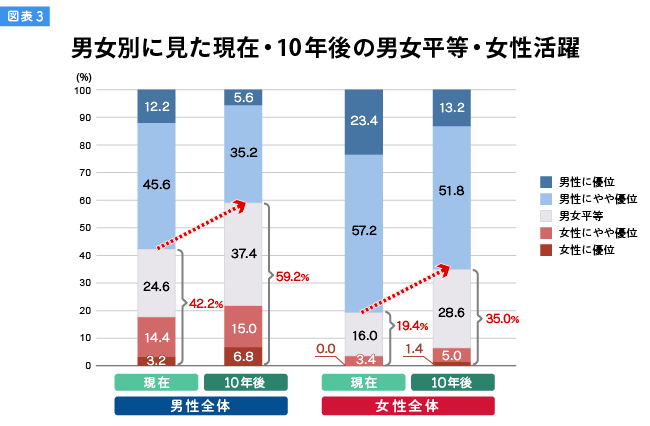
First, regarding gender equality and women's participation. Here, a significant gap in perception exists between men and women. While men show high expectations for gender equality and women's participation, with 42.2% expecting it now and 59.2% expecting it in 10 years (+17.0 points), women show a high increase but remain at only about half the actual value of men: 19.4% expecting it now and 35.0% expecting it in 10 years (+20.6 points).
Considering that a society of gender equality and women's empowerment is one where "women themselves feel they can thrive," we can say we are still halfway there.
・A society where older adults thrive: Perceptions differ by generation
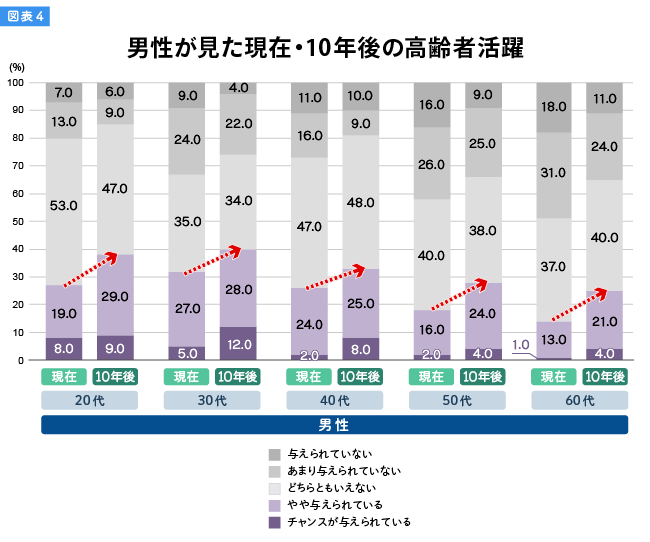
What about a society where older adults are active? Here, the differences are significant not between genders but across generations. The trend shows that younger generations tend to believe a society where older adults are active is progressing, while older generations tend to believe it is not.
Figure 4 shows men's views by age group, comparing the present and 10 years from now. The younger the age group, the stronger the tendency to believe society will be one where older adults play an active role, both now and in 10 years. This holds true for women as well, albeit to a lesser degree.
Keywords like "intergenerational gap" and "intergenerational conflict" have been buzzing in society lately, and it's fair to say the differing societal views stemming from generational differences are clearly reflected here.
・A society where few can hold onto hope? A society where young people thrive
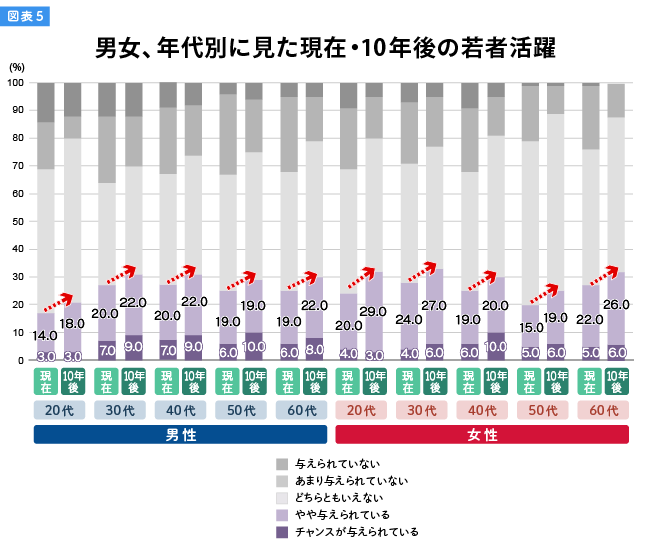
Finally, we examine a society where young people thrive. While "gender equality/women's advancement" and "elderly participation" showed differences in projected future progress by gender and age group, "youth participation" reveals little significant variation across gender or age. Both current and future projections remain low.
Figure 5 shows current and projected views by gender and age group. Across all genders and age groups, only around 20-30% believe young people will be given opportunities to thrive in 10 years, indicating low expectations for the future.
Amid Japan's advancing aging and declining birthrate, young people remain the ones who will shoulder the future, just as they always have. It is an indisputable fact that many new ideas and innovative breakthroughs originate from young people. In the era when baby boomers were young, coinciding with a major shift in values, numerous youth-driven cultures emerged.
The current state of society, where young people themselves feel they have few opportunities to thrive now or in the future, is far from desirable. Creating a society where young people feel abundant opportunities and chances to thrive are readily available is arguably the most essential requirement.
Contact: future@dentsu.co.jp
[Survey Overview]
Survey Title: "Survey on How Consumers Envision the Future in 2028"
Conducted: June 2018
Survey Method: Online Survey
Survey Participants: Men and women aged 20 to 69 living nationwide (1,000 samples)
Research Company: Dentsu Macromill Insight, Inc.
Was this article helpful?
Share this article


Newsletter registration is here
We select and publish important news every day
For inquiries about this article
Back Numbers
Author