
Note: This website was automatically translated, so some terms or nuances may not be completely accurate.
[Dialogue] Dai Tamesue × Keiichi Higuchi Part 3: A Future City Realized Through the Tokyo Olympics?!
Continuing from last time, former professional track and field athlete and current coach and commentator Dai Tamesue, along with Keiichi Higuchi, Communication Design Director at Dentsu Inc. CDC, discussed the potential for sports to contribute to addressing various societal challenges.
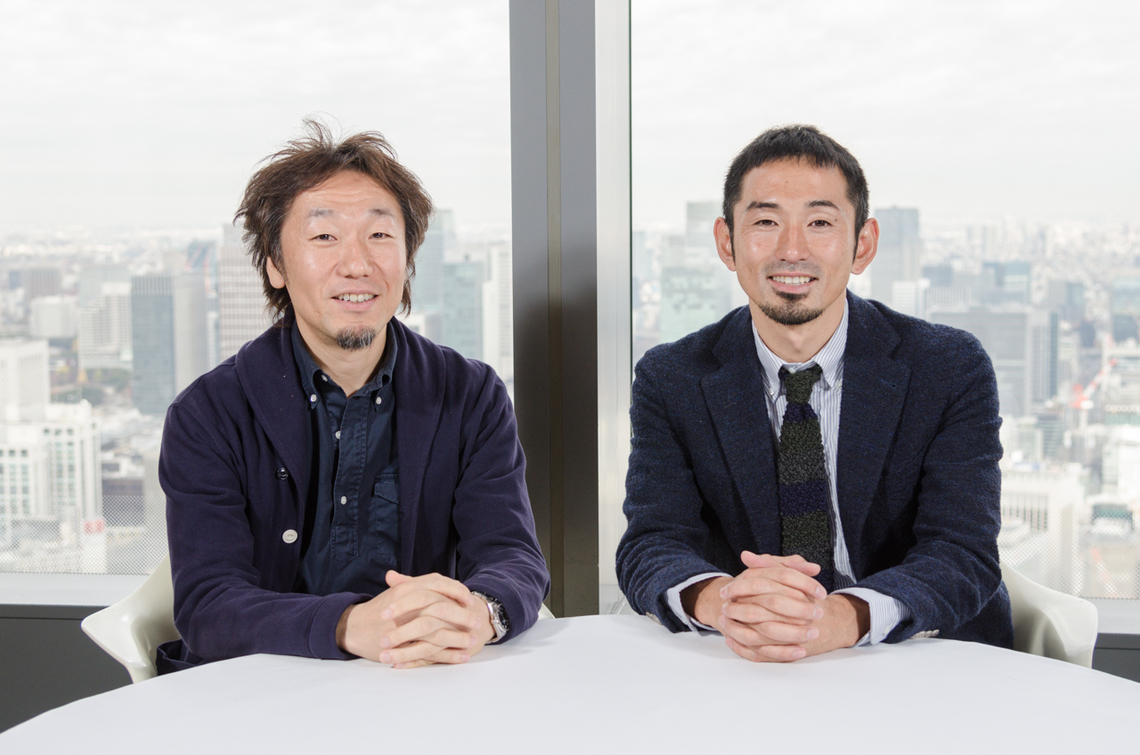
[The Potential of "Community Building" Through Sports and Lifestyle]
Tamesue: We discussed how sports wisdom could contribute to organizational building, but I believe it can also be applied beyond corporations to create horizontal connections between people. Currently, I'm involved in work that helps form communities incorporating sports. We're influenced by the people living there more than by specifications like the area or the layout of the house, right?
Higuchi: Absolutely. The way our neighbors live inevitably seeps into our own lives. And collectively, including ourselves, we shape the culture of that town.
Tamese: It's about the atmosphere of the town, or the soft aspects, if you will. Take large apartment complexes, for example. The appeal isn't just having a nursery, clinic, or park on the first floor; it's that this setup naturally fosters interaction between people of all ages. Having these soft aspects well-developed will be crucial for communities going forward, and that's what I'm trying to build through sports.
Higuchi: I understand completely. Research has long shown how environments can prompt actions or give rise to services. While some aspects are left to the judgment of those involved, the perspective of designing towns with the environment—including neighbors—in mind is fascinating.
Tamura: Exactly. You mentioned the individuals' judgment, but perhaps the providers themselves are increasingly unable to control things. So, I think the approach going forward is to provide small pieces of content and hope that the atmosphere and flow of the space change based on the people who engage with it.
To steer this in a positive direction, I believe sports can play a role in community building.
Higuchi: It's not about the physical infrastructure; it's these aspects that enhance a town's value. For example, in Kanazawa, there was a project offering disused textile factories as studios almost free of charge. This attracted many aspiring artists to move there. As they independently held exhibitions and sales events, the town, together with the 21st Century Museum of Contemporary Art, Kanazawa, became an art hub and really came alive. A sports version of that movement seems entirely feasible.
Tametsu: That's interesting. For the sports version, imagine something like your body fat being recorded every time you pass through a ticket gate (laughs). I'd like to explore mechanisms like that, rooted in daily life.
[Transforming into a City Addressing Future Challenges Through the Tokyo Olympics]
Tametsu: Still, in Japan, when we say "sports," we often imagine the level of athletes or those aiming to go pro, and I always feel there's a big gap with everyone else. Someone who's enjoyed jogging for 10 years is also a fine sportsman. It would be nice to have a bit more of a gradient, but the language itself creates a high barrier.
Higuchi: It's hard to feel like something is "sport" without a competitive or game-like element. But in the earlier town planning discussion, if athletes and regular residents just jogged together a bit, that alone could foster a pleasant relationship.
Tametsu: That's right. What you might call "weak ties" – those loose connections between strangers within a community – actually function well from a crime prevention and disaster preparedness perspective.
Higuchi: When considering crime prevention and disaster preparedness, it feels like relying solely on physical infrastructure isn't enough. We need to think about how the community contributes from a completely new perspective to find solutions. I've even heard stories where planting beautiful flowers increased the number of people watching over the area, which ended up contributing to crime prevention.
Tametsu: Cultivating something is a major factor, isn't it? When I lived in San Diego before, in an area where barely 20% of people spoke English, there was a movement to build community by growing plants or playing soccer.
Caring for plants together is communication through physicality, and soccer goes without saying. It requires no language; you run, kick the ball, feel the excitement, and gain a sense of understanding with others. That changes how you interact afterward. Initiatives like introducing sports to children in conflict zones likely have a profound impact on their psyche. Experiencing physical connection and realizing that neither you nor the other person changes makes it harder for the logic of hating your enemy to take root.
Higuchi: Sports contributing to urban development and community building, bringing about solutions. It would be great if Japan, with the Tokyo Olympics approaching, could undertake such initiatives. Regarding the theme of how to transform Japan over the next six to seven years, I expect sports will play a major role not only in the traditional sense of promoting health, but also as an approach to solving social issues.
Tamura: Beyond that, I also want to focus on Japan after the Olympics end. I feel it will become increasingly important to examine how a city changes after hosting the Olympics. For example, if we build a barrier-free city centered around Paralympians for 2020, it could support an aging society for the next 50 years. Tokyo itself is still using infrastructure built for the previous Olympics, so we should consider creating things that will last until 50 years after 2020.
Using the Olympics as a catalyst to become a city ready for future challenges. It's a bit like a time machine, isn't it? Furthermore, if we embed Japanese technology throughout that city, the 2020 Games could serve as a springboard for that technology to spread globally. I'm really fascinated by that long-term perspective right now.
Higuchi: I see. Thinking that way, the Olympics could potentially become more than just a sports event—it could be like an exhibition of new wisdom. Especially since Japan, as an advanced nation, faces major challenges like aging and declining birthrates. Good examples from Japan could be applied overseas too.
Tamesue: It would be great if a new perspective on sports, one that connects to the next 50 years, could take root in Japan. I want to dedicate myself to making that happen.
Until now, the focus of discussion has been on how society supports sports. I truly hope we can shift the conversation to how sports support society, leading to a situation where sports become essential.
Higuchi: I truly believe the wisdom possessed by sports and athletes is a social asset. I want to explore initiatives to utilize this more effectively in corporate activities and solving social issues. Thank you very much.
(End)
Interview Location: BiCE TOKYO
Was this article helpful?
Share this article


