
Note: This website was automatically translated, so some terms or nuances may not be completely accurate.
 The Essentials of D2C Inc. Brand Development [1/2]
A Major Transformation in Brand Business! What Are the Three Keys to D2C Inc. Success?

Kenta Izumi
Tagpic Inc.
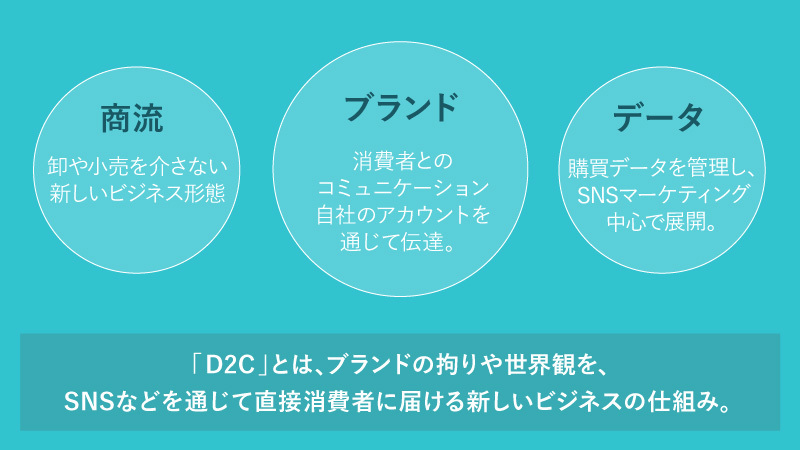
D2C Inc. is an abbreviation for "Direct To Consumer."
It refers to a business model where companies or individuals sell products and services directly to consumers via their own websites, bypassing retail stores and distributors.
It's arguably one of the most talked-about terms in the business world in recent years.
However,
it's possible that many people haven't fully grasped
In this series,
In this series, we asked Kenta Izumi—founder and chairman of Tagpic, an influencer marketing company that partners with Dentsu Inc. to support corporate D2C Inc. brand development, and also brand producer at Marche, a D2C-specialized marketing firm—to explain the overall landscape of D2C Inc. business.
This time, we asked him about key points companies looking to start must grasp: the essence of D2C Inc. brands that differs from traditional e-commerce, approaches to the D2C market unique to Japanese companies, and the essential business development processes and necessary talent for D2C Inc. business.
<Table of Contents>
▼The Essence of D2C Inc.: ① Empathy for the Brand's Worldview ② Passing Benefits Back to Users ③ The Viral Power of SNS Influencers
▼What is the 'Democratization of Consumption' Behind the D2C Inc. Trend?
▼D2C Inc. landscapes in the US and Japan. "Logistics that preserve experiential value" will drive Japan's D2C Inc. growth!
▼D2C Inc. in China and Japan. Influencers hold the key to Japan's growth potential
▼Treat it as a "completely new business venture," not just "selling online"
▼D2C Inc. is a "mixed martial arts battle"! ... What's the essence?
・Who is Kenta Izumi?
Founder and Chairman of Tagpic. A hybrid executive who also serves as a gourmet influencer with over 460,000 followers primarily on Instagram/TikTok via his personal SNS account "@nikuterrorist".
Leveraging his experience in the financial industry and as a professional manager at listed companies, he is also a "Listing Specialist" who has enhanced the corporate value of numerous companies through branding and strategic consulting.
・What is Tagpic?
An influencer marketing company boasting top-tier results in building empathy through SNS branding, with 5,000 influencers across Japan and Asia.
Executives and employees, including Mr. Izumi and co-founder and CEO Ayumi Yasuoka, actively serve as influencers themselves, possessing deep expertise in the success principles of SNS and D2C Inc. In September 2020, it established Marche, a subsidiary specialized in D2C Inc. https://tagpic.jp/
・Dentsu Inc. and Tagpic
Dentsu Inc. has formed a business alliance with Tagpic and its group subsidiary Marchewhich specializes in D2C Inc. brand development. ( See press release for)
The essence of D2C Inc. lies in: ① Empathy with the brand's worldview ② Returning benefits to users ③ The dissemination power of SNS influencers
The D2C Inc. business model has seen significant buzz-word-like momentum in recent years.
In the US, numerous D2C Inc. brands have secured massive funding rounds in recent years, becoming "unicorn companies" (*). In Japan too, companies launching D2C Inc. businesses, particularly startups, are rapidly increasing and attracting intense attention from investors and corporations.
*Unicorn company: A privately held venture company with a market valuation exceeding $1 billion.
Simply put, D2C Inc. means "delivering products directly to consumers."
You might think, "But hasn't e-commerce (EC) selling products and services on company websites existed for a while? What's different?"
You might wonder, but I believe the D2C Inc. brands currently establishing themselves possess three key characteristics absent from traditional company websites.
D2C Inc. Brand Feature ① UX Design that Conveys a Worldview
A key characteristic of D2C Inc. brands is their emphasis on "communicating the brand story online."
This requires UX design that conveys the story behind the product's creation, the dedication to raw materials and ingredients—in other words, "what is the background," "who created it," and "why" the product or service exists.
Traditional company websites were mostly used as platforms to promote facts—like the features or ingredients of products and services. That is now reaching a major turning point.
D2C Inc. brands present their brand worldview through all touchpoints, primarily social media, delivering a consistent user experience across every interaction. Consumers who "connect" with this worldview acquire not just the product, but the entire brand universe.
Furthermore, even after purchase, maintaining connections through digital touchpoints like social media and email newsletters allows communication with highly engaged users to continue. Building a fan base to encourage repeat purchases and influence is prioritized.
Compared to the past, where communication was often "sender-driven" through email newsletters and advertising campaigns, the major difference from traditional online retail is that the entire pre- and post-purchase experience is meticulously designed to be "user-driven," with the sole purpose of building a fan base.
D2C Inc. Brand Feature #2: Passing Benefits Back to Users
D2C Inc. brands often operate without physical stores and bypass distributors, enabling cost reduction and, from this perspective, profitability.
This surplus profit presents two options for users: "return it through lower prices" or "return it through value by selling items unavailable in stores or increasing added value."
The latter approach—converting surplus profits into high added value—is particularly crucial.
For example, by focusing on raw materials and components, users can obtain products with a high cost ratio. Similarly, concentrating on box design elevates the excitement of opening it, providing a more premium experiential value.
D2C Inc. Brand Feature #3: The Viral Power of Social Media Influencers
Traditional brands primarily relied on media-driven promotions. For D2C Inc. brands, social media outreach originating from individual influencers holds the key to their promotional strategy.
In recent years, as consumers increasingly use social media as an "information gathering tool," the influence of influencer-driven social media posts has grown significantly, particularly among Millennials and younger generations.
This has led to purchasing behavior where consumers will buy products recommended by trusted influencers on social media, even if they've never seen the brand on TV or in magazines.
By viewing these influencers as evangelists for D2C Inc. brands and maximizing their reach, it becomes possible to develop promotional strategies that don't rely on traditional advertising.
Among D2C Inc. brands riding the current wave, there's a growing number that assign influencers to exchange opinions even during the pre-product development stage, or that place influencers at the core of their promotions.
First, understand that three core elements underpin D2C Inc. brands: UX design that conveys the brand's story and worldview, benefits returned to users, and the reach of social media influencers.
What is the 'democratization of consumption' driving the D2C Inc. trend?
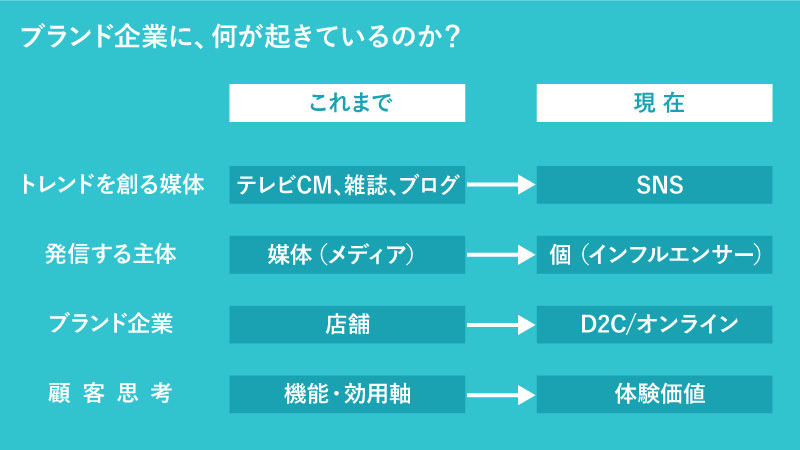
One reason for D2C Inc.'s rapid growth is the "democratization of consumer behavior" driven by consumers themselves.
Since the 2000s, the rise of major e-commerce platforms made buying goods online commonplace. Soon, sites for evaluating products and stores, along with user review features, became widespread, gradually changing consumer behavior.
While major e-commerce platforms still wield significant influence today, consumers have undergone further transformation in recent years.
Rather than blindly accepting reviews or recommendations, a new consumption style has rapidly grown, particularly among Millennials and younger generations. This style involves consumers finding and verifying things themselves—like discovering a great restaurant on Instagram—and finding value in the entire process of discovery and verification before making a purchase.
Rather than purchasing items unilaterally presented to them, consumers now actively select and buy products themselves. Alternatively, they purchase items recommended by friends or influencers they trust.
Their criteria for decision-making are:
whether they can relate to the brand's story and worldview
.
This shift from passive consumers represents, in extreme terms, the "democratization of consumption." As more consumers prioritize "choosing based on their own values" over "what everyone else has," consumption is shifting toward being more "consumer-driven."
The means of gathering information have also changed. Compared to the era when only the four traditional media (TV, radio, newspapers, magazines) existed, consumers now use search engines, and further still, social media is increasingly gaining influence.
Information shared on social media by friends, influencers, or other consumers is perceived as more neutral and trustworthy than advertising reflecting corporate intentions or information from review sites.
As mentioned earlier, the essence of D2C Inc. brands lies in creating "empathy" for a product's story and worldview, primarily through SNS, and in reinvesting the surplus profits generated by not having physical stores or bypassing distributors into enhancing the user experience.
Brands are first "discovered" by consumers on SNS, then gain their "empathy" through their story, and finally provide a high-quality "experience value." Consumers who empathize with the brand then "share" their genuine, personal recommendations. Seeing these shares, other consumers are exposed to the brand's worldview and develop their own "empathy," establishing a cycle.
It seems inevitable that D2C Inc. brands have flourished with SNS as their primary battleground.
D2C Inc. Trends in the US and Japan. "Logistics that preserve experiential value" will drive Japan's D2C Inc. growth!

D2C Inc. originated in the US and has recently gained traction in China. Let's examine the differences between Japan and these two countries.
First, comparing the US and Japan, there are significant differences in the conditions of "territory, stores, and logistics."
The United States has vastly more land area, meaning moving people and goods often takes longer.
Regarding stores, Japan boasts a dense network of convenience stores and general supermarkets in residential areas nationwide, offering a wide range of goods. In contrast, in the US, unless you're in an urban area, you often need to drive long distances to reach such stores.
Furthermore, Japanese retail stores offer consistent customer service and convenience. You can expect a similar level of service at any store nationwide, making retail convenience higher in Japan.
Japan's greatest strength lies in its highly developed logistics network. Compared to other countries like the United States, Japan maintains exceptionally high standards for delivery quality control, including refrigerated and frozen goods management.
Consumers who engage with a brand digitally and proceed to purchase expect a consistent brand experience and user journey, even when receiving and unboxing the product delivered to their home.
In this regard, Japan's superior logistics network holds a significant advantage in the development of the D2C Inc. market, as it ensures the "experience value upon product delivery" remains uncompromised.
For your reference, please take a look at the following brand site and SNS video posts for Blanche Chocolat, available at Marche.
[Designing an experience value akin to a luxury jewelry box]
https://branche-chocolat.jp
[Image of opening the cosmetic box]
https://www.instagram.com/p/CFrPxfBDu6X/
China and Japan's D2C Inc. Landscape: Influencers Holding Japan's "Room for Growth"

Next, let's compare China and Japan. The biggest difference is that in China, influencers (called Key Opinion Leaders, or KOLs) wield significant influence in e-commerce, and the proportion of live streaming is also high.
The culture of "live commerce," where influencers partnered with companies sell products while live streaming, seems thoroughly established in China, with its market size estimated to reach 2 trillion yuan (approximately 31 trillion yen) in 2021(※). However, in Japan, it is still only in the market creation phase.
※Source: Japan External Trade Organization (JETRO)https://www.jetro.go.jp/biznews/2020/10/a96bbe55659f00d6.html
This difference stems from underlying cultural and habitual disparities. For instance, in Japan, there is no custom of communicating with friends via voice messages in public spaces or streaming audio from one's smartphone. These differences have led to the significant development of commerce originating from live streaming in China, resulting in a rapid increase in influencers who can "talk and sell products."
While influencers active in the commerce space are gradually emerging in Japan too, I believe a form unique to Japan, distinct from China's, will likely emerge.
Currently, YouTube is the most profitable platform for influencers. However, this landscape could shift significantly depending on future monetization programs from Instagram and TikTok, making it essential to closely monitor platform developments.
To summarize, for D2C Inc. brands entering the Japanese market,
- High standards in retail and logistics, which greatly impact user experience
- and offers substantial room for growth, such as the rise of influencers.
These are the key advantages.
Currently, Japanese D2C Inc. brands are primarily led by startups offering luxury goods, niche products, and complex solutions.
However, the US is entering a phase where major brands are acquiring D2C Inc. companies, and the rapid market expansion in the US and China will naturally impact Japanese companies as well.
Moving forward, national brands and major brand companies will undoubtedly begin entering the space, and the product categories handled by D2C Inc. will diversify.
It should be viewed not as "selling online too," but as a "completely new business venture."
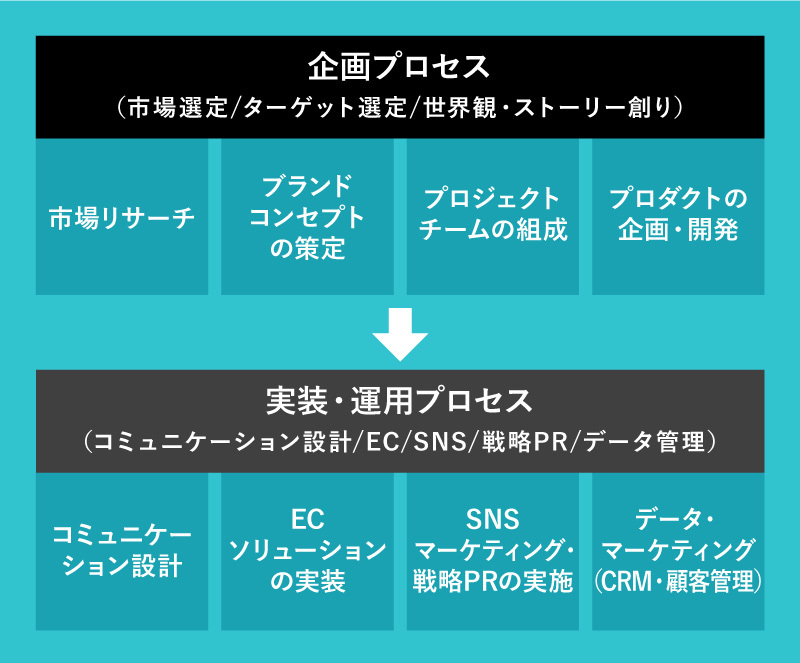
So, what exactly do Japanese companies need to launch a D2C Inc. brand? Let's start by outlining the mindset required.
● Designing User Experience Value
First and foremost, as a brand, you must focus on designing the user experience value. You need to design the entire experience value for consumers—before they encounter the brand, at the point of purchase, and after purchase.
How will consumers first see it? How will they order? What condition will it arrive in? How will they open it? How will they consume it? What photos will they take? And when will they make repeat purchases? D2C Inc. means calculating every aspect of the user experience to inform product design and UI/UX design.
Among these, the design and UI of the brand website—the actual point of sale—are crucial. To build a compelling story and worldview, we must meticulously focus on the quality of every element: content structure, catchphrases, photography, and more.
Occasionally, companies planning to launch a D2C Inc. brand ask:
"We already have product photos used in catalogs and major e-commerce sites. Can't we just use those?"
Unfortunately, we sometimes have to decline. Creatives suited for print fundamentally differ from those that shine on social media, and repurposing existing assets won't fully convey the brand's world.
To start a D2C Inc. venture, you need the mindset to completely rebuild the original brand from scratch as a 'new D2C Inc. brand.'
Incidentally, for our brand Blanche Chocolat, we developed our own original font to express a unique worldview and meticulously crafted every detail on the website and printed materials.
Companies must also assess whether their products are fundamentally suited for D2C Inc. Japan's highly developed retail and distribution networks mean low-priced items often sell far more efficiently at station-front convenience stores or category-specific shops. Switching everything to D2C Inc. just because it's trendy isn't necessary.
And as we'll discuss later, even when incorporating D2C Inc. into your business, your existing stores and channels remain crucial.
● Returning Benefits to Users
Furthermore, "returning profits to users" is essential for D2C Inc. Purchasing goods online inherently involves shipping costs. Consumers are unlikely to choose to pay for shipping themselves to buy from a D2C Inc. brand when they could purchase the same item from a retail store or a major e-commerce platform offering free shipping.
Therefore, for D2C Inc. brands, cutting out distribution and retail markups necessitates providing "added value" compelling enough for consumers to pay shipping costs.
In other words, products and services suited to D2C Inc. are typically high-value-added offerings. They are items that can build a compelling story or worldview resonating with consumers, or demonstrate a strong commitment to quality.
It's not just about "superior quality"; anything that makes consumers think, "I'm willing to pay shipping for this," becomes added value.
As mentioned earlier, current D2C Inc. leaders are in beauty/fashion, luxury goods, and products addressing specific needs. Items like cakes and sweets (which are bulky and hard to transport if shipped frozen), beverages (water, alcohol), rice, and dog food (which are heavy and cumbersome to carry from retail stores) are also highly compatible with D2C Inc.
In summary, the key point is to view D2C Inc. not as "selling existing products through your own online store," but as a "new business venture."
Develop new products specifically suited for D2C Inc.
For existing products, completely redesign them to be suitable for a D2C Inc. brand
D2C Inc. is a "mixed martial arts battle"! ...What's the meaning behind that?
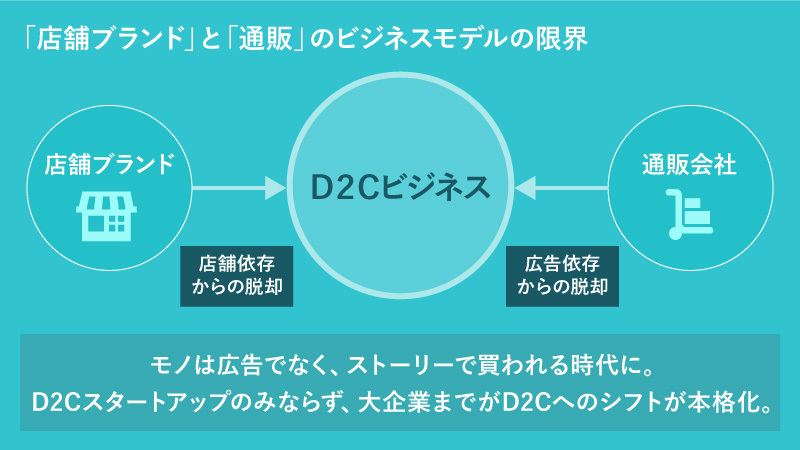
What matters most in D2C Inc. is long-term communication with consumers who resonate with your brand.
In other words, it's not just about developing and selling products—
- but also designing communication to gather consumer empathy
- Implementation of e-commerce solutions, including designing customer journeys from awareness to purchase
- Executing social media marketing and strategic PR
- Data marketing (CRM, customer management)
A series of service designs like these is necessary.
To achieve this, we begin by selecting the market and target audience, then develop the brand concept in collaboration with researchers and copywriters.
Next, we form a project team, including selecting external partners, and proceed with product planning and development, incorporating specialists knowledgeable in the relevant field based on the product's content.
We recommend bringing external specialists onto the team, such as designers and copywriters who shape the brand's worldview, UI/UX designers who design customer experience value, and social media marketing experts.
Since the purpose here is to outline D2C Inc., we'll cover specific project execution methods and required personnel in a separate article.
Finally, as President Mori of the D2C Inc. bespoke suit brand "FABRIC TOKYO" also stated in an article, we refer to the challenges of D2C Inc. business as a "mixed martial arts battle."
While SNS is the primary battlefield for D2C Inc., as explained here, we cannot ignore the existence of existing channels like mass media, retail, and e-commerce platforms.
The D2C Inc. brands we handle at Tagpic also value relationships with mass media outlets like magazines, depending on their products. Furthermore, their sales channels aren't limited to their own websites; they sometimes utilize major e-commerce platforms.
Furthermore, the role of physical stores evolves in D2C Inc. Just as American D2C Inc. brands like mattress company Casper and eyewear brand Warby Parker have opened stores in New York's SoHo district, physical stores offer unique "experiential value" that cannot be replicated online.
While physical stores were primarily measured by "sales" in the past, D2C Inc. stores serve as spaces to experience the brand's worldview and story, with actual purchases often happening online.
If the role of stores changes, store operations must also be redesigned. For example,
- - Setting store KPIs like social media conversion rates and LINE@ registration rates
- Hiring staff with strong social media presence and influence
To design incentives for stores, a strategic approach involving the HR department could be considered.
Incidentally, I believe that "delivering experiential value in physical stores" is an area where large brand companies and national brands, which already possess their own stores, distribution channels, and brand recognition, hold an advantage over startups.
However, it's crucial not to forget that exposure on e-commerce platforms or retail stores incapable of conveying the brand's story and worldview could potentially damage the brand's overall value.
Thus, even for D2C Inc. brands, it's essential to strategize branding while considering how to allocate budgets for multimedia and multi-platform expansion based on product characteristics and worldview.
While the overall shift to digital is advancing, success is not solely dependent on digital alone. It involves designing or redesigning brand strategies centered on user experience value while leveraging existing assets. The more I think about it, the more I believe D2C Inc. business is truly a "mixed martial arts battle."
Was this article helpful?
Share this article


Newsletter registration is here
We select and publish important news every day
For inquiries about this article
Author
Kenta Izumi
Tagpic Inc.
Founder / Chairman of the Board