Note: This website was automatically translated, so some terms or nuances may not be completely accurate.
 "engawa Serendipity Day" Report [2/3]
engawa Serendipity Day Report #02
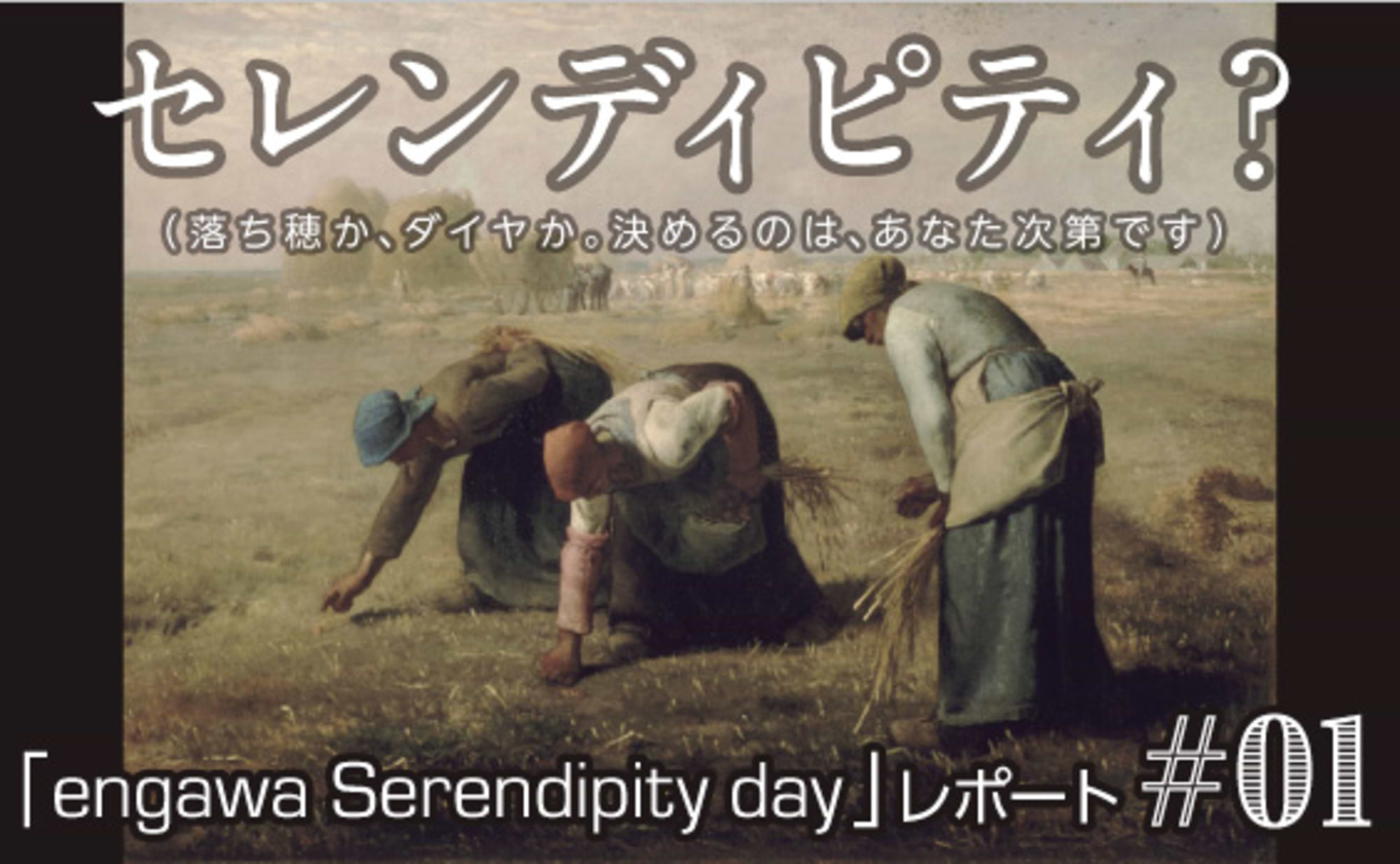
Have you heard of the word Serendipity? This term, which describes "the ability to discover unexpected value and seize good fortune through chance encounters," is currently gaining attention in the business world. What exactly is Serendipity, said to have originated from a Sri Lankan fable? Let's explore clues at the webinar "engawa Serendipity day" held on April 15, 2021. Great discoveries and happy encounters are surely waiting there.
(Responsible for text and analysis: Web Dentsu Inc. Editorial Department)
This second installment (#02) of our three-part series covers the lecture "What is Essential for Building Business Co-Creation?" delivered by Professor Hajime Takebayashi, Visiting Professor at Kyoto University's Graduate School of Management and Head of the Incubation Center at Omron's Innovation Promotion Division, during the webinar's second session.
The core of Serendipity is "co-creation." It may seem obvious, but it's "co-creation," not "competition." Professor Takebayashi explained this mechanism with his uniquely lighthearted and witty delivery. Web Dentsu Inc. has re-edited the highlights of Mr. Takebayashi's roughly hour-long lecture, focusing on the perspectives of "Kansai" and "Kyoto." We hope you will understand this as another challenge to approach Serendipity.

People don't live to breathe air.
This phrase, introduced by Mr. Takebayashi, comes from Omron founder Kazuma Tateishi. People cannot live without air. For a company, that air is profit. But making money is merely a means to survive; the purpose lies beyond that. While not exactly the "benefit for all three parties" philosophy of the Omi merchants, one can sense the unique wisdom of the Kansai people in this idea.
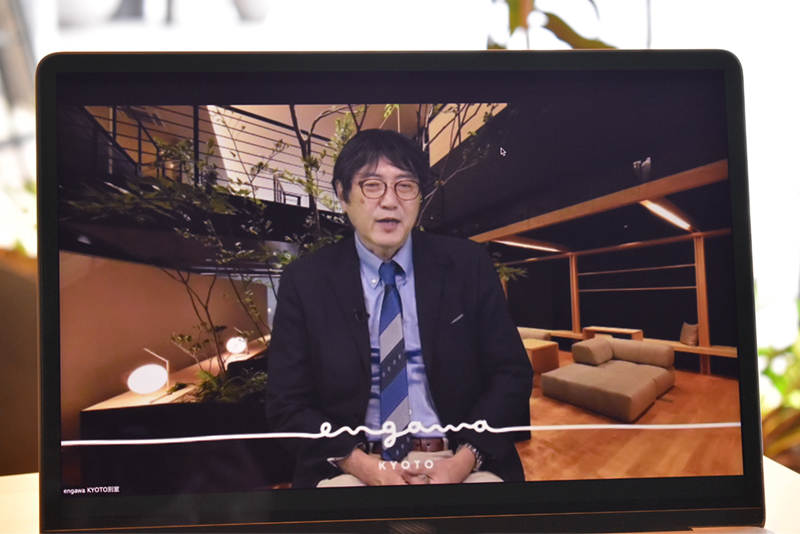
To give one example, Mr. Takebayashi redefined the "station" – previously just a place where passengers handed tickets to station staff and passed through – as the "gateway to the city." This sparked "city development centered on the station, prioritizing safety, security, and comfort." Various companies gathered around this exciting concept. The mechanism of "co-creation" is precisely visible here.
According to Mr. Takebayashi, creating a business model where "when the wind blows, the barrel maker profits" is crucial. First, create an exciting wind; people gather there and each conceive their own business. To put it another way, it's a modern version of the "Rakuichi Rakuza" concept.
The key point is the "development" phase in the narrative structure.
One particularly striking point in Mr. Takebayashi's lecture was his observation that "80% × 80% only equals 0.64." The notion that simply gathering a large number of people will materialize a major project is a delusion. Projects are the result of the "multiplication" of the abilities of those involved. In other words, a project where each individual contributes only about 80% of their capacity will inevitably result in something incredibly lackluster.
Projects are built by the people responsible for each part of the "beginning, development, turning point, and conclusion." What the people handling the "beginning" or "turning point and conclusion" should do is relatively easy to imagine. The person responsible for the "beginning" provides the spark of inspiration, and the person handling the "turning point and conclusion" nurtures it into a business. The key, Mr. Takebayashi points out, lies in the existence of the person responsible for the "development" phase. This person translates the spark of the "beginning" into exciting, relatable words and crafts it into a community vision. This is where the people responsible for the "climax and conclusion" gather.
Takebayashi describes this as "secret society-style marketing." Only a closed team (secret society) with a shared "will" can enable open business. Hierarchy is unnecessary. What matters is "horizontal solidarity." And once that horizontal solidarity forms, things naturally start rolling in a positive direction. "With just a chain of will, you don't need to invest in advertising at all." This point made by Mr. Takebayashi really hits home for someone working at an ad agency, especially someone based in Tokyo. Even the difficult marketing term "effectuation" makes perfect sense when viewed through the lens of "scientifically understanding the straw-rich man." By the way, what was the "straw-rich man" story again?
The multiplication of wisdom creates the "Straw Millionaire"
Let's revisit the story of "The Straw Millionaire." A boy was playing by tying a fly to a single straw when a woman carrying a fussy baby asked if she could trade that straw for three tangerines. Those tangerines became cloth, then a horse, and finally led to acquiring a rice field.
The key lies in "encounters," points out Mr. Takebayashi. He established the "Kyoto Research Institute for Centennial Ventures" within a Kyoto University Graduate School of Management endowed chair. His choice of Kyoto as its base was no mere coincidence. It's a city where people affectionately call him "Shi-san," reading his name "Takebayashi" as "Takebayashi-shi." From such encounters, what Shi-san calls the "year-round pursuit of dreams" emerges, sparking innovation. "It's truly a straw-like tale unique to Kyoto, surrounded by the Five Mountains."
Once again, I've deliberately condensed the content of a lecture lasting over an hour. When people hear "the straw millionaire," many likely imagine someone who "accumulated great wealth through a series of fortuitous coincidences." Yet, I believe the key to seizing serendipity lies precisely there.
【Related Links】
Abies Ventures company homepage is here.
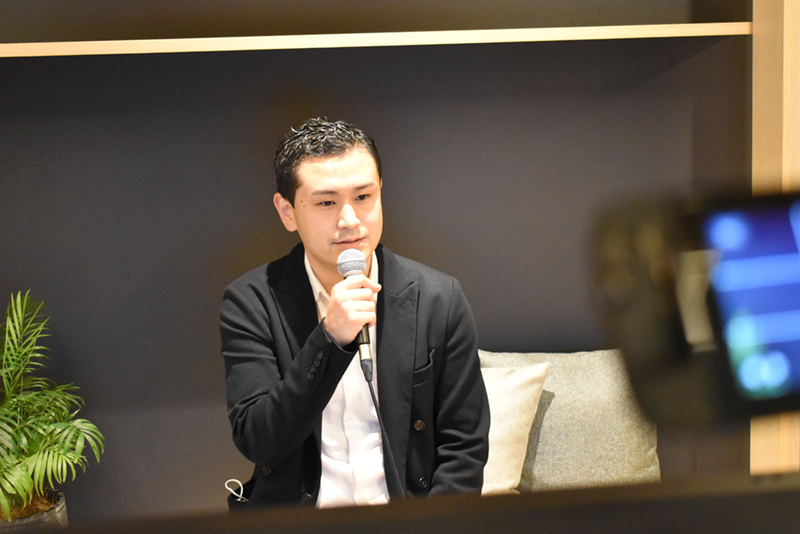
Service site introduced by Mr. Ryo Okuda, FUND X・Kyoto BAC Business Creator: Click here.
Plug and Play Japan's company homepage is here.
This series is edited from the content of the webinar titled "engawa Serendipity day," supervised by Mr. Hiroaki Tanaka (Kyoto BAC), one of the organizers, and presented from Web Dentsu Inc.'s unique perspective.
Was this article helpful?
Share this article


Newsletter registration is here
We select and publish important news every day
For inquiries about this article
Author
Hiroaki Tanaka
Dentsu Inc.
Kyoto BAC
Planning Producer
Planning Producer. After gaining experience across diverse business scales and sectors—including listed companies, sole proprietorships, and startups—joined Dentsu Inc. in 2012. Subsequently served in China, where as a Communication Planner, designed and planned branding and communication strategies while also tackling new business development based on client challenges.