
Note: This website was automatically translated, so some terms or nuances may not be completely accurate.
 Let's talk about gender. [2/4]
Super Popular at Tokyo University! We discussed "Gender and Advertising" with Kakuzo Sejima.

This series follows Dentsu Inc. creators as they confront gender issues and explore new relationships between gender and creativity through dialogue with experts across various fields.
For the second installment, we spoke with Kakuzo Sejiyama, who researches gender theory at the University of Tokyo. His 2020 book, "Reading Gender Theory Through Viral Commercials, " generated significant buzz. Dentsu Inc. communication planner Suwon Kwon (hereafter: Su) and copywriter Taiga Iwata (hereafter: Iwata) had a candid conversation with him, including about the book, covering points to be mindful of as creators of communication.
Part 1: Please Teach Us About Gender!
You never know what will go viral
Su: Today we're speaking with Professor Sejiyama from the University of Tokyo, who researches gender theory. Your book, " Reading Gender Theory Through Viral Ads, " has generated quite a response. Many people around me have read it too.
As professionals specializing in corporate communication, we found many parts very insightful.
Seyama: Thank you. Thanks to you, it's selling reasonably well.
Iwata: Ms. Sejiyama, can you actually predict which commercials will go viral?
Seshiyama: Honestly, I can't predict every single ad that will go viral. But once I see an ad that has gone viral, I can understand why it happened.
Sue: The book includes a diagram categorizing problematic commercials into four types, right? Could you briefly explain them?
The Four Quadrants of Advertising Backlash
Seyama: Yes, I'll explain following this diagram.
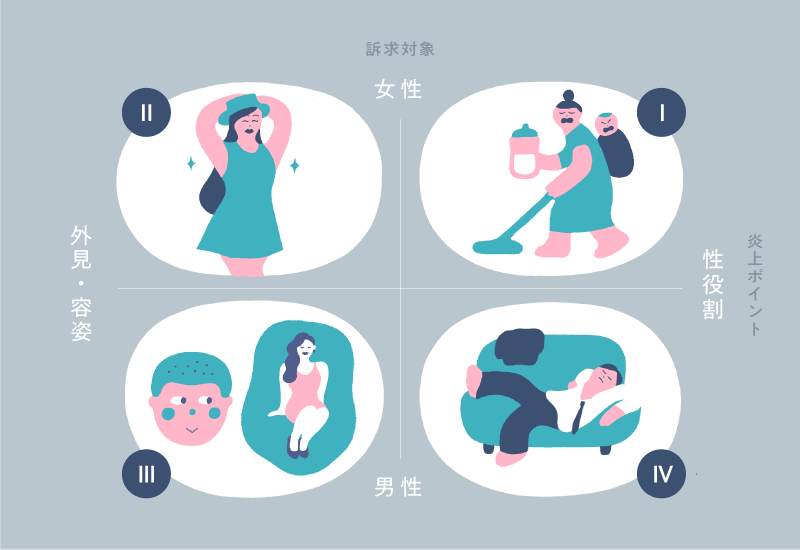
The horizontal axis represents the flashpoint, divided into "Appearance/Physical Features" and "Gender Roles." The vertical axis shows whether the target audience is "Women" or "Men."
First, [Quadrant I] covers content intended to resonate with women but ended up reinforcing gender roles. For example, scenes depicting only women doing housework or childcare.
【Quadrant II】 deals with women's appearance. It includes messages like "women should be cute, young, and beautiful." This area also easily becomes a form of pressure on women and is difficult to express appropriately.
【Quadrant III 】depicts women as sexual objects from a male perspective. This includes content created with the assumption it would be generally acceptable or humorous, but which ultimately becomes a mere expression of male desire. For example, commercials featuring scantily clad women were common a decade ago, but are now completely unacceptable.
Finally, 【Quadrant IV】 represents patterns that reinforce fixed male gender roles. These portrayals are based on male-centric assumptions: that men should focus on work, avoid household chores, or desire more personal freedom.
And I believe most controversial ads fall into one of these four categories.
Iwata: I see. That's very clear.
Why do commercials tend to become problematic in the first place?
Iwata: This takes us back to the fundamental question, but where do you think the problem lies in these backlashes?
Seyama: I don't believe only politically correct ads are good ads. Among controversial ads, there are some I actually like because I find them interesting.
However, ads are a company's message to society. They're made to be liked by people, so when they end up making a lot of people feel intensely negative, I think that's problematic when considering the purpose of advertising.
Sue: Compared to other visuals like movies or dramas, commercials seem more prone to controversy.
Seyama: I think that's because commercials are so well-made. They pack incredible persuasive power into just 15 seconds to a minute. Scenes that wouldn't be problematic in a drama or movie become unacceptable in a commercial because the weight of each single shot is different. In commercials, every single scene has meaning and there's no waste. That's precisely why they're so prone to backlash.

Sue: So how should companies best handle backlash then...?
Iwata: I think it's crucial for companies to have a solid sense of their philosophy and values. Even if some people dislike the expression in the SNS world, as a company, you can judge that it's okay as long as you're not saying anything wrong in terms of your corporate philosophy.
If the criteria for judgment are ambiguous, I suspect it becomes difficult to learn from past mistakes when creating the next commercial.
Sue: I feel that having clear judgment criteria is crucial for creators in this era. Of course, those criteria must also be correct from a gender perspective.
Gender values change with the times and environment.
Iwata: These days, most ads criticized are for sexist expressions targeting women. Conversely, I don't see many ads sparking major backlash for sexist expressions targeting men.
Seyama: In today's world, there's an unspoken understanding that it's acceptable to make fun of men's appearance. That's why most problematic commercials currently involve women. But that value might change in the future.
Sue: Personally, I think it's also problematic when commercials push ideas like "men should be masculine" or "men should have economic power."
Setsuyama: Yeah. I personally find some of those old energy drink commercials from a while back pretty scary.
That said, it depends on the context, but with men, it can sometimes be perceived as self-deprecating humor. That's because the current environment positions men as the socially powerful majority. Making fun of men tends to be more acceptable as a joke. However, piling on those in a weaker position or suffering is unacceptable. We shouldn't use expressions that leave them with no escape.
Iwata: Personally, I feel the burden of housework has become more equal compared to a few decades ago. Yet, it seems more women suffer from the pressure of household responsibilities.
Sejiyama: Take laundry, for example. Thanks to washer-dryers, it's much easier than it used to be. In this day and age, it really has nothing to do with "men's work" or "women's work" anymore.
Iwata: In household scenes, women have often appeared in commercials up until now. We need to reflect on how that has been a factor in widening the gender gap.
But going forward, we should see more depictions of men doing housework. We should see this as an opportunity to expand the range of expressions beyond what we've seen before. That would be good for society and for advertising creators alike.
Sue: Lately, I feel it's become an unspoken taboo to depict scenes like "women doing housework" or "men working hard" when creating expressions. I believe it's perfectly fine for all kinds of people to exist in the world. However, when communicating this to society, it's different. Precisely because corporate intent is involved, I think it's better to clearly express diversity.
Seyama: That's right. And one crucial point is that we're now in the age of social media. It's not just the target audience seeing the ad. Anything that catches people's attention can spread instantly. That's precisely why we need to be conscious that everyone is watching when we create.
Three things you can do when creating ads
Seyama: While completely preventing ad backlash is difficult, it can be mitigated to some extent. For example, trying the following approaches could help:
① "Check if it fits into the 4 quadrants of viral CMs"
After seeing countless ads, I've realized the four quadrants are surprisingly versatile. Applying them when planning an ad makes for a solid check. Conversely, if your ad fits into any of these categories, it's definitely a no-go, so be cautious.
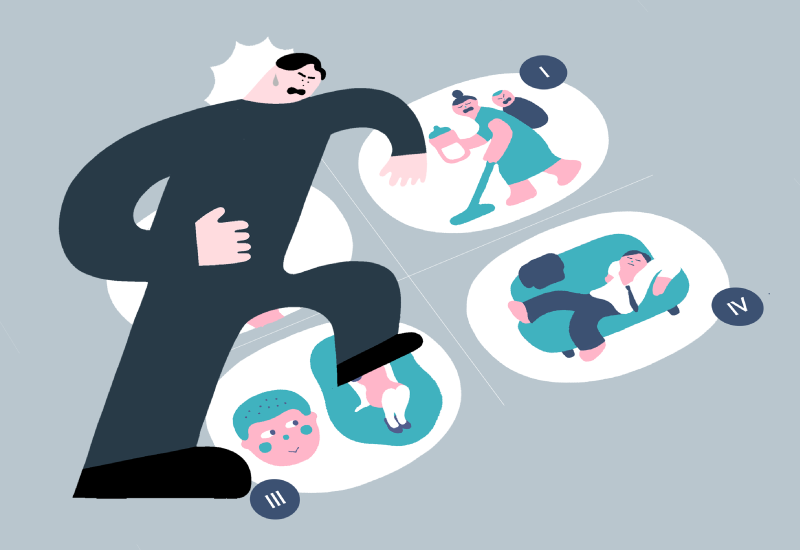
② "Flip the Gender Roles"
When planning, try flipping the genders in your concept. Depict men doing housework or childcare, and women working hard or achieving success. While this might seem like an easy approach, flipping genders can be a good opportunity to recognize your own unconscious biases.
However, be careful: if you don't truly understand the feelings of women or men, it could result in an ad that actually lacks consideration.

③ "Depict a world half a step ahead"
In advertising, depicting "a world half a step ahead" is crucial. It means portraying an ideal world that isn't the majority norm, yet exists to some extent in today's society. It's precisely that "half step" in the sense of progress. It's not too distant to feel jarring, yet being slightly ahead allows it to be perceived as an ideal world. By depicting this, you can also communicate what kind of world the company is aiming for. To achieve this, I believe updating our human rights sensibilities is essential.

Sue: Just talking for an hour like this, I found several things we can do. I thought, "Considering communication while bound by so many things might feel restrictive," but conversely, thinking about what we can do within those constraints seems interesting. I unexpectedly feel like we can do quite a lot.
Iwata: The tricky part about making commercials is that even if the message itself isn't wrong, you still have to be careful with how you express it. Even if you're saying the same thing, the difference in expression – the facial expression, the tone of voice, the scene – can make people clearly "like" or "dislike" it.
Seyama: That's not a bad thing. In fact, I think the skill of adding clever twists is what's demanded in creative work, and will be even more so in the future. Also, it's crucial that the product's marketing and the expression used align well.
Sue: If there were a checklist of absolute no-nos, creators might feel more secure exploring new expressions. Personally, I also think a gender studies course for all creators would be beneficial.
Setsuyama: For example, overseas, public agencies sometimes issue warnings about how gender is portrayed in commercials. Japan doesn't have that kind of system, right? I think it would be good for the advertising industry to establish an independent body like the BPO (Broadcasting Ethics & Program Improvement Organization).
Iwata: Companies have internal departments that review content, but having an external public body to make these judgments sounds really beneficial.
Sue: While we've focused much on commercials today, I believe a serious approach to gender considerations is crucial across all marketing domains. For instance, when developing brands or products, you set target audiences. But in today's climate, targeting only "women who aspire to be good wives and mothers" could jeopardize the business itself and call the company's very value into question. It might not spark an obvious backlash like a commercial, but conversely, it could lead to more than just withdrawals or apologies—it could even result in major business failure.
After finishing our conversation with Mr. Sejiyama
Sue: Wow! That was a really valuable conversation. We still have so much more to talk about!
Iwata: This was incredibly helpful! I might need to check my four-quadrant checklist before making any statements. Actually, I might have accidentally made a comment containing bias against women during a meeting the other day...
Sue: But everyone has some stereotypes or biases lurking in their minds! I'm sure I do too. The society we've lived in shapes us. We need to constantly monitor that part of ourselves, stay vigilant, and live carefully!
Also, what still bothers me is how comments about women often spark outrage, while those about men are still more easily tolerated... It just feels off. Maybe it's because I truly want to aim for a gender-flat society.
Iwata: I'd like to talk to more people about that too.
In this series, we plan to explore hints for future communication by discussing "gender and communication" with people from various fields.
To improve corporate communication, each individual's life, and this society as a whole.
Would you like to join us in thinking about gender together?
Illustration: Midori Manda

Was this article helpful?
Share this article


Newsletter registration is here
We select and publish important news every day
For inquiries about this article
Back Numbers

Author

Setsuyama Kaku
The University of Tokyo
Graduate School of Interdisciplinary Studies
Professor
Born in 1963 in Nara Prefecture. A gender studies researcher who single-handedly handled daycare drop-offs and pickups for two children for ten years and still prepares dinner daily. She moved to the U.S. with her children and also experienced life as a single father. Her gender studies lecture, voted the most popular course at the University of Tokyo in a survey of 100 students for Nippon TV's "The World's Most Wanted Lecture," draws over 500 attendees annually, often with standing room only. She participates in nursery school management as a board member of an NPO. Currently touring Japan delivering side-splitting lectures.

Kwon Su-yeon
Dentsu Inc.
Creative Planning Division 3 / Future Creative Center
Communication Planner
We plan with the belief that "individual happiness leads to collective happiness." After working in the Marketing Division 3 and CDC, I joined the Creative Planning Division 3 in 2021. My specialty is branding centered on digital communication. I handle a wide range of projects including corporate branding and product development. I have virtually no experience producing traditional TV commercials. Born and raised in South Korea, I've lived in Tokyo since age 18.



Yasuka Iwata
Dentsu Inc.
Creative Planning Division 1
Copywriter
At 17, I discovered philosophy. I awakened to ideas and culture. I majored in aesthetics at university and joined Dentsu Inc. in 2014. Since then, I've been solely a copywriter. Notable work includes Nissin "I want to hint at it," KANEBO "I HOPE.," KRAFT BOSS "Good job, me.", and ALFORTE "Make blue your ally." Winner of the ACC Grand Prix and Galaxy Award Grand Prix.