Note: This website was automatically translated, so some terms or nuances may not be completely accurate.
 Comprehensive B2B Business Support from a Dentsu Group Team! B2B Initiative Launched [1/3]
Advancing the "Digital Sales Shift" in B2B Business
Nice to meet you. I'm Umeki from Dentsu Inc. I have 8 years of sales experience, including career transitions, and 12 years in marketing.
This time, I wrote this article hoping it will be read by sales representatives, primarily those in their 40s like myself. The theme is the digital transformation of B2B sales, or the "Digital Sales Shift."
<Table of Contents>
▼What I Learned in Heisei-Era Sales: "Quantity Over Quality" and "Boosting Productivity to Achieve Volume"
▼The Impact of Seeing "Fully Specialized Sales Teams" in the US in 2014
▼Changes in the Buyer's Decision-Making Process Due to Internet Penetration
▼How the Pandemic Is Transforming Japan's "GNP (Giri, Ninjō, Present)" Sales Model
▼Corporate Gaps Widen Based on "Level of Digital Investment"
▼The "Two Things" Japanese Companies Need in Their Business Growth Strategy
▼ Is "GNP × Digital Sensor" the Future of Japanese B2B Sales!?
What I Learned in Heisei-Era Sales: "Quantity Over Quality" and "Productivity Improvement to Achieve Quantity"
Currently, I focus on supporting the "digital sales shift" for companies targeting business-to-business (B2B) markets, rather than the consumer-facing work (B2C) like "advertising," "campaigns," and "commercials" that people typically associate with Dentsu Inc.
While digital shifts are occurring across all industries, to understand what B2B sales fundamentally entailed and how it is evolving, let's first look back at "Heisei-era sales" – based on my own experience.
When I joined the workforce as a new graduate in 2002, I didn't go to Dentsu Inc. Instead, I joined a recruitment advertising company. After about a week of business etiquette training, the trainer handed me the following items, saying, "Here you go."
- A black business bag
- A stack of 500 business cards
- A tote bag with the company logo filled with stacks of product catalog flyers
And so began the "Business Card Acquisition Campaign," a time-honored tradition passed down through generations at that company. It was a sort of rite of passage experienced by all new hires: conducting cold calls during a set time from morning to evening, and only allowed to return to the company once they had acquired 100 business cards.
I never want to do it again, but I learned a lot from it. For example, how to create an action plan to collect 100 business cards within a limited timeframe, the ability to deliver a concise presentation in the 30 seconds you share an elevator with someone...
Next came telephone cleaning (nicknamed "Telecri"), or cold calling. Using NTT's (at the time) "Town Pages," it was intensive training: calling every single company in our assigned area until our voices were hoarse, just to secure appointments.
We learned how to bypass receptionists and get connected to HR personnel in non-face-to-face situations. Enduring hundreds of hang-ups forged our mental toughness and grit.
Experiencing firsthand that "quantity trumps quality" at a young age remains a valuable asset to this day. What I learned most from sales activities focused on "numbers" and "volume" was "how to increase the productivity of action."
My approach to action planning was goal-driven: first calculate the "average order value" relative to the sales target, then derive the "target number of contracts." From there, I worked backward to determine how many sales meetings, appointments, and calls were needed to achieve that target.
Another crucial lesson was "GNP" (Giri, Jinjo, Present = thoughtful hospitality). I learned firsthand that trust builds through persistence—enduring scoldings, making countless visits, and forging relationships. This earned customer favor and ultimately brought in business.
This is how I started my career. I imagine many salespeople of my generation have had similar experiences, right?
The Shock of Seeing "Fully Specialized Sales" in America in 2014
Now, let's jump ahead in time. This is about my first overseas business trip in 2014, when I visited New York and Boston in the United States. At that time, I was working at Dentsu Inc.
I had previously moved back and forth between sales and marketing roles several times, but it was during this trip to the U.S. that I learned about the fundamental differences between Japanese and American sales processes.
What surprised me most was that sales operated under a "strictly compartmentalized system."
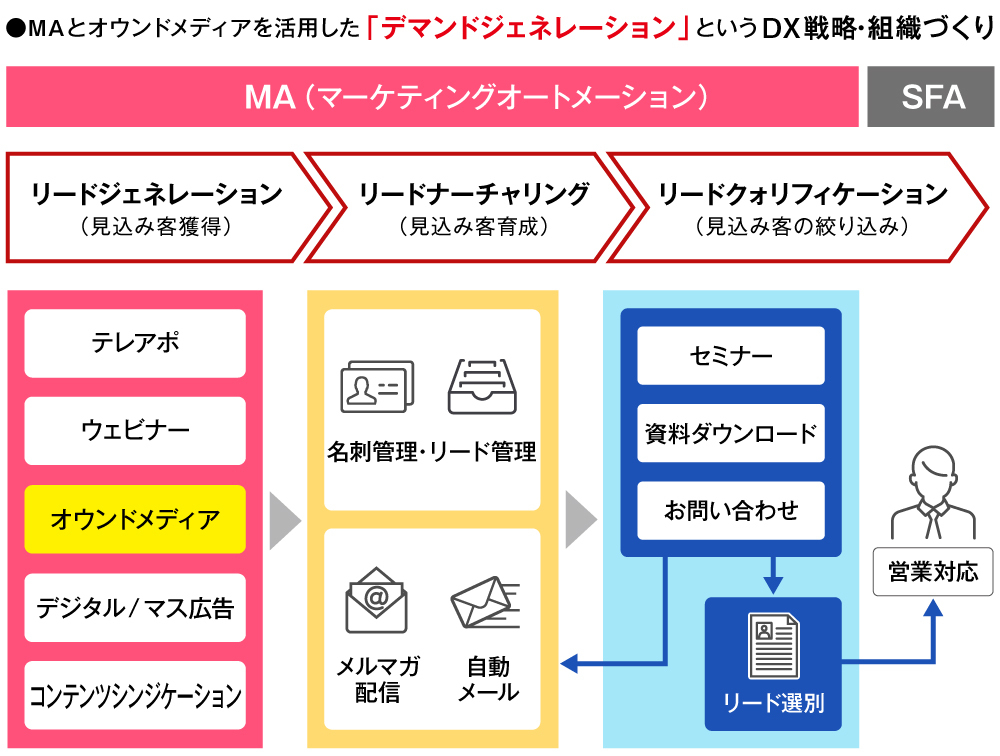
First, the marketing team handles lead generation, primarily non-face-to-face, using websites, telemarketing, webinars, social media (especially LinkedIn and blogs), and a system called marketing automation (MA).
Sales representatives then received those leads and conducted face-to-face or non-face-to-face negotiations and closings. It was a "completely specialized division of labor." There was none of the grit or tough-guy mentality associated with "cold calling" that I had been taught as the foundation of sales.
Furthermore, sales personnel managed transactions using an SFA (Sales Force Automation) system, enabling real-time information sharing with marketing staff.
This was completely different from what I considered common sense – "building personal relationships with customers" or "sales activities based on experience and intuition." Instead, they leveraged data to eliminate wasteful movements and efficiently and scientifically generated new business opportunities. That was the American sales process I observed in 2014.
Changes in the buyer's decision-making process due to the spread of the Internet
The series of activities I experienced in the US in 2014 is termed "demand generation" in B2B marketing terminology. The background to the spread of demand generation lies in the "changes in the buyer's decision-making process" brought about by the proliferation of the internet.
The key figure is "57%." This number comes from a 2012 survey conducted by the American think tank Corporate Executive Board, which surveyed over 1,400 B2B customers.
As shown in the diagram below, when the process from awareness to purchase is set at 100%, the point where the buyer first contacts the seller's sales representative occurs at the 57% mark.
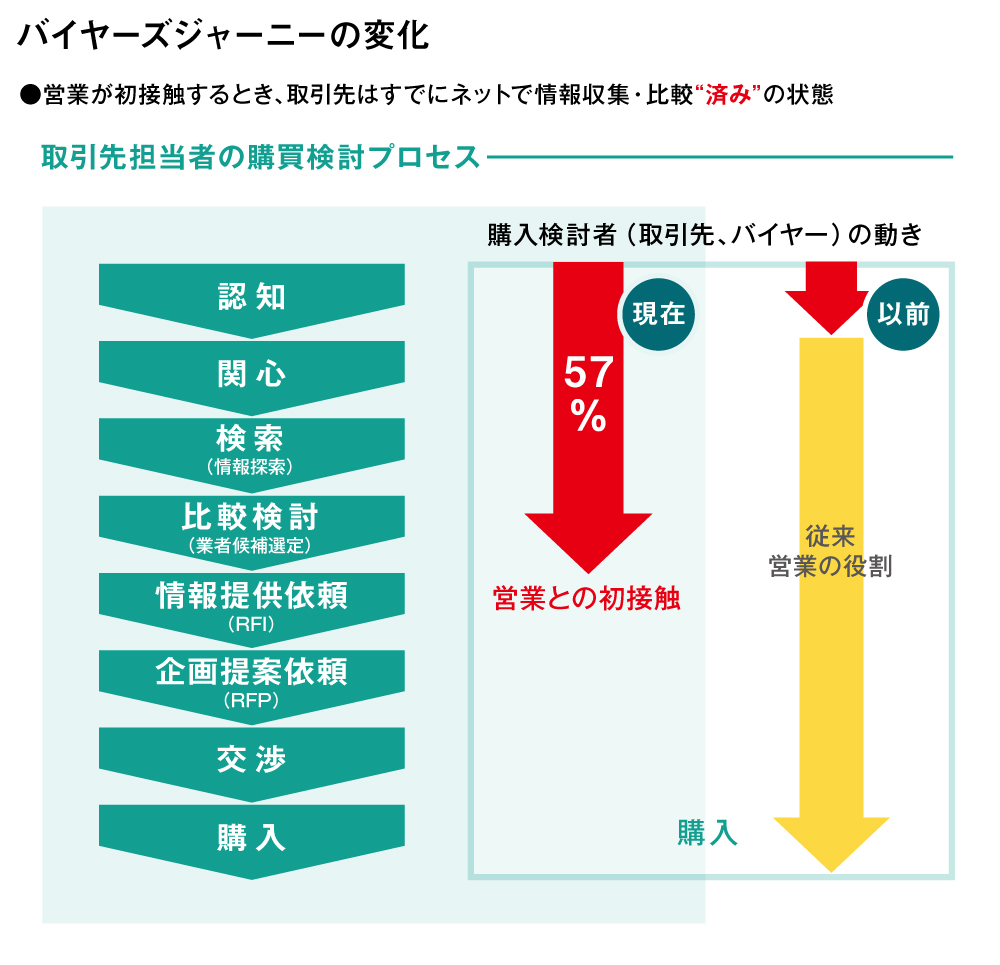
This means today's customers only engage with sales representatives at a much later stage in their purchasing consideration process.
With the spread of the internet, buyers are already gathering information through websites and social media before contacting sales (Self-Educating Buyer).
This means that if you aren't sufficiently active in sharing information online, you won't even be considered as a purchase option. Before you know it, you might find yourself in a situation where "your existing customers have already approached other vendors." That's the reality today.
Customers who once only learned about products or services when provided information by salespeople now live in an era where they can freely search for what they want to know at their own convenience, thanks to the internet.
However, looking at it the other way, the act of "buyers searching for information online" can also be "digitized" through digital technology.
In the United States, research on buyers using web data had been advancing since the early 2000s, not just 2014. Furthermore, since digital strategies like this data collection and marketing automation were often better handled by those with marketing experience than sales experience, roles changed and became specialized.
Marketing personnel began handling the bulk of traditional sales activities. Sales representatives shifted to a system where they used lead data obtained by marketing to assess the likelihood of closing a deal beforehand and conducted sales meetings based on that assessment.
Given the vast size of the American continent, with significant time differences between the east and west coasts, this approach also gained traction as a way to reduce travel time for pre-sales activities.
This new sales approach might be most easily understood by calling it "digital sales."
The pandemic is transforming Japan's "GNP" (Giri, Jinjo, Present) style of sales.
"Digital sales utilizing marketing automation and similar tools" emerged in its prototype form around 2000 in the US and grew rapidly. In Japan, however, 2014 is considered the starting point for marketing automation. This shift is attributed to the entry of foreign-affiliated marketing automation (hereafter abbreviated as MA) companies into the market.
In this same year of 2014, Dentsu Digital Inc. (then Dentsu e-marketing One) also established Marketo, a company specializing in MA, through a joint venture with the US company Marketo (acquired by Adobe Systems in 2018).
However, MA in this B2B sector did not rapidly proliferate domestically after 2014; adoption remained limited to a few companies. While many B2B firms repeatedly attempted to master MA, the reality was that it struggled to gain traction.
The reason was that the approach using MA didn't align with "Japanese-style sales," which values "face-to-face" interactions and "human relationships." I refer to the strengths of traditional Japanese-style sales as GNP (Giri, Jinsei, Present = thoughtful hospitality). Salespeople take pride in generating revenue through trust earned through hard work and cultivated relationships. They think, "Digital? DX? Who cares? We're the ones putting up the numbers!"
As mentioned earlier, having worked in sales for many years, I shared this view and believed it would take considerable time for this MA thing to gain traction in Japan. I also thought, "Well, it's a foreign concept..."
However, in 2020, an event occurred that forced the global business structure to change: the COVID-19 pandemic. This unprecedented natural disaster completely transformed the situation salespeople found themselves in.
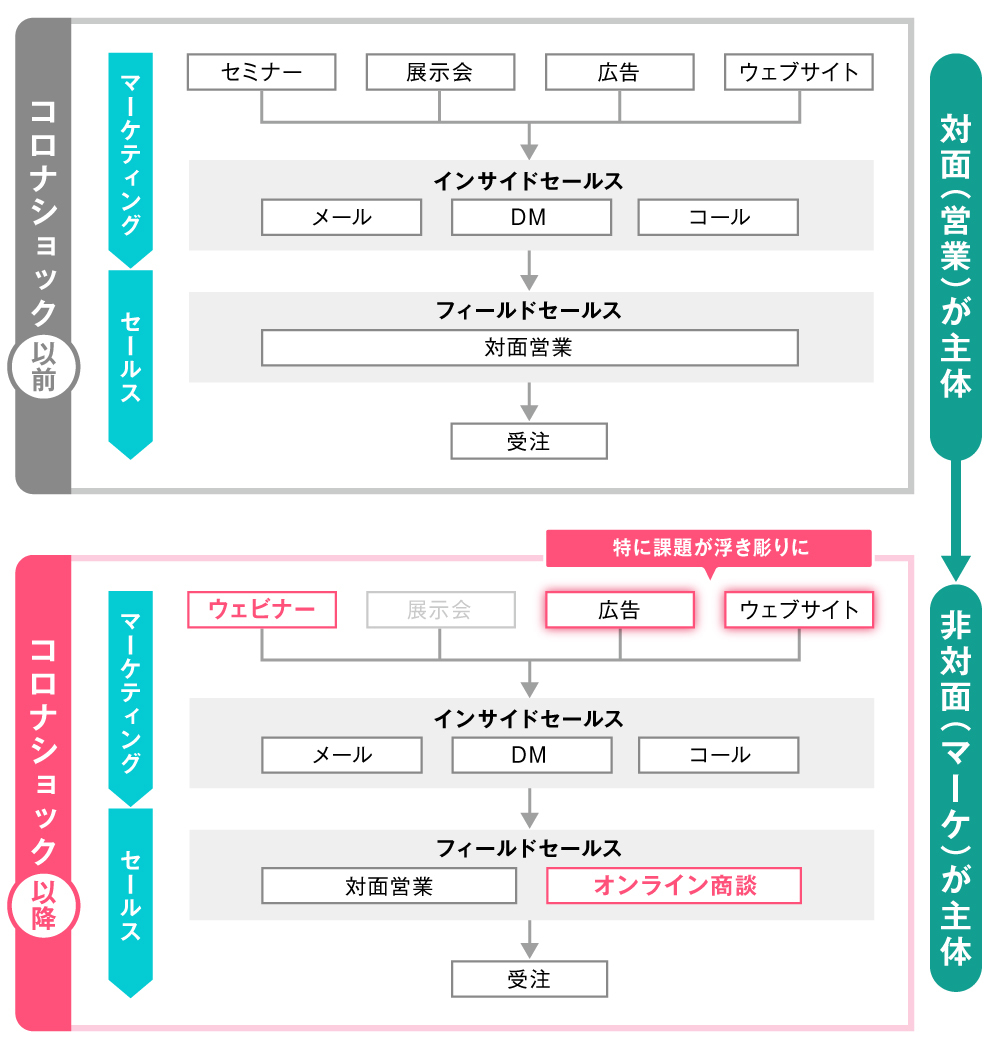
Meetings and webinars using remote tools like Zoom and Teams have become commonplace recently, but could anyone have imagined this before the pandemic?
Even if you make cold calls or conduct door-to-door sales to find new clients, the person you're trying to reach might not even be at the company. Some might think, "I'm a route salesperson (handling existing clients), so this doesn't apply to me." But competitors and emerging venture companies are leveraging digital sales to challenge you.
Even in traditional face-to-face sales environments, the time to consider digital investment is now.
The gap between companies is widening based on the "level of digital investment."
Let's examine the numbers to determine if digital investment is truly necessary. The "intangible fixed assets" metric serves as a reference for how much a company is investing in digital transformation.
Intangible fixed assets include software, patents, copyrights, and goodwill associated with M&A (mergers and acquisitions). In Japan, companies like system integrators and pharmaceutical firms tended to report higher figures.
The Nikkei newspaper analyzed the January-March 2020 earnings of companies (excluding financial firms) comprising the Nikkei 500 Index. It found that companies with a lower "intangible asset ratio"—which shows how much intangible fixed assets (excluding goodwill) account for tangible fixed assets—experienced a greater decline in performance(※).
Source: Nikkei "Digital Investment Gap Widens: Aggressive Firms See Smaller Declines"
In other words, even amid the challenging business environment during the COVID-19 pandemic, companies with a higher investment ratio in digital/IT demonstrated greater resilience in their performance.
Will face-to-face relationship building and business negotiations return to pre-pandemic levels? Vaccination is progressing rapidly within Japan as well.
However, work can still be done through remote work and remote sales. Conversely, hasn't work efficiency improved for some, enriching their work style, while others find it harder to slack off?
I personally believe a time will inevitably come when we look back and say, "We had that era, didn't we?" But even if the pandemic completely subsides, I think the remote work style and this non-face-to-face business environment are highly likely to remain.
Isn't this precisely the moment when the very nature of sales must change?
Two Essential Elements Japanese Companies Need in Their Growth Strategy
The following outlines the "Ansoff Matrix," a business growth model.
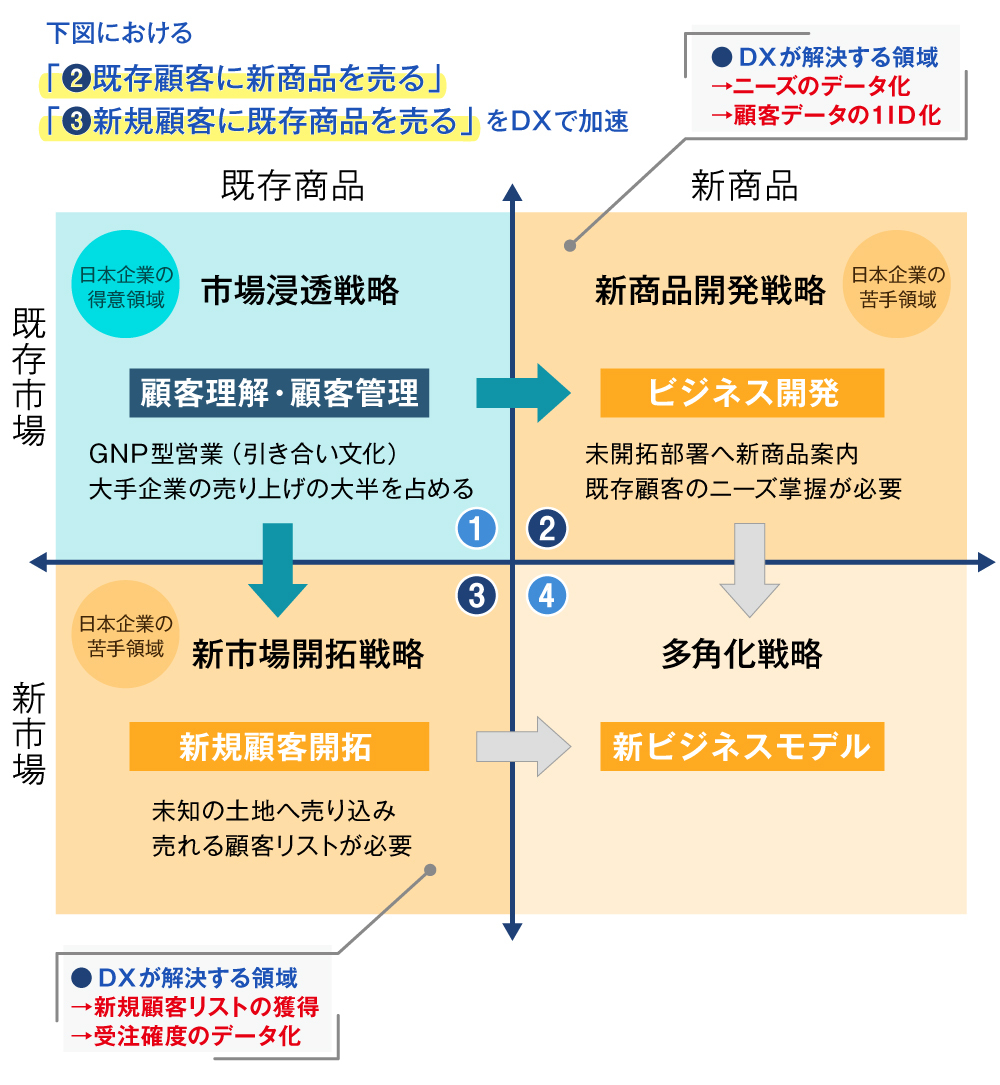
Japanese companies excel at ① Market Penetration Strategy, which focuses on "GNP." However, advancing into the areas of ② New Product Development Strategy —persuading existing customers to purchase new products—or ③ New Market Development Strategy —collecting lists of new, untapped customers and persuading them to purchase existing products—requires more than just determination and grit; it necessitates a marketing strategy.
In the realm of the New Product Development Strategy, relying solely on experience or intuition—what might be called "sales instinct"—is no longer sufficient. Today, utilizing so-called "digital sensors" (DX tools like MA, websites, advertising) enables us to understand customer needs with greater precision.
What about the area of ③ New Market Development Strategy? For B2B products targeting specific markets, simply gathering lists without a strategy is meaningless. In this area too, using "digital sensors" (such as MA, externally provided customer databases, and analysis of your own purchase data) enables efficient collection of prospect lists in specific domains and assessment of order probability.
Is "GNP × Digital Sensor" the Future of Japanese B2B Sales!?
As mentioned earlier, I describe traditional Japanese-style sales as "GNP" (Giri, Ninjō, Present). I still don't believe these elements are wrong.
On the other hand, since around 2014, with the influx of many foreign MA providers, most B2B consultants and system companies say: "Japanese sales are outdated; marketing is 10 years behind."
Consequently, B2B companies believed this and challenged themselves to shift to digital sales. Unfortunately, however, the reality is that few companies have clearly achieved this digital sales shift.
Salespeople who stay at the forefront aren't stupid. Everyone knows things can't stay as they are. Yet I've heard countless raw voices saying, "We just can't break free from past successes."
That's why I recommend the "GNP × Digital Sensor" approach.
We don't believe that completely shifting all our existing methods is the only correct path. The argument that the latest trends emerging in North America are inherently correct and that Japan is outdated is flawed. Over the past eight years, I've witnessed numerous business ventures fail repeatedly. The sales pitch and experience gained during negotiations remain universally essential. Since we're dealing with people, having conversations over drinks is also important.
We add the weapon of digital sensors to this traditional Japanese sales approach. By "digital sensors," I mean using web data and MA, as discussed earlier, to make previously invisible insights visible. GNP × Digital Sensors fundamentally transforms the sales process.
We at the Dentsu Group want to support sales and marketing professionals who are seeking change. To that end, we have the Dentsu B2B Initiative, a cross-organizational team of approximately 70 B2B professionals.
If you are currently assigned to a business division and
"How should we develop new approaches to replace trade shows?"
"How should we leverage the web?"
"We implemented MA but can't utilize it"
Sales professionals facing such challenges.
Or as a marketing manager,
"How should I collaborate with sales?"
"The means and ends have become reversed, but it's difficult to gain upper management's understanding."
If you're struggling with questions like these.
Please feel free to contact us. Thank you for reading this article to the end.
Contact: Dentsu Inc. B2B Initiative Secretariat
b2b-initiative@dentsu.co.jp

Was this article helpful?
Share this article


Newsletter registration is here
We select and publish important news every day
For inquiries about this article
Author

Toshinari Umeki
Dentsu Inc.
Solution Creation Center
Business Consultant