
Note: This website was automatically translated, so some terms or nuances may not be completely accurate.
 Comprehensive B2B Business Support from a Dentsu Group Team! B2B Initiative Launched [2/3]
Is the organizational "passion" for that DX sufficient?
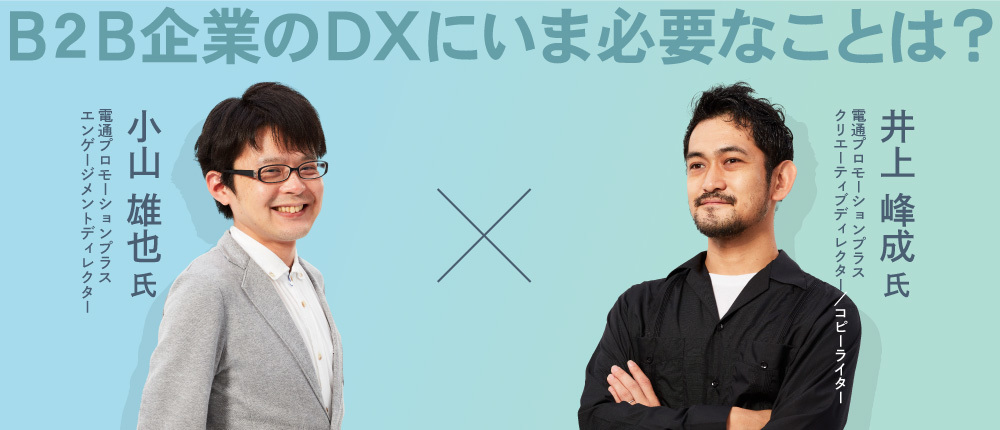
Hello. I'm Yuya Koyama, serving as sub-leader for the Dentsu Group's cross-functional project, the "Dentsu B2B Initiative." As digital transformation (DX) advances in corporate business, the "Dentsu B2B Initiative" provides support in the areas of sales DX and marketing DX.
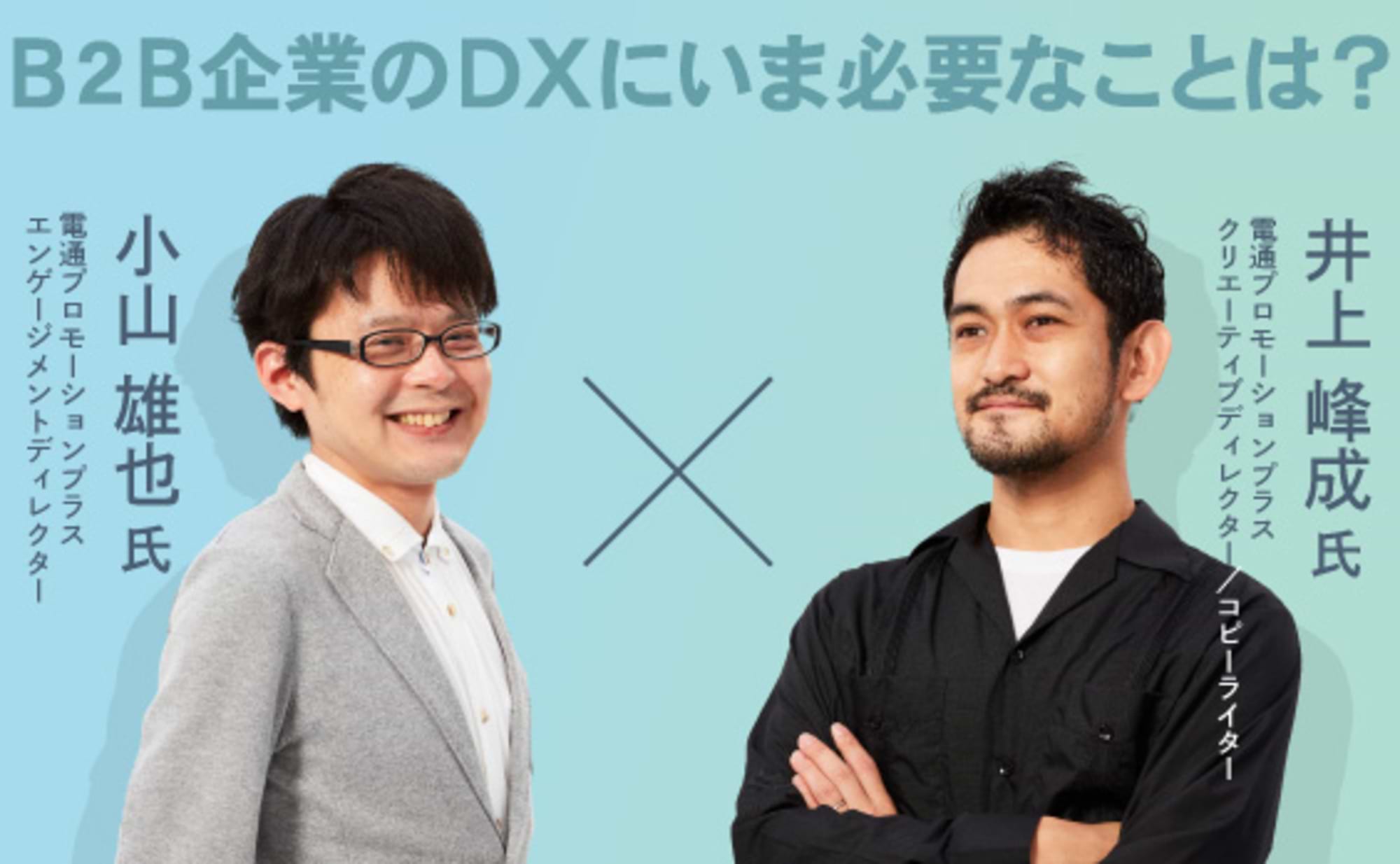
This time, we welcome Mr. Minei Inoue, a copywriter from DENTSU PROMOTION PLUS INC. (*), to explore what companies need when undertaking DX or implementing sales support and customer management systems, incorporating a creative perspective.
*DENTSU PROMOTION PLUS INC.: Renamed from Dentsu Tech in April 2022 following a group reorganization to strengthen sales promotion solutions. In the B2B domain, it handles owned site development, lead generation and nurturing through content marketing, internal branding, and communication support.
You've tried advancing DX, but it's not working well... What are the issues?
Koyama: In B2B companies, sales support systems like marketing automation, SFA (Sales Force Automation), and CRM (Customer Relationship Management) have become quite widespread over the past two years. However, we often hear that systems are implemented but not utilized, or that the expected results from implementation aren't materializing.
Inoue: That's right. Due to the impact of COVID-19, especially in the B2B sector, approaches and processes have changed dramatically in areas previously handled by field sales. Furthermore, I feel the pace of change is accelerating in corporate mergers and reorganizations, business strategy reviews, and organizational and HR strategies. Amidst these changes, internal communication methods have become quite rigid, partly because remote work has become the norm.
I often discuss corporate internal communication with Mr. Koyama, and I frequently observe internal fragmentation occurring across various companies. Within an organization, there's a "vertical axis" connecting management and frontline players, and a "horizontal axis" representing connections within the organization. If communication and collaboration break down along these two axes, no amount of corporate DX will function effectively.
Koyama: Sales support systems like CRM or SFA improve operational efficiency, but the work itself can still function without them. Therefore, unless employees truly understand the purpose behind implementing such systems, they often won't adopt them, and changes to business processes may never materialize.
Inoue: When companies initiate new actions, like introducing a new system, it inevitably tends to be top-down. It's crucial not only to consider "what to communicate" to employees but also "how to communicate it."
I've also worked on corporate branding and slogan creation. At one food manufacturer, I helped set a corporate slogan and had the opportunity to discuss the company's future direction with management. Despite having over 200 years of history, the executives didn't intend to make any dramatic changes immediately just because they launched a new slogan. They had a very long-term perspective. However, some executive officers felt that since a new slogan had been established, something needed to change immediately. I sensed a significant gap in understanding even between the executives and the executive officers. Therefore, the gap between executives and frontline players might be even wider. This made me realize the necessity of aligning the perspectives of executives and employees.
Koyama: From the perspective of how to effectively communicate the management's vision to employees and get them involved, do you have any successful examples?
Inoue: When a publishing company was deciding on its slogan, the president said, "Don't just create the slogan based on my ideas alone. Listen to each employee—editors, sales staff, everyone—and capture their individual thoughts." This approach involved the entire company in creating the slogan and allowed us to hear diverse voices from the field. Then, it was just a matter of translating that enthusiasm directly into words. It took time, but we arrived at a phrase that felt absolutely right. Beyond the slogan's content, I truly felt the importance of the process itself.
Koyama: So, what approaches are effective for boosting motivation horizontally, among employees?
Inoue: From my experience, creating spaces where people with completely different perspectives gather generates tremendous energy. It's crucial to have places where each employee can share their everyday thoughts. To gain the momentum needed to drive toward a set goal, how you design the process is key.
For example, saying "We have this challenge, so we'll implement a system to solve it" is very straightforward. However, there's a risk of losing what was previously valued, such as the company culture or its aspirations. Therefore, it's necessary to explore a path unique to that company – one where all employees truly understand what solving the challenge means for them and what should motivate them.
Koyama: Dentsu Inc. B2B Initiative supports companies in their digital sales shift. For corporate DX, it's also essential to design processes considering both vertical and horizontal dimensions while establishing them over time.
The "4 Processes" for Successful Digital Sales Shift
Koyama: Even with sales support systems, if you just monitor usage rates and push adoption after implementation, employees often feel like they're being forced to use it. To help each employee genuinely embrace and use the system, we propose a framework for embedding DX within the company: "Visualization," "Personalization," "Action," and finally, "Embedding."
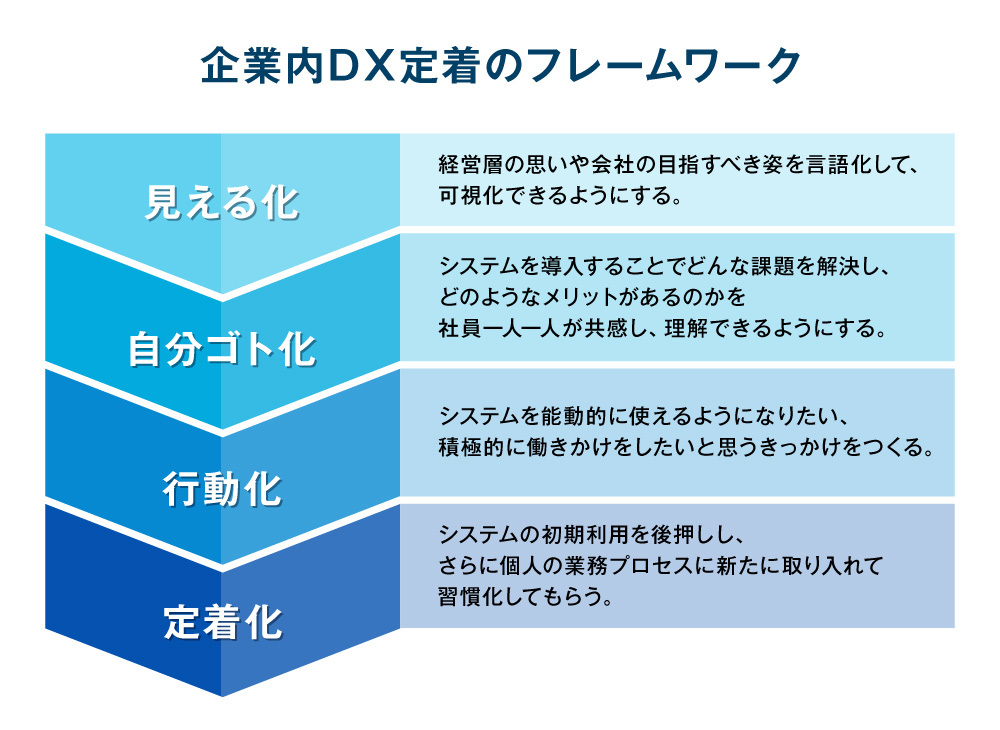
Mr. Inoue, we also collaborated on process support for a corporate client's B2B sales organization during their DX transformation and sales support system implementation. Could you explain the change management and internal communication aspects from a creative perspective?
Inoue: The system was introduced to enhance and streamline corporate sales activities. My starting point was recognizing a gap between what management envisioned as "efficiency" and what the frontline staff understood it to mean. Aligning with the framework mentioned earlier, we began by determining the optimal timing and messaging for top-level communication.
Designing the process to make employees feel personally invested was the biggest hurdle. While exploring how to create an atmosphere where this company could easily adopt the system and properly integrate it into operations, I felt incorporating playful elements or a game-like feel would encourage active engagement. I wanted something that would make employees realize their own and their organization's level would rise by continuing to use the system, allowing them to truly appreciate its benefits. As a result, I proposed creative solutions and awareness campaigns themed around RPGs.
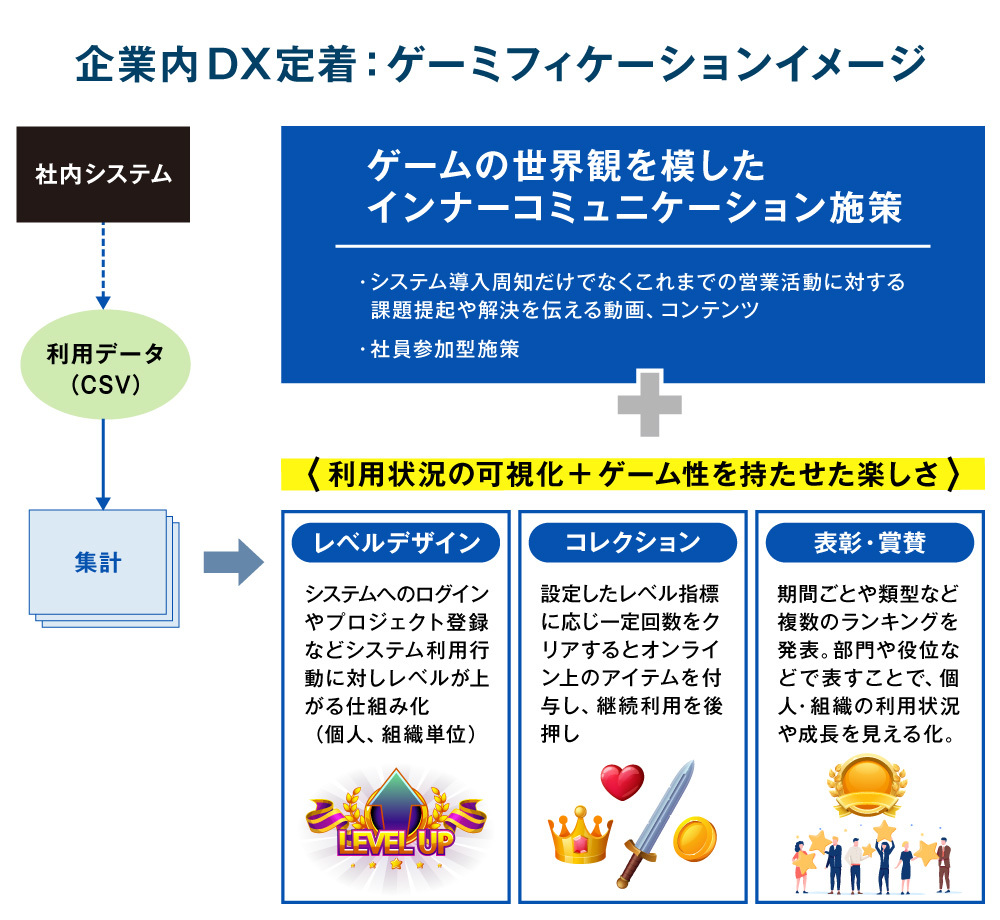
Koyama: Implementing a system changes both individual employees' and the organization's sales approaches and processes. Therefore, our goal was to get them to use the system while also establishing a mindset that included understanding why this internal system was necessary, the challenges with previous sales methods, and the changes needed. To emphasize that this was a system built together by everyone, we also implemented employee-participation initiatives and efforts to make it feel personally relevant.
For adoption and retention, we leveraged gamification principles. This involved incorporating a level-up system where users gain levels by logging into the sales support system or registering deals. Upon reaching specific point thresholds, users could collect online items, aiming to boost usage and ensure retention.
Building on these successful initiatives, DENTSU PROMOTION PLUS INC. now offers "EnGame," a solution designed to embed DX within companies. This involves developing and providing custom programs that integrate with systems like sales support tools and incorporate game design principles (details here ).
While this company used the RPG concept to drive adoption of its sales support tool, every company has unique characteristics. We propose tailored processes for "visualization," "personalization," "action," and "adoption" that align with each company's culture and environment.
Inoue: As discussed, driving corporate DX requires organizational enthusiasm. To build that enthusiasm, designing a system implementation process that incorporates internal communication and reflects the company's unique character is essential.
Koyama: However, relying solely on internal resources risks positional talk and top-down communication. That's why we, as an objective third party, aim to assess each company's situation and propose communication approaches that drive individual and organizational mindset and behavioral shifts.
At Dentsu Inc. B2B Initiative, we operate as a cross-functional team of diverse specialists from various Dentsu Inc. companies involved in B2B marketing. We offer a wide range of insights and solutions focused on achieving results through marketing DX, including organizational development and execution support (pipeline design, inside sales, customer sales), as well as training and education in B2B marketing. We aim to continue supporting internal and organizational transformation within B2B companies, as well as the establishment of new business processes in this era of DX and BX.
Learn more about the "B2B Integrated Solutions" provided by Dentsu Inc. B2B Initiative here.

Was this article helpful?
Share this article


Newsletter registration is here
We select and publish important news every day
For inquiries about this article
Author

Yuya Koyama
DENTSU PROMOTION PLUS INC.
OMO Planning Division
Engagement Director
Articles by this person

Mineaki Inoue
DENTSU PROMOTION PLUS INC.
OMO Planning Division
Creative Director / Copywriter