
Note: This website was automatically translated, so some terms or nuances may not be completely accurate.
 Comprehensive B2B Business Support from a Dentsu Group Team! B2B Initiative Launched [3/3]
B2B Products: Are Potential Partners Narrowed Down Before Negotiations Even Begin!? Insights from a Survey of 4,500 Purchasing Decision Makers
Dentsu Inc. B2B Initiative conducts original research to understand the reality of B2B business from various perspectives and utilize it for marketing. This time, we present survey results focusing on 'purchasing decision-makers' who select goods traded between companies (hereinafter referred to as B2B goods).
Challenges in Sales and Marketing Strategies for Small and Medium-Sized Enterprises
B2B products often involve multiple individuals in the purchasing process, and the decision-making process can be complex. Therefore, accurately understanding the behaviors and needs of those involved in the decision-making process is crucial in B2B marketing. With the widespread use of the internet and social media, it has become easy to independently access abundant business information without needing to meet with sales representatives. Consequently, accurately grasping the behaviors and needs of purchasing decision-makers has become one of the key challenges for B2B marketers.
Particularly, while traditional sales teams often effectively engage with purchasing stakeholders at large corporations, a growing challenge lies in strategies for approaching small and medium-sized enterprises (SMEs) and sole proprietors, who are difficult to target efficiently through sales efforts.
Indeed, one common theme in the inquiries received by Dentsu Inc. B2B Initiative revolves around how to efficiently deliver information to these SMEs and sole proprietors, gauge their readiness to buy, and ultimately drive applications (purchases) through sales agents or the company's own website.
The Aim of This Survey
Within Japan, few surveys comprehensively capture purchasing decision-making for diverse B2B products like parts, machinery, food/beverages, services, and systems. Therefore, this survey After considering product comprehensiveness and individual characteristics, we selected 45 products based on the "B2B Product Matrix" uniquely defined by Dentsu Inc. B2B Initiative. We interviewed 100 purchasing decision-makers per product (4,500 total). Understanding the differences and characteristics of the decision-making process for each product enables the formulation of more precise marketing strategies. We sincerely hope you will find this information useful.
Segmenting B2B Products into Four Categories: The "B2B Product Matrix"
While broadly termed "B2B products," these encompass a wide range of items as mentioned earlier, including parts, machinery, food and beverages, services, and systems. We propose the "B2B Product Matrix" as a framework that allows for a comprehensive and panoramic understanding of B2B products.
Specifically, we focus on two key characteristics: "Form" (a clear differentiator between products) and "Switching Costs" (※1) (which influence purchasing decisions). We establish two axes: "Tangible Products ⇔ Intangible Products" and "High Switching Costs ⇔ Low Switching Costs". Each quadrant is defined as: "Major Materials/Real Estate/Machinery," "Food & Beverages/Consumables/Equipment," "Human Resources/Data/Services," and "Software/Systems/Infrastructure."
*1 Switching costs refer to the financial, physical, and psychological costs incurred when switching from currently used products or services to alternatives.
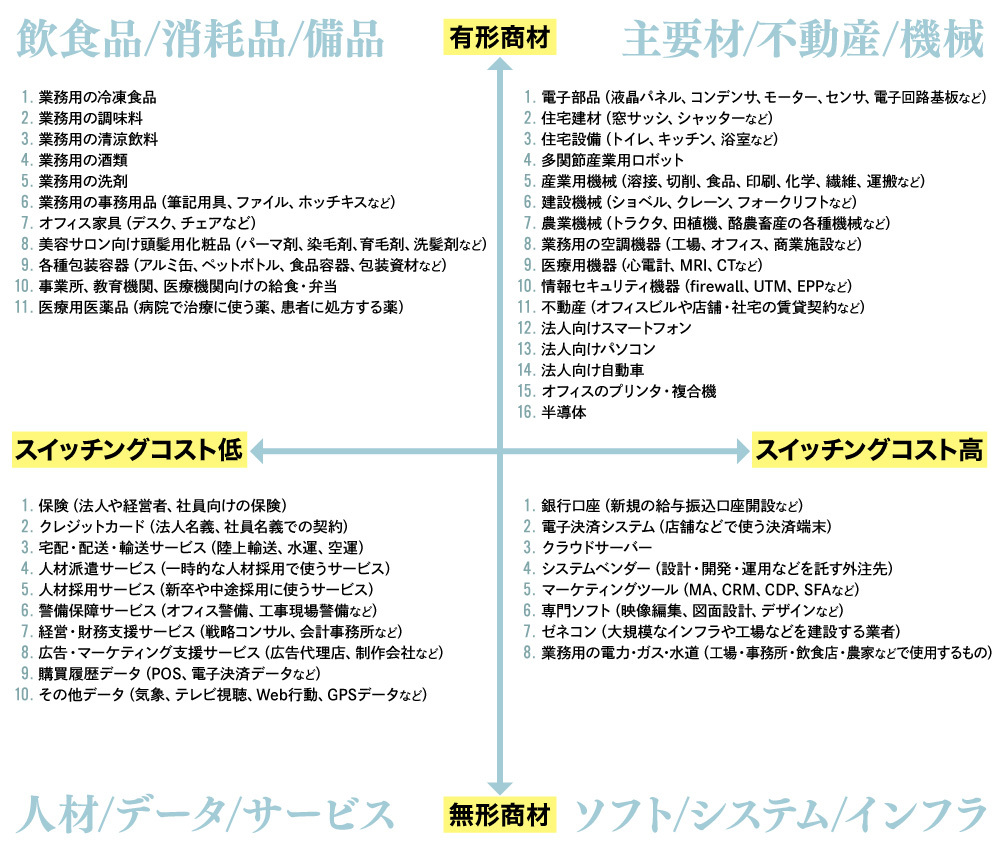
This article introduces three key findings regarding purchasing decision-makers at SMEs (300 employees or fewer), representing 2,559 of the 4,500 survey respondents.
The battle is largely decided before negotiations even begin!?
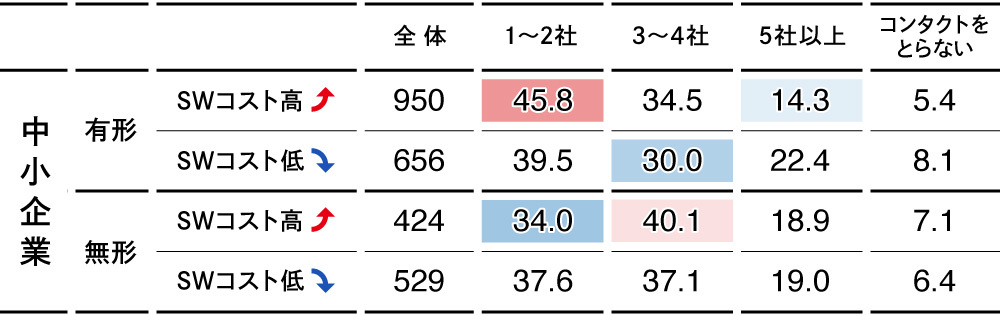
1. Around 40% of purchasing decision-makers narrow down their candidates to 1-2 companies before contacting the sales representative of the potential supplier.
When asked how many suppliers they had narrowed down to by the time they contacted a sales representative from a potential supplier, the percentage of purchasing decision-makers who had narrowed down their choices to one or two companies was 45.8% for [Key Materials/Real Estate/Machinery], 39.5% for [Food & Beverages/Consumables/Equipment], 37.6% in [Human Resources/Data/Services], and 34.0% in [Software/Systems/Infrastructure].
These scores suggest that, as is often said about B2B products, the outcome is largely decided by the time negotiations begin (with most purchasing decisions already made). Therefore, it is essential to be included in the purchasing decision-maker's consideration set (the set of products under consideration) during the evaluation process leading up to negotiations (before contact with the sales representative). Establishing touchpoints before this stage is crucial. This tendency is particularly strong for tangible products with high switching costs [key materials/real estate/machinery], as about half of buyers have already narrowed down their potential suppliers to one or two companies by the time they contact a sales representative.
● How much have potential clients narrowed down their options by the time they contact a sales representative?
Private contact points may hold the key to B2B marketing
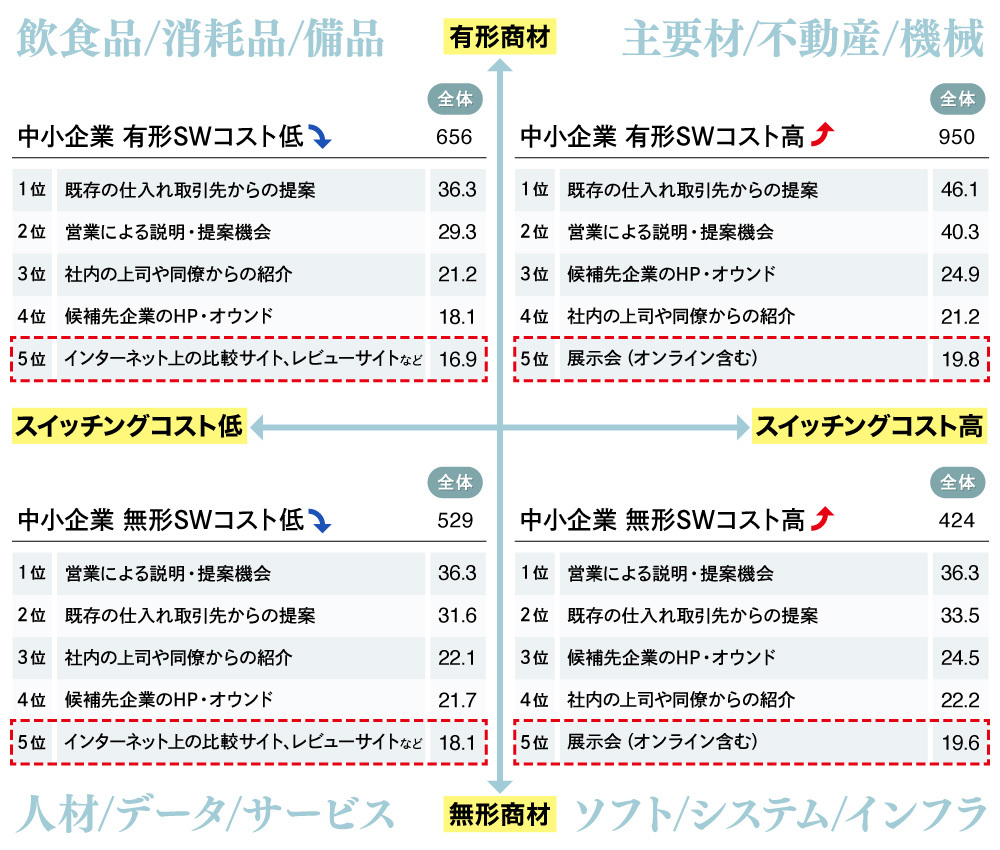
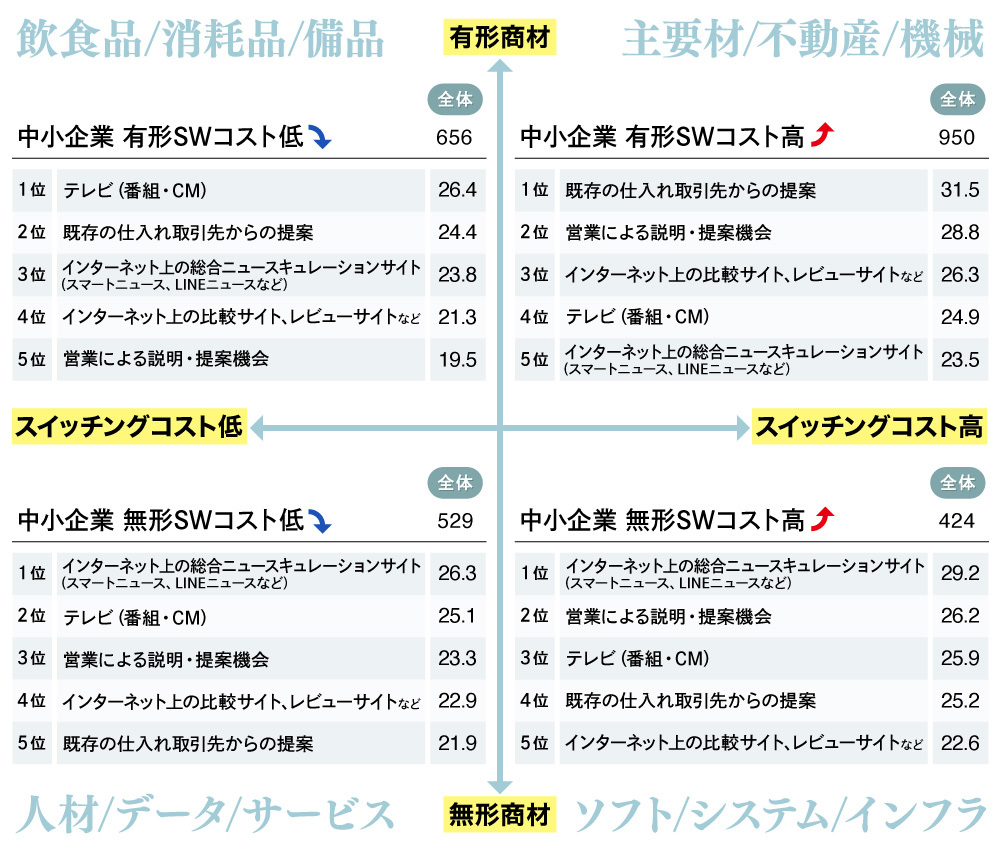
2. Information sources encountered during the consideration process show similar trends across all product segments. However, focusing on sources including private channels reveals distinct characteristics.
Looking at the information sources encountered during the consideration process for each product, while scores vary, "proposals from existing suppliers," "sales explanations/proposal opportunities," "introductions from internal superiors or colleagues," and "candidate companies' websites/owned media" rank highly across all product segments. This indicates that information from companies already on the shortlist is prioritized during consideration.
However, the sources of information frequently encountered in daily life, including private ones, show different trends across segments. For [Food/Consumables/Supplies], TV programs and commercials score highly, while for intangible products [Software/Systems/Infrastructure] and [Human Resources/Data/Services], the use of comprehensive online news curation sites is prominent. Considering that, as mentioned in point 1 above, the selection of candidates may already be narrowed down to several companies during the product selection phase, it is necessary to leverage the contact points that purchasing stakeholders use daily to establish contact in advance and ensure inclusion in the consideration set.
Here lies a point often overlooked when formulating strategy. While designing strategy, it's common to create target personas (Who are they?) and map the buyer's journey (What purchasing process do they follow?). However, it's crucial to remember that target personas are not "in business mode 24/7." It's easy to imagine they also engage with various information sources during their private time for self-improvement or hobbies. However, lacking this perspective often leads to focusing solely on essential business media and trade shows as information sources. While this allows reaching targets with explicit needs (today's customers), it overlooks uncovering latent needs (tomorrow's customers). This is precisely why "lead numbers aren't increasing further" or "website traffic isn't growing." While there are many reference books on persona design, why design down to the "hobby" level, seemingly unrelated to business? I hope you can grasp the significance of this.
● Information sources encountered when selecting products in the past
● Information sources frequently encountered in daily life, including private settings
For tangible products, "fast delivery times" are prioritized; for intangible products, "excellent sales support" is prioritized
3: When selecting suppliers, "fast delivery times" for tangible products and "good sales support" for intangible products rank highly. "Low price" and "product/service content and quality" rank highly across all product segments.
What points do purchasing decision-makers prioritize when selecting products/services? Comparing the overall values with the segment-specific figures reveals distinct characteristics: [Key Materials/Real Estate/Machinery] prioritizes "quality of after-sales service (8.1pt)", while [Food & Beverages/Consumables/Equipment] emphasizes "ease of purchase/payment methods (8.3pt)". A common priority across segments is "speed of delivery".
Conversely, for intangible products [Software/Systems/Infrastructure] and [Human Resources/Data/Services], the difference in "Thorough Information Security (8.8pt/5.2pt)" is significant, indicating it is highly valued.
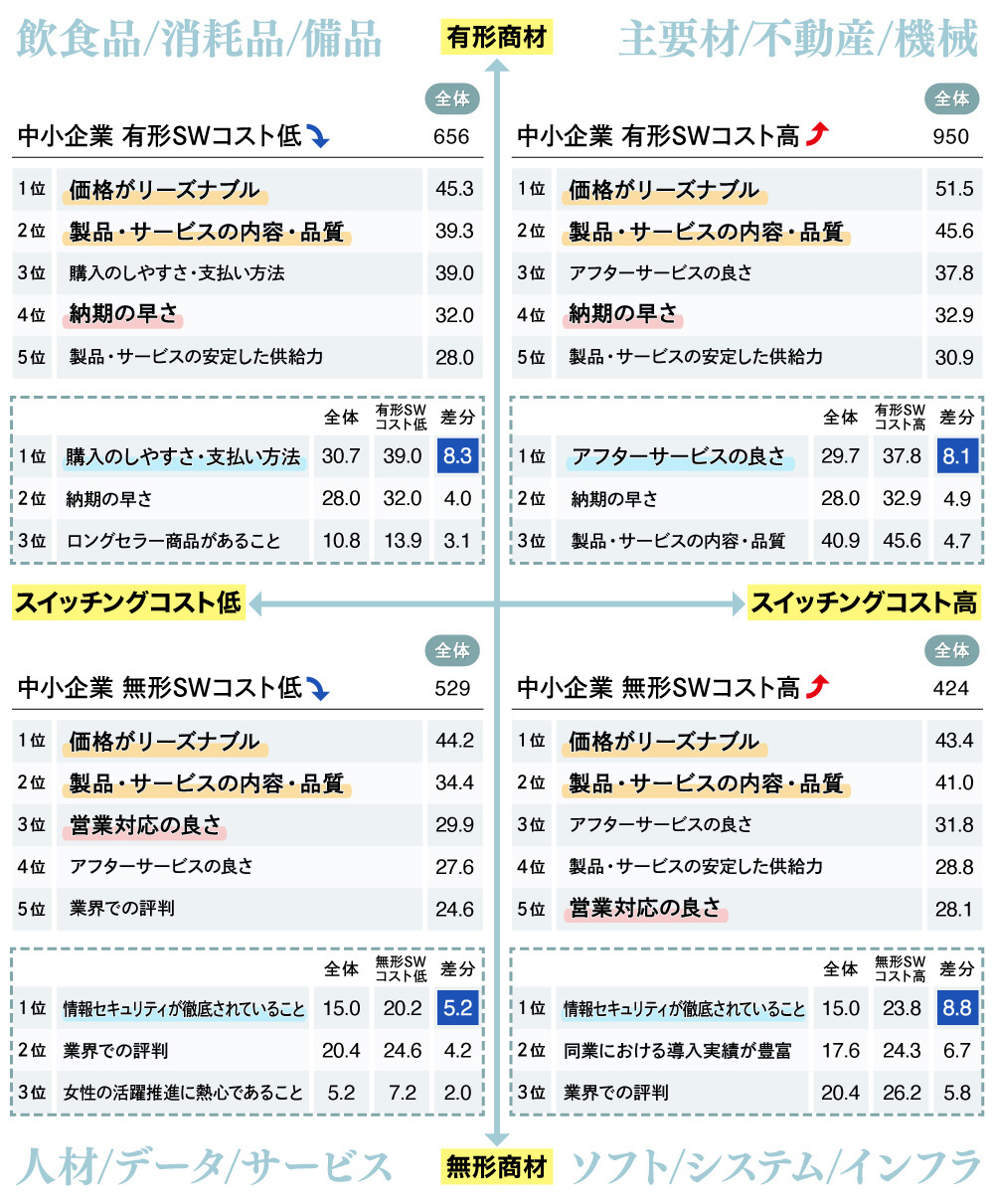
This reveals differences in purchasing behavior depending on industry classification, indicating the need for marketing strategies tailored to each sector's characteristics. While this presentation covers only part of the survey results, analysis and insights utilizing non-public data and findings from specific product categories are also available upon request.
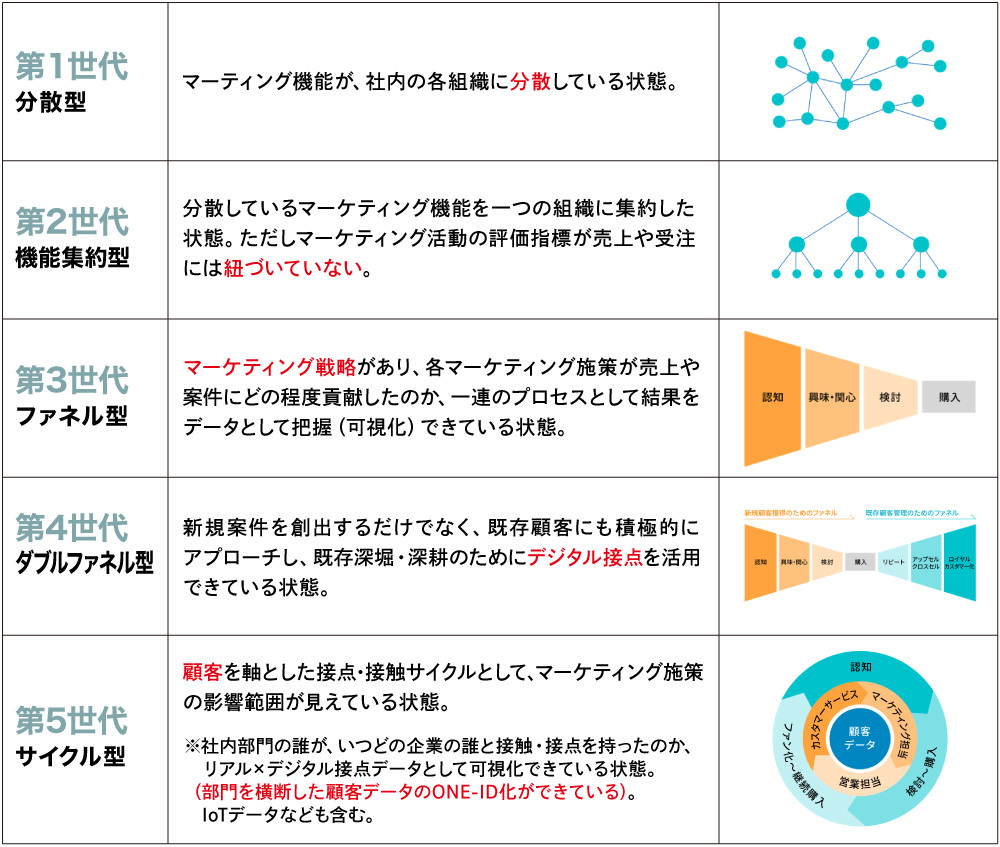
Additionally, we have conducted a "Survey on the Actual State of B2B Marketing Personnel" based on the "5-Generation Model of B2B Marketing Organizations." This survey clarifies the trends among organizations achieving results within companies undertaking B2B marketing reform, as well as the actual status and outcomes of establishing Demand Centers and Inside Sales organizations. We would be delighted if you would feel free to inquire.
[Survey Overview]
・Title: "Survey on B2B Product Purchase Decision-Making"
・Survey Method: Internet survey
・Survey Period: December 23–28, 2021
・Survey Area: Nationwide
・Survey Participants: Men and women aged 20–69, business owners/executives, company employees
45 products × 100 respondents per product = Total 4,500 respondents
・Survey Sponsor: Dentsu Inc. B2B Initiative
<DENTSU Inc. B2B Initiative>
 Dentsu B2B Initiative is a specialized organization dedicated to solving challenges in B2B business. Composed of members from nine Dentsu Group companies (※2), we provide integrated solutions across the entire value chain. This includes developing new businesses and services, digital transformation (DX) in manufacturing and logistics, supporting marketing and sales activities, and building customer success frameworks.
B2B Integrated Solutions
https://www.d-sol.jp/solutions/b2bsolution
Dentsu Group Inc. (Dentsu Innovation Initiative), Dentsu Inc., Dentsu Digital Inc., Dentsu Live Inc., DENTSU PROMOTION PLUS INC., Dentsu Consulting Inc., Dentsu International Information Services Inc. (abbreviated as ISID), CARTA COMMUNICATIONS Inc., ISID Business Consulting Inc. (as of October 2022)

Was this article helpful?
Share this article


Newsletter registration is here
We select and publish important news every day
For inquiries about this article
Back Numbers
Author

Shosuke Yamamoto
Dentsu Inc.
Third Integrated Solutions Bureau

Yoshii Yu
Dentsu Inc.
First Integrated Solutions Bureau

Takumi Hirasaki
Dentsu Inc.
First Integrated Solutions Bureau