Note: This website was automatically translated, so some terms or nuances may not be completely accurate.
 Building Amazing Organizations with the OODA Loop [1/7]
Do you know the "OODA" decision-making process for navigating change?
In a world of rapid change and accelerating diversification of values, many organizations face challenges like " struggling to build effective teams " or " struggling to keep pace with the speed of change."
The concept of " OODA " holds the potential to solve such business challenges. Derived from the initial letters of Observe, Orient, Decide, and Act, OODA is recognized in Western management and marketing as an indispensable decision-making process alongside the traditional PDCA cycle.
What exactly is OODA? How does it differ from PDCA? How can OODA be implemented?
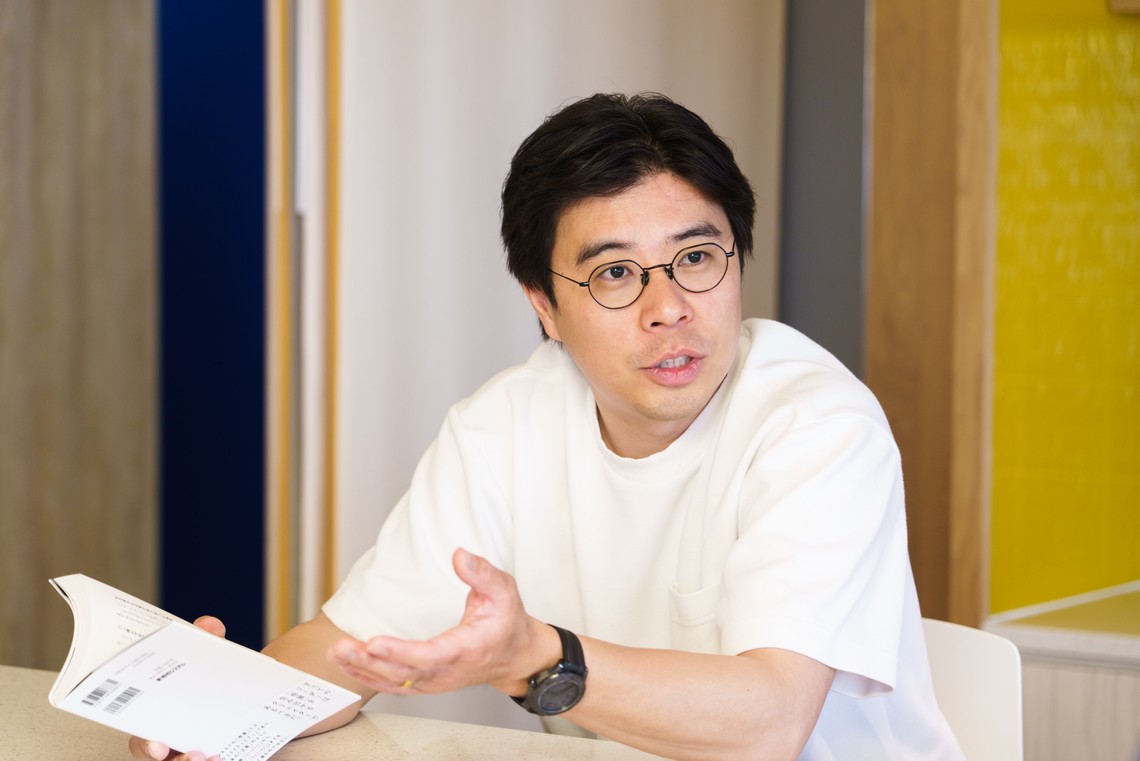
Aaron Zou, author of " OODA Leadership: The World's Most Powerful Doctrine " (Shuwa Systems), explains.
Why is leadership education lacking in Japan?
I'm Aaron Zu from Dentsu Inc. Before discussing OODA, let me talk about " leadership."
I moved around a lot growing up—Los Angeles, Tokyo, Shanghai—but I didn't properly learn the concept of leadership until I joined ROTC (Reserve Officers' Training Corps). Of course, Japanese schools have "leader" roles, but I suspect few people learn the concept of leadership from its foundations.
Why is leadership education lacking in Japan? There are various factors, but one reason is that "Japan wasn't an environment that required strong leadership." For instance, in environments like America, where individuals assert themselves strongly and unifying a team demands enormous energy, powerful leadership to steer the team in the right direction is inevitably required. In contrast, Japan's culture, with its respect for seniority and consensus-based decision-making processes, likely didn't necessitate such strong leadership.
Even so, as long as the business structure itself remained simple, there were no problems, as seen during the period of high economic growth. However, in recent years, the digital society has diversified business, rendering past success formulas ineffective.
In my daily work, I often consult with clients' executives about talent and turnover rates . Even when we start discussing new business development, digging deeper inevitably leads back to talent concerns. No matter how strong the performance, if you can't solve the "people" problem, you cannot sustain or grow that business. It's no exaggeration to say that leadership guiding team members in the right direction determines a company's future.
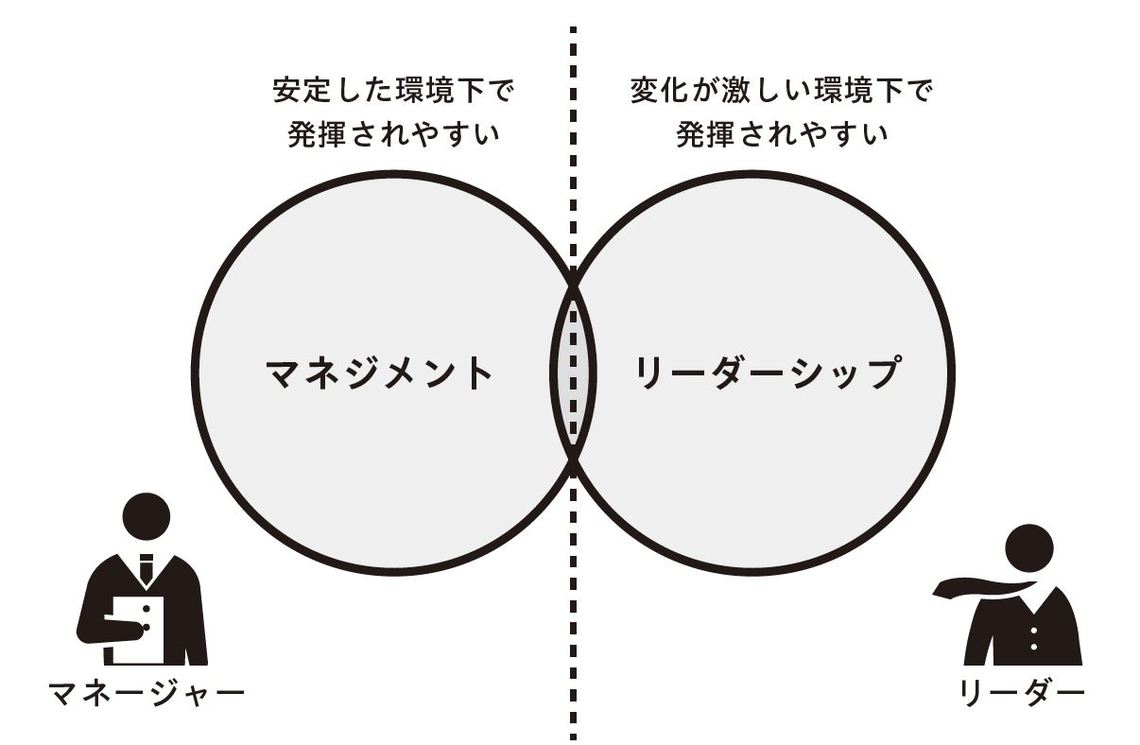
Here, I want to make it clear: " Leadership and management are similar yet fundamentally different."
Management is a set of techniques for effectively handling complex situations. Particularly in manufacturing, which dominates much of Japanese industry, excellent managers are indispensable for planning, budget management, production quality, and maintaining organizational order and consistency.
On the other hand, the role of leadership boils down to one phrase: " responding to change." It involves creating a vision, motivating members to achieve it, maintaining their motivation, and constantly guiding the team in the right direction. These leadership qualities truly shine in today's business environment, characterized by constant, rapid change, intensifying competition, and the need for large-scale reform.
Managers handle complexity; leaders handle change. That is the fundamental difference between the concepts of management and leadership.
Japanese companies achieved growth by establishing sophisticated management techniques. However, my view is that there is still significant room for growth regarding the leadership required for the rapidly changing times ahead.
What Leaders Need for the Future is OODA. How Does it Differ from PDCA?
The essential leadership quality of "responding to change" can be expressed through terms like "flexibility" and "speed." The groundbreaking framework that embodies these elements is the " OODA Loop" (hereafter OODA), proposed by John Boyd, a former U.S. Air Force Colonel and fighter pilot.
Like PDCA, which has permeated Japanese business circles, OODA is a process that completes a cycle from decision-making to action. However, the content of each process differs from PDCA's "Plan, Do, Check, Action." Below is a brief explanation of each process.
■ Observe
Grasp the current situation and gather necessary information. The key point here is to avoid speculation or judgment. Observe things objectively and accept information as fact, even if it is unfavorable to you.
■Orient
Make judgments based on the collected information, drawing on past trends and experiences. Leaders with more experience can make quicker judgments, making this a phase where a leader's experience truly shines.
■Decide
Determine specific actions based on observation and judgment. This decision is where a leader's capability is truly tested.
■Act
Finally, implement the decisions. Taking action creates change. This leads back to observation, where hypotheses about the changes are tested. Rapidly repeating this cycle enables flexible responses even in unstable environments.
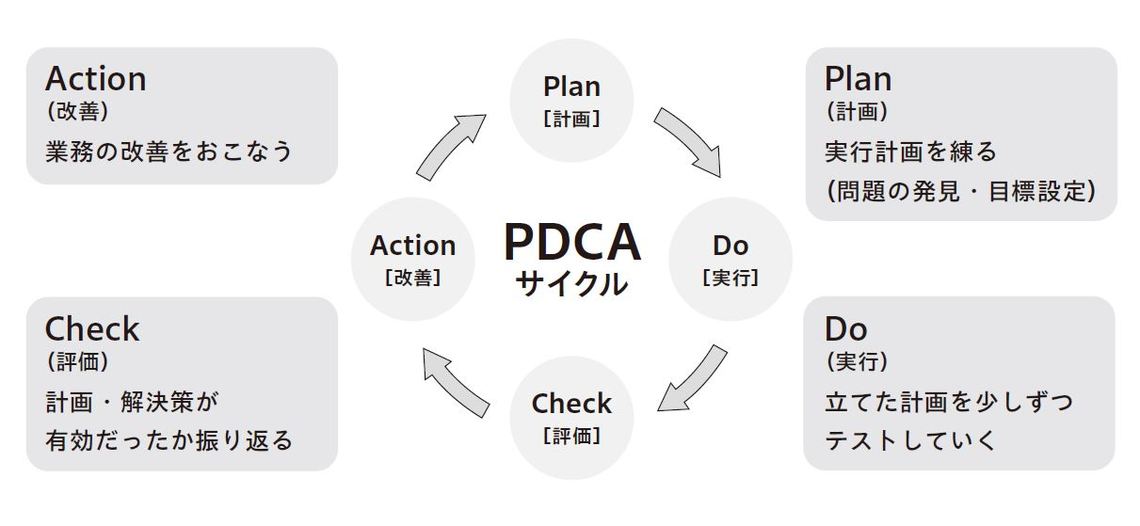
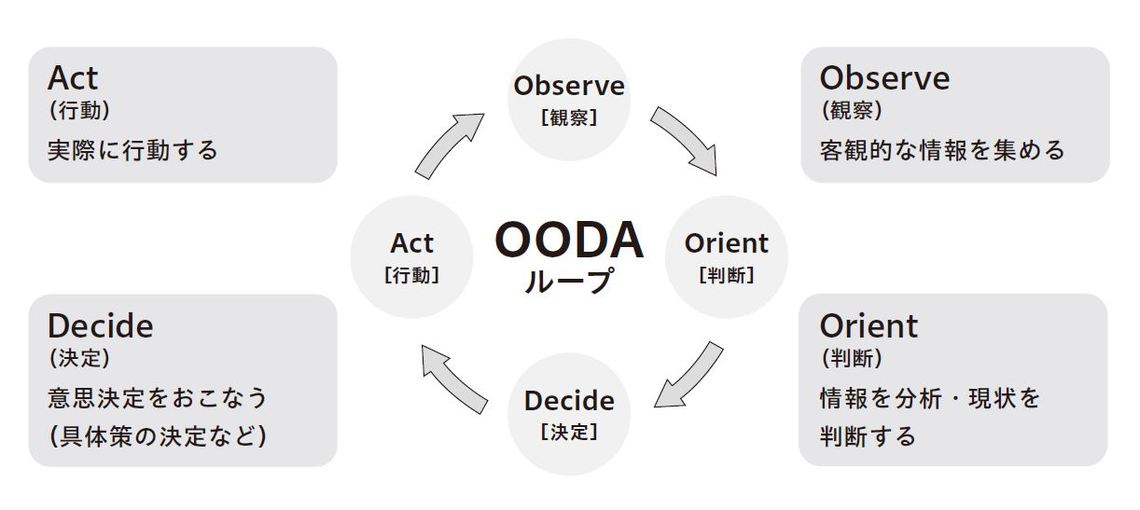
OODA prioritizes decision-making focused on " what is the best move in this moment, " aiming to consistently make the best possible move in constantly changing, unpredictable situations.
Conversely, PDCA focuses on properly managing projects and teams within stable conditions to improve quality and efficiency. To contrast them clearly: stable existing businesses should focus on "orthodox strategies "—executing PDCA cycles and meticulous management. Rapidly changing new ventures should concentrate on "unorthodox strategies" —rapidly spinning OODA to identify winning opportunities through leadership. Their roles are distinct.
There is no doubt that PDCA is an extremely useful tool. However, it is also true that the PDCA cycle cannot always keep pace with the speed of change. OODA is more flexible than PDCA in responding to environmental changes, making it an indispensable decision-making process for leaders navigating today's rapidly changing business landscape.
This might be a slight digression, but I feel the relationship between "orthodox strategy" and "unorthodox strategy" is similar to that between "products/services" and "creativity." The excitement and "aha!" moments generated by creativity have long been powerful "unconventional strategies" driving business. However, just as "ad copy means nothing without a product," neither can exist in isolation. Both PDCA and OODA serve distinct roles, and it's crucial to apply each correctly at the points where they can be most effective.
The Secret to OODA's Speed Lies in the "Decide" Process
Why can OODA cycle so rapidly? The true source of its speed lies in the "decision" (Decide) stage of the decision-making process. Slow decision-making has long been a challenge for Japanese companies. In contrast, within OODA, the "decision" process is implicit; it doesn't involve deliberately following detailed steps.
If a car suddenly swerves toward you, you take evasive action based on an instantaneous judgment, right? There's no separate "decision" process involved. Otherwise, you'd be hit by the car before you could react. In this way, OODA achieves a speedy decision-making process by having judgment directly control action.
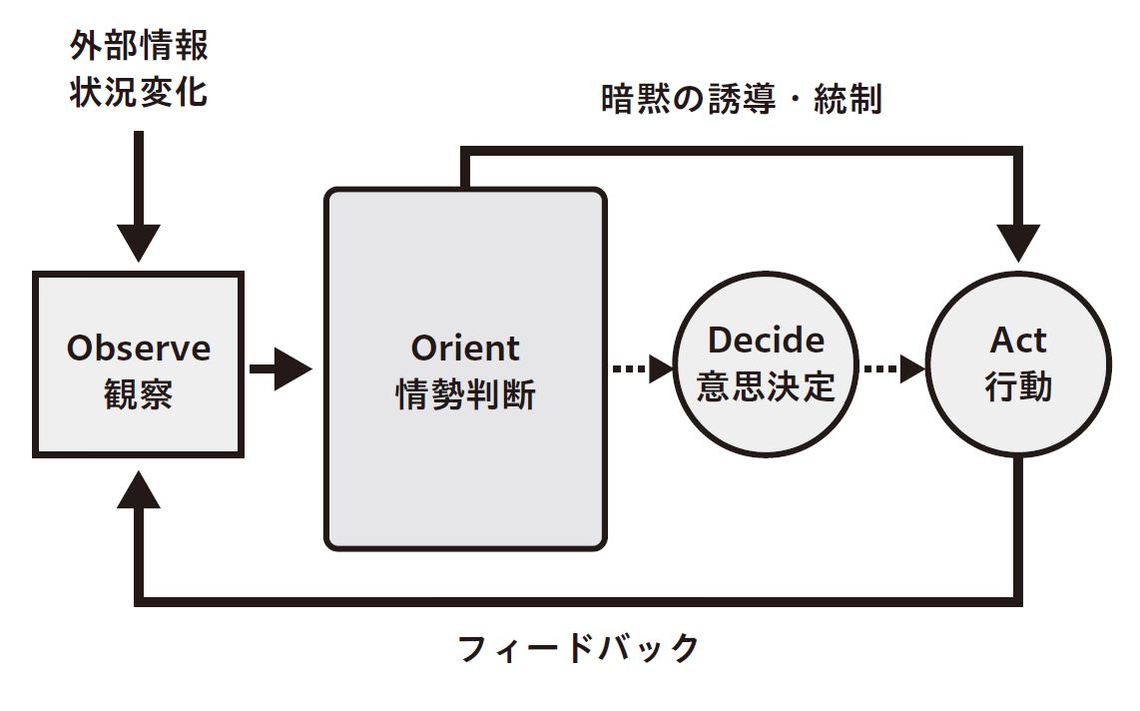
To apply this to an organization, " delegation of authority " is essential. By granting trusted members a degree of discretion, the speed of OODA significantly increases.
To reiterate, a leader's job is not "to manage," but " to guide the team in the right direction while adapting to change." After communicating the mission and value of the work to members, delegate actions within a defined scope to subordinates. This clarifies the scope of responsibility at the operational level and boosts members' motivation. Of course, this doesn't mean dumping work or responsibility entirely on subordinates. As the ultimate responsible party, it's crucial to remain on standby, ready to respond immediately if anything arises.
The Key to OODA Implementation Lies with Middle Management! What is "Issue Selling" to Drive Executive Leadership?
OODA originated from American military strategy. To implement it in Japanese corporate business, we believe a method suited to Japanese companies is necessary. This is because Japanese companies do not have the same level of workforce mobility as Western firms, and are rooted in seniority-based and consensus-driven cultures. Rather than strong top-down leaders, leaders and managers who can effectively build relationships and coordinate within complex internal environments are better suited to Japanese organizational culture.
In other words, the key to OODA-driven transformation lies not with top management, but with middle management. In practice, middle managers—those responsible for frontline operations—hold the most influence over projects. They also possess connections with various stakeholders, making them the hub where information about new products, services, and improvement ideas converges. Essentially, while top management makes "business decisions to solve problems," it is middle management's role to "determine what the actual problems are."
To get senior management to recognize a problem as a challenge, processes like proposals, groundwork, and finding collaborators are necessary. This concept, called "Issue Selling," is an unavoidable process for rapidly executing OODA in Japan. My book, " OODA-Style Leadership: The World's Most Powerful Doctrine " (Shuwa System), introduces a concrete framework for executing Issue Selling.
OODA, deployed in high-uncertainty environments, and the "unconventional strategies" it enables, have been applied not only in business but also in education, traditional performing arts, and entertainment like quizzes and mysteries. In this series, through dialogues with "OODA practitioners" across various industries, we will share insights for developing the leadership needed in the coming era and highlight the appeal of OODA.
Stay tuned.

Was this article helpful?
Share this article


Newsletter registration is here
We select and publish important news every day
For inquiries about this article
Author
Aaron Zoo
Dentsu Inc.
BXCC
Business Development Producer
Job Hunting Design for the Year-Round Recruitment Era Launch Commemorative SeriesWeb Dentsu Inc. Original Video "A Certain Brainstorming Session"CLIEN's Vision for a New Model of Community HealthcareThink in diagrams!Expanding Business Through Creativity: The Challenge of BXBuilding Amazing Organizations with the OODA LoopOODA Loop BrandingThe Expanding Possibilities of Digital Humans Through Generative AIBusiness Design by BX! New Business Development at Fujifilm BI