Note: This website was automatically translated, so some terms or nuances may not be completely accurate.
 The ideas sparked by purpose will transform marketing going forward. [1/2]
The Age of Post-Purpose? Balancing Vision and Marketing
The term "post-purpose" occasionally appears in Western advertising and marketing industry publications. What exactly is being discussed? This article explores the background behind this term, then presents insights and hints for tomorrow's marketing work, incorporating hypotheses.
Part 2: Here: Evolved Customer Focus. The Frontier Lies in Connections with Society
To avoid misunderstanding, we first clarify the scope of "purpose" discussed in this article. "Purpose" (※1) broadly falls into three categories: corporate-level purpose (focused on organizational management contexts like sustainability initiatives, corporate branding, and internal engagement), product/brand-level purpose (focused on marketing contexts like strengthening brand appeal to win customer choice, campaign development, and activation), and individual-level purpose (focused on employee engagement contexts).
The term "post-purpose" now emerging primarily refers to the second type: purpose within the "marketing context" at the product brand level.
What comes after purpose?
"Post-Purpose"? ...So, what comes after purpose? Readers of this article may have such questions. However, let me state upfront: there is no clear answer to that question. Based on research into Western advertising and marketing industry publications and information from events like Cannes Lions (※2), no new concept appears to be replacing purpose. Crucially, there was almost no discussion denying the very concept of purpose itself.
What was present instead was the question: "Can we expect marketing effectiveness from 'purpose branding'?" and an atmosphere suggesting, "It's time to move beyond the current situation where purpose has become a 'boom' in the marketing industry." While acknowledging that it's positive for product brands to clearly define their own purpose and develop activities based on it, there appears to be a trend toward scaling back the practice of purpose branding itself.
Purpose branding, commonly seen in Europe and the US, is characterized by campaigns and activations incorporating so-called social good initiatives—activities addressing social issues or contributing to society. Many are familiar with this approach, as such work frequently wins awards at events like Cannes Lions. This method has long been seen as offering significant marketing benefits: contributing to society while also increasing customer empathy and loyalty.
However, in recent years, as numerous brands have rushed to adopt this approach, creating a sort of boom, drawbacks have begun to be pointed out. Specifically, campaigns have started to feel increasingly similar, reducing their effectiveness in differentiating brands. Furthermore, some people have developed a cynical view, perceiving it as "commercial exploitation of social issues."
Balancing Purpose and Marketing Effectiveness
The "boom" itself isn't the only problem. When addressing social issues or themes of social contribution, it's crucial to ensure the brand's stance and activities possess authenticity to avoid criticism of "purpose washing" (superficial purpose). Furthermore, in Europe and the US (especially the US), where societal divisions are deepening, adopting social themes can now trigger backlashes or even boycott movements. This demands extreme caution in theme selection. For companies, purpose branding has become an approach that cannot be undertaken half-heartedly.
We cannot overlook the shifting public consciousness. Rising prices have made consumer attitudes more stringent. Looking at social consciousness itself, the enthusiasm and actions of people aiming to solve social issues or drive social change have somewhat cooled compared to previous levels. Additionally, some people feel a backlash against those tackling environmental or social issues, perceiving them as "woke."
The vision of "the future society we want to realize" is actually not uniform. Amidst these changes, it seems that implementing social good initiatives or demonstrating a brand's stance toward society does not necessarily translate into driving purchases of that brand.
Of course, purpose isn't about profit; it's about demonstrating a brand's deeper meaning and stance toward society. Yet, in today's challenging marketing environment, it inevitably faces strong headwinds.
Debates rage over whether "purpose doesn't translate to sales," "it can yield high impact if executed correctly," or "it shouldn't be applied uniformly to all brands." With no clear conclusion, we seem to have entered what's termed the "post-purpose" era. While it's difficult to summarize in a single phrase, if pressed, I'd say purpose branding is being forced to evolve to reconcile aspiration with marketing effectiveness.
To be clear, at the product brand level, engaging with society based on a company's sustainability or DEI principles is not being dismissed. Provided costs allow, continuing such efforts with clear objectives, without forcing marketing expectations onto them, aligns with current societal demands. However, if branding is positioned to deliver marketing impact, it must effectively balance purpose and marketing effectiveness. Beyond business-oriented cost-effectiveness, if marketing impact isn't achievable, realizing the purpose itself becomes unsustainable.
So, what should be done? The path forward is not yet clear. Therefore, I would like to present one hypothesis I have developed, hoping it might spark discussion among you.
Shifting the Focus Back to the Customer: A Paradigm Shift from "Social Good" to "Evolved Customer Centricity"
One key insight lies in shifting our focus.
In today's climate, where mere sympathy for a brand's social stance no longer drives brand choice, achieving marketing effectiveness may require refocusing on customer value. This is a return to "customer-centricity." However, this isn't simply reverting to traditional "customer-centricity." Having embraced the concept of purpose, I believe the destination is now an "evolved customer-centricity."
What exactly is "evolved customer-centricity"? This may be a slight digression, but I believe there are several typical types of purpose branding case studies. One is the "social contribution type," where brands undertake socially impactful activations that embody their purpose. By visualizing the brand's mission through symbolic activities, understanding and empathy for the purpose deepen. For example, consider an IT brand supporting IT literacy in developing countries. While customers in developed countries may not directly benefit from these activities, they actively choose that brand over others because they perceive it as "more worthy of respect."
The other is the "comrade-in-arms" model. This structure involves customers and society resonating with the societal vision the brand aspires to achieve, creating a bond where the brand and its audience become "comrades." Examples include brands and customers jointly participating in environmental protests or collectively supporting athletes standing up for human rights. Customers choose the brand with a sense of "casting a vote" for its ideals or because they find meaning in expressing their own values.
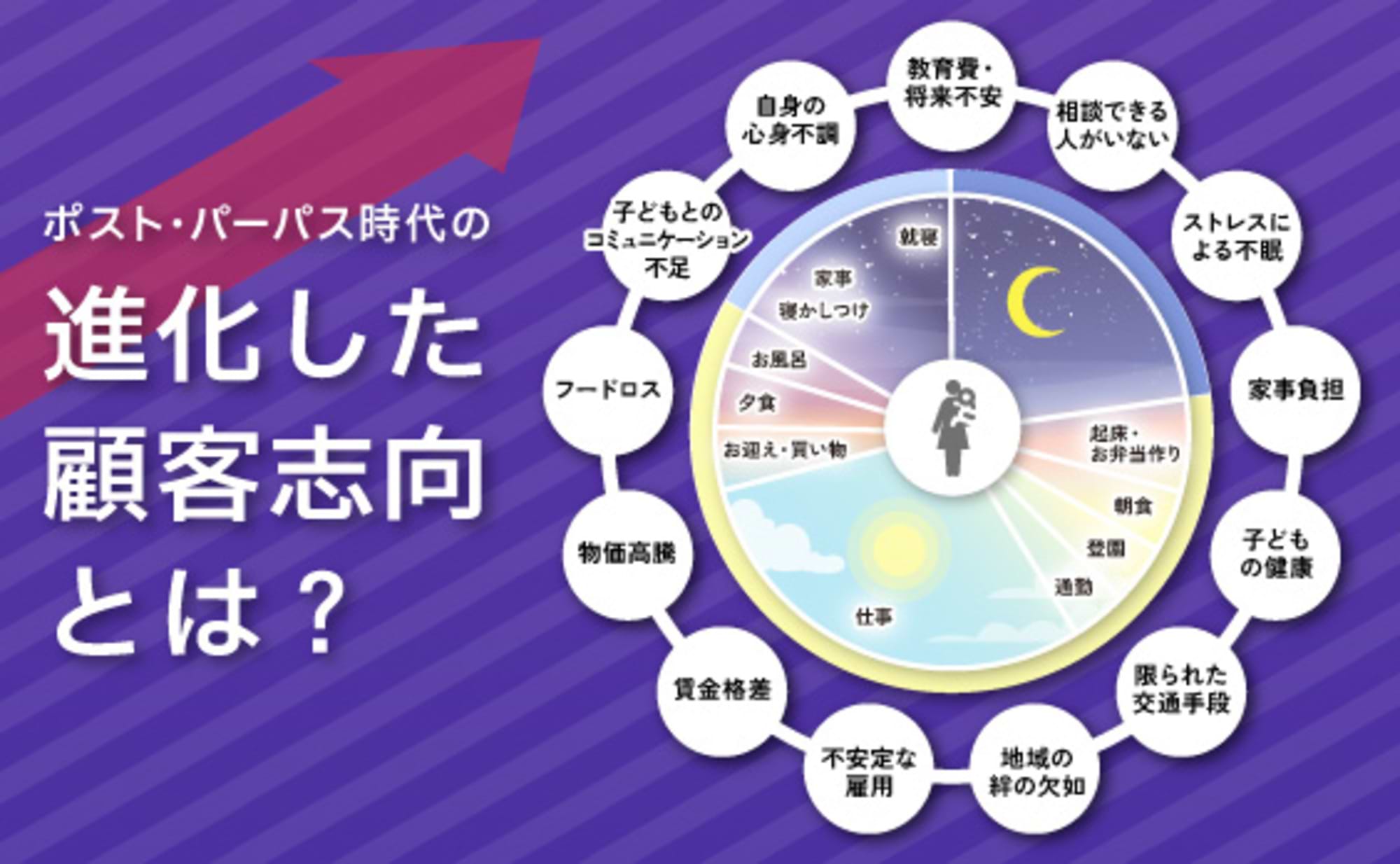
The final type is the previously mentioned "evolved customer-centric approach." "Evolved customer-centricity" is a term I coined, defined as "incorporating a 'society' perspective into traditional customer-centricity to contribute to customer happiness in a deeper, more profound way than before." The crucial perspective is how much value the experience ultimately provides for the customer. Examples include a personal care brand championing a mission to support women's self-esteem and launching campaigns to challenge society's beauty standards. Based on the insight that uniform beauty standards undermine many women's confidence, proposing diverse forms of beauty to society... This not only contributes to creating a society where women can thrive more vibrantly, but also enhances the customer's self-esteem and the happiness they feel when using that brand. To the customer, the brand appears as a "partner who understands them and provides a better experience," creating a structure that increases loyalty.
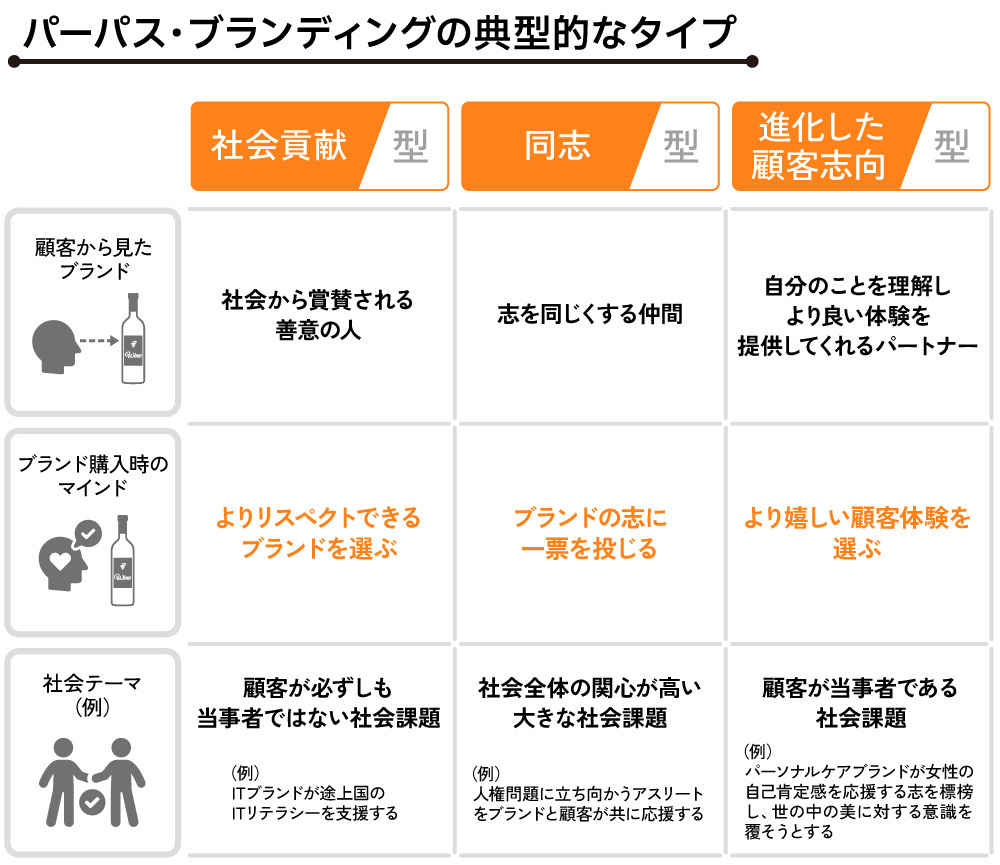
Amidst the current surge in prices, consumers are losing their financial leeway, which may weaken the response to "social contribution" types. Furthermore, "comrade types" also tend to become difficult when social divisions are significant. In that sense, the direction of "evolved customer-oriented" types, which refocus on customer value, may be the easiest way to achieve both ambition and marketing effectiveness in the current marketing environment.
The "boom" in purpose branding has ended, but that does not mean that this method has "come to an end." There are brands that continue purpose branding even after understanding its difficulty. It seems possible to improve marketing effectiveness by choosing the timing of implementation while assessing the consciousness of people and social conditions at the time, and by reviewing the content of the purpose.
Moreover, all three types mentioned above (and likely others) hold the potential to deeply move people and achieve remarkable results, depending on the strength of the planning. It might sound naive, but I suspect many within this industry, whether in Europe, America, or Japan, feel a surge of determination thinking, "If we give up here, our planner spirit dies!"
The ideas sparked by purpose will transform future marketing.
Incidentally, purpose-driven branding case studies reveal novel concepts previously unseen. The hypothesis of "evolved customer-centricity" presented here is one such example. I believe this concept can be widely applied not only to branding but across various marketing scenarios.
Therefore, next time, while unraveling this concept of "evolved customer-centricity," I will introduce a tentative framework of ideas that could be useful for tomorrow's marketing activities.
※1: The term "Purpose" here refers to the fundamental reason for a company or brand's existence, its aspirations and significance to society. Purpose is a concept that has attracted significant attention from many companies in Europe and the US for over a decade, and increasingly in Japan in recent years. Following the Lehman Shock, questions arose: "Can for-profit companies, whose primary mandate is profit maximization, truly be beneficial to society?" This prompted corporate leaders to explore new approaches to management, bringing Purpose into focus. For more details, please refer to: Business Solutions Portal Do!Solutions "What is Purpose? Explaining Its Meaning and How to Strengthen Your Company and Brand" https://www.d-sol.jp/blog/purpose-design-1
※2: Reference Information
The Work (Cannes Lions Official Website - Work Archive)
https://www.lovethework.com/
Marketing Week
https://www.marketingweek.com/
Ad Age
https://adage.com/
Campaign Japan
https://www.campaignjapan.com/
※3: Purpose branding, as used here, refers to a branding approach that starts with purpose to gain empathy and strengthen relationships with society and customers. It is adopted not only for corporate brands but also at the level of business brands such as products and services. It spread primarily in Europe and the US against the backdrop of increasing consumers—centered on socially conscious Millennials and Gen Z—questioning the raison d'être of companies and brands from a societal perspective, with purpose increasingly influencing product and brand choices.

Was this article helpful?
Share this article


Newsletter registration is here
We select and publish important news every day
For inquiries about this article
Author

Yumiko Umezu
Dentsu Inc.
Third Marketing Bureau
Marketing Consultant