
Note: This website was automatically translated, so some terms or nuances may not be completely accurate.
 Taking on the Japanese Market! What's the Success Formula for Foreign Companies? [1/2]
Taking on the Japanese market! What is the formula for success for global companies? The Inside Story: How Duolingo Made It Big in Japan

Duolingo, a global app, is currently the most downloaded educational app in Japan.
A TV commercial featuring the green owl mascot Duo rolling along to the song “Duolingorogoro” aired in Japan.
When Duolingo first entered the Japanese market in 2020, its awareness rate was less than 5%. However, as of 2025, awareness has exceeded 20%, and the number of daily active users has increased more than tenfold. Behind this success were dentsu’s meticulous media planning and the power of creative content that resonated with the Japanese people.
In this article, we interviewed Sho Mizutani, Duolingo’s Director of Regional Marketing, and Keisuke Okuno of Dentsu Inc., who was in charge of the creative for this project. Dentsu Inc. Account Lead Taichi Arakawa was the interviewer, and they all look back on Duolingo’s journey to date and how dentsu has supported the company, focusing on the behind-the-scenes story leading up to the broadcast of the Duolingorogoro TV commercial.
Why We Chose TV Commercials Despite a 3.8% Awareness Rate

Mizutani: As of March 2021, Duolingo’s awareness rate in Japan was only 3.8%, so the fact that it wasn’t well known in the first place was a challenge. On the other hand, we also knew that:
-
If people knew about the app, they were highly likely to use it
-
And of those users, a high percentage will continue to use it
That’s why the task at hand was clear: we needed to start by working to increase awareness. And among other things, I had wanted to do a TV commercial ever since I joined the company.
Arakawa: Why did you choose a TV commercial?
Mizutani: One reason is that I had experience using TV commercials for an app I was involved in at my previous job, and I realized firsthand how effective TV is at raising awareness of an app. Another reason is that I thought the Duolingo product itself would be a good fit for TV commercials.
That’s because Duolingo is accepted not only by young people, but by people of all ages. We knew that the older demographic, which is a large TV audience, would have a high retention rate for the app if they just used it. For this reason, I felt from the beginning that it would have a high affinity with TV commercials.
Arakawa: I think that for apps that are being rolled out globally, the creative is often consistent across all of the countries. Why did you choose an original creative for Japan?
Mizutani: Duolingo also airs TV commercials in the US, but the content is more focused on branding rather than raising awareness of the app. Furthermore, since they are produced with 3D animation, which is very typical of global productions, we felt it was necessary to create something original here rather than simply using the creative from the US.
Arakawa: Mr. Okuno, you’ve been the creative director of Duolingo’s commercials since the early days. What led you to become involved?
Okuno: I’ve known Mr. Mizutani since his previous job. What remains in my memory is what he said when I asked him why he wanted to join Duolingo.
“Duolingo’s mission is to eliminate educational disparities and create a world where differences in wealth do not affect educational access. I, too, want to devote my life to making the world a better place.”
When he told me this, I knew I had to do something to help!
After discussing it together, we decided that in order to raise awareness of the app, we should first promote the name Duolingo, and so we produced a video for the web. We created an original song using the phrase “Duolingorogoro,” which eventually became the seed of a TV commercial.
“Duolingorogoro” was inspired by a user enjoying his bath time

Arakawa: Where did that memorable phrase Duolingorogoro come from?
Mizutani: The hint came from something I noticed while interviewing Duolingo users. In the user interviews, when asked about the value of Duolingo, many people said it was convenient because they could use it when they woke up in the morning or before they went to bed.
One man whom I interviewed said, “I’ve been using Duolingo every day in the bathroom for two years.” At the time, I didn’t find that comment particularly interesting, but after thinking about it, I thought it was strange. I wondered why he would take the time to study during his relaxation time.
So I called the man again and asked him why he was using it in the bath. He didn’t seem to know the reason himself, but when he told me that he used to check Instagram in the bath, I realized that Duolingo is being used in the same way as reading manga or browsing social media.
In other words, the benefit of Duolingo is that you can learn a language even while you’re relaxing. I thought that this could also be described as “an app that lets you learn while you’re lolling around*”.
※‘gorogoro’ is a Japanese onomatopoeic word that translates into English words and phrases such as ‘loll’ (the person who inspired the name “Duolingorogoro” was lolling in his bath), ‘roll’ (the owl mascot Duo rolls along to the song in the TV commercial), ‘lounge around,’ and ‘chill out.’
When I mentioned this to Mr. Okuno, “Duolingorogoro” was born. I laughed to myself when I first saw the video, thinking, “Oh, I never thought of it like that!” (laughs).
Okuno: The “go” in “Duolingo” and “gorogoro” are linked, and so I thought this would be easy to create. But more than that, I think it was great that I was able to narrow down what I wanted to say.
Duolingo has a variety of features that we want to communicate—it is free, you can learn over 40 languages, and it has game elements. The fact that we held back on those and focused only on the name and on communicating the greatest value of the app was a good point for our first creative project.
Convincing the US headquarters through thorough research! Promoting the effectiveness of TV commercials through numbers

Arakawa: First, a “Duolinogorogoro” web video was created, and then the TV commercial aired nationwide in May 2022. I believe that there were many challenges along the way, but I imagine it must have been difficult to convince the US headquarters to allow the TV commercial to air on Japanese terrestrial television in the first place.
Arakawa: Japan’s media situation, with its limited number of television channels, is unique from a global perspective. How did you persuade them to do this?
※CPI = Cost Per Install. This is the cost per app install.
Arakawa: Before the TV commercial aired, you gave a final presentation, including representatives from dentsu, to Duolingo’s media director.
Mizutani: We had already gotten results that exceeded the test marketing scores, so we had received the go-ahead from the management in the US, but the head of the media department remained skeptical about TV commercials until the very end. So we created presentation materials, led by dentsu media planner Shunsuke Yoshioka, and held meetings with our global team.
I explained the current state of media in Japan and also talked about the nationwide CPI for “Duolingorogoro,” which I calculated from the results of test marketing in the regions. No matter what question I was asked, Mr. Yoshioka always answered with quantitative figures, which made his answers very persuasive.
Another effective way to explain the idea was to use dentsu’s “STADIA”* solution. STADIA enables us to see how many people who have seen a TV commercial have downloaded the app, as well as the broadcasting stations, programs, and time slots that performed well, making it an extremely effective persuasive tool. This type of TV viewing log and its effectiveness measurement is data that cannot be obtained globally, and so it was highly evaluated in the United States as well.
※STADIA = An integrated marketing platform developed by dentsu that delivers digital advertising and verifies its effectiveness based on actual TV viewing logs. While it has traditionally been difficult to measure the effectiveness of television, it is now possible to combine it with digital for analysis.
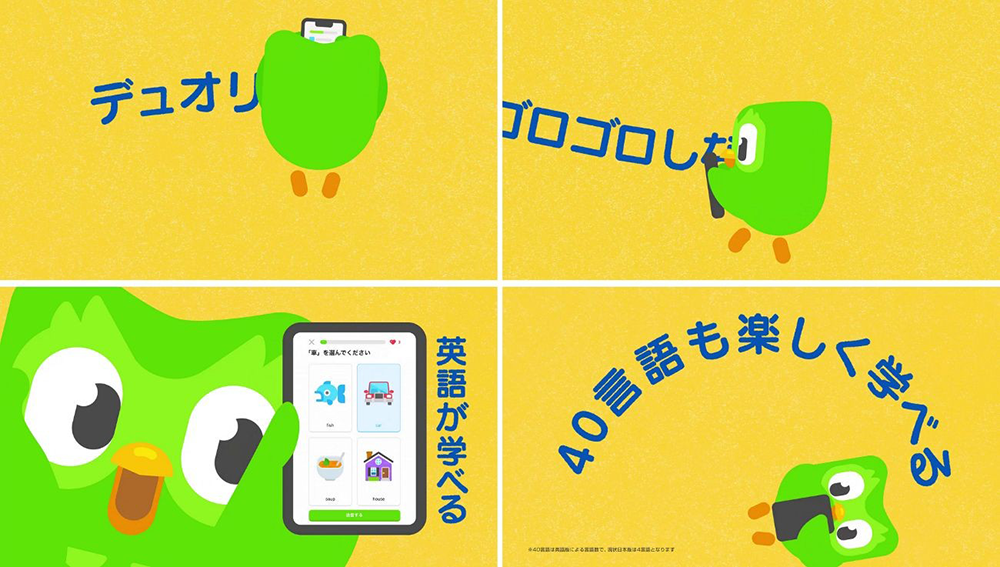
“You can learn English”
“Enjoy learning 40 languages”
Another big finding was that in addition to the effectiveness of TV commercials in Japan, there is a secondary effect in that “during a TV commercial period, the CPI for digital advertising also improves.” In other words, if a user has seen an app in a TV commercial, when they subsequently come across it through a digital ad, they will experience a so-called “halo effect” where they think, “That’s the app I saw on TV.” This is also shown in actual test figures.
Thanks to this detailed analysis and explanation, we were able to gain the understanding of the entire company including the head of the media department, and we were able to make it all the way to the national broadcast.
Thanks to the success of the TV commercial, Duolingo became the number one selling app in the education category

Arakawa: The TV commercial turned out to be a huge success!


Okuno: I’ve had a long-standing relationship with Duolingo’s Global Senior Creative Director, James Kuczynski, and I feel we’ve built a good relationship. There are also differences in creative style between Japan and the US. For example, 2D is the norm for creative animation in Japan, but 3D is more common in the US.
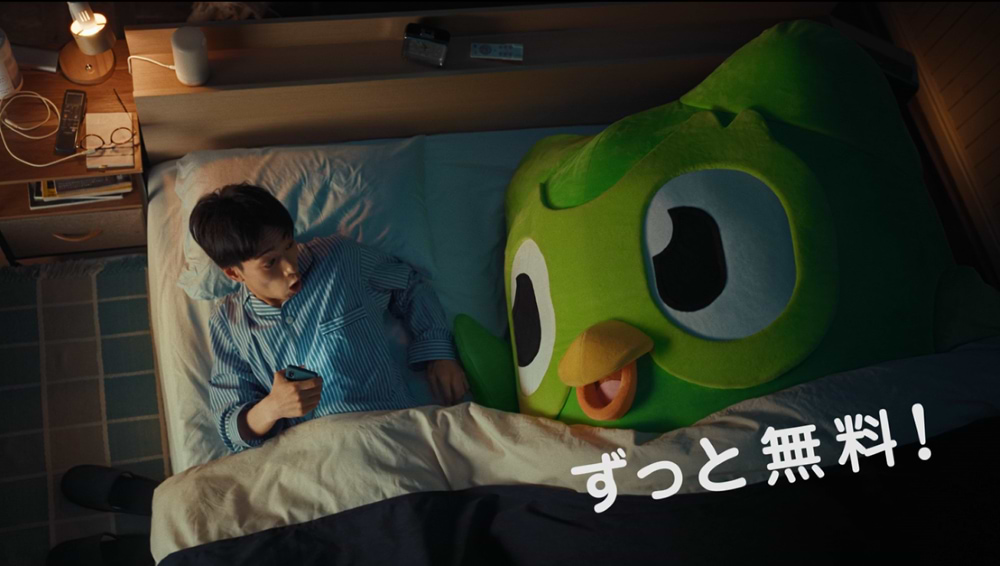
I also felt that the perception of “cute” was a little different. The green owl Duo is a global character for Duolingo, and when I first saw him I thought he was cute. But in the United States he is more of an “unhinged” character. If you skip a lesson, he’ll get angry and nag you, asking, “Aren’t you going to study today?” or saying, “Today is almost over!”(laughs). We explored the differences in our perceptions of the character, explained the situation to the team in the United States, and gradually worked things out.
But looking back now, I’m glad that we were able to create a commercial that conveyed Duo’s cuteness from the start. I’m grateful that James understood that point so well. If we had gone all out with Duo’s uniqueness from the start, it might not have been well received in Japan (laughs). However, over the course of five years, we gradually brought the character closer to the world-standard Duo, and I believe that the live-action commercial that aired in 2024 conveys Duo’s unique side, which goes beyond just being cute.
Mizutani: Of course, the commercial’s numerical results are impressive, but the creative work produced by Mr. Okuno and his team is of high quality, and they have a good understanding of the character, so I think they have earned the trust of our creative team.
And I feel that dentsu is trusted not only in terms of creativity, but also in terms of media planning. At first, we held a kick-off meeting with dentsu before the TV commercial aired, and Mr. Yoshioka and his team explained the results of simulations and analyses of the media plan, but gradually this became unnecessary. This is because the higher-ups started saying “They (dentsu) are ‘maniacs,’ so it should be fine now” (laughs).
Okuno:“Media maniacs” (laughs).
Mizutani: Also, even after the campaign is over, thanks to STADIA, we can have constructive discussions about our next measures. For example, since the “Duolingorogoro” commercial performs better on weekends, we can come up with creative that will be more effective on weekdays. This point is also appreciated within the company.
The keys to entering the Japanese market are thorough media planning and creative preparation

Arakawa: Based on the success story of Duolingo, I’d like to ask you about the important points that global companies should consider when entering the Japanese market. What are your thoughts, Mr. Mizutani?
Mizutani: First of all, I think it’s important to prepare a detailed media plan. In this case, dentsu was well-versed in the unique media landscape in Japan, and the team also provided detailed analysis using tools like STADIA, which helped us gain the trust of the company right from the start. Thanks to that, after the “Duolingorogoro” commercial, it became easier to secure budgets and move forward.
Also, with regard to creative work, because of the language barrier, I felt it was important to share as concrete an image as possible with headquarters. There are cases where the message is not conveyed accurately just by explaining the text or sharing reference videos. For the creative work for “Duolingorogoro,” Mr. Okuno first created a video storyboard that included the song, making it easier to share the image internally, which I was grateful for.
Overall, I think that preparing a concrete media plan and creative ideas from the start will make it easier to persuade and motivate global companies.
Arakawa: Thank you! Finally, please tell us about the future prospects for Duolingo in Japan.
Mizutani: Currently, the United States has the most Duolingo users and revenue. Our current goal is for Japan to surpass that position, and that is what our company president also wants.
The information published at this time is as follows.
Was this article helpful?
Share this article


Newsletter registration is here
We select and publish important news every day
For inquiries about this article
Author

Sho Mizutani
Duolingo
Director of Regional Marketing

Taichi Arakawa
Dentsu Inc.
Business Producers Division 20, Integrated Marketing & Production Division 1
Business Producer


Keisuke Okuno
Dentsu Inc.
First CR Planning Bureau
Group Creative Director