Note: This website was automatically translated, so some terms or nuances may not be completely accurate.
 NRF2025: The Paradigm Shift in Retail and Commerce for the Post-COVID Era [5/5]
"Go West Chapter II" ~ Now, to NRF EUROPE! (UK Edition)
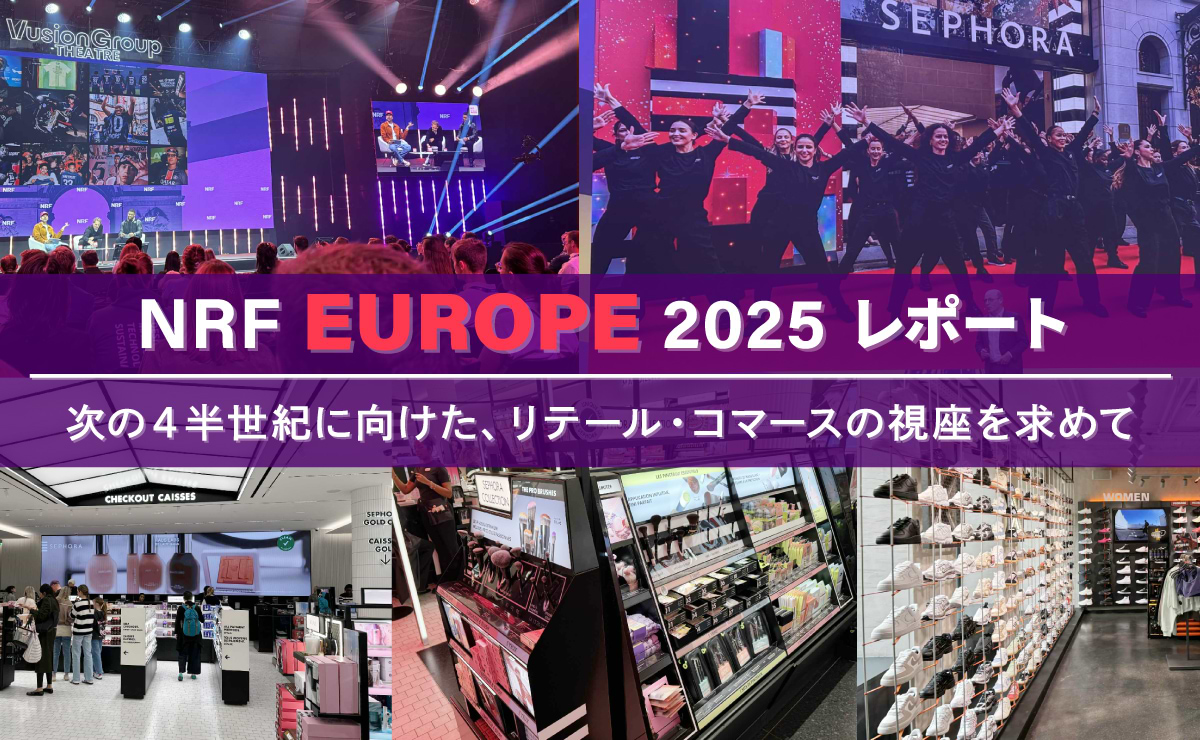
This article covers NRF EUROPE 2025, held for the first time in Paris, Europe. Following the first part focusing on France, the latter half explores UK stores and the world's largest social design event: London Design Festival 2025 (hereafter LDF). We hope you gain some insight into the current state of European retail and commerce.
<Table of Contents>
▼NRF EUROPE 2025 ~A Look Back at Part 1 and Key Speakers
▼Morrison's Magicrissons Magic
▼Britishness
▼Closing Thoughts
NRF EUROPE 2025 ~A Look Back at Part 1 and the Keynote Lineup
Beyond the three companies introduced in Part 1 —Sephora (France), Action (Netherlands), and Snipes (Germany)—NRF EUROPE 2025, held for the first time, featured a diverse lineup of participants from across Europe, including Switzerland, Italy, and Germany.
On highlighted the ecological and economic benefits its proprietary spray coating technology brings to the shoe manufacturing value chain, while also promoting the future of unified commerce through its physical stores and app. This approach was similarly adopted by KIKO Milano (not yet launched in Japan), a budget cosmetics brand with a strong customer base among Europe's Gen Z generation.
Additionally, Germany's METRO, which evolved from food wholesaling and business-to-business supermarkets into a membership-based wholesale club operator akin to Costco in the US, emphasized that while AI holds promise for retailers handling large stores and vast SKUs, "No model built on poor-quality data can deliver good results.(Based on that premise) The areas likely to become future business opportunities are probably demand forecasting, digital twins, smart logistics and inventory optimization, and employee labor efficiency."
In addition to these, I'd like to highlight Morrisons (8.5%), one of the UK's Big Four supermarkets (the other three and their shares are Tesco: 27.9%, Sainsbury's: 15.2%, and Asda: 12.5%).While its market share is being eroded by hard discounters like Aldi (11.0%) and Lidl (7.8%)—which are foreign players in the UK market—what is the reason behind its enduring support from British consumers?
Morissons Magic
The keynote on the final day, September 18th, was delayed by an hour due to major disruptions in France's public transport system caused by strikes. CEO Ramzi, undeterred, presented "Morrison's Magic: There's a Reason to Shop at Morrison's," outlining their unique corporate strategy through several key points. I'll summarize them below.
① Vertical Integration
In today's marketing landscape, where horizontal specialization and division of labor prevail, Morrison's takes the opposite approach. They directly and internally manage every function and role across the entire value chain. This includes not only store-based sales but also community contribution projects within their trade areas, chosen proactively by their employees, and even the establishment of a dedicated fund (launched in 2015) to support these initiatives.This strength—vertical rather than horizontal, and a remarkably solid customer base not reflected in market share rankings—is particularly evident in the fresh produce and food categories, key segments within the supermarket sector.
② Marketstreet (Specialty Food Section)
This in-store specialty fresh food section (meat, fish, vegetables, dairy, bread...) creates a "market-like" atmosphere, aiming to provide customers with fresh ingredients and expert service. It was the brainchild of co-founder Sir Ken Morrison. Trained food professionals cut and weigh meat and fish to customer specifications and offer cooking advice.This emphasis on face-to-face sales, reminiscent of traditional markets, embodies the British ethos of local sourcing and consumption. It serves as a key differentiator from other chains.
③ Affordability (Prices accessible to everyone)
The company constantly strives to balance three elements of customer value: price, loyalty, and promotion. Successive management teams have strongly cautioned themselves against allowing any imbalance in these areas that could compromise the customer experience. Alongside high-quality food, this simple concept of Affordability is their top priority. The true power of Morrison's management philosophy lies in how this principle is instilled in every employee through their unique in-house training program.
This is the Morrison's store I was able to visit, extending my trip from France to the UK.Located in Camden, slightly outside central areas like the City of London. The large mural illustration on the exterior wall (BREAD TALES) promoting food education for children, the Asian/Oriental customer base including Chinese shoppers and women wearing hijabs seeking halal food, the right-hand drive delivery trucks for the online supermarket parked on the left side of the road... For me, it was a store that felt somehow familiar. That was my first Morrison's experience.
Britishness
① Liberty
Liberty, the venerable department store popular even in Japan. Its founding origins are also very close to Japan and Asia. While the timber framing remains, there are no elevators. Its solid, no-frills character made me keenly feel the weight of history carried by a brand that cherishes its origins while embracing the spirit of learning from the past to innovate for the present, updating itself with the times.
② Harrods
Harrods holds a Royal Warrant, not for the Imperial Household but for the British Royal Family. While familiar in Japan for souvenirs like tea and teddy bears, what stayed with me most from visiting the actual store was the warm consideration shown by the veteran doorman, dressed in his green uniform, who saw us off as we left.
③ LDF 2025 (London Design Festival)
Finally, the LDF, the world's largest design festival held concurrently with NRF E urope, dynamically utilized "London as a venue." While varying themes by district and zone, it involved not only retailers but also hotels, restaurants, and even small, independently run galleries. It was a grand endeavor to broadcast the "story of social designing" from the local level to the global stage.
In Conclusion
In 2025, I visited three entirely different markets in a short period: the US, Singapore, and Europe (from France to the UK). Adhering to the principle of "three realities" (location, actual goods, reality), I surveyed the retail and commerce environments there and had a thought.Was Europe, particularly the UK, an environment more receptive to this Japanese author? As an island nation, and furthermore, being largely a single ethnic group, it has incorporated the essence of modernization since the Meiji Restoration. In other words, the underlying reason might be that the geographical, ethnic, and historical environments are remarkably similar.
My initial intuition at Morrisons evolved into an insight after Liberty and Harrods, and then solidified into conviction through LDF 2025.That is, the essence of Britishness—which I feel is simultaneously "Japanese-ness"—lies in the pride of seeking, finding, and cherishing the domains that AI cannot replace, even as AI is widely adopted and permeates society, allowing businesses to fully reap its benefits.
In a previous contribution, the author presented the following structured schematic diagram.
Following that model, might the era after 2025 be depicted like this?
The original meaning of "Retail" is said to derive from "re" meaning "again" and "tail" meaning "to cut," thus "retail" originally signified "to cut again." It came to mean "retail" (or "small-scale retail") from the act of "cutting again"—that is, purchasing goods from wholesalers and reselling them to consumers.
However, in the modern era, after the Pre-COVID ⇒ Post-COVID era of Retail DX, leveraging data, digital, and technology, EC can be easily built online (Store). At that very moment, it becomes a D2C Inc. (Brand). Through apps and SNS, a single employee-owner can connect with customers worldwide (People). If AI is added as a Game Changer, these gears will likely spin faster and become more sophisticated.
Simultaneously, and somewhat paradoxically, the values and significance traditionally embodied by "Retail" – namely the "Physical (Store): Story," "Real (Time): History," and "Mutual (People): Memory" that cannot be replaced by AI – are being redefined and elevated. The four examples mentioned earlier articulated this more eloquently than any previous case.
Retail is entering a stage where companies weave a "tail" (the relationship with the brand) that is "tailored" (individually optimized) for each and every customer, moving into the next 25 years of the 21st century. We also intend to continue delivering the cutting edge of retail and commerce through our ongoing NRF observation point, starting in 2026 and beyond.
Was this article helpful?
Share this article


Newsletter registration is here
We select and publish important news every day
For inquiries about this article
Back Numbers

Author

Hitoshi Kimura
Dentsu Inc.
Retail Marketing Division
Senior Producer