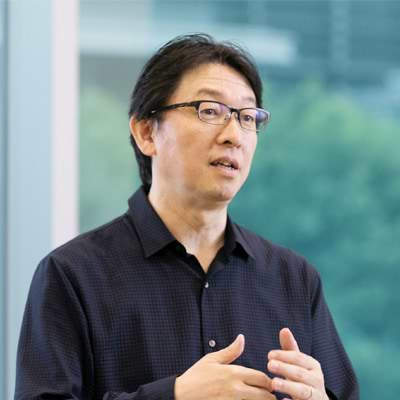
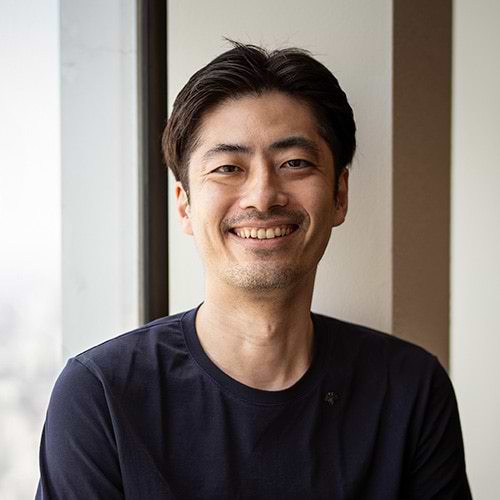
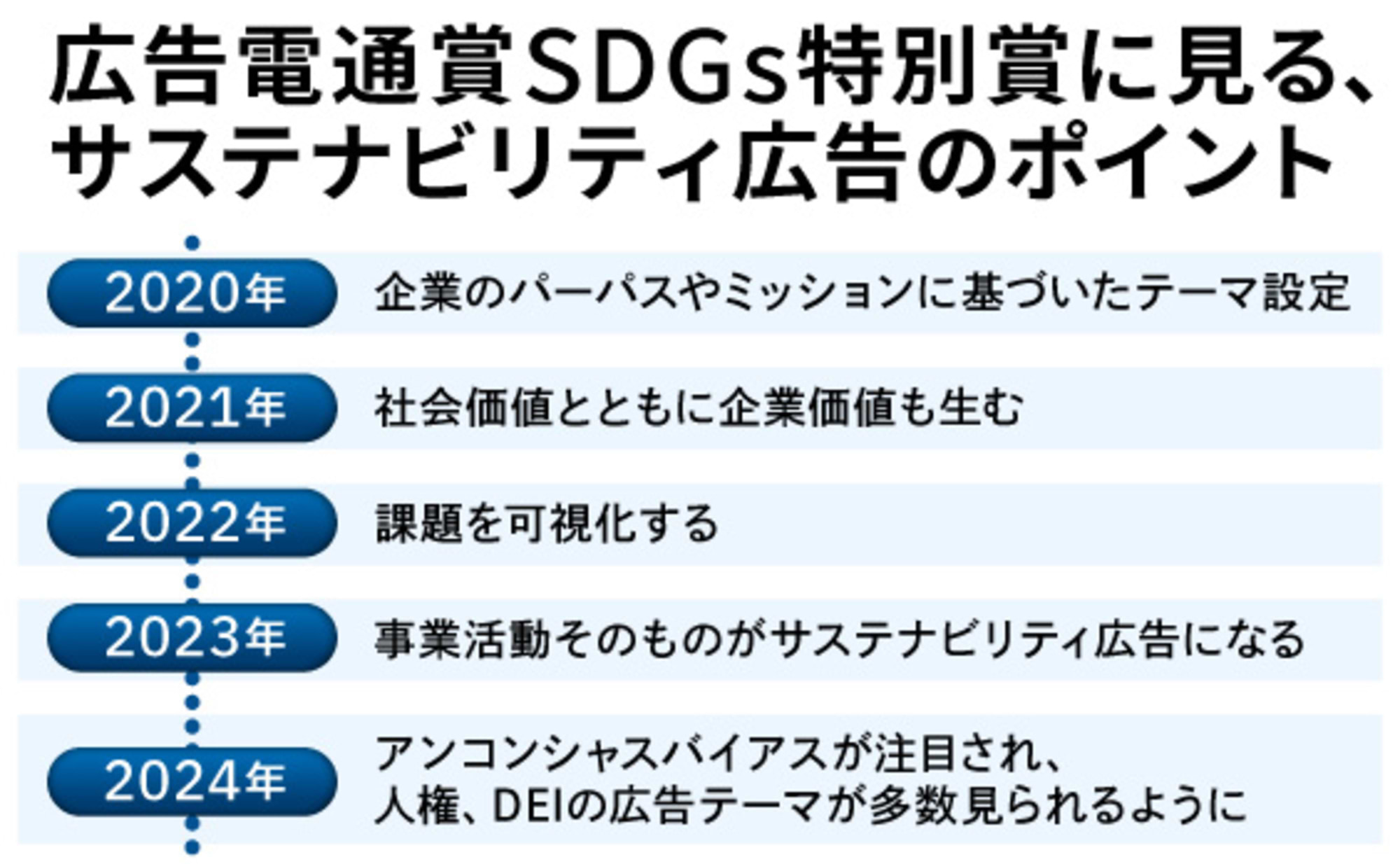
With less than five years remaining until the target year for achieving the SDGs, what questions are "sustainability advertisements" themed around the SDGs posing to consumers? In this article, Koichi Kaneda, Chair of the Selection Committee for the 78th Dentsu Inc. Advertising Awards SDGs Special Prize, and Shiro Oguni, a member of the Selection Committee, introduced the winning entries while discussing key points required for future sustainability advertising.
Using "Shift" Techniques to Envision the Future If Challenges Remain Unresolved
Kaneda: Reviewing numerous entries, I noticed three primary approaches to highlighting social issues this time. First: Highlighting the problem by "showing the future if the issue remains unresolved." Second: Getting to the root cause by "revealing the entire supply chain." Third: Challenging fixed notions by "exposing the core of the issue."The three works that won the SDGs Special Award and Excellence Awards each employed one of these approaches, catching the attention of the selection committee.
Oguni: What struck me about this year's winning entries was their unique charm—they made me think, "The creators must have really enjoyed making these." While we need the kind of "revolution" where people furrow their brows, tense their shoulders, and raise their fists, I also got a bright impression: activities are starting that create the next hope—ones where everyone works together with smiles and excitement.
Kaneda: The Think Name Project by the General Incorporated Association Asunoha, which won the SDGs Special Award, truly used unique expression to highlight the issues by showing the future if they weren't solved.
Advertising Dentsu Inc. SDGs Special Award (Area Activity) General Incorporated Association Asunoha / Tohoku University and 40 other companies "#2531 Mr. Sato Problem Think Name Project" A project creating opportunities to consider selective separate surnames for married couples, supporting equal marriage and equal career paths for men and women. Utilizing Tohoku University's simulation conclusion that "by 2531, all Japanese surnames will become Sato," it implemented awareness campaigns with supporting companies to stir public opinion.
Oguni: In Japan, where married couples are required to share a surname, the variety of surnames will decrease if current trends continue. By 2531, all Japanese people will bear the surname "Sato." We named this projected outcome the "#2531 Sato Problem." Partner companies visualized the world of 2531 on April Fools' Day via social media and press releases, disseminating it to society.
When addressing social issues, presenting the problem directly can sometimes alienate people. In this case, mentioning "optional separate surnames for married couples" could immediately spark a debate about whether it's good or bad. However, by avoiding the term "separate surnames" entirely and using the clever "shift" of "Everyone will become Satoshi!" to frame the issue, it successfully captured attention.The technique of presenting the issue to many people without creating conflict is creatively excellent and very interesting. There are limits to what a single company or organization can do, so involving many stakeholders in this way is a major point in its favor.
Kaneda: Rather than talking based solely on someone's subjective or abstract image, the presentation of solid evidence by researchers makes the questions more persuasive. With SDG washing and greenwashing becoming issues, it may become increasingly important for companies and organizations to show evidence when making their claims in the future.
Consumers themselves consider and set prices that overcome food price issues
Kaneda: One of the two SDGs Special Award Excellence Prize winners was the Fair Price Project campaign by the Ministry of Agriculture, Forestry and Fisheries. A total of about 8,200 people participated in the consumer-participation event "Supermarket Without Prices" held at KITTE Marunouchi in February 2025 over four days.
Advertising Dentsu Inc. SDGs Special Award Excellence Award (Area Activity) Ministry of Agriculture, Forestry and Fisheries "Fair Price Project The Price-Free Supermarket ~Let's Think About a 'Fair Price' for Everyone~" An event where consumers learn about the current state and costs surrounding the production, manufacturing, distribution, and retail of food before it reaches them, and consider what price is appropriate to pay. Held to raise awareness of the issue and aim for sustainable food supply through price formation that considers the reasonable cost of food.
Oguni: In today's climate where voicing opinions often invites immediate criticism, I found it truly wonderful that MAFF itself took action to bring the issue of food pricing to the public's attention.
Kaneda: I agree. While opinions may have been divided on MAFF executing this initiative, it was excellent that the government took the lead in creating a collaborative atmosphere, saying, "Let's all think about this together."
Oguni: Another positive aspect was that it posed questions rather than providing answers. When confronting sustainability issues, presenting definitive solutions tends to polarize supporters and opponents. I always felt that was such a waste... What truly matters is dialogue, consensus-building, and action. The Fair Price Project was structured to thoroughly facilitate that process.
Kaneda: Exactly. Instead of immediately declaring "this is the right answer," they skillfully used the approach of showing the entire supply chain to get people to confront the root causes of issues and think deeply. Now, even within companies, there's a growing movement to view upstream suppliers of raw materials and downstream users of products as part of an ecosystem. Discussing matters not just from one's own perspective but considering the viewpoints of various stakeholders may become increasingly common going forward.
Flipping conventional wisdom: Society embraces "it's okay to sit" work styles
Kaneda: Another project that won the SDGs Special Award Excellence Prize was Mynavi's "It's Okay to Sit PROJECT." The fact that Mynavi, not a chair manufacturer, proposed "Why not sit on a chair while working at the register?" was incredibly compelling as a corporate initiative. Amidst the broader trend of work-style reform, I believe this is a concept many companies will support.
Oguni: What I found particularly good was that it wasn't a grand, elaborate initiative. It was a simple action – placing dedicated chairs – yet it had the persuasive power to make everyone say, "Yeah, that's right. That's fine." This project gave us the insight that we don't need to change laws or rules; society just needs to say, "It's okay."
Dentsu Inc. Advertising Award SDGs Special Award Excellence Award (Brand Experience A. Corporate/Organization) Mynavi Corporation Mynavi Baito "It's Okay to Sit PROJECT" A project to reduce worker strain and improve recruitment and retention by shifting Japan's standard practice of standing at cash registers to seated customer service. Collaborating with manufacturers, we developed chairs that promote good posture and promoted their adoption among companies hiring part-time workers for standing jobs.
Kaneda: Exactly. This project got to the heart of the issue, challenging the excessive service demands born from a culture of unspoken expectations—where people feel they must conform to rigid standards for a position. It created an opportunity to rethink those fixed notions.
Oguni: It reminds me of "The Emperor's New Clothes," where everyone stays silent, thinking, "I can't say it now."As we grow up, or join a company, or become professionals in a field, we accumulate countless things we can't bring ourselves to say anymore. That's precisely why society must retain its "children" – those who can innocently declare what's wrong is wrong, just like the child who told the emperor, "The emperor has no clothes." In this case, Mynavi stepped into that child's role.
From a creative perspective, the copy "Sit down, it's cool" is excellent because it creates this slightly awkward, yet charmingly unpolished vibe that makes viewers relax a bit. Rather than relying on razor-sharp creativity, it perfectly lowers the entry barrier, striking that exquisite balance where everyone thinks, "Maybe I could do this."
Kaneda: Getting everyone to take action toward solving the problem is what truly matters. In that sense, this piece contained many elements worthy of praise.
Gathering the power of "casual participants" to create a massive force!
Kaneda: With less than five years left until the SDGs target year, I hear awareness of the SDGs in Japan has reached a good level. However, on the other hand, it's uncertain whether this awareness is translating into action to solve specific social issues. What I prioritize in advertising communication is how to engage such people in taking action.
Oguni: As you say, Mr. Kaneda, I don't think many people deeply understand social issues. That makes action all the more crucial. Sometimes, simply taking action can change one's perception and awareness.
Kaneda: Exactly. Until recently, the standard approach was to study social issues thoroughly before taking action. But the high barrier often led people to give up on getting involved altogether. That approach simply doesn't lead to significant change. I believe it's crucial to reach out to those unfamiliar with social issues, reassuring them, "You don't need to study first," and then taking action together. If we can gather the power of many "lightly involved people" and turn it into a significant force, society should start moving in a positive direction.
Oguni: Exactly. That's why I hope we see more and more examples like this award-winning work, ones that make many people think, "Oh, it's okay to take action while having fun like this."
Worked for approximately 10 years in the External Affairs Division at Sony and the Economic Section of the U.S. Embassy in Japan, handling Japan-Europe and Japan-U.S. trade policy. After graduating from the Nippon Television Announcer College, served as an announcer for economic and corporate news at Bloomberg Television from 1997 to 1999.From 1999, he was involved in promoting sustainability management at five companies: Sony (re-joined), Daiwa Securities Group Inc., Takeda Pharmaceutical Company Limited, ANA Holdings Inc., and NTT DATA Group. From 2007, he taught for two years at the Graduate School of Media and Governance, Keio University. Currently, he serves as a Director of the Japan Social Innovation Society, a Director of the Japan NGO Center for International Cooperation (JANIC), and a Visiting Researcher at the Tama University Sustainability Management Research Institute.
Shiro Oguni
Oguni Shiro Office Co., Ltd.
Representative Director / Producer
Joined NHK in 2003, primarily producing documentary programs. Later worked on "The Restaurant That Gets Your Order Wrong," where people with dementia serve as staff, before leaving NHK in 2018. Currently involved in numerous projects including "deleteC" and "Be Supporters!".

 Tips for Creating Sustainable Advertising Are Here! ~ Advertising Dentsu Inc. Award SDGs Special Prize [6/7]