What will be required going forward for social actions, including "sustainability advertising" centered on SDGs? In our previous article, we reviewed the winning entries for the 2025 Dentsu Inc. Advertising Awards SDGs Special Prize and Excellence Prize, highlighting that "proposing actions that engage people unfamiliar with social issues and allow them to participate with a smile" is essential for sustainability advertising.
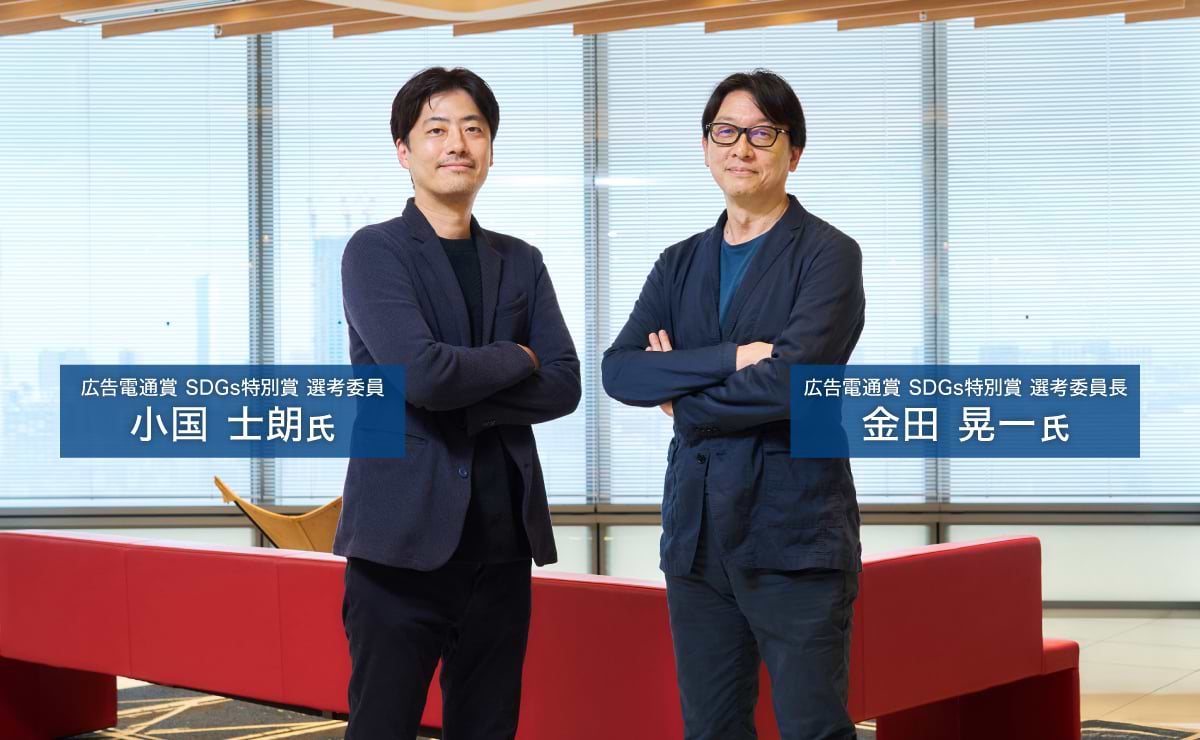
This time, we continue our discussion with Koichi Kaneda, Chair of the Selection Committee for the Dentsu Inc. Advertising Awards SDGs Special Prize, and Shiro Oguni, a member of the Selection Committee. They will share key points to keep in mind regarding corporate social action, drawing on their own experiences.
The Power of Creativity: Connecting Many Hands to Generate Great Power
Kaneda: The entries for this year's Dentsu Inc. Advertising Award SDGs Special Prize (hereafter SDGs Special Prize) fell into two categories: what we typically call "advertising" and "actions" aimed at solving issues.
Oguni: That's right. The proportion of advertisements among the total entries was surprisingly low, wasn't it?
Kaneda: As the selection committee chair reviewing entries annually, I sense a broadening scope from advertising to action. This likely reflects advertisers' intent to engage viewers and inspire individual action. Initiatives extending beyond advertising are accelerating across companies.
Oguni: I think it's good to have diverse approaches to solving problems. When you work backward from the world you want to create and consider what's needed, you realize how difficult it is for one person alone to achieve the goal. Advertising is likely one effective communication method for connecting many like-minded companies, individuals, and organizations.
Kaneda: Exactly. When tackling major challenges, you feel the necessity of connecting with many people. Furthermore, advertising effectiveness increases when multiple companies collaborate. Actually, the NTT DATA Group I belong to is currently running the " NPTech Initiative," an online IT training program for NPOs. The goal is to help NPOs leverage IT more effectively than ever before, thereby creating a greater impact on solving social issues.
This strategic social contribution program, initiated by the Japan NPO Center and NTT DATA, has expanded its training content and social impact through the participation of Dell Technologies, Intel, Itochu Techno-Solutions, LINE Yahoo, and others. The training content, leveraging each company's strengths, has become richer for NPOs. Moreover, the collective action of multiple companies collaborating has drawn media attention.
Oguni: It's a great example of many companies joining hands. If we aim to solve social issues, even companies considered rivals should collaborate. Creative power is essential for the communication needed to make that happen.
A company's purpose serves as the "North Star" for social contribution activities
Kaneda: Another crucial element in social contribution activities is "sustainability." For instance, when companies implement social contribution programs, one NPO advised us, "It's best to continue for at least five years." From experience, I completely agree.It takes about three years to collect and analyze activity data and demonstrate outcomes. Then, it takes another two years for those outcomes to become widely known and generate ripple effects (impact). Therefore, to create and disclose social impact, at least five years are necessary.
Oguni: I truly agree. These kinds of activities don't yield immediate results. They inevitably take years, so it tests how long you can endure the period without visible outcomes.
Since 2020, I've been promoting the " Be Supporterz!" project with Suntory Wellness and the J.League. This initiative, launched under the concept "From being supported to becoming supporters," aims to help seniors and people with dementia—who often find themselves in situations where they are supported—regain their physical and mental vitality by becoming soccer supporters, that is, by becoming the ones who support.
While developing the concept and seeking companies to collaborate, former Suntory Wellness President Naoto Okinaka stepped forward saying, "We want to do this!" At the time, Mr. Okinaka, who had just assumed the presidency, recognized a key challenge: "In the era of 100-year lifespans, corporate activities must shift beyond merely 'preventive' measures through supplements. They must embrace the perspective of 'coexistence' – learning to live alongside physical and mental challenges that inevitably arise during a long life."
Kaneda: I believe it's crucial for a company's long-term sustainability when the management itself embraces the idea of linking core business with social contribution activities.
Oguni: During my time as a director at NHK, I planned "The Restaurant That Gets Orders Wrong." This was a restaurant-style event where people with dementia worked as floor staff, based on the concept of "It's a mistake, but hey, it's okay." My relationship with Mr. Okinaka began when we collaborated on this event, and I knew he had a very deep understanding of social contribution activities.
However, right after the "Be supporters!" project started, naturally, there were no results, and there was almost no media exposure. So, from the president's perspective, I started to get restless (laughs).I could tell he was exercising tremendous patience, but about once a year he'd ask, "Oguni, about 'Be supporters!'... well, how's it going?" He never said it directly, but I think the employees were also starting to get restless as time passed. "We get you're trying to do something good, but what are we spending all this money for?"
Kaneda: Exactly. That's when a well-established "purpose" – showing why the company exists – makes it easier to explain to both executives and frontline staff. The "purpose" becomes an anchor when decisions get shaky or uncertain.
Oguni: Exactly. In the case of Suntory Wellness, the group's purpose includes the phrase "striving for the 'radiance of human life.'" That's precisely why Mr. Okinaka could keep telling the employees, "Let's embody this philosophy through this activity."
Then, after one year, two years, as the project matured, its visibility suddenly surged. All employees, including the president, persevered through a period without obvious major changes or results. Now, five years later, over 10,000 seniors across approximately 230 elderly care facilities nationwide have become enthusiastic soccer supporters, and Suntory Wellness's exposure has increased by tens of times.
Kaneda: That's remarkable. If you jump on social action just because it's trendy or everyone else is doing it, you risk being seen as superficial. This story really drives home how crucial it is for leaders themselves to find deep meaning in the activity and truly understand it.
Consumers are watching. For sustainability initiatives, "walking the talk" is the fundamental principle.
Kokuni: Whether it's the "NPTech Initiative" you're involved in, Mr. Kaneda, or my own "Be supporters!", I believe the key word for social contribution activities is "walking the talk." Only when the management decision to engage in social contribution aligns seamlessly with the company's existing business activities will both employees and society be convinced.
Kaneda: Exactly. Past actions can make people wonder, "Why is this company suddenly talking about doing good?" Looking back at past SDGs Special Award selection committees, some members expressed concerns about "potential SDG washing" when evaluating a company's advertising work, stating, "Given the irresponsible actions this company has taken toward society in the past, it's hard to believe they've genuinely changed their ways now."
Oguni: About 15 years ago, Patagonia's ad featuring the bold statement "Don't Buy This Jacket" prominently displayed over their own product photo caused a huge stir when it ran.Patagonia's ad resonated because the company actively champions environmental causes under its philosophy: "We run a business to save our home planet." It worked not just because it was an ad, but because they were doing what needed to be done.
Kaneda: Consumers are watching, right? Another point is that it's important for companies to scale their activities appropriately to their size.A certain number of consumers might feel uneasy seeing large corporations engaged only in small-scale initiatives, however noble. Being large means using significant natural resources and human capital, and reaching many adults and children. Therefore, their environmental/social footprint—in other words, their impact on the environment, society, and people—is substantial. Consequently, the perspective of whether their sustainability activities match that scale and quality becomes crucial.
Three Perspectives Advertisers, Creators, and Consumers Should All Maintain Going Forward
Oguni: Consumers' judgment when viewing ads is becoming sharper and more critical.
Kaneda: I agree. As we enter an era of heightened transparency, three key perspectives will be essential in advertising production going forward.
The first is how to interact with AI. While AI can be a powerful tool for diverse expression, there are concerns that it can promote false information, misinformation, and hate speech, so it must be used safely with an understanding of the risks.
The second is regulation of expression. Regulations against greenwashing, which pretends to be environmentally conscious, are spreading worldwide, and in the EU, it is regulated by law.
In 2024, the United Nations announced international guidelines called the "UN Global Principles for Information Integrity" to combat the spread of misinformation, disinformation, and hate speech accelerated by the spread of AI and to protect a trustworthy information environment (*).
The third is sensitivity to sustainability. For example, tracing the causes of large-scale human rights violations can sometimes lead back to environmental issues. We need to be aware that unexpected chains of events can occur behind the scenes. Without understanding the causal relationships, we may cause unexpected discomfort to people and be criticized.
※ UN Global Principles for Information Integrity = Five pillars: "Social Trust and Resilience," "Sound Incentives," "Empowering People," "Independent, Free, and Pluralistic Media," and "Transparency and Research."
Kokuni: These perspectives will be essential when selecting future SDGs Special Awards. Sustainability advertising and social action can sometimes become overly enthusiastic. Companies may be launching new initiatives and want to announce to the world, "We're doing good things!" But I think it's better not to get too carried away.
Initiatives related to sustainability and the SDGs usually take time, so I don't think the excitement will last. I believe maintaining a "high baseline" is crucial. That means figuring out "how to elevate it into an ongoing practice."
Kaneda: So, what's needed to "keep doing it"?
Oguni: I think it requires elements that make participants feel it's "interesting."
Kaneda: Exactly. I call that the "fan factor." Even in sustainability ads, a touch of humor makes them memorable. Conversely, if it isn't enjoyable, the ad becomes preachy. "Don't do this, don't do that" won't last.
To summarize, through this conversation with Oguni, I've gradually gained insight into what truly matters for sustainability advertising and corporate social action. It must align with the company's stated purpose, demonstrate consistency between words and actions—meaning it should naturally extend from existing business activities. It involves collaborating with diverse stakeholders to solve challenges. And it requires leveraging creative power in the communication to achieve this.I'm certainly looking forward to next year's SDGs Special Award, but more than that, I hope to see even more sustainable social actions emerge within Japanese society.
Worked for approximately 10 years in the External Affairs Division at Sony and the Economic Section of the U.S. Embassy in Japan, handling Japan-Europe and Japan-U.S. trade policy. After graduating from the Nippon Television Announcer College, served as an announcer for economic and corporate news at Bloomberg Television from 1997 to 1999.From 1999, he was involved in promoting sustainability management at five companies: Sony (re-joined), Daiwa Securities Group Inc., Takeda Pharmaceutical Company Limited, ANA Holdings Inc., and NTT DATA Group. From 2007, he taught for two years at the Graduate School of Media and Governance, Keio University. Currently, he serves as a Director of the Japan Social Innovation Society, a Director of the Japan NGO Center for International Cooperation (JANIC), and a Visiting Researcher at the Tama University Sustainability Management Research Institute.
Shiro Oguni
Oguni Shiro Office Co., Ltd.
Representative Director / Producer
Joined NHK in 2003, primarily producing documentary programs. Later worked on "The Restaurant That Gets Your Order Wrong," where people with dementia serve as staff, before leaving NHK in 2018. Currently involved in numerous projects including "deleteC" and "Be Supporters!".
Also read
What social action requires is the power to elevate ideals into everyday corporate activities.

 Tips for Creating Sustainable Advertising Are Here! ~ Advertising Dentsu Inc. Award SDGs Special Prize [7/7]