Note: This website was automatically translated, so some terms or nuances may not be completely accurate.
Published Date: 2026/02/12
Building a "Company-Wide" Organization Drives Growth: Why Dentsu Inc.’s "Recruitment Branding," Which Is Seeing Growing Demand, Directly Leads to Corporate Transformation
*This article is a partially edited version of content originally published on November 19, 2025, in "Japan Innovation Review."
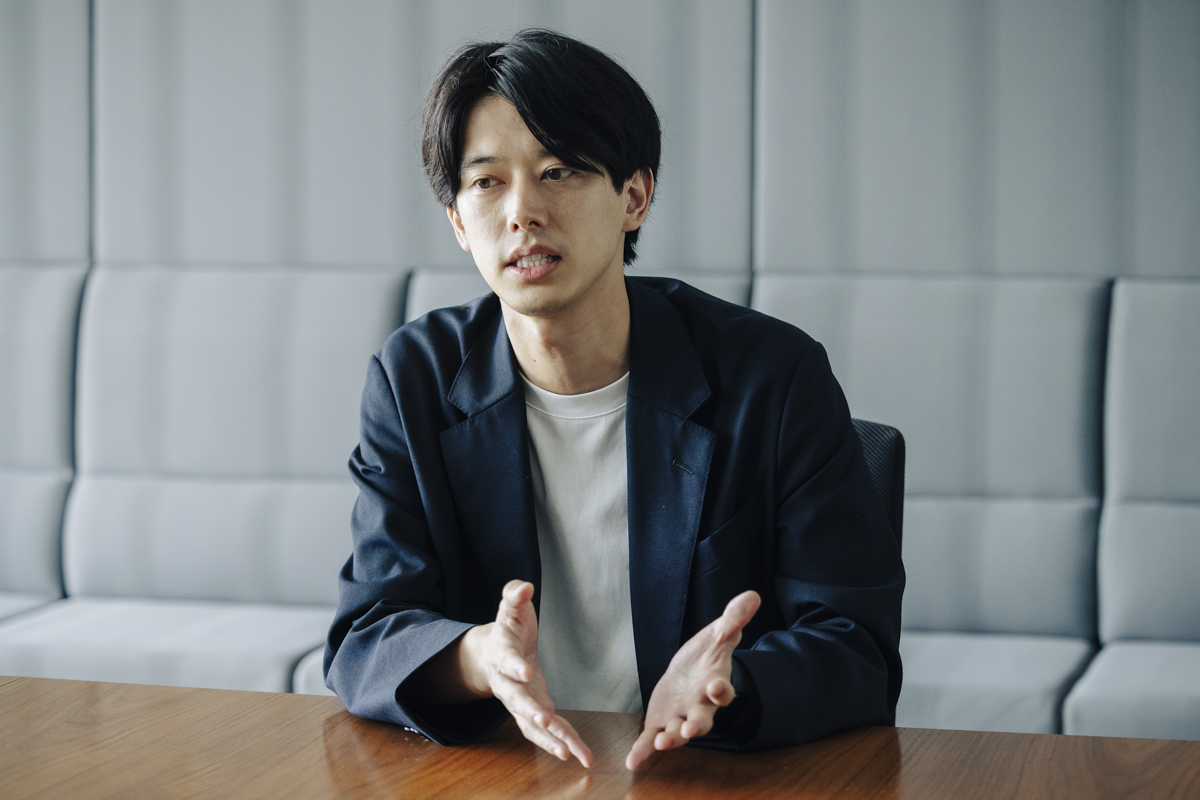
From left: Dentsu Inc. "Recruitment Branding Experts" Kento Masuda, Mihoko Nishii, and Shun Iwabe
As more companies prioritize “promoting human capital management” as the cornerstone of their transformation, “recruitment branding”—which enhances hiring capabilities by strengthening the communication of a company’s appeal—is gaining attention. In particular, the younger generation known as “Generation Z” will be the backbone of companies 10 or 20 years from now, making the acquisition of top talent an urgent priority.
Dentsu Inc.’s “Recruitment Branding Experts”—a specialized team for recruitment support launched in February 2024—is currently receiving numerous inquiries from companies that have placed recruitment at the core of their transformation efforts.Notably, many of these consultations come not just from HR departments, but directly from executive leadership, including CHROs, CEOs, and COOs. We spoke with the three leaders of this team—Mihoko Nishii, Shun Iwabe, and Kento Masuda—about why recruitment branding is essential for corporate transformation, their initiatives and results, and their outlook for the future.
Supporting Over 90 Companies in Just a Year and a Half Since the Team’s Launch
──Dentsu Inc.’s “Recruitment Branding Experts” is a consulting team that supports companies with their talent acquisition. What led to the formation of this team?
Iwabe: One of the main reasons is the rapid increase in corporate demand. In the roughly one and a half years since our launch in February 2024, we have already supported the recruitment activities of over 90 companies. As the candidate-driven market accelerates, we’ve seen an increasing number of cases where Dentsu Inc.’s expertise in corporate brand communication is being applied to recruitment-focused projects.
In addition to HR, we’ve received numerous inquiries from representatives across various departments—including PR and management—at different companies, making the establishment of a full-fledged organization an urgent priority.
Another key factor is the need to develop and utilize internal talent. The recruitment field offers a wealth of knowledge that can be applied across industries and business models, making it an ideal environment for our young planners to thrive. The team currently consists of 33 members, including young professionals in their first through fifth years at the company. We believed that, particularly for new graduate recruitment, their firsthand experience and intuition gained from having been job seekers themselves would be invaluable.
Mr. Iwabe, Marketing Consultant, Marketing Consulting Division 1, Marketing Division 5, Dentsu Inc.
──I understand that Dentsu Inc. had been engaged in recruitment support even before the team was established. What was the original starting point for this initiative?
Nishii: It began around 2011, when Dentsu Inc.’s Youth Research Department, “Wakamon”*, started handling recruitment support for Dentsu Inc. We turned that support into a highly versatile package and began offering it to clients around 2014.
*A creative unit that researches the realities of young people, primarily high school and college students, and explores ways to build better relationships between young people and society
The background behind Dentsu Inc.’s own efforts in recruitment branding included the fact that, due to the impact of the Lehman Shock, advertising agencies had become less likely to be included in job seekers’ lists of preferred companies, as well as a strong sense of crisis among management that Dentsu Inc.’s presence in the recruitment market was becoming relatively weaker.
Driven by the sense of urgency that “we must take recruitment seriously once again,” the company shifted from a defensive to an offensive recruitment strategy through various initiatives, such as participating in job fairs—something it had never done before—and launching a recruitment website.
Achieving Optimal Matching Through "People-Centric" Marketing
──Why is employer branding so important right now?
Masuda: In a nutshell, it’s because it benefits both the company and the students. First, from the company’s perspective, as the number of students declines and competition in the recruitment market intensifies, branding serves as the “foundation” for initiatives like using recruitment agencies and direct scouting, helping to solidify the company’s image and convey its appeal.
For students, a clear corporate image serves as motivation to attend information sessions and internships, deepening their understanding of the company. Being able to visualize their future career path makes it easier for them to determine whether a company is a good fit for them.
Mr. Masuda, Planner, Growth Consulting Division 2, Data Marketing Division, Dentsu Inc.
Nishii: The changing attitudes of so-called Generation Z toward employment and career development are having a significant impact. About 15 years ago, when I was job hunting, it was common to apply to 70 to 80 companies and go through the selection process at around 20 of them, but today’s students apply to an average of fewer than 10 companies.
Because the information they gather for their job search is limited to fields they’re interested in or already familiar with, their career options become quite narrow. As a result, many students end their job search without ever encountering companies they should have met.
Therefore, if companies effectively communicate their unique value and corporate culture through employer branding, they can achieve better matches. For students, this opens the door to discovering companies they were previously unaware of, increasing their chances of finding a company that truly suits them.
──What are the key features of the recruitment branding handled by Dentsu Inc.? Is it primarily driven by Dentsu Inc.’s unique advertising and marketing know-how and expertise?
Iwabe: Yes, a major feature is that we apply Dentsu Inc.’s marketing philosophy directly to recruitment activities. In particular, we leverage Dentsu Inc.’s unique “people-centric” marketing perspective.
It is crucial to understand the perspective of our target job seekers as closely as possible, so we conduct large-scale surveys on a regular basis to gain deep insights into them. Furthermore, we utilize existing marketing frameworks to clearly identify the specific types of candidates companies wish to hire and to understand what motivates them during their job search.
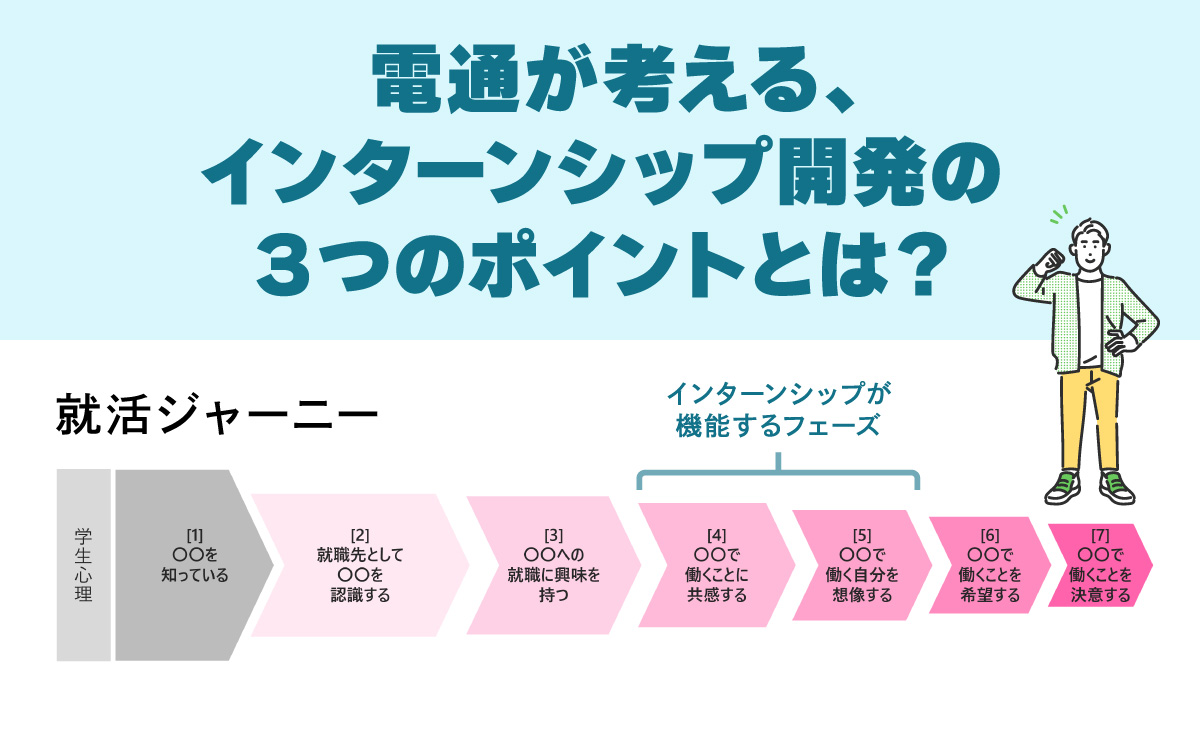
How do companies want job seekers to perceive them, generate interest, and ultimately choose them as an employer? While the approach of designing key touchpoints and the values to communicate at each phase is common in the marketing field, Dentsu Inc. adds job seeker insights to this process, enabling the design of initiatives that foster deeper empathy.
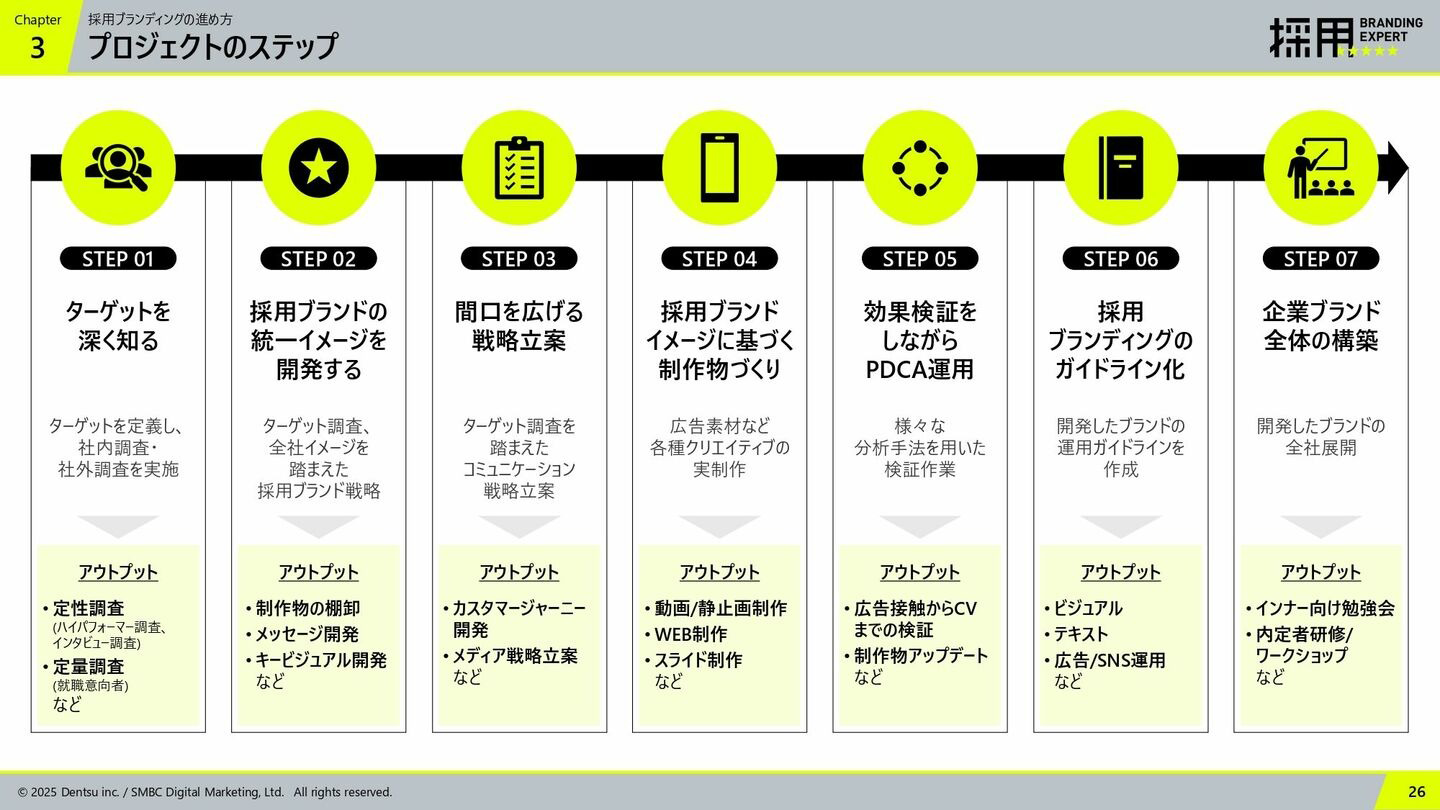
Nishii: Dentsu Inc.’s unique advantage lies in our ability to provide end-to-end support—from strategy formulation to creative development, campaign design and execution, ad management, and effectiveness verification—as well as our contribution to building self-sustaining organizations beyond that.
Mr. Nishii, Senior Branding Director, Solution Project Development Department, Marketing Division 6, Dentsu Inc.
Gaining Deep Insights into the Target Audience to Increase the Quantity and Quality of Applicants and Improve Conversion Rates
──I understand that Dentsu Inc.’s “recruitment branding” yields results such as increasing the number of applicants, improving applicant quality, and enhancing conversion rates. Could you explain specifically what you do?
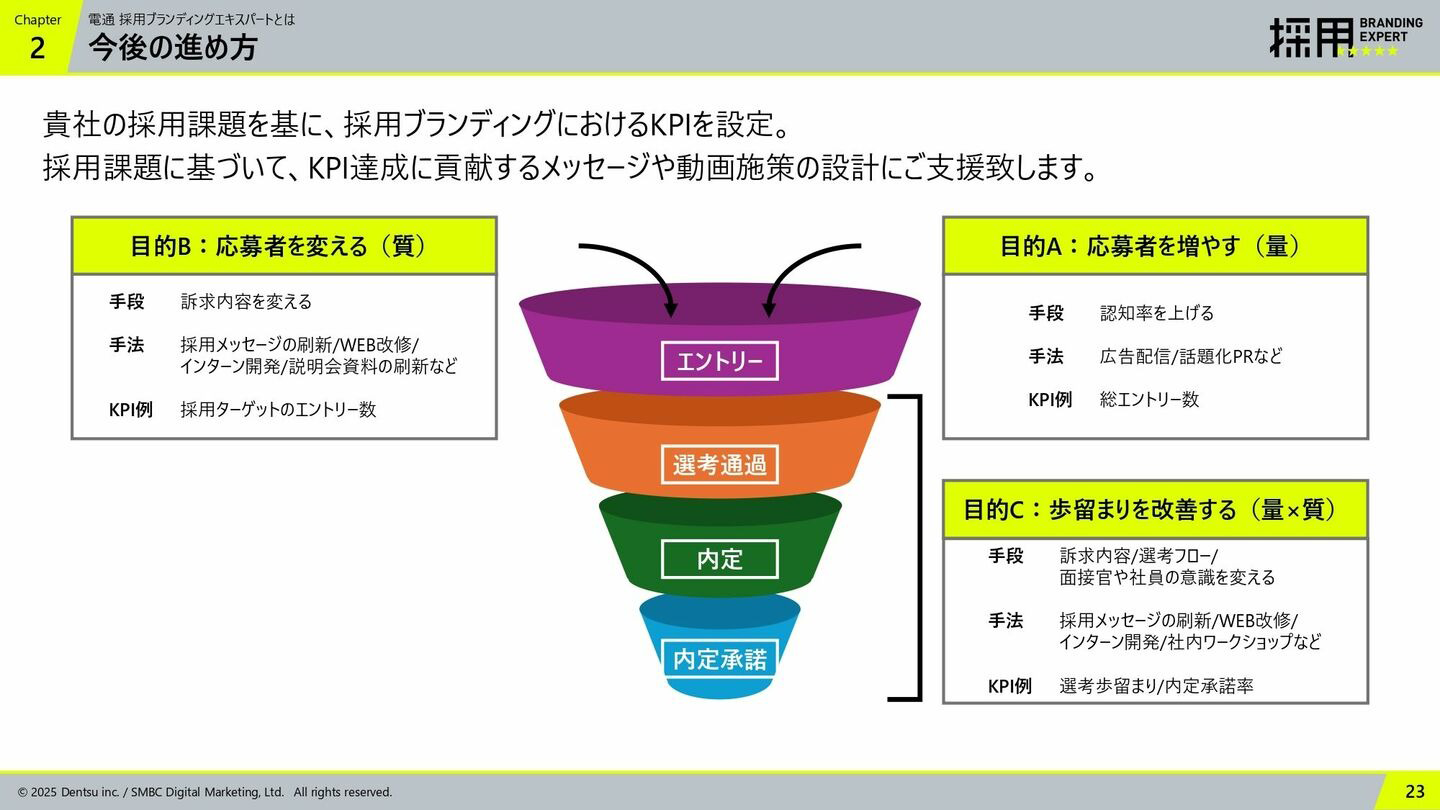
Iwabe: Regarding the volume of applicants, a common challenge—especially among B2B companies—is that the company lacks sufficient brand recognition, resulting in a lack of applicants and an inability to build a talent pool large enough to meet hiring targets.
Regarding quality, while there may be a sufficient number of applicants, companies often struggle to attract specific target candidates. This is a common concern among major companies experiencing steady growth, where frontline staff often report that “the quality of candidates is declining.”
As for conversion rates, this is a common issue for companies ranked fourth, fifth, or lower in their industry. While candidates participate in the selection process, more than half decline the job offer even after receiving it.
As for how to address these issues, the quantity problem can be improved through initiatives in Dentsu Inc.’s core areas of advertising, communications, and PR. Since “what to communicate” is crucial here, we first clearly define the values the company should convey and then create creative content that effectively reaches the target audience.
To give an example, there was a B2B general parts manufacturer with nearly 0% brand awareness, so we implemented on-campus advertising and PR as a strategy.
The company’s target audience was science and engineering students, but from a job seeker’s perspective, these students have very little free time. Many students spend their days shuttling between the lab, part-time jobs, and home, making it difficult for them to attend long-term internships or company information sessions.
Therefore, we hypothesized that it would be more effective to follow their daily routines rather than simply inviting them to events. Based on this hypothesis, we created a lab visit tool and visited universities, and we also “took over” on-campus advertising media—such as tray mats in the cafeteria—to promote the company and increase brand awareness. As a result, we were able to increase brand awareness by over 20% in just six months.
Regarding quality, changing the message you convey is effective. A common example is replacing the key message on your recruitment site with a unique message that differentiates your company from others. This attracts a different audience and creates a talent pool distinct from the traditional one.
Finally, regarding conversion rates, changing the mindset of those involved in recruitment is effective. Clearly communicate to interviewers and recruiters: “Our company faces these challenges in recruitment. Therefore, we want to convey this message and hire this type of talent.” Alternatively, having them think through these issues and incorporate them into the messaging—engaging stakeholders in this way is crucial.
──In the recruitment branding process—from strategy formulation to effectiveness verification—where does Dentsu Inc.’s strength shine the most?
Nishii: It is the step of “gaining a deep understanding of the target audience” that precedes strategic planning. Dentsu Inc. possesses a vast amount of data on job seekers, and by utilizing and analyzing this data, we can rapidly design communication strategies.
One example of a large-scale survey is our annual “Comprehensive Survey of Gen Z Job Seekers.” In addition, we can conduct quick surveys by leveraging our network of university students. Based on these surveys and analyses, as mentioned earlier, we develop a unified image for the employer brand from the job seeker’s perspective.
Another distinctive feature is our “strategy for broadening the scope.” Dentsu Inc. possesses a vast amount of data on recruitment activities across all industries. We objectively assess competition in the recruitment arena not only against competitors within the same industry but also from the perspective of employers. Furthermore, we develop unique strategies tailored to our company, including a wide range of communication initiatives such as selecting contact points suited to the target audience and maintaining appropriate communication.
Corporate Transformation and Talent Transformation Must Go Hand in Hand
—It’s been about a year and a half since the team was launched. Have you seen any changes in corporate mindset?
Nishii: Executives’ awareness of recruitment challenges is growing year by year. Corporate transformation and talent transformation should go hand in hand; if a company aims to transform itself for the next 10 or 20 years, it must transform its workforce as well. I sense that more companies are viewing recruitment as a critical management issue—both to enhance corporate value and to secure the talent that will support the company’s future—and are making a company-wide effort to build their employer brand.We’ve also seen an increase in cases where we’re approached directly by CEOs and key business leaders such as COOs, CMOs, and CHROs.
──How do you plan to address these corporate needs? Also, are there any personal challenges you’d like to take on in the future?
Iwabe: The purpose of recruitment is to secure the talent that will drive a company’s growth. If a company aims for sustainable growth or transformation, it must develop a strategy to hire talent that aligns with that vision. When strengthening recruitment, it is crucial—and we consider this our role—for not only the HR department but also management and business units to work together as a unified whole, making it a “company-wide” effort.Rather than simply saying, “We hired some good people this year,” I want to commit to building a company that will continue to be chosen by talent 10 or 20 years from now.
Furthermore, simply hiring people does not lead to corporate growth. We aim to build a system that supports employees from the moment they join—including onboarding, retention, reskilling, and even career development after they leave. We believe that only by doing so can we truly support corporate transformation.
Masuda: Thanks to your support, we have assisted numerous clients with their recruitment branding efforts to date. Going forward, we would like to focus our support on the PDCA cycle, verifying the effectiveness of recruitment branding projects based on the results of the branding initiatives we’ve actually implemented.
As the number of students continues to decline, we believe it is becoming increasingly important to efficiently recruit talent that fits your company and can shape its future by working backward from this year’s recruitment results, evaluating each initiative, and making improvements for the coming year.
Through the PDCA cycle, we aim to continue providing support that leads to feedback such as, “I’m glad I met this student” and “I’m glad I found this company.”
──Finally, I’d like to ask Mr. Nishii. I imagine there are many companies that think recruitment branding takes time and can be put off until later. What would you like to say to those companies?
Nishii: I want to convey that recruitment is a critical initiative that leads to corporate transformation. There are company representatives who thought recruitment branding was something for the distant future, only to find themselves facing irreversible consequences two or three years later.
The effects of recruitment branding aren’t seen in a single year, but rather two or three years down the line. Just like corporate transformation, it takes time over the medium to long term, so if you sense potential problems, please start your efforts tomorrow if possible.
Data Marketing Division, Growth Consulting Division 2
Associate Planner
Primarily engaged in formulating communication strategies and evaluating the effectiveness of initiatives. Additionally, serves as a "Recruitment Branding Expert" supporting branding in talent acquisition and is a member of the "Dietary Habits Lab," which supports solving challenges centered on dietary habits.
While providing management and business consulting to numerous companies, he is affiliated with the "Dentsu Inc. Youth Research Department" (https://dentsu-wakamon.com). Author of "Pagyaru Consumption: Research on the 'Gal Mindset' Hidden in 70% of Girls" (Nikkei BP) and "Why Do You All Start Talking About the Same Things When It Comes to Job Hunting?" (co-authored, Sendenkaigi). Recipient of awards including D&AD, Red Dot Design Award, One Show, and Kids Design Award. Also engaged in external activities such as serving as an advisor to the NPO Encourage.
After handling Dentsu Inc.'s new graduate recruitment and talent development in the Corporate Division, I joined the current bureau. I have been engaged in marketing strategy planning, business development support, and HR consulting for various clients. I established the "Recruitment Branding Expert" team, a cross-functional consulting group within Dentsu Inc. dedicated to supporting corporate recruitment activities.
Building a "Company-Wide" Organization Drives Growth: Why Dentsu Inc.’s "Recruitment Branding," Which Is Seeing Growing Demand, Directly Leads to Corporate Transformation










 These young people nowadays.