Note: This website was automatically translated, so some terms or nuances may not be completely accurate.
 Advanced TV Lab: Evolving Planning and Effectiveness Measurement Systems [6/6]
What does Dentsu Inc. envision as innovation in TV commercials?
In this series, we explore the evolving landscape of television media by introducing emerging services and case studies of advertisers utilizing them. We explain how to effectively leverage TV commercials based on advertisers’ KPIs and challenges.
In this installment, Yasuki Park of the MC Transformation Bureau takes a fresh look at the current state of TV commercials and discusses Dentsu Inc.’s vision for innovation in the field.
<Table of Contents>
▼The Value of TV Commercials in the Digital Age
▼Our Goal: Advancing Advertisers’ Marketing and Providing Optimal Solutions
▼Designing Roles Based on Media Characteristics
▼New Buying Methods for TV Commercials
▼Advancing Data Capabilities to Realize Integrated Online-Offline Marketing
The Value of TV Commercials in the Digital Age
Now that digital marketing and video ads have become commonplace, the value of TV commercials is being reevaluated. As consumers have gained the ability to choose from a variety of devices and platforms, media usage has diversified, particularly among younger demographics. In this context, the value of TV commercials—their ability to provide absolute broad reach across all generations—is shifting from what it was in an era when few other media options existed.
Furthermore, with the evolution of digital marketing and ad technology based on user IDs and behavioral logs, there is a growing need among advertisers to implement the PDCA cycle to drive business growth. However, TV commercials are currently failing to adequately address this need, particularly in the "D" (Do) phase of the PDCA cycle. The current difficulty in realizing ideal planning strategies has become a major concern for marketers.
TV commercials must adapt to increasingly sophisticated marketing methods and the evolving needs of advertisers. If they can meet these needs, demand for TV commercials will expand, leading to the maintenance of the future broadcasting ecosystem and the further development of information infrastructure.
The goal is to advance advertisers’ marketing strategies and provide optimal solutions
It is becoming increasingly difficult to achieve advertisers’ marketing KPIs through TV commercials alone. Currently, a variety of marketing activities and communications are required to meet these KPIs.
For example, “reach” is a fundamental element when considering KPI achievement. In a diversified media environment, the question is how to manage advertising reach. Various considerations are being made, such as “duplicate reach,” “incremental reach (*),” and “evaluation of the quality of a single touchpoint.”
How should we design communication strategies and implement the PDCA cycle—considering target audiences, budget allocation, and operational execution? Media companies and advertising agencies are required to pursue, replicate, and improve effective communication without waste. At the same time, the television industry must also address these needs and accelerate innovation.
*Refers to the increase in reach achieved by placing ads on new media in addition to existing advertising.
Designing Roles Based on Media Characteristics
In recent years, comparisons with digital advertising have led to frequent comments such as, “What digital can do, TV cannot,” or “Why can’t TV deliver targeted ads?” It is important to understand that there are technical and legal challenges involved in these areas.
Digital delivery delivers ads from a server based on user access. Using tools such as a DMP (Data Management Platform), it determines the attributes and characteristics of user IDs to deliver targeted ads. This mechanism allows for detailed and sophisticated management of ad delivery. Of course, we must also be mindful of structural issues such as privacy protection and the health of the information ecosystem, considering filter bubbles and echo chambers.
On the other hand, television broadcasting involves receiving signals transmitted via radio waves and displaying them on television sets. A major characteristic of this is the ability to convey the same content widely and at low cost all at once—in other words, its “simultaneous broadcast” nature.By leveraging both broadcasting and streaming technologies, it is not impossible to achieve a certain degree of targeting (ad delivery segmentation) even for TV commercials. However, this is limited to TV sets connected to the internet. It is necessary to carefully consider research into methods and the development of advertising products that enhance advertising effectiveness without compromising the mass broadcasting nature of TV commercials.
Consequently, while digital advertising is characterized by on-demand access and advanced management, TV commercials are defined by their mass reach—specifically, the diversity and power of their reach, as well as the speed of information delivery. In communication planning, it is essential to set KPIs and roles based on these characteristics and allocate budgets accordingly.
In addition to technical aspects, attention must also be paid to consumers’ attitudes toward advertising exposure. We often hear the opinion that “on-demand and dedicated viewing yield higher advertising effectiveness,” but is this really true? From the perspective of advertising’s impact on consumer awareness and psychology—such as ad receptivity and the stimulation of latent demand—it cannot be said that one is universally superior to the other. Media and formats must be selected based on specific objectives and the expected roles they are to fulfill.
As mentioned earlier, the current state of TV commercial advertising does not allow for sufficiently effective management of advertising effectiveness. The table below shows the volume of TV commercial airings (X-axis) and reach (Y-axis) for approximately 1,000 campaigns in the Kanto region.
The green line represents a model based on these results. Furthermore, the graph classifies campaigns into four groups based on reach performance.Even with the same ad volume (GRP: Gross Rating Points), there is this much variation in reach. In the red and blue groups, there are clear differences in conditions such as budget allocation and order specifications (additional requests), as well as in planning (scheduled broadcast slots). The reality is that order conditions often have a negative impact on reach.
New TV Commercial Buying Methods
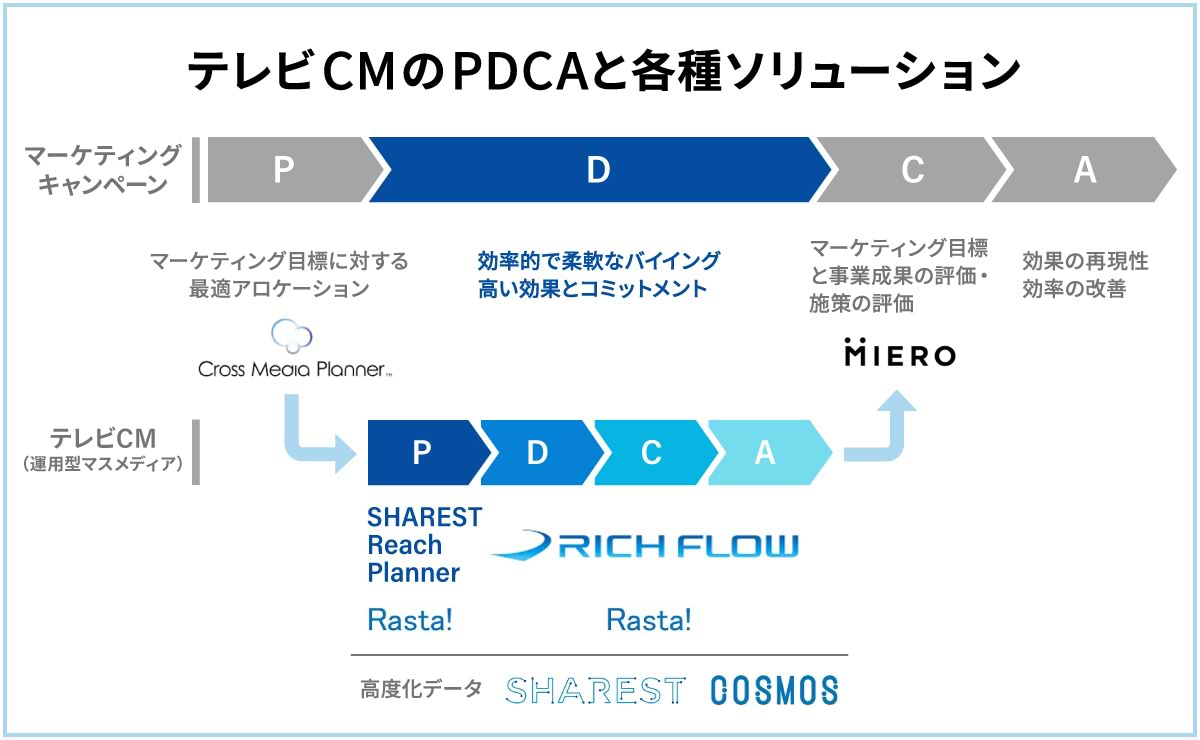
Here, we will introduce several initiatives aimed at innovating TV commercials. Dentsu Inc.’s “SHAREST Reach Planner” (hereinafter SRP), announced in a press release in July 2025,
・High-precision reach forecasting based on creative concepts (scheduled broadcast slots)
・Simulation of which programs on which stations contribute most efficiently to reach
.
Currently, SRP is available in three regions: Kanto, Kansai, and Chubu. In the “P” (Planning) phase of the PDCA cycle, it is now possible to predict which TV commercials aired on which programs will yield what level of reach, and to what extent specific time slots contribute to or detract from that reach.
However, a major issue exists in the "D" (Do) phase of the PDCA cycle. Specifically, it is difficult to execute TV commercial buying exactly according to the ideal plan. Attempting to do so would result in extremely high unit costs, making it impractical.
This is not to say that TV broadcasters are ignoring the disconnect in the "Do" phase of PDCA. Various initiatives and studies are underway, particularly among the five major Tokyo-based networks. A prime example is Nippon TV’s “Suguri,” which enables programmatic trading of terrestrial TV commercials.Since transactions can be conducted on an impression-by-impression basis in line with digital advertising standards and completed entirely online, it is possible to shorten the time span from order placement to broadcast and air TV commercials. While "Suguri" tends to be focused on the fact that TV commercials can be bought like digital ads, please pay attention to the value that this new buying method brings. By combining existing buying methods with new ones like "Suguri," it is possible to resolve the issue of managing the advertising effectiveness of TV commercials.
Furthermore, by intelligently combining spot and time slots, it is now possible to bridge the gap between ideal planning (P) and execution (D) from a reach perspective. At Dentsu Inc., we are conducting various proofs of concept (PoCs) for TV commercial management (performance-based mass media) using SRP and RICH FLOW.
Please see the article below for a specific case study.
What Is the Effective TV Commercial Planning That Helped Coca-Cola Japan Achieve Results?
Advancing Data Sophistication to Realize Integrated On- and Offline Marketing
In today’s marketing communications, there is a growing need to build and provide a PDCA environment that integrates various media, such as TV-digital convergence and online-offline integration.
Creating an environment capable of integrated management of offline media—centered on the four major media—and online media has been a major challenge over the past few years.To some extent, TV commercials and digital advertising can be managed by utilizing data clean rooms and similar tools. However, we cannot yet say we are fully addressing the needs of print media (such as newspapers, magazines, and OOH) where digital measurement is difficult; content centered on sports and entertainment; data regarding consumer psychology that is hard to capture through behavioral logs; and advertisers who have limited access to consumer data or handle products and services for which data collection is challenging. Of course, data related to TV commercials also requires further refinement.
To address these challenges and advance existing solutions and the data infrastructure for media and content, Dentsu Inc. has created “COSMOS DATA,” a database of individual TV viewing data covering approximately 20 million people nationwide, and developed “Rasta!,” a dashboard that allows for easy aggregation and analysis of this data ( click here for the release).We aim to rectify the current situation where information and marketing disparities arise due to the availability of data and differences in infrastructure, and to provide fair marketing opportunities to a wide range of partner companies.
As times change, television commercials face numerous challenges. Dentsu Inc. will continue to work on improving data and PDCA environments to support advertisers in advancing their marketing efforts.
Was this article helpful?
Share this article


Newsletter registration is here
We select and publish important news every day
For inquiries about this article
Back Numbers
Author

Park Tae-hee
Dentsu Inc.
MC Transformation Bureau, MC Data Marketing Division 1
Department Head